1
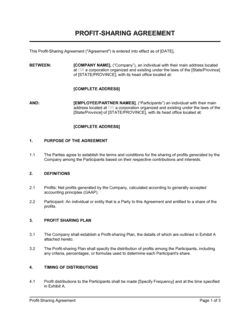
Identify the parties and the incentive type
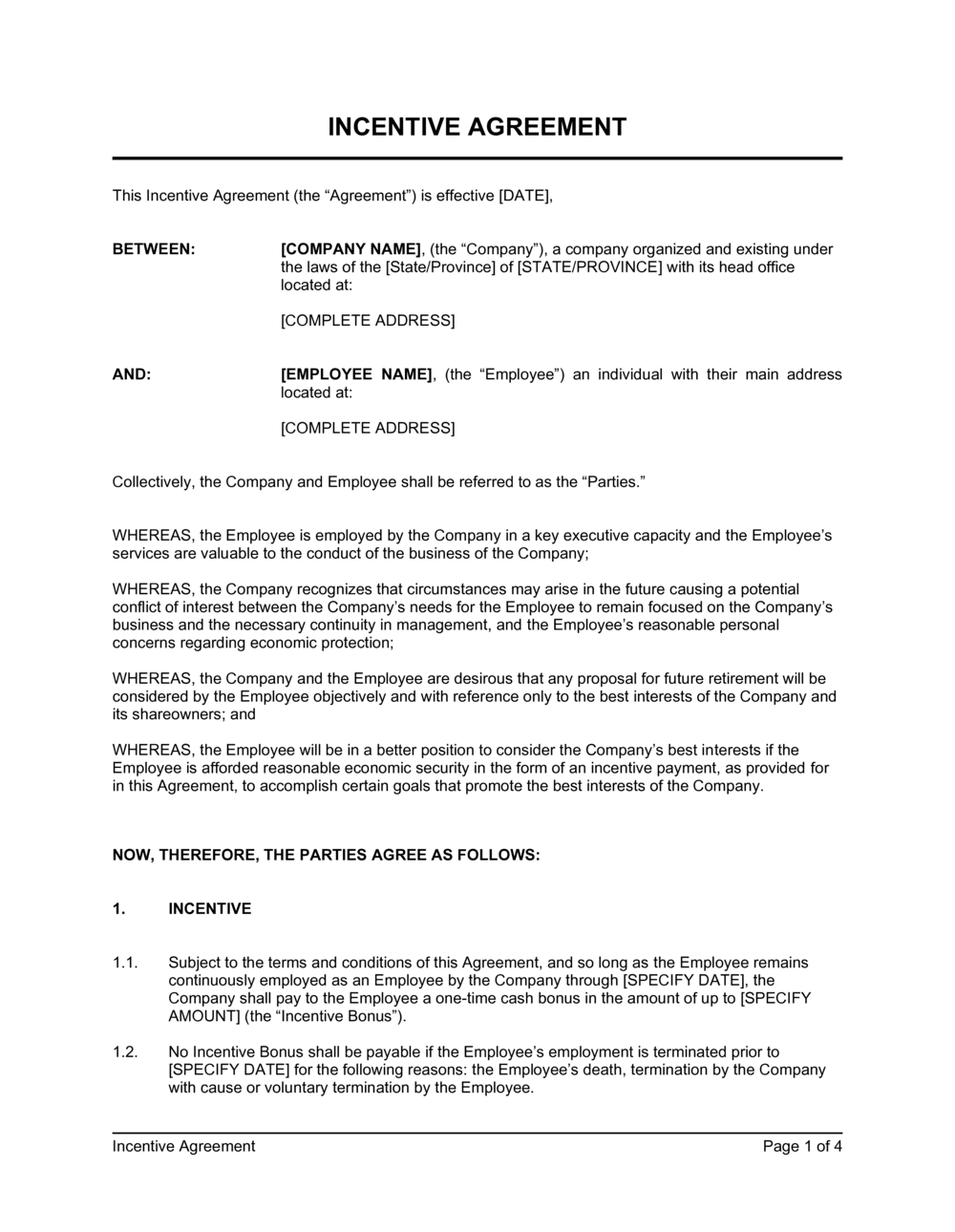
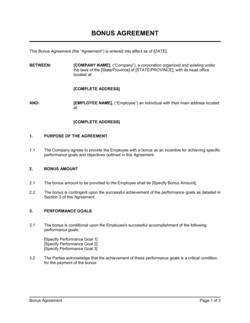
Enter the organization's full registered legal name and the participant's legal name. Specify whether the incentive is a cash bonus, commission, profit share, or other variable award.
💡 Confirm the contracting entity is the same entity that runs payroll — mismatches between legal name and payroll entity are a common source of payment disputes.
2
Define each performance metric precisely
List every metric, its weighting as a percentage of total incentive, the data source used to measure it, and who makes the final determination. Weighted metrics must sum to 100%.
💡 Limit the plan to three to five metrics. More than five creates gaming behavior and makes the agreement hard to administer consistently.
3
Set the threshold, target, and maximum payout levels
For each metric, define the minimum performance level that triggers any payment (threshold), the level that earns 100% of the target amount (target), and the absolute ceiling on payouts (maximum).
💡 A threshold at 80% of target and a maximum at 150% is a common and defensible range — document the rationale for any departure from this in the recitals.
4
Write out the calculation formula explicitly
Include the exact mathematical formula so the earned amount can be calculated independently by any party. Avoid prose descriptions alone — show the arithmetic with variables defined.
💡 Attach a worked example as Schedule A showing a sample calculation at threshold, target, and maximum performance. This alone eliminates most incentive disputes.
5
Specify payment timing and any preconditions
State the exact payment date or the maximum number of days after the performance period closes. List any conditions that must be met before payment — audit completion, board approval, continued employment.
💡 Do not condition payment solely on 'continued employment at payment date' without also providing a pro-rata right for good leavers — several jurisdictions treat this as an unlawful wage forfeiture.
6
Configure the vesting schedule and clawback trigger events
For retention-oriented awards, complete the vesting table with specific dates or milestones. List each clawback trigger event precisely, including the lookback window and the repayment mechanism.
💡 Clawback provisions required under Dodd-Frank (public companies, US) and similar regulations must be drafted to the regulator's specific template — do not substitute this general-purpose clause for a compliance-specific one.
7
Complete the termination treatment matrix
For each departure type (for cause, voluntary resignation, without cause, redundancy, death, disability), state whether the participant forfeits, receives pro-rata, or receives full payment.
💡 Present this as a table rather than prose — a departure-type matrix is easier to administer, harder to dispute, and signals careful drafting to the participant.
8
Execute before the performance period begins
Both parties must sign before the first day of the performance period. An incentive agreement signed after the period has started may be unenforceable for lack of consideration in common-law jurisdictions.
💡 Use a timestamped e-signature tool and store the fully executed agreement alongside the participant's employment contract in your HR records system.