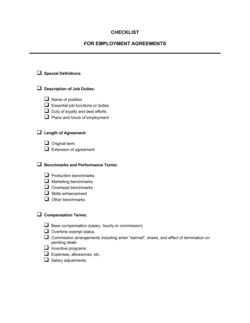
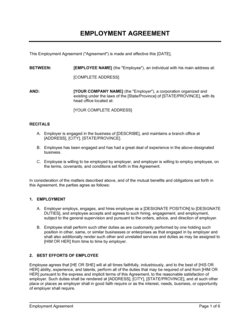
Restrictive Covenants for Employment Agreements Template

Free Word download • Edit online • Save & share with Drive • Export to PDF

3 pages25–30 min to fillDifficulty: ComplexSignature requiredLegal review recommended
Learn more ↓
FreeRestrictive Covenants for Employment Agreements Template

At a glance

What it is
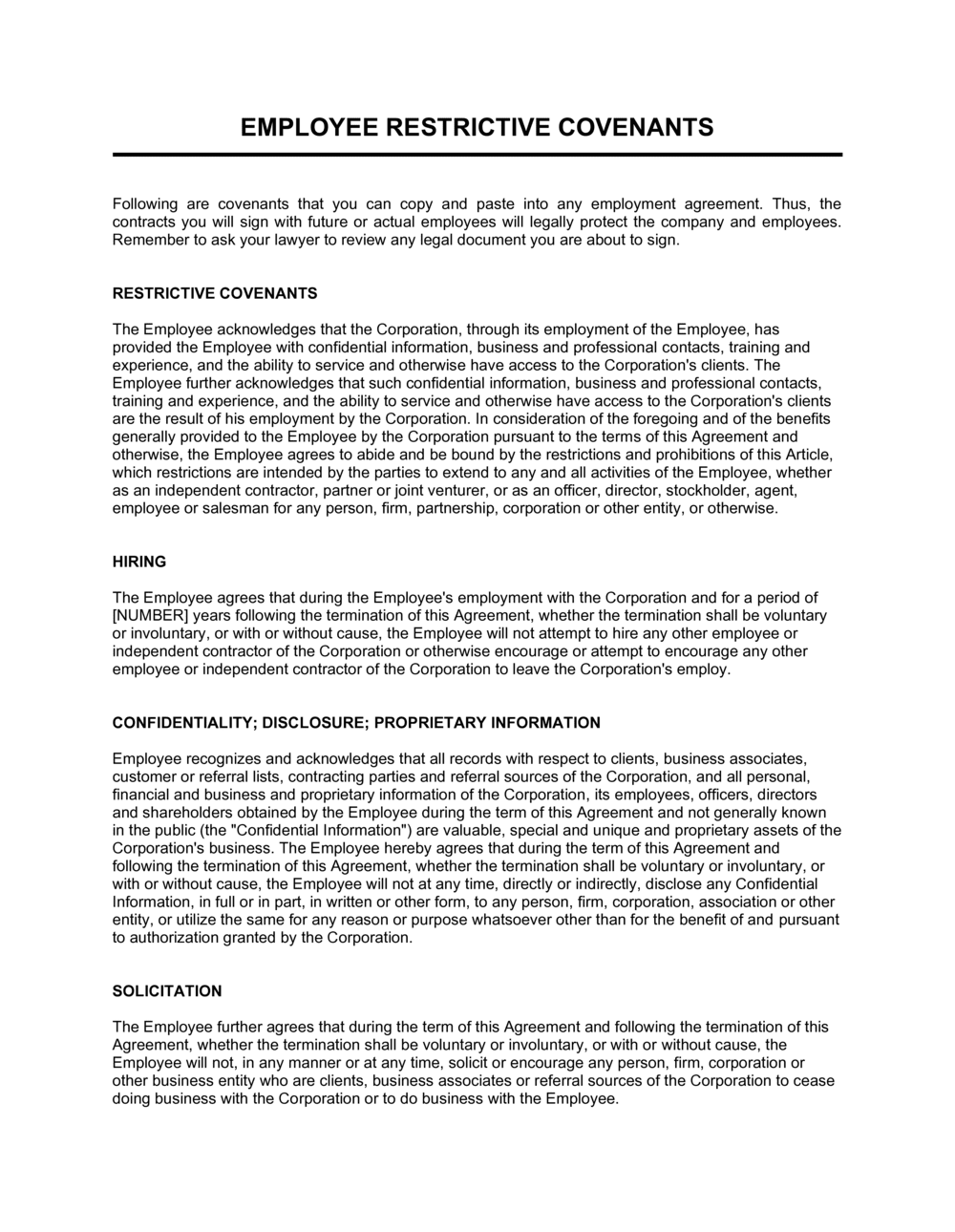
A Restrictive Covenants for Employment Agreements template is a free Word download that consolidates the post-employment and during-employment restrictions an employer needs into a single enforceable addendum or standalone document. It covers non-compete, non-solicitation of customers and employees, confidentiality, IP assignment, and garden leave — each drafted with the [PLACEHOLDERS] you replace with role-specific scope, geography, and duration.
When you need it
Use it when onboarding a new hire who will have access to trade secrets, client relationships, or proprietary technology — and whenever you need to protect those assets after the employee leaves. It is also used when updating existing employment contracts to add enforceable restrictions that were not included at the original hire date.
What's inside
Non-compete restriction with defined scope and geography, customer and employee non-solicitation clauses, confidentiality and trade-secret obligations, IP assignment, garden leave, consideration recital, and governing law — all in a single structured addendum ready to attach to any employment contract.

What is a Restrictive Covenants for Employment Agreements?

A Restrictive Covenants for Employment Agreements is a legally binding addendum or standalone document that defines the specific limits on an employee's conduct during and after employment — most commonly a non-compete clause, a non-solicitation of customers and colleagues, a confidentiality obligation, and an intellectual property assignment. Unlike a general employment contract that covers compensation and duties, this document focuses exclusively on protecting the employer's competitive position: preventing a departing employee from immediately joining a rival, taking key client relationships, recruiting former colleagues, or monetizing proprietary technology or trade secrets developed on the job. Courts in most jurisdictions will enforce these restrictions when they are proportionate to a genuine business interest, supported by adequate consideration, and drafted with precision about scope, geography, and duration.

Why You Need This Document

Without enforceable restrictive covenants, a departing employee can walk out the door on a Friday and start calling your top ten clients over the weekend — with no legal basis for you to stop them. The cost of that exposure is concrete: a senior sales rep with unrestricted access to your customer list, pricing models, and pipeline can replicate months of relationship-building at a competitor within days. Equally, an engineer who leaves without an IP assignment clause may retain co-ownership of the source code or algorithm that drives your core product. A poorly worded confidentiality clause that covers "all company information" is routinely narrowed or voided by courts, leaving trade secrets exposed at precisely the moment you need protection most. This template gives you a calibrated, clause-by-clause structure that matches restriction scope to business interest — so when enforcement matters, the document holds.

Which variant fits your situation?

If your situation is…Use this template
Adding restrictions to a new full-time employment contractRestrictive Covenants for Employment Agreements
Comprehensive employment agreement including restrictions from day oneEmployment Contract (At-Will)
Restricting an independent contractor rather than an employeeIndependent Contractor Agreement
Protecting confidential information only, without a non-competeNon-Disclosure Agreement (NDA)
Restricting a departing executive with equity and enhanced severanceExecutive Employment Agreement
Protecting confidential information shared before employment beginsEmployee Confidentiality Agreement
Standalone non-solicitation of customers after departureNon-Solicitation Agreement

Common mistakes to avoid

❌ Using a one-size-fits-all restriction for every role

Why it matters: Applying the same 24-month national non-compete to a junior customer service rep as to a VP of Sales signals to a court that the restriction is not tailored to any legitimate business interest — which is grounds for voiding it entirely.

Fix: Create a tiered covenant matrix: duration, geography, and scope should increase with the employee's seniority, customer access, and exposure to trade secrets. Junior roles warrant shorter, narrower restrictions.

❌ Adding restrictions after the employee has already started work without fresh consideration

Why it matters: In common-law jurisdictions, continued employment alone is not adequate consideration for new restrictions. Courts have voided post-start-date covenants on this basis, leaving the employer with no enforceable protection at all.

Fix: Provide a documented new benefit — a bonus, salary increase, additional PTO, or accelerated vesting — at the time the updated restrictions are signed, and reference it explicitly in the consideration recital.

❌ Choosing a governing law that does not match the employee's work location

Why it matters: Several jurisdictions — California being the most prominent — apply their own employment law to protect workers regardless of what the contract states. A New York choice-of-law clause does not make a California-based employee's non-compete enforceable.

Fix: Always specify governing law based on where the employee physically works. For multi-state remote workers, obtain jurisdiction-specific legal advice before drafting the clause.

❌ Defining 'Confidential Information' as everything the employee learns on the job

Why it matters: An overbroad confidentiality definition — covering general industry knowledge and skills the employee developed during the role — is routinely narrowed or struck down, and may contaminate the enforceability of adjacent clauses.

Fix: Limit the definition to specific, identifiable categories of non-public information the employee will actually access. A specific definition survives enforcement scrutiny far better than a catch-all clause.

❌ No separate schedule of prior inventions

Why it matters: Without a prior inventions schedule, employees have a basis to claim that IP assigned under the agreement predates their employment — creating expensive ownership disputes over key technology or designs.

Fix: Attach a Schedule of Prior Inventions at signing where the employee discloses any pre-existing IP. A blank schedule is still valuable — it records that the employee identified nothing to carve out.

❌ Failing to include a severability clause

Why it matters: If one clause — such as an overbroad non-compete — is struck down without a severability provision, courts in some jurisdictions may void the entire agreement rather than preserve the remaining restrictions.

Fix: Include a severability clause explicitly stating that any invalid provision is to be modified to the minimum extent necessary to be enforceable, and that all other provisions survive independently.

The 10 key clauses, explained

Recital of Consideration

In plain language: States the specific benefit the employee receives in exchange for agreeing to the restrictions — a job offer, promotion, bonus, or salary increase — establishing the legal foundation for enforceability.

Sample language
In consideration of the Employee's commencement of employment with [COMPANY NAME] on [START DATE] / receipt of a bonus of $[AMOUNT], and other good and valuable consideration, the Employee agrees to the following restrictions.

Common mistake: Omitting any consideration recital, particularly when restrictions are added after the employee has already started work. Without fresh consideration, courts in common-law jurisdictions routinely void the entire document.

Definitions

In plain language: Precisely defines key terms used throughout — 'Confidential Information,' 'Competing Business,' 'Customer,' 'Restricted Territory,' and 'Restricted Period' — so there is no ambiguity about what the covenants actually cover.

Sample language
'Competing Business' means any entity that designs, develops, or sells [PRODUCT/SERVICE DESCRIPTION] to [CUSTOMER TYPE] within the [RESTRICTED TERRITORY]. 'Restricted Territory' means [GEOGRAPHIC AREA, e.g., the continental United States / the Province of Ontario].

Common mistake: Defining 'Competing Business' so broadly that it covers any company in the employee's general industry — courts treat overreach as evidence the employer is protecting market position rather than legitimate business interests, and void the clause.

Non-Compete Restriction

In plain language: Prohibits the employee from working for a competing business or establishing a competing enterprise within a defined geography for a defined period after leaving — the most heavily scrutinized clause in any restrictive covenant.

Sample language
During the Restricted Period of [6 / 12 / 24] months following the termination of employment for any reason, Employee shall not directly or indirectly engage in, own, manage, operate, or be employed by a Competing Business within the Restricted Territory.

Common mistake: Setting the same non-compete duration and geography for every role regardless of seniority. A 24-month national non-compete for a junior sales rep is routinely struck down; calibrating scope to the employee's actual competitive knowledge dramatically improves enforceability.

Non-Solicitation of Customers

In plain language: Prevents the departing employee from approaching or accepting business from the employer's customers or prospects they personally dealt with during employment.

Sample language
For [12] months following separation, Employee shall not solicit, contact, or accept business from any Customer or Prospective Customer of [COMPANY NAME] with whom Employee had material contact during the [24] months preceding termination.

Common mistake: Drafting the clause to cover all customers of the company rather than only those the employee personally worked with. An enterprise-wide customer ban is almost always considered broader than necessary and is difficult to enforce.

Non-Solicitation of Employees

In plain language: Prevents a departing employee from recruiting or inducing colleagues to leave the company for a competing or new venture for a defined period.

Sample language
For [12] months following separation, Employee shall not directly or indirectly solicit, recruit, or induce any employee of [COMPANY NAME] to terminate their employment or accept employment with any other entity.

Common mistake: Extending the employee non-solicitation to anyone at the company regardless of whether the departing employee ever worked with them. Courts have limited overly wide clauses to employees the departing person actually managed or closely collaborated with.

Confidentiality and Trade Secrets

In plain language: Requires the employee to keep the employer's non-public business information strictly confidential during and indefinitely after employment, and to return or destroy all confidential material on departure.

Sample language
Employee shall not, during or after employment, disclose, use, or permit use of any Confidential Information of [COMPANY NAME] without prior written consent. Upon termination, Employee shall immediately return or certifiably destroy all Confidential Information in any medium.

Common mistake: Failing to require return or destruction of confidential materials on departure. Without an explicit obligation, a former employee may retain copies of customer databases or source code and claim they simply forgot to return them.

IP Assignment

In plain language: Transfers ownership of all work product, inventions, software, designs, and improvements created by the employee in connection with the company's business — including work done remotely or on personal devices — to the employer.

Sample language
Employee irrevocably assigns to [COMPANY NAME] all right, title, and interest in any Work Product created by Employee during employment that relates to the Company's actual or reasonably anticipated business, research, or development.

Common mistake: Limiting IP assignment to work created on company equipment or during business hours. Remote and hybrid employees regularly create IP on personal devices; without location and time-neutral language, ownership is contested.

Garden Leave

In plain language: Allows the employer to place the employee on paid leave during their notice period — keeping them off the market and away from clients and colleagues while salary continues to accrue.

Sample language
The Company may, at its discretion, require Employee to remain away from the workplace and refrain from performing duties during all or any part of the notice period, while continuing to pay base salary and maintain benefits ('Garden Leave').

Common mistake: Including garden leave language without reducing any post-termination non-compete period by the garden leave served. Courts in many jurisdictions count garden leave against the total restriction period — failing to address this creates ambiguity and potential overreach.

Acknowledgment of Reasonableness

In plain language: A statement signed by the employee confirming that they have read, understood, and consider the restrictions reasonable — used as evidence against a later claim that the covenants are unenforceable.

Sample language
Employee acknowledges that the restrictions in this Agreement are reasonable and necessary to protect [COMPANY NAME]'s legitimate business interests, and that Employee has had the opportunity to seek independent legal advice before signing.

Common mistake: Including the acknowledgment as boilerplate without actually giving the employee time and opportunity to review the document before signing. A court will look past a pro forma acknowledgment if the circumstances show the employee was pressured into signing on their first day without time to read it.

Governing Law and Severability

In plain language: Specifies which jurisdiction's law governs the agreement, and provides that if any individual clause is found unenforceable, the rest of the document remains in full force.

Sample language
This Agreement is governed by the laws of [STATE / PROVINCE / COUNTRY]. If any provision is held invalid or unenforceable, it shall be modified to the minimum extent necessary to make it enforceable; all other provisions remain in full force.

Common mistake: Choosing a governing law based on where the employer is incorporated rather than where the employee actually works. Many jurisdictions apply local employment law regardless of what the contract states — an employee working in California is protected by California law even if the contract specifies New York.

How to fill it out

  1. 1

    Identify the legitimate business interest you are protecting

    Before filling in any field, confirm the specific interest at stake — trade secrets, key customer relationships, a stable workforce, or proprietary technology. Courts require a genuine protectable interest; restrictions drafted without one in mind tend to be overbroad and unenforceable.

    💡 Write one sentence describing exactly what competitive harm you would suffer if this specific employee left to join a competitor — use that sentence to anchor every scope decision in the document.

  2. 2

    Define the restricted territory with geographic precision

    Enter a specific geography — named states, provinces, countries, or a radius in miles from a specific address. The territory must match the employee's actual area of work and influence, not the employer's global footprint.

    💡 For inside sales reps or remote workers, geography may be less meaningful than customer or industry scope — consider substituting 'accounts Employee personally managed' for a geographic definition.

  3. 3

    Set the restricted period calibrated to seniority

    Enter the post-employment duration for each restriction. Typical enforceable ranges: 6–12 months for non-competes for most roles, 12–24 months for C-suite or heads of sales, 12 months for customer and employee non-solicitation.

    💡 If you operate in California, Minnesota, or the UK post-employment context, seek legal advice before entering any non-compete duration — these jurisdictions ban or severely restrict post-employment competition clauses.

  4. 4

    Draft the confidential information definition precisely

    List specific categories of information — customer pricing, product roadmaps, source code, financial forecasts — rather than relying on a catch-all 'all company information' definition. Specific definitions are more credible in enforcement proceedings.

    💡 Cross-reference the employee's actual job description to confirm the categories listed are information they will genuinely access in their role.

  5. 5

    Complete the consideration recital with a specific benefit

    State the exact benefit the employee receives in exchange for signing — the job offer, a stated bonus amount, or a salary increase. For existing employees signing updated covenants, the consideration must be a new and distinct benefit, not just continued employment.

    💡 A $500–$1,000 signing bonus documented in this clause is often sufficient fresh consideration for an existing employee signing updated restrictions — and costs far less than a failed enforcement action.

  6. 6

    Address IP assignment scope for remote and hybrid workers

    Confirm the IP assignment clause covers work created on personal devices and outside business hours if it relates to the company's business. Add a carve-out for pre-existing personal inventions by attaching a Schedule of Prior Inventions.

    💡 Ask the employee to complete and attach a Prior Inventions Schedule at signing — this eliminates later disputes about whether specific IP predates their employment.

  7. 7

    Sign before or on the first day of employment

    Both parties must execute the document before the employee begins work, or alongside the main employment contract. Post-start-date signatures require documented fresh consideration to be enforceable in common-law jurisdictions.

    💡 Use a timestamped eSignature to create an auditable record of exactly when each party signed — critical evidence if enforceability is ever challenged.

  8. 8

    Store the executed copy and calendar a review date

    Retain the fully executed copy in the employee's personnel file. Set a calendar reminder to review the restrictions if the employee is promoted, changes roles, or gains access to significantly more sensitive information.

    💡 A role change that gives an employee access to new trade secrets or a broader customer base is a natural trigger to update restrictions — and provides the fresh consideration needed to do so.

Frequently asked questions

What are restrictive covenants in an employment agreement?

Restrictive covenants are contractual obligations in an employment agreement that limit what an employee can do during or after their employment. They typically include non-compete clauses, non-solicitation of customers and employees, confidentiality obligations, and IP assignment. Courts enforce them only when they protect a genuine business interest and are reasonable in scope, geography, and duration.

Are restrictive covenants in employment agreements enforceable?

Enforceability depends entirely on the jurisdiction and how the clause is drafted. In most US states, courts enforce non-competes that are reasonable in scope and duration and protect a legitimate business interest. California, Minnesota, North Dakota, and Oklahoma effectively ban post-employment non-competes. In the UK, Canada, and the EU, restrictions are enforceable if reasonable but courts will not rewrite grossly overbroad clauses. Confidentiality and non-solicitation clauses are generally easier to enforce than non-competes across all jurisdictions.

What is the difference between a non-compete and a non-solicitation clause?

A non-compete prevents the employee from working for a competing business or starting one within a defined geography and time. A non-solicitation clause is narrower — it prevents the employee from approaching specific customers, prospects, or colleagues they worked with, but does not stop them from joining a competitor. Non-solicitation clauses are more consistently enforced because their scope is easier to define and their impact on the employee's ability to earn a living is less severe.

What consideration is required for restrictive covenants to be enforceable?

In common-law jurisdictions — the US, Canada, UK, and Australia — restrictive covenants require consideration to be binding. For a new hire, the job offer itself is sufficient consideration. For an existing employee, you must provide something new and distinct — a bonus, salary increase, additional leave, or accelerated vesting. Courts have voided post-start-date covenants where the only consideration offered was "continued employment."

Can I add restrictive covenants to an existing employment contract?

Yes, but you must provide fresh consideration — a new benefit the employee was not already entitled to — at the time of signing. Simply presenting updated terms to an employee who is already working, without an additional benefit, is generally insufficient in common-law countries. Document the consideration explicitly in the agreement and obtain a separate signature.

How long can a non-compete clause last?

In jurisdictions that permit them, courts most consistently enforce non-competes of 6–12 months for most employees and up to 24 months for senior executives or key technical staff with broad access to trade secrets. Restrictions beyond 24 months are rarely enforced in any jurisdiction. The duration should be proportionate to the time it would take the employer to protect the threatened business interest — recruiting a replacement, re-securing client relationships, or updating compromised trade secrets.

What is garden leave and how does it relate to non-compete clauses?

Garden leave is a notice period during which the employee is paid their full salary but required to stay away from the workplace. It serves a similar protective function to a non-compete — keeping the employee off the market while clients and information age. In the UK, courts often reduce the post-termination non-compete period by the length of garden leave served, on the basis that the employer has already had the protection it needs. Employment contracts should address this offset explicitly.

Do restrictive covenants apply to independent contractors?

The same types of restrictions — confidentiality, non-solicitation, IP assignment — can be included in an independent contractor agreement, but the analysis differs. Contractors are typically subject to less stringent restrictions because they are not employees, and over-restricting a contractor can contribute to worker misclassification risk. Non-competes for contractors are enforceable in fewer jurisdictions and must be narrowly tailored to the specific engagement.

What happens if a court finds a restrictive covenant unenforceable?

The outcome depends on the jurisdiction and whether the agreement has a severability clause. In jurisdictions that practice blue-pencilling, a court may narrow an overbroad restriction — reducing the geographic scope or duration — and enforce the modified version. In others, the entire clause is struck. Without a severability clause, an unenforceable non-compete could potentially bring down adjacent clauses like non-solicitation in the same document. Including severability language is essential to protect surviving provisions.

Should I have a lawyer review my restrictive covenants?

Yes, for any employee with meaningful access to trade secrets, key client relationships, or proprietary technology. The enforceability of restrictive covenants is highly jurisdiction-specific and fact-dependent, and an over-engineered clause often provides less protection than a well-calibrated one. A 1–2 hour review by an employment lawyer typically costs $300–$600 and is worthwhile for senior hires, technical founders, or sales leaders with direct access to your most valuable accounts.

How this compares to alternatives

vs Non-Disclosure Agreement (NDA)

An NDA addresses confidentiality only — it prevents disclosure of specific information but does not restrict competition or client solicitation. Restrictive covenants cover a broader set of post-employment behaviors including non-compete, non-solicitation, and IP assignment. Use an NDA for vendor, partner, or pre-employment situations; use restrictive covenants for a comprehensive employment restriction package.

vs Employment Contract

An employment contract governs the entire working relationship — position, compensation, termination, and benefits — and may include restrictive covenants as embedded clauses. A standalone restrictive covenants document is used as an addendum when the original employment contract lacks them, or when updated restrictions are needed for an existing employee. Both can achieve the same legal outcome; the addendum approach avoids re-executing the full employment contract.

vs Non-Solicitation Agreement

A non-solicitation agreement is a narrower document covering only the prohibition on approaching customers or employees after departure. Restrictive covenants combine non-solicitation with non-compete, confidentiality, IP assignment, and garden leave in a single enforceable package. Choose a standalone non-solicitation only when the non-compete and IP elements are already adequately covered elsewhere or are not applicable.

vs Employee Confidentiality Agreement

An employee confidentiality agreement focuses solely on the obligation to keep company information secret during and after employment. Restrictive covenants go further — they actively restrict where the employee can work, who they can contact, and who owns the IP they create. When confidentiality alone is insufficient to protect your business interests, a full restrictive covenants package is the appropriate document.

Industry-specific considerations

Technology / SaaS

IP assignment is the highest-stakes clause — covering source code, algorithms, and training data created on personal devices by remote engineers and product managers.

Financial Services

Client non-solicitation is critical given fee-based relationships; garden leave is standard practice for departing advisors to prevent immediate client poaching.

Professional Services

Non-solicitation of clients and colleagues takes precedence over non-compete given that the employee's skills are their value, but protecting fee relationships is commercially vital.

Healthcare / Life Sciences

Trade secret protection for clinical data, formulations, and patient protocols; non-compete scope must account for highly specialized geographic markets for certain specialties.

Retail / Consumer Brands

Non-disclosure of proprietary supplier relationships, pricing strategy, and new product pipelines; non-competes are rarely appropriate for frontline staff but are standard for category buyers and brand directors.

Manufacturing

IP assignment covers process improvements and engineering modifications; confidentiality protects supplier contracts and cost structures that are commercially sensitive.

Jurisdictional notes

United States

Enforceability varies sharply by state. California, Minnesota, North Dakota, and Oklahoma ban most post-employment non-competes. The FTC attempted a near-total federal ban in 2024, which was blocked in court as of 2025 — employers should monitor ongoing litigation. In states that permit them, courts require non-competes to be reasonable in duration (typically 6–12 months), geographic scope, and limited to protecting a genuine business interest. Confidentiality and non-solicitation clauses are enforceable in nearly all states with fewer restrictions.

Canada

Non-competes are subject to a strict reasonableness test and are rarely enforced for non-executive employees — Ontario's Employment Standards Act, 2000 explicitly bans non-competes for most employees as of October 2021. Non-solicitation and confidentiality clauses are more consistently enforced. Fresh consideration is mandatory for post-start-date covenants. Quebec employment agreements must be in French for provincially regulated employers, and Quebec courts apply the Civil Code's public policy protections rather than common law.

United Kingdom

Post-termination restrictive covenants are enforceable in principle but heavily scrutinized. Courts will not blue-pencil to rescue an overbroad clause — they strike the whole provision. Garden leave is widely used and courts generally reduce non-compete periods by garden leave served. The UK government proposed a three-month cap on non-competes in 2023 but legislation had not been enacted as of mid-2025. Confidentiality and non-solicitation clauses are more reliably enforced than non-competes.

European Union

Restrictive covenants vary significantly by member state. Germany and Austria require financial compensation — typically 50% of last salary — for the duration of any post-employment non-compete; failure to include this makes the clause void. France similarly requires compensation. The Netherlands permits non-competes only in written contracts and requires justification for remote or mobile workers. GDPR considerations arise when employee data is referenced in confidentiality clauses — data protection obligations survive termination.

Template vs lawyer — what fits your deal?

PathBest forCostTime
Use the templateStandard domestic hires in a single US state or Canadian province where the employer needs documented non-compete, non-solicit, and confidentiality restrictionsFree30–45 minutes
Template + legal reviewSenior hires, cross-border employees, roles with significant IP creation, or jurisdictions with complex enforceability rules (CA, ON, UK, EU)$300–$6001–3 days
Custom draftedC-suite executives, founders with equity, highly regulated industries, or multi-jurisdiction workforces where one unenforceable clause could expose the entire restriction package$1,000–$4,000+1–2 weeks

Glossary

Restrictive Covenant
A contractual promise by an employee that limits certain activities during or after employment, typically to protect the employer's legitimate business interests.
Non-Compete Clause
A post-employment restriction preventing the employee from working for, or starting, a competing business within a defined geography and time period.
Non-Solicitation Clause
A restriction preventing a departing employee from approaching the employer's customers or employees for a defined period after leaving.
Garden Leave
A notice period during which the employee is paid their full salary but required to stay away from the workplace, preventing access to clients, colleagues, and confidential information.
Confidential Information
Non-public data — including trade secrets, customer lists, pricing, and product roadmaps — that the employee agrees not to disclose or misuse during or after employment.
IP Assignment
A clause transferring ownership of inventions, code, designs, and other work product created by the employee in connection with their role to the employer.
Legitimate Business Interest
The specific protectable interest — trade secrets, client relationships, stable workforce — that a court requires the employer to demonstrate before enforcing a restrictive covenant.
Blue-Pencilling
A judicial practice in some jurisdictions of modifying an overly broad restrictive covenant to make it enforceable rather than striking it down entirely.
Consideration
Something of value given in exchange for the employee's agreement to the restrictive covenants — such as a job offer, bonus, or salary increase — required for the contract to be enforceable.
Restraint of Trade
The legal doctrine under which courts assess whether a post-employment restriction is reasonable in scope, geography, and duration before enforcing it.
Trade Secret
Commercially valuable information that derives its value from secrecy and that the employer has taken reasonable steps to protect — such as proprietary formulas, processes, or source code.

Part of your Business Operating System

This document is one of 3,000+ business & legal templates included in Business in a Box.

  • Fill-in-the-blanks — ready in minutes
  • 100% customizable Word document
  • Compatible with all office suites
  • Export to PDF and share electronically

Create your document in 3 simple steps.

From template to signed document — all inside one Business Operating System.
1
Download or open template

Access over 3,000+ business and legal templates for any business task, project or initiative.

2
Edit and fill in the blanks with AI

Customize your ready-made business document template and save it in the cloud.

3
Save, Share, Send, Sign

Share your files and folders with your team. Create a space of seamless collaboration.

Save time, save money, and create top-quality documents.

★★★★★

"Fantastic value! I'm not sure how I'd do without it. It's worth its weight in gold and paid back for itself many times."

Managing Director · Mall Farm
Robert Whalley
Managing Director, Mall Farm Proprietary Limited
★★★★★

"I have been using Business in a Box for years. It has been the most useful source of templates I have encountered. I recommend it to anyone."

Business Owner · 4+ years
Dr Michael John Freestone
Business Owner
★★★★★

"It has been a life saver so many times I have lost count. Business in a Box has saved me so much time and as you know, time is money."

Owner · Upstate Web
David G. Moore Jr.
Owner, Upstate Web

Run your business with a system — not scattered tools

Stop downloading documents. Start operating with clarity. Business in a Box gives you the Business Operating System used by over 250,000 companies worldwide to structure, run, and grow their business.

Start free · No credit card required