Union Collective Bargaining Agreement Template

Free Word download β€’ Edit online β€’ Save & share with Drive β€’ Export to PDF

3 pagesβ€’25–30 min to fillβ€’Difficulty: Standardβ€’Signature requiredβ€’Legal review recommended
Learn more ↓
FreeUnion Collective Bargaining Agreement Template

At a glance

What it is
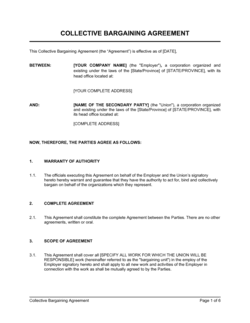
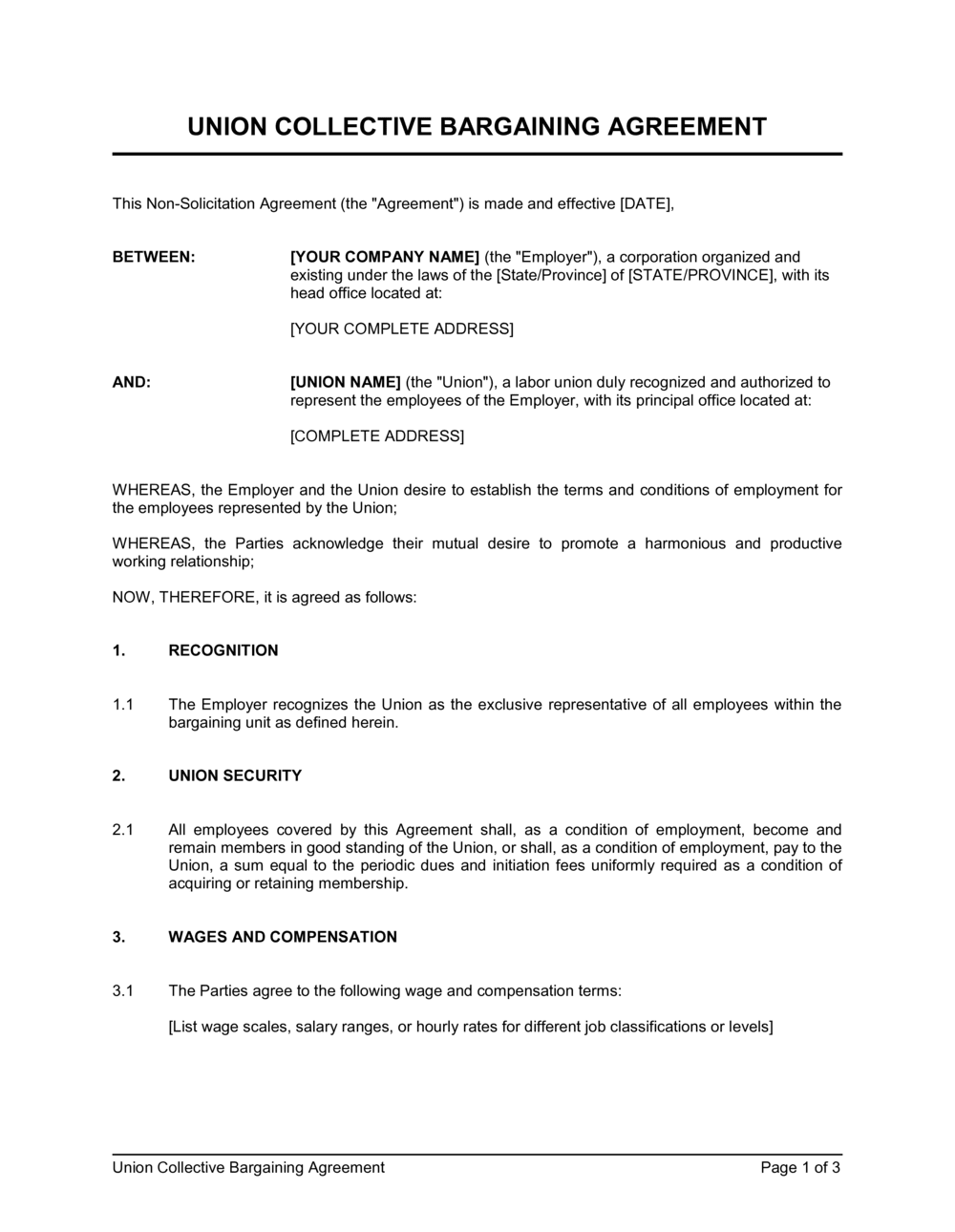
A Union Collective Bargaining Agreement (CBA) is a legally binding contract negotiated between an employer and a certified union that governs the terms and conditions of employment for all workers in the bargaining unit. This free Word download gives you a structured starting point covering wages, hours, benefits, grievance procedures, union security, and management rights β€” ready to edit online and export as PDF for execution by both parties.
When you need it
Use it when a union has been certified or recognized as the exclusive bargaining representative for a group of employees, and both parties are ready to reduce their negotiated terms to a signed written agreement. It is also the reference document for any subsequent contract renewals, mid-term amendments, or grievance arbitrations.
What's inside
Recognition and bargaining unit definition, union security and dues checkoff, management rights, wages and classification schedules, hours of work and overtime, benefits (health, pension, leave), grievance and arbitration procedures, no-strike and no-lockout clauses, seniority and layoff rules, and term and reopener provisions.

What is a Union Collective Bargaining Agreement?

A Union Collective Bargaining Agreement (CBA) is a legally binding contract negotiated between an employer and a certified union that governs every material term and condition of employment for all workers in the bargaining unit. It covers wages and job classifications, scheduled hours and overtime premiums, health and retirement benefits, disciplinary standards, grievance and arbitration rights, seniority rules, and the duration of the agreement itself. Unlike an individual employment contract, a CBA is negotiated collectively and applies automatically to every covered employee β€” whether or not they personally voted for the union or participated in negotiations. Once ratified and signed, neither party may unilaterally change its terms during the contract's life.

Why You Need This Document

Without a signed CBA, the terms of employment for a unionized workforce exist as a patchwork of verbal understandings, historical practices, and informal side agreements β€” none of which are reliably enforceable. Employers who fail to reduce negotiated terms to writing expose themselves to unfair labor practice charges for unilaterally changing conditions, unlimited back-pay liability in arbitration, and costly disputes over what was actually agreed during bargaining. Unions face the same risk from the other direction: promises made at the table cannot be enforced without a written contract. A properly drafted CBA fixes the terms for a defined period, channels disputes into a predictable grievance procedure instead of work stoppages, and gives both supervisors and shop stewards a single authoritative source of truth. This template provides the structural framework that experienced labor counsel can tailor to your bargaining unit, jurisdiction, and industry β€” replacing ambiguity with clarity before the first grievance is filed.

Which variant fits your situation?

If your situation is…Use this template
Private-sector employer subject to the NLRAUnion Collective Bargaining Agreement (NLRA)
Federal government agency with unionized employeesFederal Sector CBA (FSLMRS)
State or municipal public employeesPublic Sector Collective Agreement
Construction project with multiple trade unionsProject Labor Agreement
Amending specific terms during a contract's active termCBA Amendment / Letter of Understanding
First contract with a newly certified unionFirst Collective Agreement (Mediated)
Cross-border employer with Canadian bargaining unitsCanadian Collective Agreement

Common mistakes to avoid

❌ Including a union security clause in a right-to-work state

Why it matters: In the 28 US states with right-to-work laws, mandatory union membership or agency fee requirements are illegal. Including them exposes the employer to NLRB unfair labor practice charges and the union to litigation from affected employees.

Fix: Check the applicable state law before drafting. In right-to-work states, replace mandatory membership language with a dues checkoff authorization that is voluntary and individually revocable.

❌ Embedding specific benefit plan terms in the CBA body

Why it matters: When the plan changes β€” as health plans routinely do annually β€” the CBA language becomes incorrect. The discrepancy can be cited as a breach of contract in arbitration even if the plan change was otherwise lawful.

Fix: Reference the plan by name and document date only. State that employees are entitled to participate 'as the plan is in effect from time to time' and attach the summary plan description as a non-binding appendix.

❌ Missing the 60-day statutory notice before expiration

Why it matters: NLRA Section 8(d) requires written notice at least 60 days before a party seeks to terminate or modify a CBA. Failure to give notice strips the union's right to strike over new demands and can constitute an independent unfair labor practice.

Fix: Calendar the notice deadline at contract signing. Send written notice by certified mail and email to the other party's designated representative, and retain proof of delivery.

❌ Failing to define seniority as unit-wide or classification-specific

Why it matters: An ambiguous seniority clause generates grievances every time there is a layoff or job posting. Arbitrators resolve ambiguity inconsistently, meaning the same contract produces different outcomes in different arbitrations.

Fix: State explicitly whether seniority applies across the full bargaining unit or within individual job classifications, and define any bumping rights and the qualifications required to exercise them.

❌ Omitting time limits in the grievance procedure

Why it matters: Without specific deadlines at each step, grievances accumulate unresolved for months or years, creating large back-pay exposure. Courts and arbitrators routinely dismiss stale grievances β€” but only if the CBA contains a clear time limit to trigger the defense.

Fix: Assign a specific number of business days to every step, including the time to request arbitration after a final denial. Include a clear waiver clause for grievances not advanced within the stated deadline.

❌ No-strike clause without a corresponding employer duty to arbitrate

Why it matters: A no-strike clause is generally enforceable only so long as the employer honors its corresponding obligation to resolve disputes through the grievance and arbitration process. An employer that refuses arbitration on a meritorious grievance may be held to have excused the union's no-strike obligation.

Fix: Pair the no-strike clause with an explicit employer commitment to submit all grievances to binding arbitration at the union's request, and include a clause confirming that arbitration is the exclusive remedy for contract disputes.

The 10 key clauses, explained

Recognition and bargaining unit definition

In plain language: Identifies the union as the exclusive bargaining representative and defines precisely which job titles, classifications, and locations are covered.

Sample language
The Employer recognizes [UNION NAME] as the sole and exclusive collective bargaining representative of all [JOB CLASSIFICATIONS] employed at [FACILITY/LOCATION], excluding supervisors, managers, confidential employees, and guards as defined by the NLRA.

Common mistake: Defining the bargaining unit by department name rather than job classification. Department names change with reorgs; classification-based definitions survive restructuring without triggering a recognition dispute.

Union security and dues checkoff

In plain language: States the union membership or fee obligations for employees in the unit and authorizes the employer to deduct dues from paychecks and remit them to the union.

Sample language
As a condition of continued employment, all bargaining-unit employees shall become and remain members of the Union, or pay an agency fee equal to dues, within [30] days of hire, to the extent permitted by applicable law. The Employer shall deduct dues from wages upon receipt of a signed authorization card.

Common mistake: Using a union security clause without checking state right-to-work law. In the 28 US right-to-work states, mandatory membership or fee requirements are unenforceable β€” including this clause as written exposes the employer to unfair labor practice charges.

Management rights

In plain language: Reserves to the employer the right to direct operations, set policies, hire and discipline employees, and make business decisions, except where expressly limited elsewhere in the agreement.

Sample language
The Employer retains the exclusive right to manage its operations, direct the workforce, establish work rules, determine methods of production, subcontract work, and take all actions necessary to run the business efficiently, subject only to the express limitations set forth in this Agreement.

Common mistake: Omitting the management rights clause entirely to avoid union pushback. Without it, arbitrators apply the 'reserved rights' doctrine inconsistently β€” an explicit clause creates a cleaner, more predictable baseline.

Wages, job classifications, and schedules

In plain language: Sets out base wage rates by job classification and step, specifies effective dates for any scheduled increases, and attaches a wage schedule as an exhibit.

Sample language
Effective [DATE], wage rates for each classification shall be as set forth in Schedule A. Effective [DATE + 12 MONTHS], rates shall increase by [X]%. Step progression from Step 1 to Step [N] shall occur after [X] months of satisfactory service in the classification.

Common mistake: Embedding specific dollar amounts in the body text rather than a Schedule A exhibit. When rates change mid-term or at renewal, an embedded rate requires a formal amendment; a Schedule A can be replaced without amending the main agreement.

Hours of work, overtime, and scheduling

In plain language: Defines the standard workday and workweek, the overtime threshold and premium rate, shift differentials, and the employer's scheduling obligations.

Sample language
The standard workday is [8] hours; the standard workweek is [40] hours, Monday through Friday. Overtime at 1.5Γ— the regular rate is paid for hours in excess of [8] per day or [40] per week. A shift differential of $[X] per hour applies to all hours worked between 6:00 p.m. and 6:00 a.m.

Common mistake: Setting an overtime trigger only at 40 hours per week without a daily overtime provision in states like California that require daily overtime after 8 hours. The state statutory floor applies regardless of what the CBA says.

Benefits: health, pension, and leave

In plain language: Describes employer contributions to health insurance and pension or retirement plans, vacation and sick leave accrual, and any other negotiated benefits.

Sample language
The Employer shall contribute $[X] per hour worked to the [HEALTH FUND NAME] and $[Y] per hour worked to the [PENSION FUND NAME] on behalf of each covered employee. Employees accrue vacation at [X] days per year for Years 1–5 and [Y] days per year thereafter.

Common mistake: Describing benefit plan terms in the CBA body rather than referencing the plan documents. If the plan changes and the CBA language doesn't match, the employer faces a breach-of-contract claim even if the plan change was lawful.

Grievance and arbitration procedure

In plain language: Establishes the step-by-step process for filing and resolving complaints about contract violations, ending in binding arbitration by a neutral third party if the earlier steps fail.

Sample language
Step 1: Employee and steward present grievance to supervisor within [5] business days of the incident. Step 2: Union presents written grievance to HR within [10] business days of Step 1 denial. Step 3: Meeting with senior management within [15] business days. Step 4: Binding arbitration administered by [AAA / FMCS] if unresolved after Step 3.

Common mistake: Setting arbitration filing deadlines without a clear tolling rule for holidays and weekends. Missed arbitration deadlines are typically held to be fatal to the grievance β€” even meritorious ones β€” because courts enforce CBA time limits strictly.

No-strike and no-lockout

In plain language: Mutual promises by the union to refrain from strikes, slowdowns, or work stoppages, and by the employer to refrain from lockouts, for the duration of the agreement.

Sample language
During the term of this Agreement, the Union agrees that there shall be no strike, work stoppage, slowdown, or concerted refusal to work. The Employer agrees that there shall be no lockout of bargaining-unit employees. Violations of this clause shall be subject to immediate disciplinary action up to and including discharge.

Common mistake: No-strike clauses without a corresponding obligation on the employer to use the grievance procedure rather than unilateral action. Courts have found that an employer's material breach of the CBA can excuse the union from its no-strike obligation under Boys Markets principles.

Seniority, layoff, and recall

In plain language: Defines how seniority is calculated, how it governs layoff order and recall rights, and the time limit within which a laid-off employee retains recall standing.

Sample language
Seniority is defined as continuous length of service in the bargaining unit from the most recent date of hire. In the event of a reduction in force, employees shall be laid off in inverse order of seniority within the affected classification. Laid-off employees retain recall rights for [24] months.

Common mistake: Failing to specify whether seniority is unit-wide or classification-specific. Classification seniority can trap a senior employee in a dying job class; unit-wide seniority creates bumping rights across classifications that supervisors may not anticipate.

Term, expiration, and reopener

In plain language: States the effective date, expiration date, and automatic renewal or termination notice requirements, along with any mid-term reopener rights.

Sample language
This Agreement shall be effective [DATE] and shall remain in full force through [DATE], a period of [X] years. Either party may reopen negotiations on wages only during the [MONTH] of the final year. Notice of intent to terminate or modify shall be given at least [60] days prior to expiration.

Common mistake: Omitting the 60-day written notice requirement before expiration. Under NLRA Section 8(d), failure to give timely notice before a CBA expires can strip the union of its right to strike in support of new demands and expose the employer to unfair labor practice claims for premature unilateral changes.

How to fill it out

  1. 1

    Define the bargaining unit precisely

    List every job classification covered by the agreement by its exact title, and explicitly exclude supervisors, managers, confidential employees, and any other categories your labor board has determined are outside the unit.

    πŸ’‘ Use the job titles from the union's certification order or recognition agreement β€” any deviation creates a recognition dispute that can delay ratification.

  2. 2

    Complete the wages and classification schedule

    Build Schedule A as a separate exhibit listing each job classification, every step in the pay progression, the effective date of current rates, and the date and percentage of any negotiated increases.

    πŸ’‘ Express increases as percentages rather than flat dollar amounts so compounding is unambiguous across multi-year agreements.

  3. 3

    Set overtime and scheduling rules against your state's statutory floor

    Enter the daily and weekly overtime thresholds, premium rates, and shift differential amounts. Cross-reference the applicable state wage-and-hour law to confirm the CBA meets or exceeds the legal minimum.

    πŸ’‘ In California, daily overtime after 8 hours and double-time after 12 are mandatory β€” a CBA cannot waive these below the statutory floor.

  4. 4

    Draft the grievance procedure with specific time limits

    Assign a specific number of business days to each step and name the decision-maker at each level. Include a clear statement that the arbitrator's decision is final and binding.

    πŸ’‘ Keep Step 1 informal β€” supervisor and steward only β€” so minor issues are resolved quickly without consuming HR and union resources.

  5. 5

    Specify benefit contribution rates and reference plan documents

    Enter the employer's hourly or per-employee contribution to each benefit fund, and reference the governing plan document rather than describing plan terms in the CBA body.

    πŸ’‘ Confirm contribution rates with your benefits administrator before signing β€” even a one-cent-per-hour discrepancy in a large bargaining unit creates a significant underpayment liability over a three-year term.

  6. 6

    Calibrate seniority and layoff rules to your operations

    Choose between unit-wide and classification-specific seniority and set the recall period. If bumping rights apply across classifications, define the minimum qualifications an employee must meet to exercise a bump.

    πŸ’‘ A skills-based bumping test ('employee must be able to perform the job with minimal training') is generally upheld by arbitrators and prevents senior employees from displacing junior workers in roles they genuinely cannot perform.

  7. 7

    Insert the term, expiration date, and notice requirements

    Enter the effective and expiration dates, the length of the term (typically 2–4 years), and the required notice period β€” at least 60 days under the NLRA β€” before either party can terminate or modify the agreement.

    πŸ’‘ Calendar the 60-day notice deadline as soon as the agreement is signed β€” missing it is a statutory unfair labor practice, not just a contract breach.

  8. 8

    Execute before implementation of any new terms

    Both the authorized employer representative and the union president or designee must sign before any changed wages, benefits, or rules take effect. Attach all schedules and letters of understanding as exhibits.

    πŸ’‘ Provide each signatory with a fully executed copy the same day β€” delays in circulating the signed agreement create ambiguity about which version governs.

Frequently asked questions

What is a union collective bargaining agreement?

A union collective bargaining agreement (CBA) is a legally binding contract negotiated between an employer and a certified union that sets the terms and conditions of employment β€” wages, hours, benefits, discipline procedures, and grievance rights β€” for all workers in the bargaining unit. Once ratified and signed, it governs the employment relationship for its stated term, typically two to four years, and neither party can unilaterally change its terms without the other's consent.

What must be included in a collective bargaining agreement?

A complete CBA covers: recognition of the union and definition of the bargaining unit, union security and dues checkoff, management rights, wage and classification schedules, hours of work and overtime rules, health and retirement benefits, grievance and arbitration procedure, no-strike and no-lockout commitments, seniority and layoff rules, and the term and expiration date with notice requirements. Missing any of these creates interpretive gaps that arbitrators fill in unpredictable ways.

Is a collective bargaining agreement legally required?

In the US, the NLRA requires private-sector employers to bargain in good faith with a certified union over wages, hours, and working conditions, but it does not mandate that the parties reach agreement. However, once agreement is reached, reducing it to a signed written CBA is standard practice and effectively required to create enforceable obligations on both sides. In the UK, Canada, and most EU member states, statutory frameworks create similar or stronger obligations.

How long does a collective bargaining agreement last?

Most private-sector CBAs run two to four years. Public-sector agreements often run one to three years, depending on budget cycles. Under the NLRA, either party may notify the other of intent to terminate or modify the agreement at least 60 days before expiration. The agreement continues in force during negotiations for a successor contract unless it is formally terminated after proper notice.

What happens when a collective bargaining agreement expires?

When a CBA expires, the employer generally must maintain the status quo β€” continuing existing wages, benefits, and conditions β€” while bargaining in good faith for a new agreement. Unilaterally changing terms after expiration without bargaining to impasse is an NLRA unfair labor practice. The union regains the right to strike in support of new demands once the 60-day notice period has passed.

What is the difference between a CBA and an individual employment contract?

An individual employment contract governs the relationship between the employer and a single employee and can be negotiated individually. A CBA is negotiated between the employer and a union representing an entire group of employees, and its terms automatically apply to every worker in the bargaining unit β€” even those who did not personally agree to them. Where a CBA exists, its terms generally supersede any conflicting individual employment agreement for covered employees.

Do I need a labor lawyer to draft a collective bargaining agreement?

Given the complexity of NLRA compliance, state law variations, and the long-term financial implications of benefit and wage commitments, engaging a labor lawyer for at least a template review is strongly recommended. This is especially true for first contracts, multi-site agreements, or any CBA involving pension fund contributions or public-sector statutory requirements. A typical review costs $1,500–$5,000 and is modest compared to the cost of a single arbitration or unfair labor practice proceeding.

What is a grievance arbitration, and how does it relate to the CBA?

Grievance arbitration is the final step in most CBA dispute resolution procedures, in which a neutral arbitrator β€” rather than a court β€” hears and decides a claim that the employer or union violated the contract. The arbitrator's authority is defined entirely by the CBA itself, and decisions are generally final and binding, reviewable by courts only on narrow grounds such as fraud or a clear violation of public policy.

How this compares to alternatives

vs Employment Contract

An individual employment contract governs one employee's relationship with the employer and is negotiated between those two parties directly. A CBA is negotiated with a union and applies automatically to every worker in the bargaining unit. Where a CBA exists, it supersedes conflicting individual contracts for covered employees. Use an employment contract for non-union or management hires; use a CBA where a union holds bargaining rights.

vs Non-Disclosure Agreement

An NDA protects confidential information and is typically an individual agreement signed by one employee or counterparty. A CBA governs the entire employment relationship for a bargaining unit and contains confidentiality provisions only incidentally, if at all. These documents serve different purposes and are not substitutes for each other.

vs Independent Contractor Agreement

An independent contractor agreement engages a self-employed individual outside the employment relationship β€” no union rights, no NLRA coverage, no CBA obligations. Misclassifying unionized employees as contractors is a serious NLRA violation. If the workers are employees doing the core work of your business under your direction, a CBA governs their terms β€” not a contractor agreement.

vs Employee Handbook

An employee handbook sets general workplace policies and can be revised unilaterally by the employer with notice. A CBA is a negotiated contract that cannot be changed without the union's consent. For unionized workforces, the CBA controls on any subject it addresses β€” the handbook fills gaps but cannot contradict CBA terms. Both documents should be reviewed together for consistency.

Industry-specific considerations

Manufacturing

Production classification hierarchies, shift schedules, skilled-trades jurisdictions, and safety committee rights are standard CBA provisions in manufacturing environments.

Healthcare

Nurse-to-patient staffing ratios, on-call and callback pay, mandatory overtime limits, and licensure maintenance obligations are frequently bargained subjects in hospital CBAs.

Construction and Trades

Project labor agreements, trade jurisdictions, apprentice-to-journeyman ratios, and hiring hall dispatch procedures define the CBA structure for building and construction unions.

Public Sector and Education

Tenure protections, class-size limits, preparation time, and binding interest arbitration replace strike rights in many jurisdictions for teachers and public employees.

Transportation and Logistics

Hours-of-service rules, mileage pay, layover and per diem rates, and seniority-based route bidding are central to CBAs covering truck drivers and transit workers.

Retail and Food Service

Scheduling predictability requirements, part-time benefit eligibility thresholds, and premium pay for holiday and Sunday work are common bargained issues in retail and hospitality CBAs.

Jurisdictional notes

United States

Private-sector CBAs are governed by the National Labor Relations Act and enforced under LMRA Section 301. Employers must bargain in good faith over mandatory subjects β€” wages, hours, and working conditions. State right-to-work laws in 28 states prohibit mandatory union membership or agency fee clauses. California imposes daily overtime requirements that CBAs cannot waive below the statutory floor, and several states have additional public-sector bargaining statutes.

Canada

Labour relations in Canada are governed provincially for most workers, with separate federal legislation (Canada Labour Code) covering federally regulated industries such as banking, telecommunications, and interprovincial transport. First-contract arbitration is available in most provinces if the parties cannot reach agreement voluntarily. Quebec requires that all workplace documents, including CBAs, be available in French for provincially regulated employers.

United Kingdom

Collective agreements in the UK are presumed not to be legally binding contracts between the union and employer unless they are in writing and expressly state they are intended to be binding β€” a statutory default under the Trade Union and Labour Relations (Consolidation) Act 1992. However, CBA terms incorporated into individual contracts of employment are fully enforceable. Statutory recognition procedures under the Employment Relations Act 1999 apply where the employer refuses voluntary recognition.

European Union

EU member states have widely varying collective bargaining frameworks. In Germany, sectoral CBAs negotiated by industry associations cover entire industries and can be extended by ministerial decree to non-union employers. In France, CBAs are legally binding and sectoral agreements automatically apply to all employers in the sector. The EU Adequate Minimum Wages Directive (2022/2041) targets 80% collective bargaining coverage across member states. GDPR requires that any personal data processing obligations on the employer in the CBA comply with data protection law.

Template vs lawyer β€” what fits your deal?

PathBest forCostTime
Use the templateSmall employers preparing an initial draft to bring to the bargaining table or documenting a simple renewal with minor changesFree2–4 hours for initial draft
Template + legal reviewFirst contracts, multi-year agreements with pension fund contributions, or any CBA involving public-sector statutory requirements$1,500–$5,0003–7 days for attorney review and redline
Custom draftedMulti-site or multi-union agreements, project labor agreements, or complex industries such as healthcare and construction with significant financial exposure$5,000–$25,000+2–8 weeks including negotiation support

Glossary

Bargaining Unit
The defined group of employees β€” by job classification, location, or craft β€” that the union is certified to represent in contract negotiations.
Union Security Clause
A provision requiring employees in the bargaining unit to join the union or pay dues (or an agency fee) as a condition of employment, to the extent permitted by applicable law.
Dues Checkoff
An arrangement under which the employer deducts union dues directly from employee paychecks and remits them to the union, based on signed employee authorization.
Management Rights Clause
A provision reserving to the employer the authority to direct the workforce, set production standards, assign work, and make operational decisions, except as explicitly limited by the agreement.
Grievance Procedure
The multi-step internal process β€” typically three to four steps escalating from supervisor to arbitration β€” by which disputes over contract interpretation or application are resolved.
Interest Arbitration
A process in which a neutral arbitrator resolves a bargaining impasse by imposing contract terms, used primarily in public-sector or essential-service contexts.
Seniority
A system ranking employees by length of continuous service within the bargaining unit, used to govern layoff order, recall rights, shift preference, and promotion.
No-Strike / No-Lockout Clause
Mutual promises by the union not to strike and by the employer not to lock out employees during the term of the agreement, in exchange for binding arbitration of disputes.
Letter of Understanding (LOU)
A signed side agreement between the employer and union that clarifies or modifies a specific CBA provision without reopening the full contract.
Reopener Clause
A provision allowing either party to reopen negotiation on specified subjects β€” typically wages β€” at a defined point during the contract term without waiting for full expiration.
Past Practice
A consistent, longstanding way of doing something at the workplace that arbitrators may treat as an implied term of the contract even if not explicitly written.

Part of your Business Operating System

This document is one of 3,000+ business & legal templates included in Business in a Box.

  • Fill-in-the-blanks β€” ready in minutes
  • 100% customizable Word document
  • Compatible with all office suites
  • Export to PDF and share electronically

Create your document in 3 simple steps.

From template to signed document β€” all inside one Business Operating System.
1
Download or open template

Access over 3,000+ business and legal templates for any business task, project or initiative.

2
Edit and fill in the blanks with AI

Customize your ready-made business document template and save it in the cloud.

3
Save, Share, Send, Sign

Share your files and folders with your team. Create a space of seamless collaboration.

Save time, save money, and create top-quality documents.

β˜…β˜…β˜…β˜…β˜…

"Fantastic value! I'm not sure how I'd do without it. It's worth its weight in gold and paid back for itself many times."

Managing Director Β· Mall Farm
Robert Whalley
Managing Director, Mall Farm Proprietary Limited
β˜…β˜…β˜…β˜…β˜…

"I have been using Business in a Box for years. It has been the most useful source of templates I have encountered. I recommend it to anyone."

Business Owner Β· 4+ years
Dr Michael John Freestone
Business Owner
β˜…β˜…β˜…β˜…β˜…

"It has been a life saver so many times I have lost count. Business in a Box has saved me so much time and as you know, time is money."

Owner Β· Upstate Web
David G. Moore Jr.
Owner, Upstate Web

Run your business with a system β€” not scattered tools

Stop downloading documents. Start operating with clarity. Business in a Box gives you the Business Operating System used by over 250,000 companies worldwide to structure, run, and grow their business.

Start freeΒ Β·Β No credit card required