Terms and Warranties Templates
★★★★★4.7from 280+ reviews· Trusted by 20M+ businesses
Set clear rules for every customer relationship — service, credit, website, and franchise — before disputes arise.
WordEditable onlinePDF56+ terms and warranties templates
Other Legal Agreements categories
Most popular terms templates
Website and digital services
Contract review and checklists
Notices and confirmations
More terms and warranties templates
250K+Clients
20M+Free users
20+Years
190+Countries
10,000+Law firms
50M+Downloads
Trusted across review platforms
- Capterra★★★★☆4.649 reviews
- G2★★★★☆4.713 reviews
- GetApp★★★★☆4.649 reviews
- Google Play★★★★☆4.6179 ratings
- Google Reviews★★★★☆4.567 reviews
Frequently asked questions
Are terms and conditions legally enforceable?
Yes, terms and conditions are generally enforceable when they are presented clearly before the transaction and the customer has a reasonable opportunity to read them. Courts in most jurisdictions will uphold standard T&Cs as long as they don't violate consumer protection law, include unconscionable clauses, or hide material obligations in fine print. Clickwrap acceptance (a checkbox or active acknowledgment) provides stronger evidence than browsewrap (a passive link at the bottom of a page).
Do I need separate terms and conditions for my website and my service?
Often yes. Website terms and conditions cover visitor behavior, acceptable use of your site, intellectual property, and disclaimer of liability for website content. Service terms (or a Terms of Service Agreement) govern the commercial relationship — pricing, delivery, warranties, and dispute resolution. Many businesses link both sets of terms from their website footer and present the service terms again at the point of purchase or signup.
Can I copy terms and conditions from another website?
Copying another company's T&C verbatim carries two risks: the original may be protected by copyright, and the terms almost certainly won't match your business model, jurisdiction, or applicable law. Using a professionally drafted template that you customize to your situation is a safer and faster approach. For high-risk industries — financial services, healthcare, insurance — have a lawyer review the final document.
How do I notify customers when I update my terms?
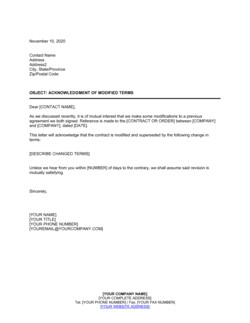
Common notification methods include email to registered users, a banner or pop-up on your website, and a revision date in the document header. The notice should identify what changed and give customers a reasonable window to review the new terms before they take effect. Including a modification clause in your original T&C that describes this process makes subsequent updates easier to enforce. Use the Acknowledgment of Modified Terms template (D846) to document formal acceptance of changes.
What's the difference between a warranty disclaimer and a limitation of liability?
A warranty disclaimer states that the business makes no promises beyond what is explicitly written — for example, no implied warranty of fitness for a particular purpose. A limitation of liability clause caps the amount of money a customer can recover if something does go wrong, typically to the value of the purchase price. Both clauses work together but serve different functions, and courts evaluate them independently.
Do I need terms and conditions if I already have a signed contract?
A signed contract governs the specific deal between named parties. Terms and conditions are designed to scale across many customers or transactions without individual negotiation. If you transact with multiple customers under standard conditions, T&Cs are more efficient and consistent than individual contracts for each. Many businesses use both: a T&C for standard terms and a separate agreement for project-specific details.
Can terms and conditions limit my liability to zero?
No. Most jurisdictions prohibit excluding liability for personal injury, death, fraud, or willful misconduct. Consumer protection laws in many countries also restrict how far businesses can limit liability toward consumers. A well-drafted limitation clause caps liability at a commercially reasonable amount rather than attempting to exclude all liability, which courts are more likely to strike down entirely.
Are terms and conditions the same as a privacy policy?
No. Terms and conditions govern the commercial relationship — what you provide, what the customer owes, and how disputes are resolved. A privacy policy discloses what personal data you collect, how you use it, and what rights users have over it. Both are legally required in most jurisdictions for businesses that collect personal data online, but they serve distinct legal purposes and are typically presented as separate documents.
Terms and Warrantie vs. related documents
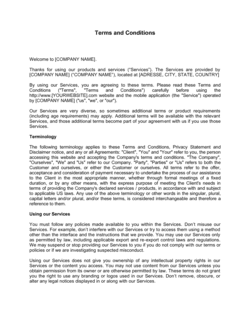
"Terms of Service" (ToS) and "Terms and Conditions" (T&C) are used interchangeably in most contexts. ToS is more common for digital platforms, apps, and SaaS products where users create accounts; T&C is more common in product sales, e-commerce, and physical service businesses. The legal function is identical — both establish the rules governing the relationship between the business and the customer or user.
A T&C governs the commercial and usage relationship — what you can do, what you owe, and what happens if something goes wrong. A Privacy Policy governs data collection, storage, and use obligations under applicable privacy law (GDPR, CCPA, etc.). Most businesses need both: the T&C on every transaction or account, the Privacy Policy wherever personal data is collected.
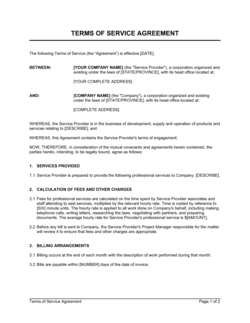
A Service Agreement is a bilateral contract negotiated between two named parties and signed by both. Terms and Conditions are typically a standard set of rules issued by one party (the business) that the other party accepts by purchasing, signing up, or using the service. T&Cs are meant to scale; service agreements are tailored to specific engagements.
Terms and conditions define the rules of the entire relationship, including payment, delivery, dispute resolution, and acceptable use. A warranty is one specific promise within that relationship — that a product will perform as described for a defined period. Warranty terms are often embedded inside a broader T&C document rather than issued as a separate contract.
Key clauses every Terms and Warrantie contains
Most terms and conditions documents — regardless of industry or format — share the same core clauses, adapted to the specific business context.
- Acceptance of terms. States that using the service, purchasing, or opening an account constitutes agreement to the terms.
- Scope of service or sale. Describes what the business agrees to provide and any limitations on that commitment.
- Payment and pricing. Covers prices, billing cycles, late fees, interest charges, and accepted payment methods.
- Intellectual property rights. Clarifies who owns content, software, or materials created or exchanged during the relationship.
- Limitation of liability. Caps the business's financial exposure to the customer for losses arising from the relationship.
- Disclaimer of warranties. Excludes implied warranties to the extent permitted by law, defining exactly what is and is not guaranteed.
- Modifications to terms. Describes how and when the business may update its terms and how it will notify users of changes.
- Governing law and dispute resolution. Names the jurisdiction whose laws apply and the mechanism for resolving disagreements.
- Termination. Specifies the conditions under which either party can end the relationship and what obligations survive.
How to write terms and conditions
Effective terms and conditions are plain enough to be understood by the customer and specific enough to be enforced in court.
1
Identify the parties and the relationship type
Name the business entity issuing the terms and define whether the relationship is a sale, a service, a license, or a credit arrangement.
2
Define the scope of what you are offering
Describe the product, service, or platform in enough detail that the customer's reasonable expectations are set in writing.
3
Set payment terms clearly
State your prices, billing schedule, accepted payment methods, late fees, and what happens when payment fails.
4
Address IP ownership and acceptable use
Clarify who owns any content or materials, what the customer may and may not do with them, and any prohibited uses.
5
Add your limitation of liability and warranty disclaimers
Cap your exposure and exclude implied warranties to the extent your jurisdiction allows — this is among the most commercially significant clauses.
6
Draft your modification and termination provisions
Explain how you will notify customers of changes and under what conditions either party can end the relationship.
7
Choose governing law and a dispute-resolution method
Name a jurisdiction and decide whether disputes will go to court, arbitration, or mediation first.
8
Make acceptance clear and documented
Present the terms at checkout, account creation, or contract signing so you can demonstrate the customer accepted them.
At a glance
- What it is
- Terms and conditions (T&C) documents are legally binding rules that govern the relationship between a business and its customers, users, or partners. They define what each party can expect, what is permitted, and what happens when something goes wrong.
- When you need one
- Any time you sell a product, offer a service, run a website, extend credit, or operate a platform, you need terms and conditions in place before the relationship begins.
Which Terms and Warrantie do I need?
The right template depends on your business model and what the terms govern — a website, a service relationship, a credit account, or a specific deal. Match your situation below.
Your situation
Recommended template
Publishing rules and disclaimers on a business website
Covers acceptable use, IP ownership, disclaimers, and liability limits for website visitors.Running an affiliate or referral partner program
Sets commission rules, tracking terms, and prohibited promotional practices for affiliates.Formalizing the general terms of a service or sale
A general-purpose T&C covering payment, delivery, returns, and warranties.Offering a customer a revolving credit or charge account
Specifies credit limits, payment schedules, interest, and default remedies.Delivering a software product or online platform to users
Governs account creation, acceptable use, data handling, and subscription terms.Distributing software at no charge under defined usage rules
Grants use rights while limiting redistribution, modification, and liability.Selling to customers on cash-on-delivery payment terms
Formally notifies the customer that payment is required on delivery before goods are released.Extending a customer's existing debt payment schedule
Documents the revised payment timeline and any new conditions agreed by both parties.Glossary
- Terms and conditions (T&C)
- A standard set of rules issued by a business that governs the relationship with every customer or user who accepts them.
- Terms of service (ToS)
- A variant name for terms and conditions used most often by digital platforms, SaaS products, and apps.
- Acceptance
- The act by which a customer or user agrees to be bound by the terms — typically by clicking a checkbox, signing, or completing a purchase.
- Clickwrap
- An acceptance mechanism requiring the user to take an active step (such as checking a box) before proceeding, providing strong evidence of agreement.
- Browsewrap
- An acceptance mechanism that relies on a notice that continued use of a website constitutes agreement; generally weaker evidence of acceptance than clickwrap.
- Limitation of liability
- A clause that caps the financial amount a party can recover from the business if a loss occurs under the agreement.
- Disclaimer of warranties
- A clause that excludes implied promises about product or service quality beyond what is explicitly stated.
- Governing law
- The jurisdiction whose laws will be applied if there is a dispute about the terms.
- Modification clause
- A provision describing how the business may update its terms and how it will notify customers of those changes.
- COD (cash on delivery)
- A payment arrangement requiring the buyer to pay in full at the time goods are physically delivered.
- Charge account
- A credit arrangement allowing a customer to purchase goods or services now and pay according to agreed billing terms later.
- Freeware license
- A set of terms permitting end users to use software at no charge while restricting modification, redistribution, or commercial use.
What is a terms and conditions document?
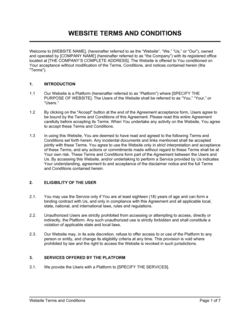
A terms and conditions document (also called a terms of service or T&C) is a legally binding agreement that defines the rules governing a commercial relationship between a business and its customers, users, or partners. It tells each party what to expect — what the business will deliver, how payment works, what rights each side holds, and what happens when something goes wrong.
Terms and conditions exist because no transaction is self-explanatory. Even a simple online sale involves questions of delivery, returns, warranty, liability, intellectual property, and data handling. A well-drafted T&C answers those questions before they become disputes. Unlike a bespoke contract negotiated between two named parties, terms and conditions are designed to scale: one set of rules that governs every customer transaction without individual negotiation.
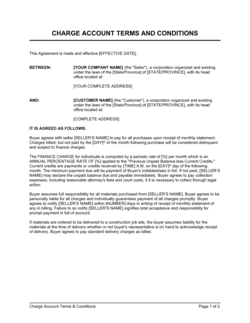
T&Cs take different forms depending on the context. Website terms and conditions govern visitor behavior and content use. Terms of service agreements govern platform accounts, subscriptions, and software access. Charge account terms govern credit relationships. Affiliate program terms govern referral and commission arrangements. Despite their different names, all these documents share the same structural logic and the same core clauses.
When you need a terms and conditions document
Any time your business interacts with customers, users, or partners in a repeatable way — online or offline — you need terms and conditions in place before the relationship begins. Disputes are far easier to resolve when the rules were agreed to upfront.
Common triggers:
- Launching a website, app, or SaaS platform where visitors or users interact with your content or services
- Opening an e-commerce store or selling products with delivery, return, or warranty obligations
- Extending credit, opening a charge account, or selling on invoice to customers
- Running an affiliate, reseller, or referral program where commissions and conduct rules apply
- Distributing software — including freeware — to end users
- Selling on cash-on-delivery terms that require formal notice to customers
- Confirming employment terms or extending existing payment arrangements in writing
- Entering a franchise relationship where the franchisor's standard terms must be documented
Skipping a terms and conditions document doesn't eliminate your legal exposure — it just means disputes get resolved without a written record of what was agreed. Courts may imply terms you didn't intend, consumer protection law may fill gaps in ways that favor the customer, and you lose the ability to point to a clear limitation of liability or warranty disclaimer. A clear, plainly written T&C is one of the lowest-cost legal safeguards a business can put in place.
Award-winning platform
- Great Place to Work 2025
- BIG Award — Product of the Year 2025
- Smartest Companies 2025
- Global 100 Excellence 2026
- Best of the Best 2025