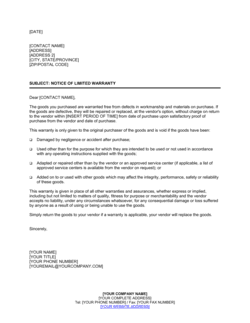
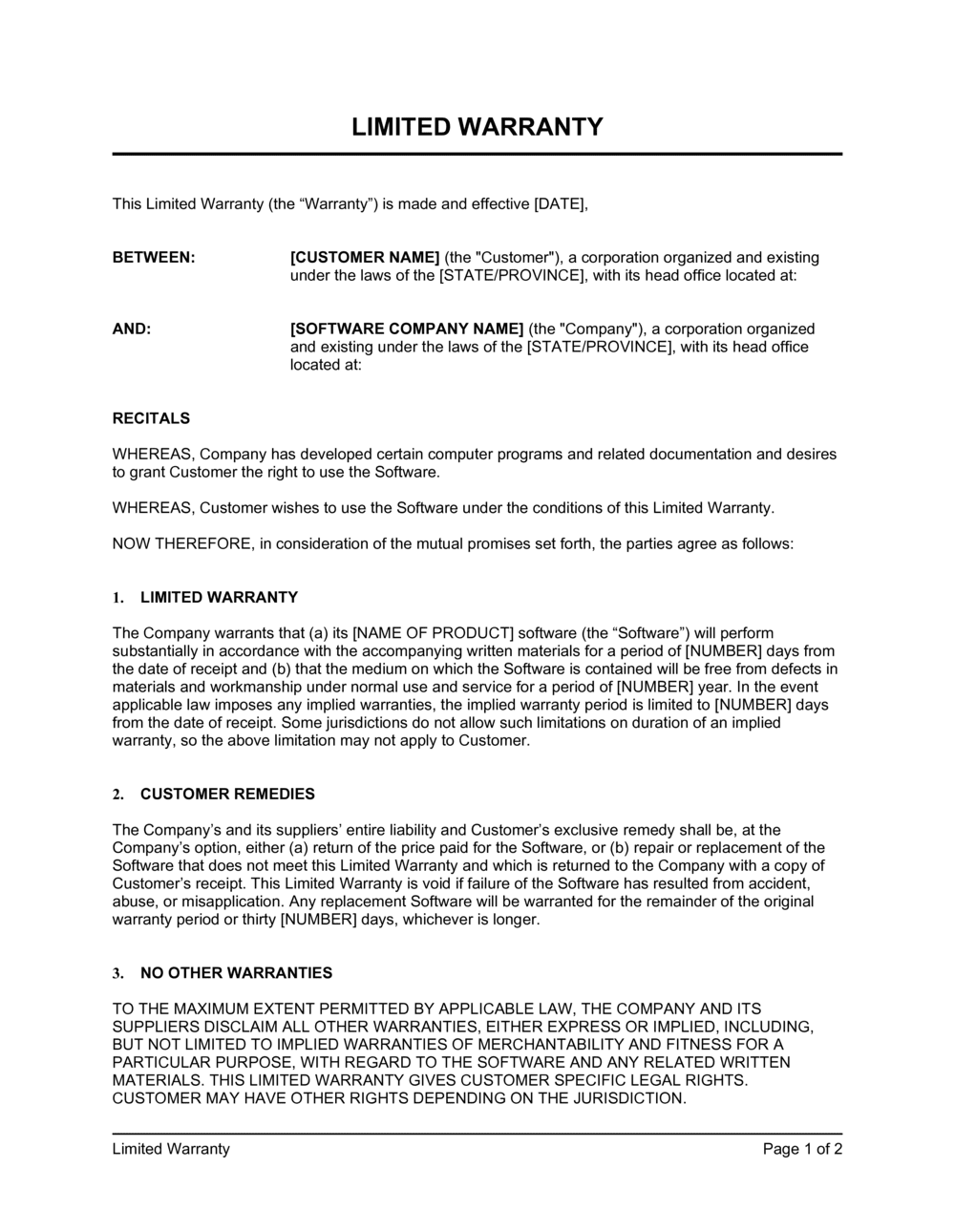
Limited Warranty Template

Free Word download • Edit online • Save & share with Drive • Export to PDF

2 pages20–30 min to fillDifficulty: StandardSignature requiredLegal review recommended
Learn more ↓
FreeLimited Warranty Template

At a glance

What it is
A Limited Warranty is a legally binding document a manufacturer or seller provides with a product to define exactly what defects are covered, for how long, and what remedy the buyer can expect. This free Word download lets you fill in product details, warranty period, exclusions, and remedy options, then export as PDF to include in packaging or post on your website.
When you need it
Use it when you sell any physical product — consumer goods, electronics, appliances, equipment, or tools — and need to set enforceable boundaries on your warranty obligations while meeting consumer-protection disclosure requirements in your target markets.
What's inside
Covered products and defects, warranty period, specific exclusions such as misuse and normal wear, the designated remedy (repair, replacement, or refund), claim procedure, limitation of liability, and governing law. In the United States, the document is structured to satisfy Magnuson-Moss Warranty Act disclosure requirements for written warranties on consumer products.

What is a Limited Warranty?

A Limited Warranty is a written legal document in which a manufacturer or seller guarantees to the original purchaser that a product is free from defects in materials and workmanship for a defined period and under specific conditions, and commits to a named remedy — repair, replacement, or refund — if a covered defect occurs. Unlike an open-ended satisfaction guarantee, a limited warranty deliberately defines its boundaries: which defects are covered, which causes of failure are excluded, how long coverage lasts, and how a buyer must make a claim. In the United States, a document that uses the term "limited warranty" triggers specific disclosure and consumer-protection obligations under the Magnuson-Moss Warranty Act, including the requirement to make warranty terms available before purchase and to refrain from fully disclaiming implied warranties on consumer goods.

Why You Need This Document

Selling a physical product without a written warranty does not eliminate your liability — it eliminates your control over it. In the absence of a written warranty, courts apply implied warranties of merchantability and fitness for a particular purpose under the Uniform Commercial Code in the US and equivalent statutes in Canada, the UK, and the EU — and consumers can pursue claims under those implied warranties for an extended statutory period. A properly drafted limited warranty converts that open-ended exposure into a defined obligation: specific defects, a fixed duration, and a named remedy. It also satisfies the Magnuson-Moss pre-sale disclosure requirement, meets major marketplace and retail-chain documentation requirements, and gives your customer-service team a clear, defensible basis for evaluating every claim. This template gives you a compliant starting point in under an hour.

Which variant fits your situation?

If your situation is…Use this template
Selling consumer products in the US requiring Magnuson-Moss complianceLimited Warranty (Consumer Goods)
Providing coverage for commercial or industrial equipment sold to businessesCommercial Equipment Warranty
Offering a warranty that covers all defects with no exclusionsFull Warranty
Warranting software or a SaaS product's uptime and functionalitySoftware License and Warranty Agreement
Covering installation or workmanship rather than the product itselfContractor Workmanship Warranty
Extending the original warranty for an additional paid periodExtended Warranty Agreement
Disclosing that no warranty is provided with the productWarranty Disclaimer (As-Is Sale)

Common mistakes to avoid

❌ Attempting to disclaim all implied warranties on a consumer product

Why it matters: The Magnuson-Moss Warranty Act prohibits a warrantor who issues a written warranty on a consumer product from fully disclaiming implied warranties. Attempting to do so renders the disclaimer void and may expose the company to FTC enforcement.

Fix: Limit implied warranties to the duration of the express warranty period rather than disclaiming them outright. Include the standard savings clause noting that some states may not allow even this limitation.

❌ Using vague exclusion language instead of specific categories

Why it matters: Courts construe ambiguous warranty exclusions narrowly against the drafting party. A clause like 'damage not caused by manufacturing defect' may be read to cover far more than the warrantor intended, turning a limited warranty into a broad return policy.

Fix: List each exclusion category explicitly — misuse, accident, unauthorized modification, incompatible accessories, environmental conditions outside rated range, and normal cosmetic wear — with a brief example for any category prone to dispute.

❌ Offering repair as the only remedy when parts availability is uncertain

Why it matters: If the product is discontinued or parts become unavailable during the warranty period, a repair-only obligation becomes impossible to fulfill — which constitutes breach of warranty and may trigger statutory remedies under Magnuson-Moss.

Fix: Draft the remedy clause to allow repair, replacement with a comparable unit (new or refurbished), or refund at the warrantor's election. This preserves flexibility without reducing the buyer's right to a remedy.

❌ Failing to make the warranty available before purchase

Why it matters: Magnuson-Moss requires that written warranties on consumer products priced above $15 be available to buyers before they make a purchase — not just inside the box. Non-compliance is an unfair or deceptive trade practice under FTC rules.

Fix: Publish the full warranty text on your website's product pages, provide it on request at the point of sale, and upload it to any third-party marketplace listing where the product is sold.

❌ Using a limitation-of-liability clause to cap personal-injury claims

Why it matters: Contractual liability caps are routinely struck down when applied to personal-injury claims arising from defective consumer products. Attempting to cap such claims may also draw regulatory attention and undermine the enforceability of the rest of the limitation clause.

Fix: Carve out personal-injury and property-damage claims from the limitation-of-liability section, or omit those categories from the cap entirely and limit it explicitly to economic loss and product replacement value.

❌ Choosing a governing-law state or country with no connection to the sale

Why it matters: Consumer-protection statutes in the EU, UK, California, and several other jurisdictions apply to consumers in those locations regardless of what the warranty document says. A governing-law clause that ignores this creates a false impression of the buyer's rights.

Fix: Choose a governing law that reflects your primary place of business, and add a savings clause confirming that consumers in other jurisdictions retain any statutory rights that cannot be contractually reduced.

The 9 key clauses, explained

Warrantor identification and covered product

In plain language: States who is making the warranty — the legal entity name and address — and precisely which product or product line is covered, including model numbers if applicable.

Sample language
[COMPANY LEGAL NAME], located at [ADDRESS] ('Warrantor'), warrants to the original purchaser that the [PRODUCT NAME / MODEL NUMBER] ('Product') is free from defects in materials and workmanship under normal use and service conditions.

Common mistake: Using a brand name instead of the registered legal entity. If the warrantor entity differs from the seller on the purchase receipt, the buyer may have difficulty directing a valid claim — and enforcement becomes ambiguous.

Warranty period

In plain language: Specifies the exact duration of coverage, when it begins (typically date of purchase or delivery), and whether any part of the product carries a different coverage period.

Sample language
This warranty is effective for [X YEAR(S)] from the date of original purchase ('Warranty Period'). Coverage for consumable components — including [BATTERIES / FILTERS / BELTS] — is limited to [X MONTHS].

Common mistake: Omitting a start trigger and relying on 'from date of manufacture.' Products sold through distribution can sit in a warehouse for months, effectively shortening consumer coverage and drawing regulatory scrutiny.

Scope of coverage

In plain language: Defines what constitutes a covered defect — specifically, defects in materials and workmanship — as distinct from performance degradation, cosmetic imperfections, or design limitations.

Sample language
This warranty covers defects in materials and workmanship that cause the Product to fail to operate according to its published specifications under normal use and service conditions.

Common mistake: Writing coverage so broadly that it captures performance issues, cosmetic wear, and customer dissatisfaction — converting a limited warranty into an open-ended returns policy and exposing the warrantor to unlimited claims.

Exclusions

In plain language: Lists the specific circumstances that void warranty coverage — misuse, accident, unauthorized modification, use of incompatible parts, failure to follow instructions, or normal wear.

Sample language
This warranty does not cover: (a) damage caused by accident, misuse, abuse, or negligence; (b) modifications not authorized in writing by Warrantor; (c) damage caused by operating the Product outside permitted environmental conditions; (d) normal wear and tear, including cosmetic degradation; (e) damage caused by service performed by anyone other than a Warrantor-authorized service provider.

Common mistake: Using catch-all language like 'any damage not caused by manufacturing defect' without listing specific exclusions. Vague exclusions are narrowly construed against the warrantor by courts and consumer-protection regulators.

Claim procedure

In plain language: Tells the buyer exactly how to make a warranty claim — who to contact, what information to provide (proof of purchase, serial number), and how to return or present the product for evaluation.

Sample language
To obtain warranty service, contact [CONTACT METHOD] within the Warranty Period with proof of purchase and a description of the defect. Warrantor will issue a Return Merchandise Authorization ('RMA') number. Products returned without an RMA will not be accepted.

Common mistake: Imposing a claim procedure so burdensome — multiple written notices, notarized proof of purchase, prepaid shipping at buyer's expense for low-value items — that it effectively denies coverage. In the US and EU, disproportionate procedures can be challenged as unconscionable or unfair.

Remedy

In plain language: States what the warrantor will do to fix a covered defect — repair, replacement with a new or refurbished unit, or refund — and which option the warrantor controls.

Sample language
At Warrantor's sole discretion, Warrantor will repair the defective Product, replace it with a new or refurbished unit of equal or greater functionality, or refund the original purchase price. Warrantor's election of remedy is final.

Common mistake: Promising only repair without preserving the right to substitute replacement or refund. If the product is discontinued or parts are unavailable, a repair-only remedy becomes impossible to fulfill — exposing the warrantor to breach-of-warranty claims.

Disclaimer of implied warranties

In plain language: Limits or disclaims implied warranties — such as the implied warranty of merchantability and fitness for a particular purpose — to the extent permitted by applicable law.

Sample language
TO THE EXTENT PERMITTED BY APPLICABLE LAW, THIS LIMITED WARRANTY IS THE SOLE AND EXCLUSIVE WARRANTY. ALL IMPLIED WARRANTIES, INCLUDING THE IMPLIED WARRANTIES OF MERCHANTABILITY AND FITNESS FOR A PARTICULAR PURPOSE, ARE LIMITED TO THE DURATION OF THIS WARRANTY.

Common mistake: Attempting to disclaim implied warranties entirely in a consumer-product context. The Magnuson-Moss Act bars total disclaimer of implied warranties in a written consumer warranty — the warrantor can limit their duration but cannot eliminate them.

Limitation of liability and exclusion of consequential damages

In plain language: Caps the warrantor's total liability at the product's purchase price and excludes indirect, incidental, and consequential damages such as lost profits, data loss, or personal injury claims not covered by other law.

Sample language
IN NO EVENT SHALL WARRANTOR BE LIABLE FOR ANY INCIDENTAL, SPECIAL, OR CONSEQUENTIAL DAMAGES, INCLUDING LOST PROFITS OR DATA, ARISING FROM THE USE OR INABILITY TO USE THE PRODUCT. WARRANTOR'S TOTAL LIABILITY SHALL NOT EXCEED THE ORIGINAL PURCHASE PRICE PAID FOR THE PRODUCT.

Common mistake: Relying on a consequential-damages exclusion to cover personal-injury claims. Courts in most jurisdictions will not enforce a limitation-of-liability clause against a personal-injury claim arising from a defective consumer product.

Governing law and dispute resolution

In plain language: Specifies which jurisdiction's law governs the warranty and how disputes are resolved — arbitration, small-claims court, or litigation — including any class-action waiver.

Sample language
This warranty is governed by the laws of [STATE / PROVINCE / COUNTRY], without regard to conflict-of-laws principles. Any dispute arising under this warranty shall be resolved by binding arbitration in [CITY] under [AAA / JAMS] rules, except that either party may bring a claim in small-claims court.

Common mistake: Choosing a governing-law jurisdiction with no connection to where the product is sold. Several US states and EU member states apply local consumer-protection law regardless of contract choice, rendering the clause ineffective and potentially misleading to consumers.

How to fill it out

  1. 1

    Identify the warrantor's legal entity and address

    Enter the full registered legal name and physical address of the entity making the warranty — not a brand name or DBA. This is the party consumers will contact and potentially sue if a claim is denied.

    💡 Confirm the entity name matches exactly what appears on your product's purchase receipt and corporate registration to avoid mismatched-party defenses in a dispute.

  2. 2

    Define the covered product precisely

    List the product name, model number, and SKU if applicable. If multiple models share the same warranty, list them all or reference a product family name that is unambiguous.

    💡 Avoid catch-all language like 'all products sold by [COMPANY]' — this creates unintended coverage for products you intend to exclude or warrant differently.

  3. 3

    Set the warranty period and its start trigger

    Enter the duration (e.g., one year, two years) and specify whether coverage begins on the date of purchase, date of delivery, or date of activation. For products with consumable components, add a shorter sub-period for those parts.

    💡 Using 'date of original purchase as shown on proof of purchase' is the cleanest start trigger — it puts the burden on the consumer to retain the receipt and creates a verifiable date.

  4. 4

    Draft the exclusions list with specific examples

    List every category of damage or failure you intend to exclude: misuse, accidental damage, unauthorized modification, incompatible accessories, use outside rated specifications, and normal wear and tear. Be as concrete as possible.

    💡 Review your actual warranty claims history or customer-service logs for the most common denial reasons — build your exclusions list from real-world patterns, not generic legal boilerplate.

  5. 5

    State the available remedy and who selects it

    Choose from repair, replacement, or refund — or allow all three with the warrantor electing. Make clear whether replacement units may be refurbished and whether shipping costs are covered.

    💡 Preserve flexibility by allowing all three remedies at your election. A repair-only warranty becomes impossible to fulfill when parts are discontinued.

  6. 6

    Describe the claim procedure step by step

    Explain how a buyer initiates a claim — phone, email, or web portal — what documentation they must provide, and how the product is returned or inspected. Include estimated turnaround times if your process supports them.

    💡 Publish the claim procedure on your website in addition to including it in the document. Magnuson-Moss requires that the procedure be available to buyers before purchase for products over $15.

  7. 7

    Review limitation-of-liability and implied-warranty language for jurisdiction

    Confirm that the disclaimer and liability cap comply with the law of every jurisdiction where you sell. Some US states (e.g., Massachusetts, Mississippi) do not permit limiting implied-warranty duration; the EU and UK prohibit disclaiming statutory consumer rights entirely.

    💡 Add a savings clause: 'Some states/countries do not allow limitations on implied warranties or exclusion of consequential damages, so the above limitations may not apply to you.' This is required under Magnuson-Moss for consumer-product warranties.

  8. 8

    Execute and distribute the warranty

    Have an authorized officer sign the warranty document, attach it to product packaging or ship it in the box, and publish the full text on your website before the product goes on sale.

    💡 For products sold on third-party marketplaces (Amazon, Walmart Marketplace), upload the warranty document to the product listing — marketplace policies and Magnuson-Moss both require pre-sale availability.

Frequently asked questions

What is a limited warranty?

A limited warranty is a written guarantee from a manufacturer or seller that a product is free from defects in materials and workmanship for a defined period and under specific conditions. Unlike a full warranty, it restricts coverage to named defects, excludes certain causes of failure such as misuse or normal wear, and limits the available remedy to repair, replacement, or refund at the warrantor's election. In the US, the term 'limited warranty' has a specific legal meaning under the Magnuson-Moss Warranty Act.

What is the difference between a limited warranty and a full warranty?

Under the Magnuson-Moss Warranty Act, a full warranty must remedy any defect or malfunction within a reasonable time and at no charge to the consumer, and cannot limit the duration of implied warranties. A limited warranty may restrict coverage to specific defects, exclude certain causes of failure, limit the remedy, and cap implied-warranty duration to the express warranty period. Most manufacturers issue limited warranties because full warranties create broader and harder-to-limit obligations.

Does a limited warranty need to comply with the Magnuson-Moss Warranty Act?

Yes, if you sell consumer products in the US for more than $15 and provide a written warranty, Magnuson-Moss applies. The Act requires you to label the warranty as 'limited' or 'full,' disclose specific terms in plain language, make the warranty available before purchase, and prohibits you from fully disclaiming implied warranties in a written consumer warranty. Non-compliance can be enforced by the FTC or through private consumer lawsuits.

Can a limited warranty disclaim implied warranties entirely?

No — not in a written consumer-product warranty subject to Magnuson-Moss. The Act prohibits full disclaimer of implied warranties when a written warranty is issued for a consumer product. You may limit the duration of implied warranties to the express warranty period, but you cannot eliminate them. Some US states — including Massachusetts and Mississippi — do not permit even this limitation, so a savings clause is essential.

What exclusions are typically enforceable in a limited warranty?

Courts and regulators generally enforce exclusions for damage caused by misuse, accident, unauthorized modification, use of incompatible parts or accessories, failure to follow the owner's manual, use outside the product's rated environmental conditions, and normal cosmetic wear and tear. Exclusions must be stated specifically — vague catch-all language is narrowly construed against the warrantor. Exclusions that effectively deny all coverage for a commonly occurring failure mode are vulnerable to challenge as unconscionable.

What remedies must a limited warranty provide?

A limited warranty must provide at least one remedy for a covered defect — repair, replacement, or refund. It does not need to offer all three, but offering only repair creates risk if parts are unavailable. Magnuson-Moss requires that remedy be provided within a reasonable time and without charge to the consumer for defects that are covered. 'Without charge' means the warrantor covers parts, labor, and return shipping costs for the covered repair.

Is a signature required on a limited warranty?

An authorized representative of the warrantor should sign the warranty document to confirm its authenticity and bind the issuing entity. While a printed warranty included in product packaging is generally enforceable without the consumer's counter-signature, having an officer execute the master document and retaining a signed copy creates a clear record for regulatory purposes and internal governance.

How does a limited warranty interact with consumer-protection laws in the EU and UK?

In the EU, the Sale of Goods Directive provides consumers a minimum two-year statutory guarantee against non-conforming products, which exists independently of any written warranty. In the UK, the Consumer Rights Act 2015 provides similar statutory protections. A written limited warranty cannot reduce these statutory rights — it supplements them. A warranty that appears to limit or replace statutory rights is misleading and unenforceable in those jurisdictions.

Do I need a lawyer to create a limited warranty?

For standard consumer products sold domestically, a carefully completed template is usually sufficient. Engage a lawyer when you sell in multiple jurisdictions with different statutory floors, when the product carries significant personal-injury risk, when you are operating in a regulated product category (medical devices, children's toys, automotive parts), or when the warranty will accompany a product sold through major retail chains that impose their own supplier warranty requirements.

How this compares to alternatives

vs Full Warranty

A full warranty under Magnuson-Moss must remedy any defect within a reasonable time and at no charge, and cannot limit the duration of implied warranties. A limited warranty restricts coverage to named defects, excludes specific causes of failure, and caps the implied-warranty period. Most manufacturers choose a limited warranty to control exposure.

vs Extended Warranty Agreement

An extended warranty is a paid service contract that continues or expands coverage after the original warranty expires. A limited warranty is the initial, typically free, coverage provided at time of sale. Extended warranties require separate consideration and are regulated as service contracts in most US states.

vs Product Liability Waiver

A product liability waiver attempts to disclaim all liability for product-related harm. A limited warranty defines the scope of coverage for defects while limiting remedies. Courts routinely refuse to enforce product liability waivers for personal injury in consumer contexts, whereas a properly drafted limited warranty's remedy limitations are generally upheld for economic loss.

vs As-Is Bill of Sale

An as-is sale expressly disclaims all warranties — the buyer accepts the product with no recourse for defects. A limited warranty provides at least some defined coverage. As-is disclaimers are more defensible in commercial-to-commercial transactions; consumer-protection laws in most jurisdictions restrict them in consumer sales.

Industry-specific considerations

Consumer Electronics

Battery and consumable sub-periods, firmware update exclusions, and water-resistance rating disclaimers are standard additions to the base warranty.

Manufacturing

Industrial and commercial equipment warranties typically run 12–36 months, cover parts and labor separately, and exclude damage from inadequate maintenance or operation outside rated load specifications.

Retail / E-commerce

Online sellers must publish the warranty text on the product listing page before purchase to satisfy Magnuson-Moss pre-sale availability requirements and major marketplace policies.

Healthcare / MedTech

Medical device warranties must align with FDA labeling requirements; claims about device performance made in the warranty can be treated as intended-use statements and must be clinically supportable.

Jurisdictional notes

United States

The Magnuson-Moss Warranty Act (15 U.S.C. §§ 2301–2312) governs written warranties on consumer products priced above $15. Warranties must be labeled 'limited' or 'full,' made available before purchase, and written in plain language. Implied warranties cannot be fully disclaimed in a written consumer warranty — only their duration can be limited. Some states, including Massachusetts and Mississippi, prohibit even that limitation. The FTC's Warranty Disclosure Rule requires six specific disclosures on every written warranty.

Canada

Provincial sale-of-goods legislation (e.g., Ontario's Sale of Goods Act, Quebec's Civil Code) implies statutory warranties of merchantability and fitness that cannot be excluded in consumer transactions. Quebec's Consumer Protection Act provides particularly strong protections, including a mandatory 1-year implied warranty on goods and a prohibition on any clause that reduces statutory rights. Warranty documents intended for Quebec consumers must be in French.

United Kingdom

The Consumer Rights Act 2015 provides consumers a 30-day short-term right to reject faulty goods and a 6-year statutory limitation period (5 years in Scotland) for claims against sellers. A written limited warranty supplements — but cannot reduce — these statutory rights. The Unfair Contract Terms Act 1977 renders unenforceable any term that attempts to exclude liability for death or personal injury caused by negligence, or that unreasonably excludes consumer remedies.

European Union

The EU Sale of Goods Directive (2019/771) requires sellers to provide a minimum 2-year statutory guarantee of conformity on all goods sold to consumers, extendable to 3 years in some member states. A commercial warranty (Herstellergarantie) is separate from and additional to this statutory right. Any warranty that appears to replace or limit statutory rights is void and misleading under EU consumer law. GDPR applies to personal data collected through the warranty claim process, requiring a compliant privacy notice.

Template vs lawyer — what fits your deal?

PathBest forCostTime
Use the templateSmall businesses and e-commerce sellers offering standard consumer or commercial goods in a single domestic marketFree30–60 minutes
Template + legal reviewSellers distributing across multiple US states or into Canada, the EU, or the UK where statutory floors differ$300–$8002–5 days
Custom draftedRegulated product categories (medical devices, children's products, automotive), major retail-chain supplier requirements, or products with significant personal-injury exposure$1,000–$4,000+1–3 weeks

Glossary

Limited Warranty
A written warranty that covers defects under specific conditions and for a defined period, explicitly excluding certain causes of failure.
Full Warranty
Under the Magnuson-Moss Act, a warranty that must remedy any defect or malfunction within a reasonable time and without charge, with no limitation on implied warranties.
Magnuson-Moss Warranty Act
A US federal law governing written warranties on consumer products costing more than $15, requiring specific disclosures and regulating the scope of warranty disclaimers.
Implied Warranty of Merchantability
An automatic legal guarantee — imposed by the UCC in the US and equivalent statutes elsewhere — that a product will perform its ordinary purpose.
Exclusion Clause
A provision that removes specific causes of failure from warranty coverage, such as misuse, accidental damage, unauthorized modification, or normal wear and tear.
Remedy
The specific relief the warrantor agrees to provide when a covered defect occurs — typically repair, replacement with a comparable unit, or a full or partial refund.
Warranty Period
The defined duration during which the warrantor's obligations are active, typically running from the date of purchase or date of delivery.
Consequential Damages
Losses beyond the product's value that flow indirectly from a defect — such as lost profits or data loss — which limited warranties typically disclaim.
Privity
The legal relationship between contracting parties; in a warranty context, it determines whether an end user who bought through a retailer can enforce the manufacturer's warranty.
As-Is Sale
A transaction where the seller expressly disclaims all warranties, meaning the buyer accepts the product in its current condition with no recourse for defects.
Statutory Rights
Consumer rights granted directly by law — such as UK consumer guarantees or EU conformity requirements — that a warranty cannot reduce below the statutory floor.

Part of your Business Operating System

This document is one of 3,000+ business & legal templates included in Business in a Box.

  • Fill-in-the-blanks — ready in minutes
  • 100% customizable Word document
  • Compatible with all office suites
  • Export to PDF and share electronically

Create your document in 3 simple steps.

From template to signed document — all inside one Business Operating System.
1
Download or open template

Access over 3,000+ business and legal templates for any business task, project or initiative.

2
Edit and fill in the blanks with AI

Customize your ready-made business document template and save it in the cloud.

3
Save, Share, Send, Sign

Share your files and folders with your team. Create a space of seamless collaboration.

Save time, save money, and create top-quality documents.

★★★★★

"Fantastic value! I'm not sure how I'd do without it. It's worth its weight in gold and paid back for itself many times."

Managing Director · Mall Farm
Robert Whalley
Managing Director, Mall Farm Proprietary Limited
★★★★★

"I have been using Business in a Box for years. It has been the most useful source of templates I have encountered. I recommend it to anyone."

Business Owner · 4+ years
Dr Michael John Freestone
Business Owner
★★★★★

"It has been a life saver so many times I have lost count. Business in a Box has saved me so much time and as you know, time is money."

Owner · Upstate Web
David G. Moore Jr.
Owner, Upstate Web

Run your business with a system — not scattered tools

Stop downloading documents. Start operating with clarity. Business in a Box gives you the Business Operating System used by over 250,000 companies worldwide to structure, run, and grow their business.

Start free · No credit card required