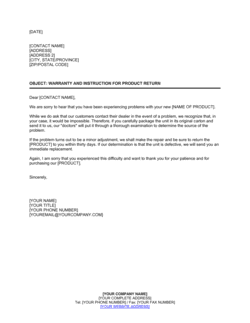
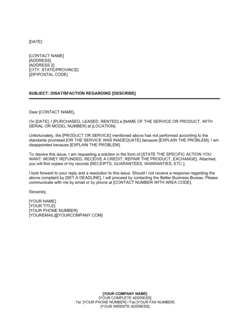
We've Followed the Warranty to the Letter - and Beyond Template

Free Word download β€’ Edit online β€’ Save & share with Drive β€’ Export to PDF

1 pageβ€’15–20 min to fillβ€’Difficulty: Standard
Learn more ↓
FreeWe've Followed the Warranty to the Letter - and Beyond Template

At a glance

What it is
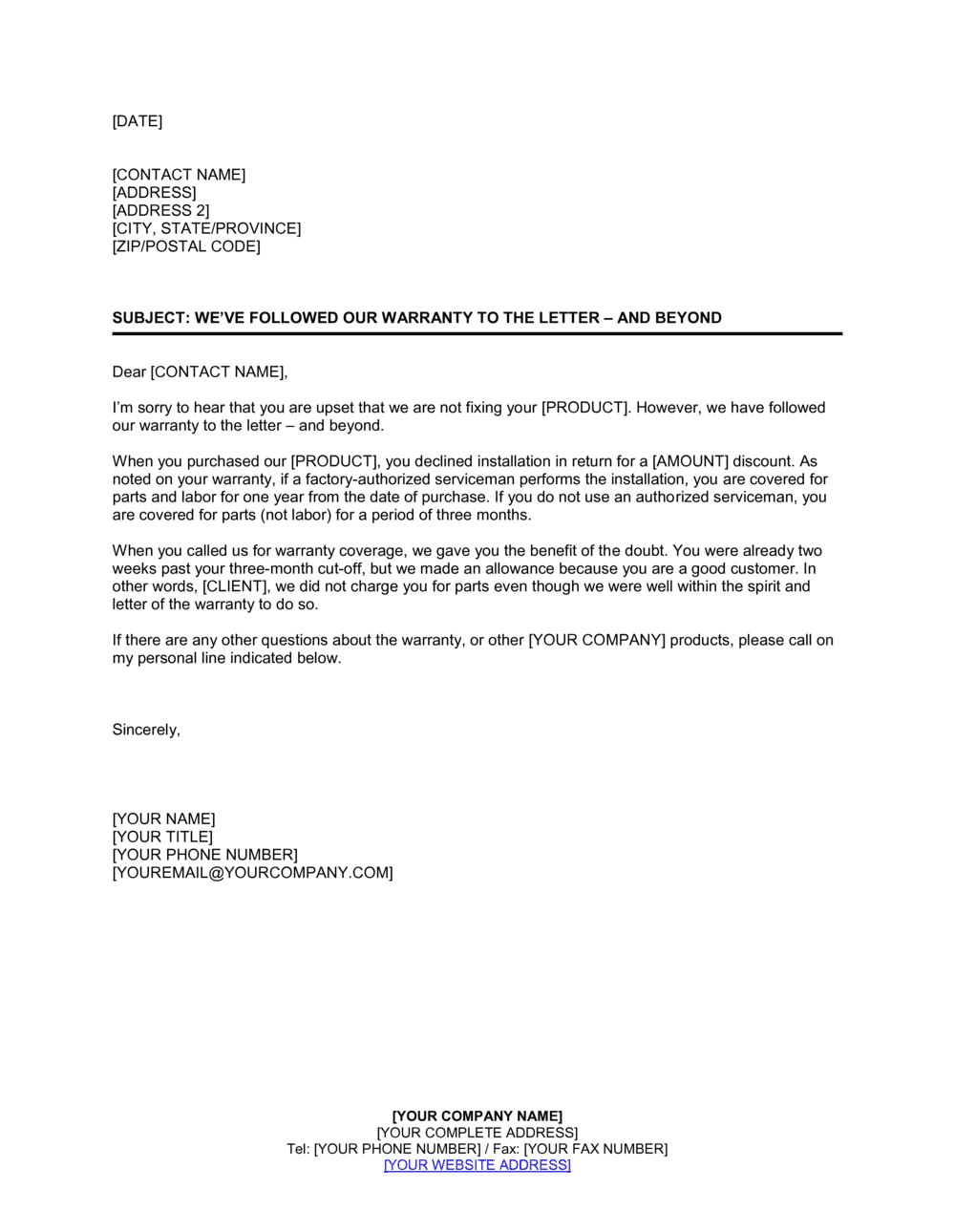
A warranty compliance letter is a formal written response a seller or manufacturer sends to a buyer or claimant to document that all warranty obligations have been met β€” and in many cases exceeded. This free Word download gives you a structured, professional starting point you can edit online and export as PDF in minutes.
When you need it
Use it when a customer or counterparty disputes whether warranty terms were honored, or when you need a written record confirming your compliance before a situation escalates to a formal complaint, chargeback, or legal claim.
What's inside
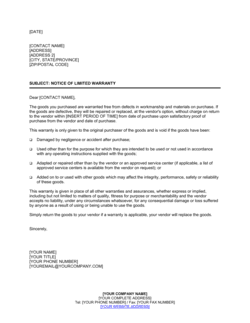
A dated reference header, a clear statement of the warranty terms in dispute, a factual chronology of every action taken to fulfill those terms, evidence of any goodwill steps taken beyond what was contractually required, and a firm but professional closing that states your position.

What is a "We've Followed the Warranty to the Letter and Beyond" Letter?

A warranty compliance letter is a formal written communication a seller or manufacturer sends to a buyer documenting that every obligation under an applicable warranty has been fulfilled β€” and that the seller voluntarily went further than those terms required. It presents a factual, date-ordered account of every service event, replacement, repair, or follow-up communication undertaken in response to the buyer's claim, and states clearly that the seller's warranty obligations have been discharged. This free Word download gives you a structured, professional template you can complete with your specific facts and send within the same business day.

Why You Need This Document

Without a written record of your warranty compliance, a dissatisfied buyer's narrative becomes the only version of events on file. That gap is where chargebacks, consumer protection complaints, and small claims actions originate. A factual compliance letter, sent promptly and backed by attached service records, puts your position in writing before any third party becomes involved β€” and gives payment processors, mediators, and adjudicators something concrete to evaluate beyond the buyer's assertion alone. It also signals to the buyer that the company tracks its obligations carefully, which resolves the majority of disputes at the letter stage rather than the legal stage. This template ensures you cover every component of a credible written position β€” reference header, warranty terms, dated chronology, goodwill documentation, and a clear closing statement β€” so nothing is left out when it matters most.

Which variant fits your situation?

If your situation is…Use this template
Responding to a buyer who claims a product defect was never repairedWe've Followed the Warranty to the Letter and Beyond
Formally denying a warranty claim that falls outside coverage termsWarranty Claim Denial Letter
Notifying a customer that a warranty period has expiredWarranty Expiration Notice Letter
Offering a goodwill repair or replacement after warranty expiryGoodwill Gesture Letter
Responding to a formal complaint filed with a consumer protection bodyResponse to Consumer Complaint Letter
Issuing a written warranty at the point of saleProduct Warranty Certificate
Confirming a product return and replacement under warrantyProduct Return and Replacement Confirmation Letter

Common mistakes to avoid

❌ Opening with language that implies fault

Why it matters: Phrases like 'we apologize for the inconvenience caused by our product' can be used as admissions in a subsequent dispute or chargeback process.

Fix: Acknowledge the buyer's concern without characterizing it as a product failure: 'We write in response to your warranty concern dated [DATE].'

❌ Vague chronology with no specific dates or outcomes

Why it matters: A narrative that says 'we serviced your product on several occasions' carries no evidentiary weight and will not stop a determined dispute.

Fix: List every service event with the exact date, the action taken, and the name or ID of the technician or confirmation record.

❌ Not stating that the warranty obligation is fully discharged

Why it matters: Leaving the letter open-ended signals to the recipient that further pressure may yield additional concessions, prolonging the dispute.

Fix: Include one clear sentence: '[COMPANY NAME] has fulfilled all obligations under the applicable warranty as of [DATE].'

❌ Sending to the wrong contact within the buyer's organization

Why it matters: A letter sent to the original purchaser instead of the accounts payable or legal department may never reach the person empowered to close the dispute.

Fix: Confirm the correct recipient β€” the person who filed the claim or their designated representative β€” before sending, and copy any relevant escalation contact.

The 8 key clauses, explained

Reference header

In plain language: Identifies the date, the recipient's name and address, and a subject line that ties the letter to the specific warranty claim or order number.

Sample language
[DATE] | [RECIPIENT NAME] | [ADDRESS] | Re: Warranty Claim β€” Order #[ORDER NUMBER] / Product: [PRODUCT NAME]

Common mistake: Omitting the order or claim reference number. Without it, the letter cannot be matched to the transaction record, slowing any internal or external review.

Opening acknowledgment

In plain language: Opens by confirming receipt of the recipient's warranty concern and stating the purpose of the letter β€” to document the seller's compliance.

Sample language
We are writing in response to your warranty concern dated [DATE] regarding [PRODUCT NAME]. This letter documents the actions [COMPANY NAME] has taken to fulfill our warranty obligations in full.

Common mistake: Opening with an apology that implies liability. Acknowledge the concern without admitting fault at the outset.

Statement of warranty terms

In plain language: Quotes or paraphrases the specific warranty provision that applies, including duration, coverage scope, and any conditions the buyer was required to meet.

Sample language
The [PRODUCT NAME] is covered by a [DURATION] limited warranty against defects in materials and workmanship, subject to the conditions set out in the warranty documentation provided at purchase on [PURCHASE DATE].

Common mistake: Referencing the warranty in vague terms without specifying the coverage period or conditions. Vague references invite the recipient to dispute what was actually promised.

Chronology of compliance actions

In plain language: A factual, date-ordered account of every step taken to address the claim β€” service calls, replacement shipments, technician visits, and communications.

Sample language
On [DATE], we received your service request and dispatched a technician within [X] business days. On [DATE], [REPAIR/REPLACEMENT] was completed and confirmed by [TECHNICIAN NAME / SERVICE RECORD #]. On [DATE], we followed up to confirm satisfactory resolution.

Common mistake: Narrating the chronology in vague language without specific dates and outcomes. Each action must be tied to a date and a documented result to be credible.

Evidence of going beyond warranty terms

In plain language: Documents any goodwill steps taken that exceeded the written warranty β€” extended repair windows, complimentary replacements, or additional support provided at no charge.

Sample language
In addition to the foregoing, and as a gesture of goodwill, [COMPANY NAME] provided [DESCRIPTION OF EXTRA ACTION] at no cost to you on [DATE], which is beyond the scope of the warranty terms.

Common mistake: Skipping this section when goodwill actions were taken. Undocumented concessions can later be characterized as admissions that the warranty was insufficient.

Statement of current position

In plain language: Clearly states that the seller has fulfilled all contractual warranty obligations and that no further action is owed under the warranty terms.

Sample language
Based on the foregoing, [COMPANY NAME] has fulfilled all obligations under the warranty applicable to your purchase. We consider this warranty claim to be resolved in full as of [DATE].

Common mistake: Leaving the position ambiguous by not explicitly stating that the obligation has been discharged. Ambiguity invites continued escalation.

Invitation to provide further documentation

In plain language: Offers the recipient an opportunity to submit any additional evidence they believe has not been considered, while reaffirming the seller's position.

Sample language
If you believe there is relevant information or documentation that has not been considered in our review, please provide it in writing to [CONTACT NAME / EMAIL] within [X] business days and we will assess it promptly.

Common mistake: Omitting this paragraph entirely. Closing the door completely can appear dismissive and escalate a resolvable dispute into a formal complaint.

Closing and contact information

In plain language: Closes professionally, provides a named contact for further correspondence, and signs off with the sender's title and company name.

Sample language
We value your business and remain committed to the quality of our products. Should you have further questions, please contact [NAME] at [EMAIL / PHONE]. Sincerely, [NAME], [TITLE], [COMPANY NAME].

Common mistake: Providing a generic customer service inbox instead of a named contact. A named contact signals accountability and discourages further escalation.

How to fill it out

  1. 1

    Gather the full claim file before drafting

    Collect the original purchase record, the warranty document, all prior communications with the buyer, service records, and any shipping or technician confirmations. The letter is only as strong as the documentation behind it.

    πŸ’‘ Organize the records in date order before you start writing β€” the chronology section drafts itself once the timeline is clear.

  2. 2

    Complete the reference header with the exact claim or order number

    Enter today's date, the recipient's full name and address, and a subject line that includes the specific order or claim reference number. This ties the letter to the transaction file.

    πŸ’‘ If the buyer has assigned their own claim number, include both yours and theirs in the subject line.

  3. 3

    State the applicable warranty terms precisely

    Quote or closely paraphrase the warranty coverage period, the specific defect categories covered, and any buyer conditions (registration, proper use, authorized repair) that were required.

    πŸ’‘ Attach a copy of the warranty document as an exhibit and reference it in this section: 'as set out in the warranty enclosed as Exhibit A.'

  4. 4

    Write the compliance chronology with specific dates

    List every action taken in date order β€” service requests received, technician dispatched, repairs completed, replacements shipped, follow-up calls made. Tie each item to a verifiable record.

    πŸ’‘ Use MM/DD/YYYY format consistently throughout the chronology so dates cannot be misread.

  5. 5

    Document any goodwill steps taken beyond the warranty

    If you provided a free replacement, extended the service window, or made any concession not required by the warranty, document it here with the date and a description.

    πŸ’‘ Frame goodwill steps as voluntary and relationship-based β€” not as an acknowledgment that the original response was inadequate.

  6. 6

    State your position clearly and close the letter professionally

    Write a direct sentence confirming that all warranty obligations have been fulfilled as of a specific date. Invite the recipient to submit additional documentation if they believe something was missed, then close with a named contact.

    πŸ’‘ Have someone not involved in the dispute read the final draft β€” if any sentence could be read as an admission of fault, revise it before sending.

Frequently asked questions

What is a warranty compliance letter?

A warranty compliance letter is a formal written response from a seller or manufacturer to a buyer documenting that every obligation under an applicable warranty has been met β€” and in many cases voluntarily exceeded. It creates a written record of the seller's position, the actions taken, and the dates those actions occurred, which can be used to close a dispute or defend against a chargeback or complaint.

When should I send this type of letter?

Send it as soon as a buyer signals dissatisfaction with how a warranty claim was handled, or whenever a dispute risks escalating to a formal complaint, chargeback, or legal claim. Sending it proactively β€” before the situation escalates β€” is far more effective than waiting until a third party (such as a card issuer or consumer protection body) becomes involved.

Should I include supporting documents with the letter?

Yes, whenever possible. Attach copies of the warranty document, service records, shipping confirmations, and any prior written communications referenced in the chronology. Label each as an exhibit and reference it by exhibit letter in the body of the letter. Documents carry more weight than assertions alone.

Can I use this letter to respond to a credit card chargeback?

Yes. Card networks require merchants to submit a written rebuttal with supporting documentation when disputing a chargeback. A warranty compliance letter that includes a dated chronology of service events and copies of service records is directly useful as part of a chargeback rebuttal package. Follow your payment processor's specific submission format requirements in addition to sending this letter.

What tone should the letter use?

Professional, factual, and firm β€” not defensive or apologetic. The goal is to document a position clearly, not to win an argument in the letter itself. Avoid language that implies fault or liability, avoid condescending phrasing, and close with a genuine offer to review any additional documentation the recipient believes is relevant.

Does the letter need to be signed?

A handwritten signature is not legally required for this type of correspondence in most jurisdictions, but including a named sender with a title and direct contact information adds credibility and accountability. For high-stakes disputes, a physical signature from a manager or director signals the company's engagement with the matter.

What if the buyer responds and escalates further?

Keep a copy of every letter sent and received, including delivery confirmation. If the buyer files a formal complaint with a consumer protection body or initiates legal action, your documented compliance record β€” including this letter β€” becomes the foundation of your defense. At that point, consult a lawyer to determine whether additional steps are warranted.

How this compares to alternatives

vs Warranty Claim Denial Letter

A warranty claim denial letter is used when the claim falls outside coverage β€” wrong product, expired period, or excluded cause of failure. A compliance letter is used when the claim was valid and the seller fulfilled it. Use the denial letter to close claims you are not obligated to honor; use the compliance letter to document claims you did honor.

vs Customer Complaint Response Letter

A customer complaint response letter addresses general dissatisfaction with a product or service and typically offers a remedy. A warranty compliance letter specifically documents that contractual warranty obligations were met and may go further than the complaint alone. When the complaint is about warranty service specifically, this template is more precise.

vs Goodwill Gesture Letter

A goodwill gesture letter offers a voluntary concession β€” discount, free replacement, or extended coverage β€” where no obligation exists. A warranty compliance letter documents that obligations were met; it may reference goodwill steps as supporting context, but its primary function is to establish compliance, not to offer remedies.

vs Demand Letter

A demand letter is sent by the aggrieved party to the non-compliant party, asserting a breach and demanding specific action. A warranty compliance letter runs in the opposite direction β€” it is the seller's written assertion that no breach occurred. If a buyer sends you a demand letter, this compliance letter is the structured form of your written response.

Industry-specific considerations

Consumer Electronics

High claim volumes and short warranty windows make a standardized compliance letter essential for efficiently closing disputes before they become chargebacks.

Construction and Trades

Workmanship warranties on renovations and builds are frequently disputed; a dated compliance letter with signed inspection records is the primary defense against holdback disputes.

Manufacturing

B2B warranty claims on equipment can involve significant downtime costs; a precise chronology of service events protects the manufacturer from consequential-damages claims.

Retail and E-commerce

Online retailers face elevated chargeback risk when customers claim warranty obligations were not met; a documented compliance letter is a core component of the chargeback rebuttal package.

Template vs pro β€” what fits your needs?

PathBest forCostTime
Use the templateSmall business owners and customer service teams handling standard warranty disputes with documented service recordsFree15–30 minutes
Template + professional reviewDisputes involving amounts over $5,000, formal complaints to consumer protection bodies, or buyers represented by legal counsel$150–$400 for a one-hour lawyer review1–2 business days
Custom draftedHigh-value B2B warranty disputes, litigation-track matters, or industries with specific regulatory complaint-handling requirements$500–$2,000+3–7 business days

Glossary

Express Warranty
A written or oral promise made by a seller about the quality, condition, or performance of a product, creating an enforceable obligation.
Implied Warranty of Merchantability
An automatic legal guarantee in most jurisdictions that a product is fit for its ordinary intended use, even without a written warranty.
Warranty Period
The defined window of time during which the seller is obligated to repair, replace, or refund a defective product at no additional cost.
Warranty Claim
A formal request by a buyer for the seller to fulfill its warranty obligations β€” typically submitted in writing with proof of purchase and a description of the defect.
Goodwill Gesture
A voluntary concession β€” such as a free repair, extended coverage, or partial refund β€” offered by a seller beyond what the warranty strictly requires, to preserve the customer relationship.
Dispute Chronology
A factual, date-ordered record of every communication, service event, and action taken between the parties in connection with a warranty claim.
Without Prejudice
A designation on correspondence indicating that the content cannot be used as an admission of liability in subsequent legal proceedings.
Chargeback
A forced reversal of a payment initiated by a card-issuing bank on the buyer's behalf, commonly triggered when a customer claims a product or service was not delivered as described.
Consequential Damages
Losses suffered by a buyer beyond the defective product itself β€” such as lost profits or downtime β€” which standard warranties typically exclude from coverage.
Proof of Service
Documentation confirming that a warranty repair, replacement, or other remedial action was actually carried out, such as a service record, technician sign-off, or delivery confirmation.

Part of your Business Operating System

This document is one of 3,000+ business & legal templates included in Business in a Box.

  • Fill-in-the-blanks β€” ready in minutes
  • 100% customizable Word document
  • Compatible with all office suites
  • Export to PDF and share electronically

Create your document in 3 simple steps.

From template to signed document β€” all inside one Business Operating System.
1
Download or open template

Access over 3,000+ business and legal templates for any business task, project or initiative.

2
Edit and fill in the blanks with AI

Customize your ready-made business document template and save it in the cloud.

3
Save, Share, Send, Sign

Share your files and folders with your team. Create a space of seamless collaboration.

Save time, save money, and create top-quality documents.

β˜…β˜…β˜…β˜…β˜…

"Fantastic value! I'm not sure how I'd do without it. It's worth its weight in gold and paid back for itself many times."

Managing Director Β· Mall Farm
Robert Whalley
Managing Director, Mall Farm Proprietary Limited
β˜…β˜…β˜…β˜…β˜…

"I have been using Business in a Box for years. It has been the most useful source of templates I have encountered. I recommend it to anyone."

Business Owner Β· 4+ years
Dr Michael John Freestone
Business Owner
β˜…β˜…β˜…β˜…β˜…

"It has been a life saver so many times I have lost count. Business in a Box has saved me so much time and as you know, time is money."

Owner Β· Upstate Web
David G. Moore Jr.
Owner, Upstate Web

Run your business with a system β€” not scattered tools

Stop downloading documents. Start operating with clarity. Business in a Box gives you the Business Operating System used by over 250,000 companies worldwide to structure, run, and grow their business.

Start freeΒ Β·Β No credit card required