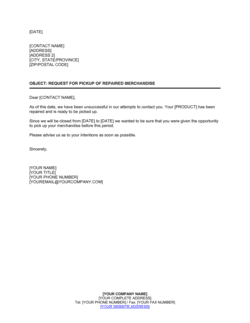
Request for Repair of Enclosed Merchandise Template

Free Word download β€’ Edit online β€’ Save & share with Drive β€’ Export to PDF

1 pageβ€’15–25 min to fillβ€’Difficulty: Standard
Learn more ↓
FreeRequest for Repair of Enclosed Merchandise Template

At a glance

What it is
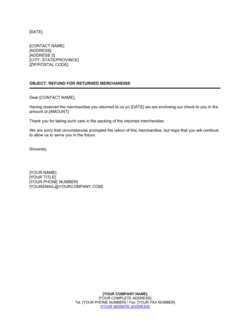
A Request For Repair Of Enclosed Merchandise is a formal business letter sent alongside a defective product to a manufacturer, retailer, or service center to formally request that the item be repaired under warranty or at agreed terms. This free Word download gives you a structured, professional letter you can edit online and export as PDF in minutes.
When you need it
Use it when shipping a defective or malfunctioning item to a vendor, manufacturer, or repair facility and you need a written record of the defect, the repair request, and the terms under which you expect the work to be completed. It is especially useful when the repair is covered by an active warranty.
What's inside
Sender and recipient details, product identification information, a description of the defect or malfunction, warranty or purchase reference details, a clear repair request with timeline expectations, and instructions for return shipping or contact upon completion.

What is a Request For Repair Of Enclosed Merchandise?

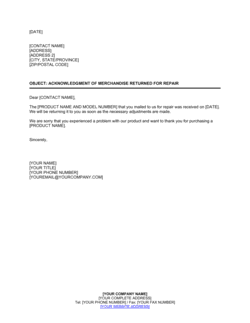
A Request For Repair Of Enclosed Merchandise is a formal business letter sent alongside a defective product to a manufacturer, authorized service center, or vendor, asking that the item be repaired β€” typically under a product warranty. The letter identifies the sender and recipient, describes the specific defect, references the applicable warranty and proof of purchase, defines the authorized scope of repair, and sets timeline and return shipping expectations. Because it is enclosed with the physical shipment, it serves simultaneously as a cover letter, a warranty assertion, and a written record of the terms under which the repair is requested.

Why You Need This Document

Shipping a defective product without a formal repair request letter exposes you to four predictable problems: the repair facility performs unauthorized paid work and invoices you for it; the item is returned unrepaired with a "no fault found" note because the technician had no description of the defect; the warranty claim is denied because no proof of purchase was submitted; or the repaired item is returned to the wrong address because no return instructions were provided. Each of these outcomes adds days or weeks to the resolution and creates disputes that require far more effort to unwind than the original repair. A completed repair request letter, enclosed with the shipment and emailed to the repair contact, eliminates all four risks β€” giving the facility everything it needs to process the repair correctly on the first pass, and giving you a dated, documented record if the vendor fails to deliver.

Which variant fits your situation?

If your situation is…Use this template
Product is defective and within the manufacturer's warranty periodRequest For Repair Of Enclosed Merchandise
Product arrived damaged and you want a replacement instead of repairRequest For Replacement Of Defective Merchandise
Product is out of warranty and you need a repair cost estimate firstRequest For Repair Estimate Letter
You want a full refund rather than a repair or replacementRequest For Refund Letter
Vendor has failed to repair the item after a prior requestFollow-Up Complaint Letter
You need to formally dispute a charge for an unrequested repairBilling Dispute Letter

Common mistakes to avoid

❌ Vague defect description

Why it matters: Repair technicians who cannot reproduce a specific fault will often return the item marked 'no fault found,' wasting time and leaving the defect unresolved.

Fix: Describe the exact symptom, when it first occurred, and what triggers it. Specific descriptions allow technicians to diagnose and repair the issue on the first attempt.

❌ No proof of purchase enclosed

Why it matters: Without documentation of the purchase date, the repair center has no basis to confirm warranty eligibility and will typically treat the repair as a paid, out-of-warranty job.

Fix: Always enclose a copy of the original invoice or receipt and highlight the purchase date. Keep the original in your records.

❌ Failing to limit the repair scope in writing

Why it matters: A repair facility that performs unauthorized work beyond the warranty can legally invoice for those services, creating a dispute that takes far longer to resolve than the repair itself.

Fix: Add a sentence stating that no work beyond the specified warranty repair may be performed without prior written authorization from the sender.

❌ Omitting return shipping instructions

Why it matters: Without clear return instructions, repaired items can be held, shipped to the wrong address, or returned via an expensive carrier that bills the recipient.

Fix: Specify the exact return address, preferred carrier, and who bears the return shipping cost. Include a shipping account number if you want the cost billed to your account.

The 9 key clauses, explained

Sender and recipient identification

In plain language: Opens the letter with the sender's full name or business name, address, and contact details, followed by the recipient's name, title, and address.

Sample language
[SENDER NAME / COMPANY NAME] | [ADDRESS] | [CITY, STATE, ZIP] | [DATE] | [RECIPIENT NAME], [TITLE] | [COMPANY NAME] | [ADDRESS]

Common mistake: Addressing the letter to a general department rather than a named contact. A named recipient reduces routing delays and creates a clear accountability trail.

Reference line

In plain language: A brief line identifying the product, model number, order or invoice reference, and RMA number if one has already been issued.

Sample language
Re: Repair Request β€” [PRODUCT NAME], Model [MODEL NUMBER], Order No. [ORDER NUMBER], RMA No. [RMA NUMBER IF APPLICABLE]

Common mistake: Omitting the model or serial number. Without it, the repair facility cannot match the letter to the correct product on arrival.

Opening statement and purpose

In plain language: One to two sentences stating that the letter accompanies the enclosed item and summarizes the purpose β€” to request warranty repair.

Sample language
Please find enclosed our [PRODUCT NAME] (Model [MODEL NUMBER], Serial No. [SERIAL NUMBER]), which we are submitting for warranty repair in accordance with the terms of your [WARRANTY PERIOD] warranty.

Common mistake: Writing a long introductory paragraph that buries the core request. The first sentence should state the purpose plainly.

Defect description

In plain language: A specific, factual account of the malfunction or defect β€” what the problem is, when it first appeared, and how it affects normal use.

Sample language
The unit began [DESCRIBING THE MALFUNCTION β€” e.g., 'failing to power on'] on or around [DATE]. The defect manifests as [SPECIFIC SYMPTOM] and prevents the unit from [INTENDED FUNCTION].

Common mistake: Using vague language like 'it stopped working.' Technicians need specific symptoms to diagnose efficiently β€” vague descriptions cause delays and sometimes result in a 'no fault found' return.

Warranty and purchase reference

In plain language: Cites the applicable warranty, its duration, and attaches or references the proof of purchase confirming the item is within warranty.

Sample language
This unit was purchased on [PURCHASE DATE] from [RETAILER / DISTRIBUTOR NAME] (Invoice No. [INVOICE NUMBER], copy enclosed). The malfunction falls within the [DURATION]-year warranty covering [SCOPE OF COVERAGE].

Common mistake: Claiming warranty coverage without enclosing or referencing proof of purchase. Without it, the repair center may treat the item as out-of-warranty and charge for service.

Repair request and scope

In plain language: Explicitly requests repair of the described defect and β€” if relevant β€” limits the authorized scope to warranty-covered work only.

Sample language
We respectfully request that [COMPANY NAME] repair the above-described defect at no charge under the applicable warranty. Please do not perform any work beyond the warranty-covered repair without our prior written authorization.

Common mistake: Failing to limit the repair scope. Without this language, a facility may perform unrequested paid repairs and invoice the sender.

Timeline expectation

In plain language: States the sender's expected turnaround time and requests confirmation of the receipt and estimated completion date.

Sample language
We request that the repair be completed within [NUMBER] business days of receipt. Please confirm receipt of this item and provide an estimated completion date at your earliest convenience.

Common mistake: Omitting any timeline request. Without it, the repair can sit in a queue indefinitely with no contractual basis for following up.

Return shipping instructions

In plain language: Specifies how and to whom the repaired item should be returned, including the preferred carrier, shipping account number if applicable, and the return address.

Sample language
Upon completion, please return the item to [RETURN ADDRESS] via [PREFERRED CARRIER]. Our shipping account number is [ACCOUNT NUMBER]. Please include a repair report or service summary with the returned unit.

Common mistake: Not specifying who bears the return shipping cost. Leaving this unstated can result in unexpected charges or the item being held pending payment.

Closing and contact information

In plain language: A professional closing paragraph with the sender's direct contact details for questions about the repair, followed by a formal sign-off.

Sample language
If you require any additional information to process this repair request, please contact [NAME] at [PHONE NUMBER] or [EMAIL ADDRESS]. We appreciate your prompt attention to this matter. Sincerely, [SENDER NAME / TITLE]

Common mistake: Closing without a contact name and direct number. A general 'contact us' close makes it harder for the repair facility to reach the right person quickly.

How to fill it out

  1. 1

    Enter sender and recipient details

    Fill in your full business name and address at the top, then add the name, title, and address of the repair department or authorized service contact at the manufacturer or vendor.

    πŸ’‘ Call ahead to confirm the correct contact name and mailing address β€” repair departments often use a different address than the main company headquarters.

  2. 2

    Complete the reference line

    Add the product name, model number, serial number, and your original order or invoice number. If you have already been issued an RMA number, include it here.

    πŸ’‘ Copy the serial number directly from the product label rather than from a box or manual β€” manufacturing runs can produce minor discrepancies.

  3. 3

    Write a specific defect description

    Describe exactly what the product does or fails to do, when the problem first appeared, and under what conditions it occurs. Avoid generalizations β€” write as if explaining to a technician who has never seen the product.

    πŸ’‘ If the defect is intermittent, note the frequency and any conditions that trigger it (temperature, load, startup sequence). This detail cuts diagnostic time significantly.

  4. 4

    Reference the warranty and attach proof of purchase

    Cite the warranty period and coverage, the purchase date, and the retailer or distributor. Enclose a copy β€” not the original β€” of your invoice or receipt.

    πŸ’‘ Highlight the purchase date on the receipt copy so it is immediately visible to the receiving clerk.

  5. 5

    State the repair request and limit the scope

    Explicitly request the repair and include language authorizing only warranty-covered work. Add a line requiring written approval before any additional paid work is performed.

    πŸ’‘ This one sentence protects you from surprise invoices for upgrades or non-warranty repairs performed without your consent.

  6. 6

    Set a turnaround expectation and return shipping instructions

    State your expected number of business days for completion, your return address, and your preferred carrier or shipping account. Request a repair summary document be included with the returned item.

    πŸ’‘ 10–15 business days is a reasonable expectation for most warranty repairs. For critical equipment, specify this upfront and note the business impact of extended downtime.

  7. 7

    Proofread, print, and enclose with the shipment

    Review the letter for accuracy β€” especially model numbers, serial numbers, and dates. Print two copies: one to enclose inside the package and one to keep with your shipping records.

    πŸ’‘ Photograph both the letter and the packaged item before sealing the box. This creates a timestamped record of what was sent in what condition.

Frequently asked questions

What is a request for repair of enclosed merchandise letter?

It is a formal business letter sent alongside a defective product to a manufacturer, retailer, or authorized service center to request that the item be repaired β€” typically under a product warranty. The letter identifies the product, describes the defect, references the applicable warranty, and sets expectations for turnaround time and return shipping. It also creates a written record of the repair request, which is useful if a dispute arises.

When should I use this letter instead of just calling the repair center?

Whenever you are physically shipping a product for repair, a written letter enclosed with the item provides a clear, documented record of exactly what was sent, why, and under what terms. Phone calls leave no paper trail β€” if the repair center loses the item, performs unauthorized work, or returns it unrepaired, the letter is your primary evidence. It is also required by some manufacturers as part of the formal warranty claim process.

Do I need an RMA number before sending the letter?

Many manufacturers require an RMA number before they will accept a returned item for repair. Check the manufacturer's warranty or return policy first. If an RMA is required, obtain it and include it in the reference line of the letter. If no RMA process exists, the letter alone is typically sufficient to initiate the repair.

What should I enclose with the letter besides the defective item?

At minimum, enclose a copy of the original purchase receipt or invoice to confirm warranty eligibility, and the completed request letter. Some manufacturers also ask for the original packaging, accessories, or a completed warranty registration form. Check the warranty documentation before packing to avoid delays caused by missing materials.

How do I protect myself if the repair center performs unauthorized work?

Include explicit language in the letter stating that no work beyond the described warranty repair may be performed without your prior written authorization. This creates a contractual limit on the facility's scope. If unauthorized work is performed and invoiced, you can reference this language to dispute the charge β€” and in most jurisdictions the facility has limited recourse for work you did not authorize in writing.

What if my product is out of warranty?

If the warranty has expired, the letter can still be used β€” simply remove the warranty references and replace them with a request for a repair estimate before any work begins. State clearly that you authorize the diagnostic inspection only, and that full repair authorization is contingent on your written approval of the quoted cost.

Should I send this letter by certified mail or email?

For items shipped physically, print the letter and enclose it inside the package alongside the product. Also send a scanned copy by email to the repair contact so there is a timestamped digital record before the package arrives. For high-value items, ship with a carrier that provides tracking and delivery confirmation and retain that documentation with your copy of the letter.

How long should I expect the repair to take?

Turnaround time varies widely by manufacturer and product type. Consumer electronics warranty repairs typically run 5–15 business days. Industrial or specialized equipment can take 3–6 weeks depending on parts availability. Stating your expected timeline in the letter β€” and requesting a confirmation with an estimated completion date β€” gives you a documented basis to follow up if the repair exceeds that window.

Can a small business use this letter for equipment sent to a vendor?

Yes β€” this letter is equally suited to B2B repair requests as it is to consumer warranty claims. Small businesses commonly use it when returning office equipment, manufacturing tools, or electronic devices to vendors or authorized service centers. The structured format ensures the vendor has all the reference information needed to process the repair quickly and without back-and-forth clarification.

How this compares to alternatives

vs Request For Replacement Of Defective Merchandise

A replacement request asks the vendor to swap the defective item for a new or equivalent unit rather than repair the existing one. Use the repair request when the item is repairable and you prefer to keep the original; use the replacement request when the defect is severe, the item is beyond repair, or a replacement is faster. Some warranties specify which remedy applies first.

vs Product Complaint Letter

A product complaint letter communicates dissatisfaction with a product's quality or performance but does not necessarily send the item back for service. The repair request is a logistics document that accompanies a physical shipment and authorizes specific work. If you have not yet decided on a remedy, a complaint letter is the appropriate first step; once repair is confirmed as the resolution, the repair request letter follows.

vs Request For Refund Letter

A refund request seeks a monetary reimbursement for a defective purchase rather than a physical remedy. Use it when the product cannot be repaired, when the defect recurs after repair, or when the warranty explicitly covers refunds. The repair request is appropriate when you want the item fixed and returned; the refund letter is appropriate when you want your money back.

vs Return Merchandise Authorization Form

An RMA form is typically issued by the manufacturer or vendor to authorize the return before the item is shipped. The repair request letter is written by the sender and accompanies the shipment. In many warranty workflows both documents are used together: the sender obtains the RMA number, then encloses the completed repair request letter β€” referencing the RMA number β€” when shipping the item.

Industry-specific considerations

Manufacturing

Used to return defective components, tools, or machinery to suppliers under vendor warranty terms, with repair scope limited to avoid downtime charges.

Retail

Retailers use it to forward customer-returned defective merchandise to distributors or manufacturers for warranty service before issuing a replacement to the customer.

Professional Services

Law firms, accounting offices, and consultancies use it to return malfunctioning office technology β€” printers, projectors, or AV equipment β€” to vendors under service agreements.

Healthcare

Medical practices and clinics send diagnostic or monitoring equipment to authorized repair centers, where the letter also documents that the device was shipped in compliance with applicable handling requirements.

Template vs pro β€” what fits your needs?

PathBest forCostTime
Use the templateAny business or individual sending a defective item for warranty repair with standard termsFree10 minutes
Template + professional reviewHigh-value equipment repairs or situations where the warranty scope is disputed$50–$150 for a brief legal or procurement advisor review1–2 hours
Custom draftedComplex commercial disputes involving recurring defects, consequential damages, or supplier contract enforcement$300–$800 for attorney-drafted correspondence1–3 days

Glossary

Warranty
A manufacturer's or seller's written commitment to repair, replace, or refund a product that fails within a defined period under normal use.
Defect
A flaw, malfunction, or failure in a product that prevents it from performing its intended function as specified or reasonably expected.
RMA (Return Merchandise Authorization)
A reference number issued by a manufacturer or retailer that authorizes the return of a defective product for repair, replacement, or refund.
Proof of Purchase
A receipt, invoice, or order confirmation that documents when and where an item was bought, often required to initiate a warranty claim.
Turnaround Time
The number of business days a repair facility commits to completing the repair and returning the item to the sender.
Bill of Lading
A shipping document issued by a carrier that records the type, quantity, and destination of goods β€” used as evidence that the item was shipped.
Consequential Damages
Losses beyond the product's repair cost β€” such as business downtime or lost revenue β€” that result from a product's defective condition.
Express Warranty
A specific, stated promise about a product's performance or quality made by the seller or manufacturer in writing or verbally.
Implied Warranty of Merchantability
An unwritten guarantee, recognized in most jurisdictions, that a product sold in the ordinary course of business will perform its basic intended function.
Repair Authorization
Written permission from the product owner instructing the repair facility to perform specific work, often required before any service begins.

Part of your Business Operating System

This document is one of 3,000+ business & legal templates included in Business in a Box.

  • Fill-in-the-blanks β€” ready in minutes
  • 100% customizable Word document
  • Compatible with all office suites
  • Export to PDF and share electronically

Create your document in 3 simple steps.

From template to signed document β€” all inside one Business Operating System.
1
Download or open template

Access over 3,000+ business and legal templates for any business task, project or initiative.

2
Edit and fill in the blanks with AI

Customize your ready-made business document template and save it in the cloud.

3
Save, Share, Send, Sign

Share your files and folders with your team. Create a space of seamless collaboration.

Save time, save money, and create top-quality documents.

β˜…β˜…β˜…β˜…β˜…

"Fantastic value! I'm not sure how I'd do without it. It's worth its weight in gold and paid back for itself many times."

Managing Director Β· Mall Farm
Robert Whalley
Managing Director, Mall Farm Proprietary Limited
β˜…β˜…β˜…β˜…β˜…

"I have been using Business in a Box for years. It has been the most useful source of templates I have encountered. I recommend it to anyone."

Business Owner Β· 4+ years
Dr Michael John Freestone
Business Owner
β˜…β˜…β˜…β˜…β˜…

"It has been a life saver so many times I have lost count. Business in a Box has saved me so much time and as you know, time is money."

Owner Β· Upstate Web
David G. Moore Jr.
Owner, Upstate Web

Run your business with a system β€” not scattered tools

Stop downloading documents. Start operating with clarity. Business in a Box gives you the Business Operating System used by over 250,000 companies worldwide to structure, run, and grow their business.

Free Forever PlanΒ Β·Β No credit card required