Renewal Agreement Template

Free Word download β€’ Edit online β€’ Save & share with Drive β€’ Export to PDF

6 pagesβ€’25–35 min to fillβ€’Difficulty: Complexβ€’Signature requiredβ€’Legal review recommended
Learn more ↓
FreeRenewal Agreement Template

At a glance

What it is
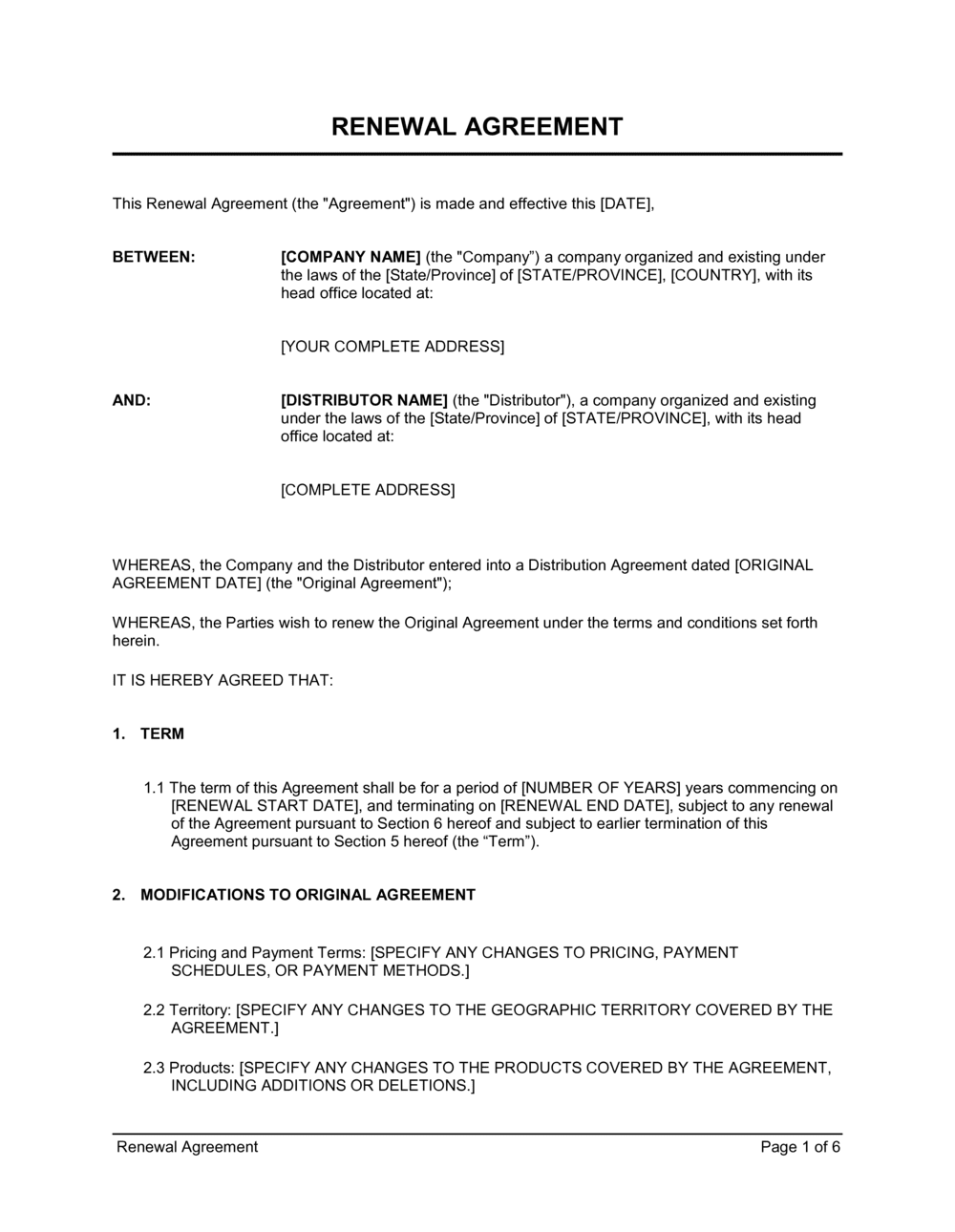
A Renewal Agreement is a legally binding document that extends an existing contract for an additional term β€” either on the original terms or with negotiated updates to pricing, scope, duration, or other conditions. This free Word download gives you a structured, editable template you can complete in under 30 minutes and export as PDF for countersignature.
When you need it
Use it when an existing contract is approaching its expiration date and both parties want to continue the relationship in writing rather than relying on informal agreements or automatic-renewal clauses. It is also appropriate when renewing on materially different terms that warrant a standalone signed document rather than a simple amendment.
What's inside
Party identification and recitals, reference to the original agreement, the new term start and end date, any revised pricing or scope, conditions precedent to renewal, representations and warranties, confidentiality carry-through, termination rights, and governing law.

What is a Renewal Agreement?

A Renewal Agreement is a legally binding document that formally extends an existing contract for an additional term once the original period is approaching or has reached its expiration date. Rather than requiring both parties to negotiate and draft a new contract from scratch, a renewal agreement incorporates the original contract by reference, confirms the new term dates, records any updated commercial terms β€” pricing, scope, service levels β€” and re-establishes both parties' obligations on a clear, signed basis. It is used across virtually every contract type: vendor and supplier agreements, commercial leases, service retainers, software licenses, employment arrangements, and consulting engagements.

Why You Need This Document

Allowing a contract to expire without a signed renewal creates a dangerous gap in your legal protection. During any period when no governing agreement is in place, confidentiality obligations, intellectual property assignments, and non-solicitation restrictions may no longer be enforceable β€” and either party can walk away without the notice or severance provisions the original contract required. Relying on informal email exchanges or verbal agreements to extend a contract is even riskier: courts apply jurisdiction-specific defaults to fill the gaps, and those defaults almost never favor the party that failed to document the renewal. For ongoing vendor or service relationships, a missing renewal also means there is no clear record of the updated pricing or scope that both parties actually agreed to, turning every invoice dispute into a credibility contest. This template gives you a structured, attorney-reviewed starting point that captures every material term of the renewed relationship in a single signed document β€” protecting both parties and eliminating the ambiguity that causes contract disputes to escalate.

Which variant fits your situation?

If your situation is…Use this template
Renewing a commercial or residential leaseLease Renewal Agreement
Extending a service contract with updated pricingService Agreement Renewal
Renewing an independent contractor or consulting arrangementContract Extension Agreement
Making minor changes to an existing contract mid-termContract Amendment
Replacing an expired contract with entirely new termsNew Service Agreement
Automatically renewing a subscription licenseSoftware License Agreement
Extending an employment contract for a fixed additional termFixed-Term Employment Contract

Common mistakes to avoid

❌ Executing after the original contract has already expired

Why it matters: A renewal agreement signed after expiration may be treated as a new contract rather than a continuation β€” affecting how prior obligations, IP assignments, and confidentiality provisions carry through.

Fix: Start the renewal process 60–90 days before expiration and build a signed-by date into the timeline. If expiration passes before execution, have a lawyer assess whether a fresh agreement is needed.

❌ Relying on silence to confirm unchanged terms

Why it matters: If the renewal document does not explicitly address a term β€” such as pricing or service level β€” parties often assume different things, leading to disputes that are expensive to resolve without clear written evidence.

Fix: Confirm every material term in writing, either by stating it has changed or by stating explicitly that it remains unchanged from the original agreement.

❌ Setting a non-renewal notice window shorter than 60 days

Why it matters: Notice windows of 15 or 30 days routinely cause businesses to miss the deadline and get locked into another automatic renewal term they did not want.

Fix: Use a minimum 60-day notice window for most B2B agreements, and calendar the deadline immediately upon signing the renewal.

❌ Failing to resolve pre-existing breaches before executing

Why it matters: Renewing a contract while an uncured breach exists can be interpreted as a waiver of that breach, forfeiting your right to claim damages or terminate on that basis.

Fix: Use the conditions-precedent clause to require resolution of all outstanding defaults before the renewal becomes effective, and document the cure in writing.

❌ Omitting the incorporation-by-reference clause

Why it matters: Without it, the renewal agreement is a standalone document and courts may find that provisions not restated β€” including confidentiality and IP β€” no longer apply during the renewal term.

Fix: Always include a clause stating that all terms of the original agreement not expressly modified continue in full force and effect through the renewal term.

❌ Using different governing law in the renewal than in the original

Why it matters: Conflicting choice-of-law provisions in two related documents create genuine legal uncertainty about which jurisdiction's courts and statutes govern disputes arising during the renewal term.

Fix: Either match the original governing-law clause exactly or explicitly supersede it by stating 'Notwithstanding Section X of the Original Agreement, this Renewal Agreement shall be governed by the laws of [JURISDICTION].'

The 10 key clauses, explained

Recitals and Reference to Original Agreement

In plain language: Identifies both parties, recites the existence and key details of the original agreement, and states the mutual intent to renew.

Sample language
WHEREAS, [PARTY A] and [PARTY B] entered into that certain [AGREEMENT TITLE] dated [ORIGINAL DATE] (the 'Original Agreement'); and WHEREAS, the parties desire to extend the Original Agreement for an additional term on the terms set out below;

Common mistake: Referencing the original agreement by informal name only without including the execution date and full party names β€” creating ambiguity when a party has multiple contracts with the same counterpart.

Renewal Term and Effective Date

In plain language: States the exact start and end date of the renewal period so both parties have a clear, shared understanding of the new expiration.

Sample language
The Original Agreement is hereby renewed for an additional term commencing [START DATE] and expiring on [END DATE] (the 'Renewal Term'), unless earlier terminated in accordance with the terms hereof.

Common mistake: Using relative language like 'one year from signing' without specifying a calendar date. When signature dates differ between parties, 'from signing' becomes ambiguous and unenforceable.

Updated Pricing and Commercial Terms

In plain language: Records any changes to fees, rates, payment schedules, or scope of services that apply during the renewal term, superseding the original commercial terms.

Sample language
During the Renewal Term, the fees payable by [PARTY B] to [PARTY A] shall be $[AMOUNT] per [PERIOD], payable within [X] days of invoice. All other payment terms of the Original Agreement remain unchanged.

Common mistake: Leaving pricing unchanged by silence rather than by explicit confirmation. If an amended rate was discussed but not documented, a dispute arises over which rate governs.

Incorporation of Original Agreement Terms

In plain language: States that all terms of the original agreement not expressly modified by the renewal continue in full force, avoiding the need to restate the entire contract.

Sample language
Except as expressly modified herein, all terms and conditions of the Original Agreement are hereby incorporated by reference and shall continue in full force and effect during the Renewal Term.

Common mistake: Failing to include this clause and then restating only some original provisions β€” creating ambiguity about whether omitted clauses are still in effect.

Conditions Precedent to Renewal

In plain language: Lists any requirements each party must satisfy before the renewal becomes effective, such as clearing overdue invoices or providing updated insurance certificates.

Sample language
This Renewal Agreement shall not become effective unless and until: (a) [PARTY B] has paid all amounts outstanding under the Original Agreement as of [DATE]; and (b) [PARTY A] has delivered to [PARTY B] a current certificate of insurance meeting the requirements of Section [X] of the Original Agreement.

Common mistake: Omitting conditions precedent entirely when outstanding obligations exist β€” the renewal then takes effect even if the counterpart is in breach of the original agreement.

Representations and Warranties

In plain language: Each party confirms that they still have the legal authority to enter the renewal, that no material breach of the original agreement exists, and that no circumstances have arisen that would prevent performance.

Sample language
Each party represents and warrants that: (a) it has full authority to execute this Renewal Agreement; (b) it is not in material breach of the Original Agreement; and (c) no event has occurred that, with notice or passage of time, would constitute a material breach.

Common mistake: Copying representations verbatim from the original agreement without updating them to reflect the renewal context β€” leading to stale warranties about facts that may have changed.

Automatic Renewal and Notice of Non-Renewal

In plain language: Specifies whether the renewed contract will auto-renew again at the end of the renewal term, and the advance notice window each party must use to prevent that.

Sample language
Upon expiration of the Renewal Term, this Agreement shall automatically renew for successive [X]-month periods unless either party provides written notice of non-renewal at least [X] days prior to the end of the then-current term.

Common mistake: Setting a non-renewal notice window shorter than 30 days. In practice, procurement and legal review cycles mean parties miss short windows and are locked into unwanted renewals.

Termination for Cause

In plain language: Preserves each party's right to terminate the renewed agreement immediately or on short notice if the other party commits a material breach and fails to cure it within the specified remedy period.

Sample language
Either party may terminate this Renewal Agreement immediately upon written notice if the other party materially breaches any provision hereof and fails to cure such breach within [30] days of receiving written notice specifying the breach in reasonable detail.

Common mistake: Incorporating termination-for-cause rights by reference to the original agreement without confirming the cure period still applies β€” courts have found ambiguity when the renewal document is silent.

Governing Law and Dispute Resolution

In plain language: Specifies which jurisdiction's law governs the renewal agreement and whether disputes are resolved through courts, arbitration, or mediation β€” consistent with the original agreement unless the parties have agreed to change it.

Sample language
This Renewal Agreement shall be governed by and construed in accordance with the laws of [STATE / PROVINCE / COUNTRY], without regard to its conflict-of-law principles. Any dispute shall be resolved in accordance with Section [X] of the Original Agreement.

Common mistake: Specifying a different governing law in the renewal than in the original agreement without explicitly superseding the original provision β€” creating a direct conflict between two binding documents.

Entire Agreement and Counterparts

In plain language: Confirms that this renewal agreement, together with the original agreement, constitutes the full understanding between the parties, and allows execution by separate counterpart signatures.

Sample language
This Renewal Agreement, together with the Original Agreement and any schedules thereto, constitutes the entire agreement between the parties with respect to the subject matter hereof. This Agreement may be executed in counterparts, each of which shall be deemed an original.

Common mistake: Omitting the entire-agreement clause so that informal email exchanges about renewal terms can be introduced as evidence of additional obligations.

How to fill it out

  1. 1

    Identify the original agreement precisely

    Enter the full legal names of both parties as they appear in the original contract, the exact title of that agreement, and its execution date. Pull the document to confirm these details rather than working from memory.

    πŸ’‘ If the original agreement was amended before renewal, reference the most recent amendment as the governing document, not the original execution date.

  2. 2

    Set the renewal term with exact calendar dates

    Enter the start date as the day immediately following the original expiration date, and calculate the end date based on the agreed renewal length. Write both dates in full β€” day, month, and year β€” to eliminate ambiguity.

    πŸ’‘ Confirm the original expiration date in writing with the other party before executing β€” calendar errors on the original term are more common than you expect.

  3. 3

    Document any changes to pricing or scope

    List every commercial term that is changing during the renewal β€” fees, deliverables, volume commitments, or service levels. If nothing is changing, state that explicitly: 'All commercial terms of the Original Agreement remain unchanged during the Renewal Term.'

    πŸ’‘ Even a 0% price increase is worth documenting explicitly. It prevents a later claim that a rate discussed in negotiations was agreed but not captured.

  4. 4

    Set or confirm the conditions precedent

    List any obligations either party must fulfill before the renewal takes effect β€” outstanding invoices, updated certificates of insurance, or regulatory approvals. Include a deadline for each condition.

    πŸ’‘ Send a conditions-precedent checklist to the counterpart at least 30 days before the renewal date so there is time to resolve outstanding items.

  5. 5

    Choose automatic renewal or fixed expiry

    Decide whether the renewed contract should auto-renew again at the end of the renewal term. If yes, set the non-renewal notice window β€” a minimum of 60 days is practical for most B2B agreements. If no, state that the agreement expires without further action.

    πŸ’‘ If auto-renewal applies, calendar the notice deadline the moment the renewal is signed β€” missing it is the most common and costly renewal mistake.

  6. 6

    Confirm governing law matches the original

    Check that the governing law and dispute-resolution clause in the renewal agreement is consistent with the original. If the parties have agreed to change it, state explicitly that the renewal supersedes Section X of the original.

    πŸ’‘ For cross-border agreements, confirm that the chosen governing law is still legally valid for the renewed term β€” regulatory changes in some jurisdictions can affect choice-of-law enforceability.

  7. 7

    Execute before the original expiration date

    Both parties must sign the renewal agreement before the original contract expires. A gap between expiration and execution creates a period where neither party has a governing document β€” exposing both to risk.

    πŸ’‘ Start the renewal process at least 60–90 days before expiration to allow time for negotiation, review, and signature collection from all required signatories.

  8. 8

    Store the executed renewal with the original agreement

    File the fully signed renewal agreement alongside the original contract so that anyone reviewing the relationship has the complete picture. Update your contract management system or file index with the new expiration date.

    πŸ’‘ Set a calendar reminder for the new expiration date and the non-renewal notice deadline the same day you file the executed document.

Frequently asked questions

What is a renewal agreement?

A renewal agreement is a legally binding document that extends an existing contract for an additional period β€” either on the same terms or with negotiated changes to pricing, scope, or duration. It is executed before or at the expiration of the original contract and preserves the parties' obligations without requiring them to draft an entirely new agreement. It differs from an amendment, which modifies a contract mid-term rather than extending it at expiration.

When should I use a renewal agreement instead of just letting the contract auto-renew?

Use a signed renewal agreement whenever any term is changing β€” pricing, scope, delivery obligations, or notice periods. A standalone renewal document is also advisable when the original contract's auto-renewal language is ambiguous, when the relationship is high-value or long-standing, or when you need an auditable record of both parties' consent to the new term. Auto-renewal clauses are convenient but create disputes when one party later claims they did not intend to renew.

What is the difference between a renewal agreement and a contract amendment?

A renewal agreement extends the contract's term at or near its expiration date. A contract amendment modifies specific terms of an existing, in-force contract before it expires. If your contract is mid-term and you need to change the price or scope, use an amendment. If the contract is expiring and you want to continue on updated terms, use a renewal agreement. The two documents serve different functions and should not be substituted for each other.

Does a renewal agreement need to be signed by both parties?

Yes. A renewal agreement is a binding contract modification and requires signatures from authorized representatives of both parties to be enforceable. A unilateral renewal notice is not sufficient unless the original contract specifically grants one party the unilateral right to renew. Always confirm that the person signing on behalf of each entity has the authority to bind that organization.

What happens if the original contract expires before we sign the renewal?

If the original contract expires without a signed renewal in place, the parties are operating without a governing agreement. Courts in most jurisdictions may imply a month-to-month arrangement based on continued conduct, but key protections β€” confidentiality, IP assignment, non-solicitation β€” may no longer be enforceable. Execute the renewal before the expiration date; if that window has passed, consult a lawyer about whether a fresh agreement is needed to restore full protection.

Can I change pricing and other terms in a renewal agreement?

Yes. A renewal agreement can continue the original terms unchanged or replace specific provisions β€” including fees, service levels, deliverables, and notice periods β€” for the renewal term. Any term not explicitly modified in the renewal continues under the original contract's language. Document every change, even a confirmed 0% price increase, to prevent later disputes about what was agreed.

How far in advance should I start the renewal process?

For most B2B contracts, begin the renewal process 60–90 days before expiration. This allows time for internal review, commercial negotiations, legal review where warranted, and signature collection from all required signatories. High-value or complex contracts β€” enterprise software, commercial leases, or multi-party service arrangements β€” may require 90–120 days. Missing the renewal window is one of the most common and costly contract management failures in small and mid-size businesses.

Are renewal agreements enforceable without a lawyer?

A properly completed renewal agreement template is generally enforceable when signed by authorized representatives of both parties, executed before the original contract expires, and clearly referencing the original agreement. Legal review is advisable when the contract value is significant, when terms are changing materially, when the relationship crosses jurisdictions, or when pre-existing breaches need to be resolved as a condition of renewal. A 1–2 hour lawyer review typically costs $300–$600 and is appropriate for renewals above $50,000 in annual value.

What is an evergreen clause and should I include one?

An evergreen clause causes the contract to automatically renew for successive periods β€” typically monthly or annually β€” unless one party gives written notice of non-renewal within a specified window before the end of the current term. Include one when continuity of service is important and you want to avoid administrative gaps. Omit it, or use a fixed-expiry structure, when the relationship is project-based or when you want to force a deliberate renegotiation at each renewal. If you include an evergreen clause, always set a non-renewal notice window of at least 60 days and calendar the deadline immediately.

How this compares to alternatives

vs Contract Amendment

A contract amendment modifies specific terms of a contract that is still in force β€” changing a price, deadline, or deliverable mid-term without altering the original expiration date. A renewal agreement extends the contract's term at expiration, typically with optional updates to commercial terms. Use an amendment for mid-term changes and a renewal agreement when the contract is approaching or has reached its end date.

vs New Service Agreement

A new service agreement replaces an expired or terminated contract with a fully negotiated document covering all terms from scratch. A renewal agreement is faster and more appropriate when the relationship is continuing on substantially similar terms β€” it incorporates the original contract by reference rather than restating it entirely. Use a new agreement when the scope, parties, or structure of the relationship has changed fundamentally.

vs Letter of Intent

A letter of intent expresses a party's intention to renew or enter a new agreement but is typically non-binding on the commercial terms. A renewal agreement is the binding executed document that creates enforceable obligations for the new term. An LOI may precede a renewal agreement during negotiations but cannot substitute for it once the parties are ready to commit.

vs Evergreen Auto-Renewal Clause

An evergreen clause built into the original contract renews the agreement automatically unless a party gives timely notice of non-renewal β€” no separate document is required. A standalone renewal agreement is appropriate when the original contract lacks an evergreen provision, when terms are changing, or when both parties want a fresh signed acknowledgment of the new term. Auto-renewal is efficient; a signed renewal agreement provides a clearer audit trail and is easier to enforce if disputed.

Industry-specific considerations

Technology / SaaS

Annual software license and subscription renewals with updated pricing tiers, usage caps, SLA commitments, and data processing addenda that must be refreshed to maintain GDPR and CCPA compliance.

Commercial Real Estate

Lease renewals for office, retail, and industrial space with updated rent schedules, tenant improvement allowances, and option-to-purchase provisions distinct from the original lease.

Professional Services

Consulting, accounting, and legal retainer renewals that confirm the continued scope of engagement, updated hourly or fixed rates, and any change in the lead personnel assigned to the account.

Healthcare and Life Sciences

Vendor, supplier, and managed-services contract renewals that must confirm continued regulatory compliance, updated HIPAA Business Associate Agreement terms, and credentialing status of key personnel.

Manufacturing and Supply Chain

Supplier and distributor agreement renewals addressing updated minimum order quantities, revised pricing tied to commodity indexes, and refreshed force-majeure and supply-disruption provisions.

Staffing and Human Resources

Fixed-term employment and staffing agency contract renewals confirming continued engagement, updated compensation, and renewed non-solicitation obligations between the agency, employer, and placed worker.

Jurisdictional notes

United States

Contract law is governed at the state level in the US, and renewal enforceability depends on the originating state's rules on consideration and modification. Most states require some form of fresh consideration for a renewal that materially changes terms β€” continued performance is generally sufficient for straightforward extensions. California and New York impose specific disclosure requirements for auto-renewal clauses in consumer contracts; B2B renewals are less regulated but should still include clear notice provisions. Non-compete carry-through clauses in renewed employment contracts should be reviewed for state-specific enforceability.

Canada

Canadian contract law requires that renewal agreements include consideration β€” typically continued performance or adjusted compensation β€” to be enforceable across all provinces. In Quebec, contracts must be in French for provincially regulated businesses, and renewal agreements are subject to the same bilingual requirements. Ontario and British Columbia have specific rules on automatic-renewal clauses in consumer contracts; commercial renewals have more flexibility but benefit from explicit notice provisions. Severance and notice obligations under provincial employment standards acts apply to renewed fixed-term employment contracts and cannot be contracted out.

United Kingdom

Under English law, a renewal agreement requires consideration to be binding β€” continued obligations and updated commercial terms typically satisfy this requirement. The Landlord and Tenant Act 1954 provides business tenants with a statutory right to renew commercial leases, subject to the landlord's grounds for opposition; lease renewal agreements should confirm whether the tenancy is protected or excluded. Auto-renewal clauses in B2B contracts are generally enforceable but may be subject to the Unfair Contract Terms Act 1977 reasonableness test in standard-form agreements. Post-Brexit, cross-border renewal agreements with EU counterparts should confirm which jurisdiction's law governs.

European Union

EU member states each have national contract laws, but renewal agreements must generally comply with the EU's Unfair Commercial Practices Directive and the Consumer Rights Directive where consumer parties are involved. GDPR data processing addenda incorporated by reference in the original agreement should be reviewed and updated at renewal to reflect any changes in data flows, sub-processors, or retention periods β€” a renewal is a natural trigger for a GDPR compliance review. In Germany and France, significant unilateral changes to commercial terms at renewal may require additional notice periods beyond what the original contract states. Auto-renewal clauses in B2C contracts face strict transparency requirements across most member states.

Template vs lawyer β€” what fits your deal?

PathBest forCostTime
Use the templateStandard B2B service, vendor, or staffing contract renewals on substantially unchanged terms with a value under $50,000 per yearFree20–30 minutes
Template + legal reviewRenewals involving pricing changes, cross-border parties, pre-existing disputes, or annual contract values between $50,000 and $250,000$300–$6001–3 days
Custom draftedHigh-value renewals above $250,000 per year, complex multi-party or multi-jurisdiction arrangements, regulated industries, or renewals involving unresolved breach claims$1,000–$3,500+1–2 weeks

Glossary

Renewal Term
The new period of time for which the agreement will remain in force after the original expiration date.
Original Agreement
The prior executed contract that the renewal agreement extends, referenced by title, date, and parties.
Evergreen Clause
A provision that causes a contract to renew automatically at the end of each term unless one party gives written notice of non-renewal within a specified window.
Conditions Precedent
Requirements that must be satisfied before the renewal becomes effective β€” such as payment of outstanding invoices or delivery of updated insurance certificates.
Carry-Through Provisions
Clauses from the original agreement β€” typically confidentiality, IP assignment, and dispute resolution β€” that remain in force through the renewal term without being restated in full.
Notice Period
The minimum advance notice one party must give the other to prevent an automatic renewal or to trigger termination at the end of a term.
Representations and Warranties
Statements of fact made by each party at the time of renewal β€” such as confirming continued authority to contract and absence of known breaches.
Effective Date
The date on which the renewal term begins β€” typically the day immediately following the expiration of the original term.
Material Breach
A failure to perform a fundamental obligation under the agreement that gives the non-breaching party the right to terminate without further liability.
Counterparts Clause
A provision allowing each party to sign a separate copy of the agreement, with all signed copies together constituting a single binding document.

Part of your Business Operating System

This document is one of 3,000+ business & legal templates included in Business in a Box.

  • Fill-in-the-blanks β€” ready in minutes
  • 100% customizable Word document
  • Compatible with all office suites
  • Export to PDF and share electronically

Create your document in 3 simple steps.

From template to signed document β€” all inside one Business Operating System.
1
Download or open template

Access over 3,000+ business and legal templates for any business task, project or initiative.

2
Edit and fill in the blanks with AI

Customize your ready-made business document template and save it in the cloud.

3
Save, Share, Send, Sign

Share your files and folders with your team. Create a space of seamless collaboration.

Save time, save money, and create top-quality documents.

β˜…β˜…β˜…β˜…β˜…

"Fantastic value! I'm not sure how I'd do without it. It's worth its weight in gold and paid back for itself many times."

Managing Director Β· Mall Farm
Robert Whalley
Managing Director, Mall Farm Proprietary Limited
β˜…β˜…β˜…β˜…β˜…

"I have been using Business in a Box for years. It has been the most useful source of templates I have encountered. I recommend it to anyone."

Business Owner Β· 4+ years
Dr Michael John Freestone
Business Owner
β˜…β˜…β˜…β˜…β˜…

"It has been a life saver so many times I have lost count. Business in a Box has saved me so much time and as you know, time is money."

Owner Β· Upstate Web
David G. Moore Jr.
Owner, Upstate Web

Run your business with a system β€” not scattered tools

Stop downloading documents. Start operating with clarity. Business in a Box gives you the Business Operating System used by over 250,000 companies worldwide to structure, run, and grow their business.

Start freeΒ Β·Β No credit card required