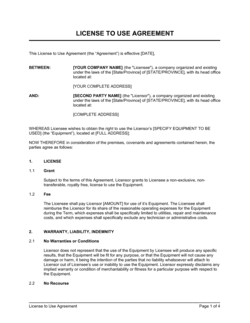
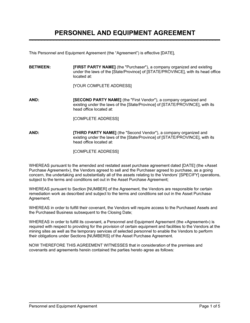
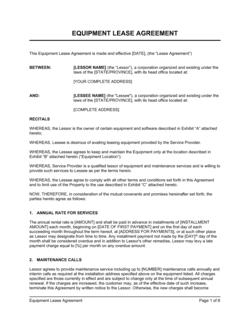
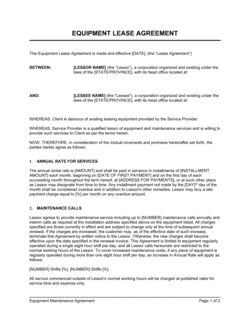
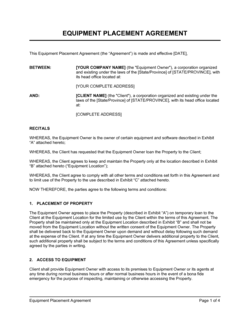
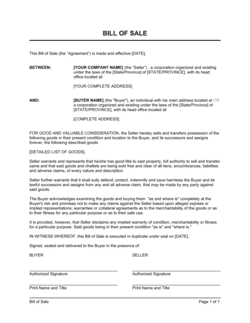
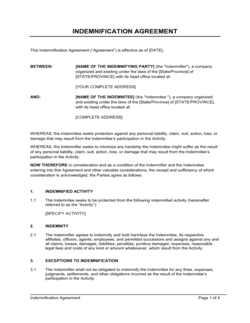
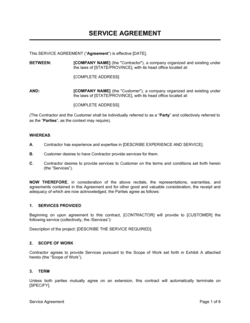
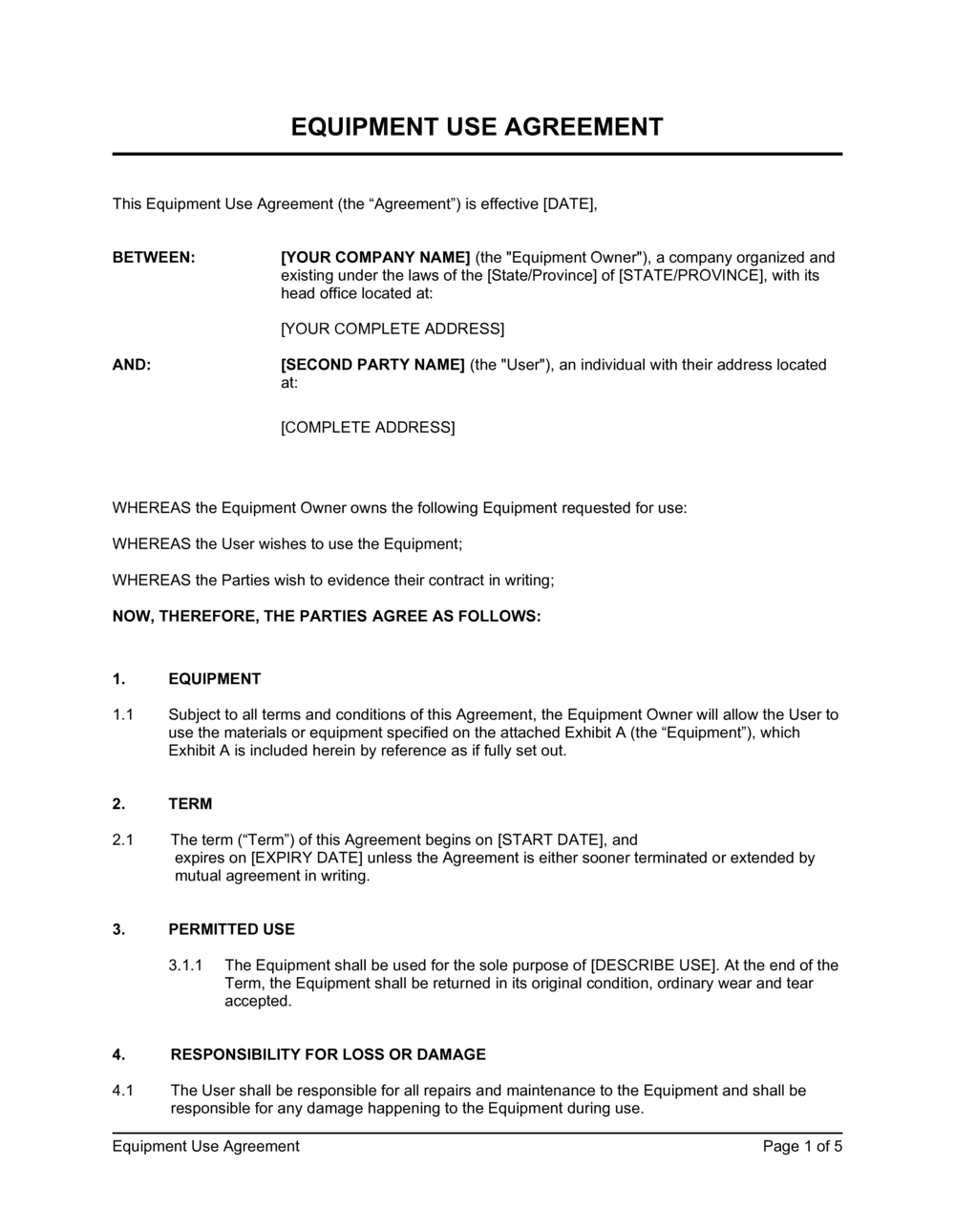
Equipment Use Agreement Template

Free Word download • Edit online • Save & share with Drive • Export to PDF

5 pages25–35 min to fillDifficulty: ComplexSignature requiredLegal review recommended
Learn more ↓
FreeEquipment Use Agreement Template

At a glance

What it is
An Equipment Use Agreement is a legally binding document between an equipment owner and a user that governs how specified equipment may be accessed, operated, and returned. This free Word download covers shared use, fee structures, operating restrictions, maintenance responsibilities, insurance, and liability — giving both parties a clear written record of their obligations from day one.
When you need it
Use it whenever one party grants another access to equipment they do not own — whether in a workshop, research facility, shared makerspace, or commercial setting where a formal loan or rental arrangement needs documented terms and conditions.
What's inside
Identification of the equipment and parties, permitted use and operating restrictions, fee or compensation terms, maintenance and care obligations, insurance requirements, liability and indemnification, return conditions, and termination provisions.

What is an Equipment Use Agreement?

An Equipment Use Agreement is a legally binding contract between an equipment owner and an authorized user that governs how specified equipment may be accessed, operated, maintained, and returned. Unlike a simple equipment loan, this agreement accommodates fee-for-use structures, shared-access scheduling, detailed operating restrictions, insurance requirements, and formal liability allocation — making it the appropriate document for workshops, research facilities, construction sites, and any setting where equipment changes hands under terms more complex than a casual handoff. The agreement creates a bailment relationship under common law, placing defined duties of care on the user while protecting the owner against loss, damage, and third-party claims arising from the user's operation of the equipment.

Why You Need This Document

Without a signed equipment use agreement, every aspect of the arrangement is governed by informal expectations — and informal expectations do not hold up when equipment is damaged, returned late, or operated in ways you never intended to permit. The absence of a condition record at handover means any damage claim becomes a credibility contest; the absence of an insurance requirement means a user with no coverage operates your equipment at your financial risk; the absence of an indemnification clause means you may be drawn into third-party liability for how someone else used your property. A well-drafted equipment use agreement closes all of these gaps before access begins — documenting the condition of the equipment, the scope of permitted use, the user's insurance obligations, and a clear process for assessing and recovering damage costs. This template gives you a complete starting point that you can tailor to your equipment and situation in under 30 minutes.

Which variant fits your situation?

If your situation is…Use this template
Short-term loan of equipment at no charge between known partiesEquipment Loan Agreement
Commercial rental of equipment with daily or weekly feesEquipment Rental Agreement
Long-term lease of capital equipment with option to purchaseEquipment Lease Agreement
Shared use of office or facility space alongside equipmentFacility Use Agreement
Transfer of equipment ownership to another partyBill of Sale (Equipment)
Maintenance and repair obligations for equipment under a service contractEquipment Maintenance Agreement
Use of software or digital tools rather than physical equipmentSoftware License Agreement

Common mistakes to avoid

❌ No condition documentation at handover

Why it matters: Without a signed condition checklist or photographs taken at the moment of handover, any damage claim becomes a credibility contest — and users almost always dispute pre-existing issues.

Fix: Attach a signed condition exhibit with timestamped photographs to every agreement before the user takes possession. Make both parties sign it at the same time as the agreement.

❌ Vague permitted use language

Why it matters: An agreement that allows 'general workshop use' gives the user permission to argue that any task falls within scope, including uses the owner would never have authorized.

Fix: List the specific intended purposes and add an explicit prohibition clause covering modifications, off-site removal, and unauthorized subletting.

❌ Omitting insurance coverage limits

Why it matters: Requiring 'adequate insurance' without a dollar threshold lets the user carry a nominal policy that pays out far less than the cost of replacing damaged equipment.

Fix: State minimum per-occurrence and aggregate limits and require a certificate of insurance naming you as additional insured before any access is granted.

❌ No cure period before termination for breach

Why it matters: An immediate termination right triggered by any breach — including minor or inadvertent ones — is frequently found unenforceable by courts, leaving the owner without a clean exit in genuine default situations.

Fix: Build in a written notice and cure period of at least 5–10 business days for remediable breaches, reserving immediate termination for clear-cut events like unauthorized sublease or complete non-payment.

❌ No damage-assessment process or replacement value formula

Why it matters: Without a named assessor and a defined valuation method, the owner issues a repair invoice and the user disputes every line item, turning a straightforward recovery into extended litigation.

Fix: Specify whether damage is assessed by the owner's technician, an independent appraiser, or a written quote from a named service provider, and state that replacement value is fair market value less depreciation.

❌ Open-ended term with no expiry date

Why it matters: An agreement with no end date can create unintended long-term commitments and, in some jurisdictions, may be interpreted as a tenancy or ongoing obligation requiring statutory notice to terminate.

Fix: Set a fixed end date with an optional auto-renewal clause that either party can cancel on 30 days' written notice — this keeps the arrangement time-bounded without requiring renegotiation each cycle.

The 10 key clauses, explained

Identification of equipment and parties

In plain language: Names the equipment owner and authorized user as legal entities and describes the specific equipment being covered — including make, model, serial number, and condition at handover.

Sample language
This Equipment Use Agreement is entered into on [DATE] between [OWNER LEGAL NAME] ('Owner') and [USER LEGAL NAME] ('User'). Owner grants User the right to use the following equipment: [DESCRIPTION, MAKE, MODEL, SERIAL NUMBER] ('Equipment'), which is confirmed to be in [CONDITION] condition as of the date of this Agreement.

Common mistake: Describing equipment generically (e.g., 'one drill press') without a serial number or condition record. Without unique identification, disputes over damage or loss are impossible to resolve objectively.

Permitted use and operating restrictions

In plain language: States exactly what tasks the equipment may be used for, where it may be operated, who may operate it, and what is explicitly prohibited — including modifications, subletting, and off-site use.

Sample language
User shall use the Equipment solely for [PURPOSE] at [LOCATION]. Only the following individuals are authorized to operate the Equipment: [NAMES / ROLES]. User shall not modify, sublease, or remove the Equipment from [LOCATION] without Owner's prior written consent.

Common mistake: Omitting an explicit list of prohibited uses. Without it, users argue that anything not banned was permitted — leaving the owner with no contractual basis to deny unusual or damaging uses.

Term and schedule of use

In plain language: Sets the start and end date of the agreement and, where applicable, the specific days, hours, or blocks of time during which the user may access the equipment.

Sample language
This Agreement commences on [START DATE] and expires on [END DATE], unless earlier terminated in accordance with Section [X]. User's scheduled access is: [DAYS/HOURS/BLOCKS, e.g., 'Tuesdays and Thursdays, 8:00 AM – 5:00 PM'].

Common mistake: Leaving the term open-ended with no expiry. An indefinite term creates ambiguity about when either party can exit and may trigger statutory tenancy or long-term commitment rules in some jurisdictions.

Fee, payment, and deposit

In plain language: States the fee structure for use — whether hourly, daily, flat, or usage-based — payment due dates, the method of payment, and any security deposit required and the conditions for its return.

Sample language
User shall pay Owner a use fee of $[AMOUNT] per [HOUR / DAY / MONTH], due on [DAY]. A refundable security deposit of $[AMOUNT] is payable on or before [DATE] and shall be returned within [X] days of agreement termination, less any deductions for damage or unpaid fees.

Common mistake: Omitting a security deposit clause for high-value equipment. Without one, the owner has no immediately available remedy for damage — pursuing a claim through courts takes months.

Maintenance, care, and condition on return

In plain language: Allocates responsibility for routine maintenance, cleaning, and safe storage between owner and user, and specifies the condition in which equipment must be returned.

Sample language
User shall maintain the Equipment in good working order, perform daily cleaning after each use, and promptly report any malfunction to Owner. Upon termination, Equipment shall be returned in the same condition as received, subject to normal wear and tear.

Common mistake: Assigning all maintenance to the user without defining what 'normal wear and tear' means for the specific equipment. The resulting disputes over repair costs are the single most common source of litigation under these agreements.

Insurance requirements

In plain language: Specifies the types and minimum coverage amounts of insurance each party must maintain — typically general liability and property insurance — and requires each to provide proof of coverage on request.

Sample language
User shall maintain commercial general liability insurance with limits of not less than $[AMOUNT] per occurrence and $[AMOUNT] aggregate, and property insurance covering the full replacement value of the Equipment. User shall name Owner as an additional insured and provide a certificate of insurance within [X] days of signing.

Common mistake: Requiring insurance without specifying the minimum coverage limits. A vague 'adequate insurance' clause gives the user discretion to carry minimal coverage that won't come close to covering a loss.

Liability and indemnification

In plain language: Allocates risk between the parties — typically making the user liable for loss or damage caused by their negligence or misuse, and requiring the user to indemnify the owner against third-party claims arising from the user's operation of the equipment.

Sample language
User shall be liable for all loss, damage, or injury caused by User's negligent or unauthorized use of the Equipment. User shall indemnify, defend, and hold Owner harmless from any third-party claims, costs, or damages arising out of User's use of the Equipment, except to the extent caused by Owner's own negligence.

Common mistake: Using a blanket mutual indemnification clause without carving out each party's own negligence. Courts in many jurisdictions refuse to enforce indemnification for a party's own gross negligence, and an overly broad clause can be struck down entirely.

Damage, loss, and repair costs

In plain language: Sets out the process for documenting damage discovered during or after use, identifies who bears the cost of repair or replacement, and establishes how the value of loss is calculated.

Sample language
If the Equipment is damaged during User's possession, User shall notify Owner within [X] hours. Repair costs shall be assessed by [OWNER'S DESIGNATED TECHNICIAN / INDEPENDENT APPRAISER]. If repair is not economically feasible, User shall pay Owner the replacement value of the Equipment as of the date of loss, less any applicable depreciation.

Common mistake: Not specifying who assesses damage or how replacement value is calculated. Without an objective standard, the owner sets an inflated repair estimate and the user has no contractual recourse except litigation.

Termination and early return

In plain language: States the conditions under which either party may end the agreement early — including material breach and cure periods — and what happens to fees and deposits upon early termination.

Sample language
Either party may terminate this Agreement on [X] days' written notice. Owner may terminate immediately upon User's material breach, including unauthorized use, failure to maintain insurance, or non-payment. Upon termination, User shall return Equipment within [X] hours and Owner shall return the deposit, less any deductions, within [X] days.

Common mistake: Allowing immediate termination for any breach without a cure period. Courts in many jurisdictions will not enforce a termination triggered by a trivial or curable breach, making the clause unenforceable when it matters most.

Governing law and dispute resolution

In plain language: Specifies which jurisdiction's law governs the agreement and how disputes are resolved — mediation, arbitration, or litigation — and identifies the venue.

Sample language
This Agreement is governed by the laws of [STATE / PROVINCE / COUNTRY]. Any dispute not resolved within [30] days of written notice shall be submitted to binding arbitration administered by [AAA / JAMS / NAMED BODY] in [CITY], except claims for injunctive relief, which may be brought in any court of competent jurisdiction.

Common mistake: Omitting a governing law clause entirely. Without it, either party can argue for the most favorable jurisdiction — driving up litigation costs before the merits are even reached.

How to fill it out

  1. 1

    Identify both parties and describe the equipment precisely

    Enter each party's full legal name and entity type. For the equipment, include make, model, serial number, and a brief description of condition — ideally backed by a signed condition checklist attached as an exhibit.

    💡 Photograph the equipment from multiple angles at handover and attach the photos to the agreement as Exhibit A. This eliminates almost all damage disputes.

  2. 2

    Define permitted use and operating restrictions

    List the specific tasks the equipment may be used for, the location where it may be operated, and the names or roles of individuals authorized to use it. Include an explicit list of prohibited actions.

    💡 If the equipment requires a certification or license to operate legally, note that requirement in the restrictions clause — this shifts liability clearly to the user if they operate without qualification.

  3. 3

    Set the term and access schedule

    Enter start and end dates. If use is shared or scheduled, specify the days and hours of access in a table or list. For ongoing arrangements, include an auto-renewal clause with a notice period to cancel.

    💡 A defined end date with an optional renewal is easier to administer than an open-ended term — it forces both parties to revisit conditions annually.

  4. 4

    Complete the fee, payment, and deposit section

    Specify the fee rate (hourly, daily, or monthly), payment due dates, and accepted payment methods. If you require a security deposit, state the amount, the due date, and the exact conditions for any deductions.

    💡 Set the deposit equal to the estimated cost of the most common type of damage — not the full replacement value. An unattainably high deposit may deter legitimate users.

  5. 5

    Allocate maintenance responsibilities

    Assign routine cleaning and minor maintenance to the user. Reserve major repairs and scheduled servicing to the owner. Define what 'normal wear and tear' looks like for this specific equipment in the exhibit or a separate maintenance schedule.

    💡 Attach a one-page maintenance log as an exhibit and require the user to complete an entry after every use. The log creates a contemporaneous record that is far more reliable than recollections months later.

  6. 6

    Specify insurance requirements with coverage limits

    State the exact policy types and minimum limits the user must carry — general liability at a minimum, plus property insurance for high-value equipment. Require the user to name you as an additional insured and deliver a certificate before access begins.

    💡 Call your own insurer before finalizing the coverage limits to confirm what threshold is needed for your equipment's replacement value.

  7. 7

    Review liability, indemnification, and damage provisions

    Confirm the indemnification clause excludes the owner's own negligence. Complete the damage-assessment process by naming the technician or appraiser and the method for calculating replacement value.

    💡 For equipment worth more than $10,000, have a lawyer review the liability and indemnification clauses specifically — this is the section most likely to be litigated.

  8. 8

    Sign before the user takes possession

    Both parties must execute the agreement before the equipment changes hands. Attach the condition checklist and any maintenance schedule as signed exhibits. Retain a fully executed copy in a secure location.

    💡 Use a timestamped e-signature service so the execution date is independently verifiable — critical if a damage dispute arises shortly after handover.

Frequently asked questions

What is an equipment use agreement?

An equipment use agreement is a legally binding contract between the party that owns equipment and the party permitted to use it. It defines the scope of permitted use, any fee charged, maintenance responsibilities, insurance requirements, liability allocation, and the conditions for returning the equipment. It is broader than a simple loan agreement because it can cover shared access, fee-for-use arrangements, and multi-party or ongoing access rather than a single defined loan period.

When do I need an equipment use agreement instead of a rental agreement?

Use an equipment use agreement when the arrangement involves shared access, institutional or workshop settings, or non-commercial peer-to-peer lending where a formal rental framing would be inappropriate. Rental agreements typically imply a commercial lessor-lessee relationship with daily or weekly rates. Equipment use agreements are better suited to research facilities, shared workspaces, subcontractor arrangements, and situations where the fee structure is flexible or secondary to the access terms.

Who is liable if the equipment is damaged during use?

In most jurisdictions, the user is liable for damage caused by their negligent operation or unauthorized use of the equipment. The agreement typically codifies this through an indemnification clause and a damage assessment process. The owner may remain liable for damage caused by their own negligence, such as providing equipment with a known defect. A properly drafted liability clause allocates risk clearly and prevents both parties from bearing costs they did not agree to assume.

Is an equipment use agreement legally enforceable?

An equipment use agreement is generally enforceable when properly executed by both parties, supported by consideration (such as a fee or mutual benefit), and contains sufficiently definite terms. Courts have upheld equipment use agreements across multiple jurisdictions as a form of bailment contract. Enforceability can be weakened by overbroad indemnification clauses, missing terms, or agreements signed after the user has already taken possession. Consider having a lawyer review the agreement for high-value equipment or complex arrangements.

Does an equipment use agreement need to be notarized?

Notarization is not required for an equipment use agreement to be enforceable in most jurisdictions. A signed agreement with dated execution by both parties is typically sufficient. Notarization may be advisable for high-value equipment or where the agreement will be filed with a regulatory body or used in a jurisdiction that places weight on notarized documents as evidence.

What happens if the user refuses to return the equipment?

The agreement should include a termination and return clause specifying the deadline for returning equipment after the term ends or the agreement is terminated. Failure to return equipment on time typically constitutes a material breach, entitling the owner to immediate remedies including the security deposit, a claim for the equipment's replacement value, and potential criminal conversion or civil detinue proceedings depending on the jurisdiction. A well-drafted agreement eliminates ambiguity about the return obligation and timeline.

Can multiple users be covered under a single equipment use agreement?

Yes. A single agreement can name multiple authorized users or define a class of users by role (e.g., 'all certified lab technicians employed by User'). For workshop or facility settings, a master agreement covering all members — supplemented by individual user acknowledgment forms — is a common and efficient approach. Each authorized user should be listed or their qualification criteria clearly defined to avoid disputes about unauthorized operation.

What insurance does the user need to carry?

At minimum, the user should maintain commercial general liability insurance to cover third-party bodily injury or property damage arising from their use of the equipment. For high-value or specialized equipment, the owner should also require property insurance covering the full replacement value of the equipment. The owner should be named as an additional insured on the user's policy, and a certificate of insurance should be delivered before access begins. Specific coverage limits will depend on the equipment's value and the nature of its use.

How does this agreement differ from an equipment lease agreement?

An equipment lease agreement typically covers long-term use of capital equipment — often 12 months or more — and may include an option to purchase at the end of the term. It is structured more like a financing instrument, governed by UCC Article 2A in the US and equivalent commercial statutes elsewhere. An equipment use agreement is generally shorter-term, more operationally focused, and suited to shared access, workshop, or collaborative settings where ownership transfer is not contemplated.

How this compares to alternatives

vs Equipment Loan Agreement

An equipment loan agreement covers a short-term, typically no-fee transfer of equipment for a specific defined purpose. An equipment use agreement is broader — it accommodates ongoing or shared access, fee-for-use structures, and more detailed operating restrictions. Use a loan agreement for a simple one-time favor; use a use agreement when fees, scheduling, or multi-party access are involved.

vs Equipment Rental Agreement

A rental agreement establishes a commercial lessor-lessee relationship with daily, weekly, or monthly rates and is typically used by equipment rental businesses. An equipment use agreement is better suited to institutional sharing, subcontractor arrangements, or peer-to-peer access where the relationship is not purely commercial. The use agreement offers more flexibility on fee structure and access scheduling.

vs Equipment Lease Agreement

A lease agreement covers long-term capital equipment use — often with purchase options — and is governed by commercial financing law in most jurisdictions. An equipment use agreement is shorter-term and operationally focused, with no financing or ownership-transfer component. Use a lease when the arrangement runs more than 12 months or involves a buyout option; use a use agreement for access and sharing arrangements.

vs Facility Use Agreement

A facility use agreement governs access to a physical space — including any equipment within it — and focuses on premises rules, occupancy conditions, and liability for the space itself. An equipment use agreement is narrower, addressing specific items of equipment rather than a venue. When a user needs both space and equipment, both agreements should be executed or a combined document drafted.

Industry-specific considerations

Research and Education

Lab equipment shared between departments or with external researchers requires clear authorized-user lists, maintenance logs, and IP considerations for outputs generated using the equipment.

Construction and Trades

Heavy machinery and site tools shared between subcontractors on a job site demand specific operator-certification requirements, on-site location restrictions, and alignment with the main construction contract's liability framework.

Healthcare

Diagnostic and therapeutic equipment sharing between providers involves regulatory compliance obligations, infection-control maintenance standards, and credentialing requirements for authorized operators.

Creative and Event Production

Audio-visual, lighting, and staging equipment used across multiple events requires per-event condition checks, specific transport and storage terms, and clear damage thresholds tied to production budgets.

Jurisdictional notes

United States

Equipment use agreements are governed primarily by state common law as bailment contracts. UCC Article 2A applies to true equipment leases but generally not to short-term use agreements. Liability and indemnification clauses are subject to state anti-indemnity statutes in states like California, Texas, and New York — these can limit or void provisions requiring a party to indemnify another for their own negligence. Security deposit and damage-assessment terms should be drafted to comply with the governing state's commercial practices.

Canada

Equipment use agreements in Canada are governed by provincial contract and bailment law, which varies between common-law provinces and Quebec. In Quebec, the Civil Code of Quebec governs the loan for use (commodat) and rental relationships with specific default obligations. Ontario and British Columbia follow common-law bailment principles, requiring the bailee to exercise reasonable care proportionate to the benefit received. Consumer protection legislation may apply if the user is an individual rather than a business.

United Kingdom

In the UK, equipment use agreements are governed by the Supply of Goods and Services Act 1982 and common law bailment principles. The Unfair Contract Terms Act 1977 and Consumer Rights Act 2015 restrict the ability to exclude liability for negligence causing personal injury or death — clauses purporting to do so are void. Where the user is a consumer, fairness requirements under the Consumer Rights Act apply. Employers lending equipment to employees should also consider health and safety obligations under the Health and Safety at Work Act 1974.

European Union

EU member states each have their own contract and property law governing equipment use, and there is no single EU-level framework for equipment use agreements. However, EU product liability directives may affect indemnification clauses where defective equipment causes harm, and GDPR considerations arise if the equipment collects or processes personal data (e.g., medical devices, smart tools). Consumer protection directives restrict the exclusion of liability for personal injury in B2C arrangements. French, German, and Spanish law each impose specific duties of care on the bailor that cannot be contracted away.

Template vs lawyer — what fits your deal?

PathBest forCostTime
Use the templateWorkshop operators, small businesses, and facilities granting shared access to equipment valued under $25,000Free20–30 minutes
Template + legal reviewHigh-value equipment, multi-party or institutional sharing arrangements, or settings with significant personal injury risk$300–$7002–5 days
Custom draftedEquipment worth more than $100,000, regulated industries such as healthcare or aviation, or cross-border arrangements$1,000–$3,500+1–3 weeks

Glossary

Equipment Owner
The party who holds title to the equipment and grants permission for its use under the agreement.
Authorized User
The individual or organization permitted to operate the equipment within the scope defined in the agreement.
Permitted Use
The specific purposes, tasks, and locations for which the equipment may lawfully be used under the agreement.
Operating Restrictions
Rules governing how the equipment must be handled — including prohibited modifications, maximum load or capacity, and required safety procedures.
Fee for Use
A payment charged by the equipment owner to the user, expressed as a flat rate, hourly charge, or usage-based fee, in exchange for access to the equipment.
Indemnification
A clause in which one party agrees to compensate the other for losses, damages, or legal costs arising from specified events — typically the user's negligence or misuse.
Bailment
The legal relationship created when property is temporarily transferred from one party (the bailor) to another (the bailee) for a specific purpose, without transferring ownership.
Force Majeure
A clause excusing a party from performance when an extraordinary event beyond their control — such as a natural disaster or government order — makes performance impossible.
Depreciation
The reduction in equipment value over time through normal use, relevant to assessing damage liability and distinguishing fair wear and tear from chargeable damage.
Subrogation
The right of an insurer who has paid a claim to step into the insured's position and pursue recovery from the responsible third party.
Material Breach
A failure to perform a core obligation under the agreement significant enough to allow the non-breaching party to terminate and seek damages.

Part of your Business Operating System

This document is one of 3,000+ business & legal templates included in Business in a Box.

  • Fill-in-the-blanks — ready in minutes
  • 100% customizable Word document
  • Compatible with all office suites
  • Export to PDF and share electronically

Create your document in 3 simple steps.

From template to signed document — all inside one Business Operating System.
1
Download or open template

Access over 3,000+ business and legal templates for any business task, project or initiative.

2
Edit and fill in the blanks with AI

Customize your ready-made business document template and save it in the cloud.

3
Save, Share, Send, Sign

Share your files and folders with your team. Create a space of seamless collaboration.

Save time, save money, and create top-quality documents.

★★★★★

"Fantastic value! I'm not sure how I'd do without it. It's worth its weight in gold and paid back for itself many times."

Managing Director · Mall Farm
Robert Whalley
Managing Director, Mall Farm Proprietary Limited
★★★★★

"I have been using Business in a Box for years. It has been the most useful source of templates I have encountered. I recommend it to anyone."

Business Owner · 4+ years
Dr Michael John Freestone
Business Owner
★★★★★

"It has been a life saver so many times I have lost count. Business in a Box has saved me so much time and as you know, time is money."

Owner · Upstate Web
David G. Moore Jr.
Owner, Upstate Web

Run your business with a system — not scattered tools

Stop downloading documents. Start operating with clarity. Business in a Box gives you the Business Operating System used by over 250,000 companies worldwide to structure, run, and grow their business.

Start free · No credit card required