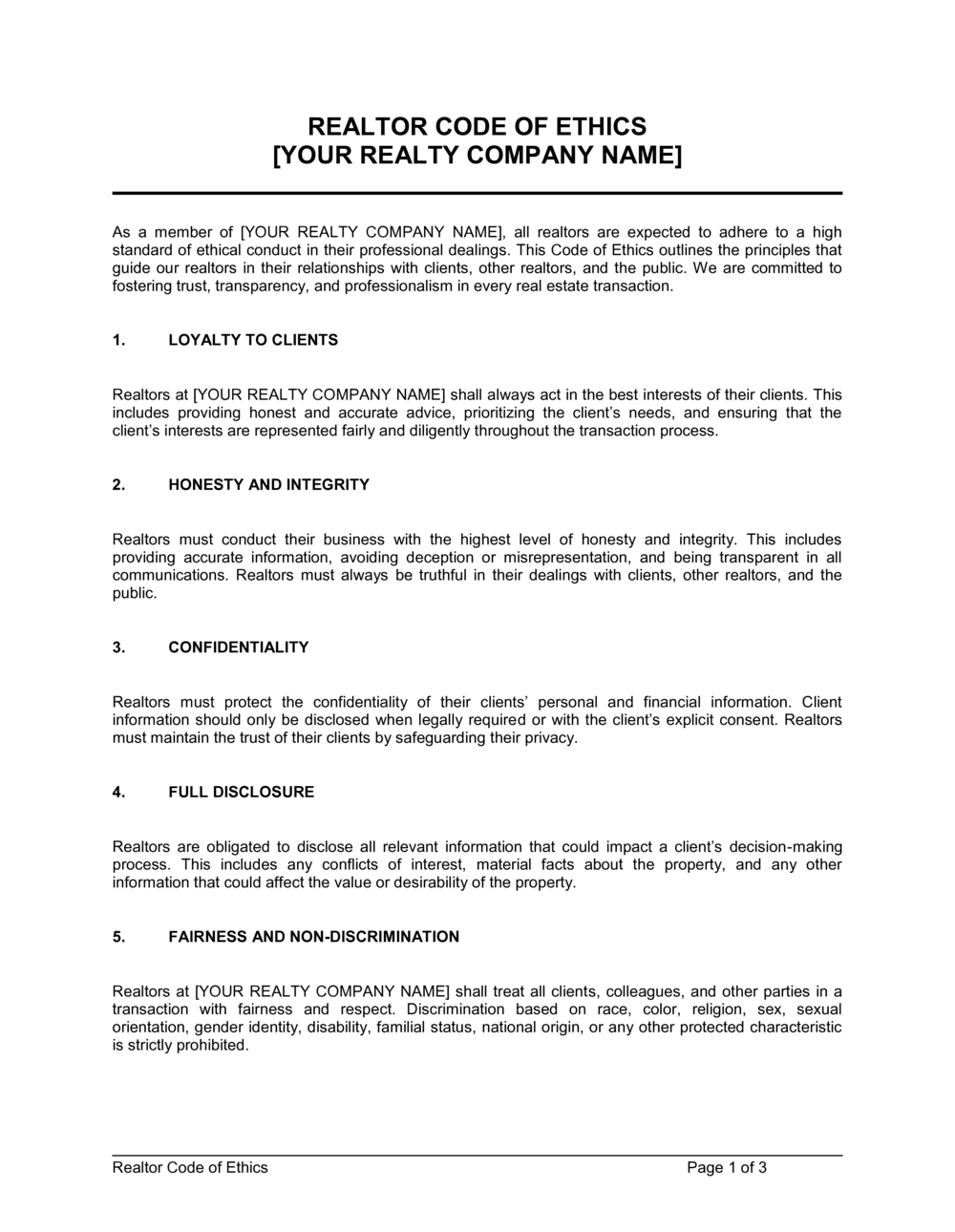
Realtor Code Of Ethics Template

Free Word download β€’ Edit online β€’ Save & share with Drive β€’ Export to PDF

3 pagesβ€’25–30 min to fillβ€’Difficulty: Standardβ€’Signature requiredβ€’Legal review recommended
Learn more ↓
FreeRealtor Code Of Ethics Template

At a glance

What it is
A Realtor Code of Ethics is a binding professional conduct document that establishes the ethical obligations real estate agents and brokers owe to their clients, the public, and fellow practitioners. This free Word download lets you adapt a comprehensive, structured code to your brokerage or individual practice and export it as PDF for signing and filing.
When you need it
Use it when onboarding new agents to a brokerage, establishing a firm-wide conduct standard, or formalizing the ethical framework required by a state licensing board or professional association membership. It is also used when a brokerage needs a documented policy for handling complaints or disciplinary proceedings.
What's inside
Duties to clients and customers, fiduciary obligations, fair housing compliance, disclosure requirements, confidentiality, advertising standards, duties to fellow practitioners, dispute resolution procedures, and acknowledgment and signature blocks.

What is a Realtor Code of Ethics?

A Realtor Code of Ethics is a binding professional conduct document that defines the ethical obligations real estate agents and brokers owe to their clients, the public, and fellow practitioners. It translates fiduciary principles β€” loyalty, confidentiality, disclosure, obedience, reasonable care, and accounting β€” into specific, enforceable rules covering every phase of a real estate transaction, from first client contact through post-closing confidentiality. Where the National Association of Realtors publishes a national model code for member agents, a brokerage's internal code of ethics supplements that framework with firm-specific standards for advertising accuracy, social media use, dual agency disclosures, and disciplinary procedures tailored to the brokerage's operating environment and jurisdiction.

Why You Need This Document

Without a written, signed code of ethics, a brokerage has no documented standard to point to when a client files a complaint, a licensing board opens an investigation, or an agent's conduct in a transaction becomes the subject of litigation. The absence of a code does not mean no standard applies β€” it means the standard will be supplied by the state licensing board or a court, and the brokerage will have no evidence it ever communicated or enforced any conduct expectations. A well-drafted code closes that gap by creating a clear, acknowledged record of the rules every affiliated agent agreed to follow. It also reduces the frequency of the underlying problems: agents who sign a specific, detailed code before their first transaction make materially fewer disclosure errors, fair housing missteps, and advertising violations than those operating without one. This template gives brokerages of any size a structured, customizable foundation that meets NAR member requirements, aligns with state licensing board expectations, and holds up as a compliance document the first time it is tested.

Which variant fits your situation?

If your situation is…Use this template
Establishing conduct rules for all agents at a multi-agent brokerageRealtor Code of Ethics (Brokerage Policy)
Individual agent affirming ethics compliance for licensing renewalProfessional Conduct Acknowledgment
Governing the relationship between a buyer and their agentBuyer Representation Agreement
Governing the relationship between a seller and their listing agentListing Agreement
Handling referral relationships and fee-sharing between agentsReal Estate Referral Agreement
Documenting agent non-solicitation and non-compete obligations on departureIndependent Contractor Agreement (Real Estate Agent)
Formalizing property management conduct obligationsProperty Management Agreement

Common mistakes to avoid

❌ Using a generic code without jurisdiction-specific protected classes

Why it matters: A code listing only the seven federal Fair Housing Act categories misses state and local additions β€” agents operating under it may discriminate in ways that are illegal locally but not captured by the policy, exposing the brokerage to regulatory action.

Fix: Research your state real estate commission's fair housing guidance and add all applicable protected classes before distributing the code for signatures.

❌ No version control or re-signature requirement on updates

Why it matters: An agent who signed Version 1.0 in 2021 is not automatically bound by a 2024 amendment unless the original agreement contains an incorporated-amendments clause or a new signature was obtained.

Fix: Add a version number and effective date to every edition, include a clause stating that material amendments require re-acknowledgment, and collect new signatures within 30 days of any update.

❌ Omitting post-transaction confidentiality duration

Why it matters: Confidentiality obligations that expire at closing leave the brokerage unprotected β€” a former agent can legally disclose a client's financial distress or motivation after the deal closes.

Fix: State explicitly that confidentiality obligations survive the termination of the agency relationship and have no expiration date.

❌ No social media and online advertising standards

Why it matters: Agents posting inaccurate square footage, unverified neighborhood claims, or outdated listings on social platforms create misrepresentation liability that attaches to the brokerage even if the post came from a personal account.

Fix: Add a dedicated advertising standards clause that covers social media, third-party portals, and AI-generated content, specifying what review or approval is required before publication.

❌ Signing the acknowledgment after the agent's first transaction

Why it matters: An agent who has already completed a deal under the brokerage's umbrella without signing the code undermines the argument that the code governed their conduct β€” creating a gap in the brokerage's liability defense.

Fix: Make code acknowledgment a prerequisite for accessing the brokerage's MLS credentials, email systems, or listing templates β€” no signature, no access.

❌ Undefined or open-ended disciplinary timelines

Why it matters: A complaint process with no specified response windows or decision deadlines exposes the brokerage to claims of selective or retaliatory enforcement, and makes it difficult to defend the process if the state licensing board reviews it.

Fix: Specify exact day counts for each stage β€” complaint submission, respondent response, investigation, and decision β€” and document every step in writing.

The 10 key clauses, explained

Preamble and Statement of Purpose

In plain language: Sets out the philosophy and foundational values of the code β€” honesty, integrity, and professionalism β€” and explains that adherence is a condition of practice within the brokerage or association.

Sample language
This Code of Ethics governs the professional conduct of all licensed agents operating under [BROKERAGE NAME] and reflects the standards established by [APPLICABLE ASSOCIATION / LICENSING BODY]. Adherence to this Code is a condition of continued affiliation.

Common mistake: Treating the preamble as a marketing statement rather than a binding commitment. If the code does not explicitly state that violations carry consequences, agents may treat it as aspirational rather than enforceable.

Duties to Clients and Customers

In plain language: Defines the agent's obligations to clients they represent and customers they work with β€” including honesty, competence, and the duty to put client interests first.

Sample language
Agents shall at all times represent the interests of their client with loyalty and good faith. When dealing with customers not represented by [BROKERAGE NAME], agents shall treat all parties honestly and shall not misrepresent or withhold any material fact.

Common mistake: Conflating client and customer duties. A client is owed fiduciary duties; a customer is owed only honesty. Treating both identically either under-serves clients or over-extends obligations to unrepresented parties.

Fiduciary Obligations

In plain language: Enumerates the six core fiduciary duties owed to represented clients: loyalty, confidentiality, disclosure, obedience, reasonable care, and accounting.

Sample language
Agents representing a client owe the duties of loyalty, confidentiality, full disclosure, obedience to lawful instructions, reasonable care and diligence, and accurate accounting of all funds received in connection with the representation.

Common mistake: Omitting the accounting duty. Agents who co-mingle client earnest money or referral fees with operating funds create serious liability and licensing violations, even when the omission was unintentional.

Fair Housing and Non-Discrimination

In plain language: Prohibits agents from steering, discriminating, or making representations based on protected characteristics, and requires affirmative compliance with federal, state, and local fair housing laws.

Sample language
No agent shall, on account of race, color, religion, national origin, sex, disability, familial status, or any other characteristic protected under applicable law, refuse to show, sell, or rent property; steer a client toward or away from a neighborhood; or make any representation designed to induce or prevent a transaction.

Common mistake: Listing only the seven federal Fair Housing Act protected classes and omitting state or local additions. Many jurisdictions add source of income, sexual orientation, and marital status β€” a code that lists only federal classes exposes the brokerage to state-level complaints.

Disclosure Obligations

In plain language: Requires agents to proactively disclose all known material facts affecting the property or transaction, including conflicts of interest, agency relationships, and personal financial interests.

Sample language
Agents shall disclose to all parties any known material defects, latent conditions, or facts likely to affect the value or desirability of the property. Agents with a personal financial interest in a transaction β€” including ownership, family relationship, or referral fee β€” shall disclose such interest in writing before proceeding.

Common mistake: Using a blanket 'as-is' framing to avoid disclosure. Known material defects must be disclosed even in as-is transactions in most jurisdictions; failing to do so exposes the agent and brokerage to rescission claims and license suspension.

Advertising and Marketing Standards

In plain language: Sets requirements for truthful, accurate advertising β€” including online listings, social media, and signage β€” and prohibits misleading claims about price, availability, or property condition.

Sample language
All advertising and marketing materials produced by or on behalf of [BROKERAGE NAME] shall be truthful, accurate, and not misleading. Agents shall not advertise a listed property without the seller's written authorization and shall remove listings from public platforms within [X] days of sale or withdrawal.

Common mistake: No specific rule on social media and online portals. Agents posting outdated listings, unverified square footage, or AI-generated property descriptions without review create misrepresentation liability the brokerage inherits.

Confidentiality and Data Protection

In plain language: Restricts agents from disclosing client financial information, motivation, negotiating position, or personal data to unauthorized parties during or after the transaction.

Sample language
Agents shall not disclose, without written authorization, the price a client will accept, the client's motivation for selling or buying, or any personal or financial information obtained in the course of representation. This obligation survives the termination of the agency relationship.

Common mistake: Confidentiality clauses that expire at closing. A client's motivation, financial constraints, or health circumstances shared during the transaction remain confidential indefinitely β€” a time-limited clause invites post-closing disclosures.

Duties to Fellow Practitioners

In plain language: Governs how agents interact with other real estate professionals β€” including cooperation on listings, commission-sharing, and prohibitions on disparaging competitors.

Sample language
Agents shall cooperate with other real estate professionals where such cooperation is in the best interest of the client. Agents shall not make false or misleading statements about fellow practitioners and shall not interfere with an existing exclusive agency relationship.

Common mistake: Omitting procuring cause language. Disputes over who earned a commission when multiple agents worked with the same buyer are among the most common inter-agent conflicts β€” a clear procuring cause standard in the code prevents most of them.

Dispute Resolution and Disciplinary Procedures

In plain language: Establishes the process for filing a complaint, conducting an investigation, and imposing sanctions β€” including referral to a licensing board, fines, suspension, or termination of affiliation.

Sample language
Complaints alleging a violation of this Code shall be submitted in writing to [MANAGING BROKER / ETHICS COMMITTEE] within [X] days of the alleged incident. The respondent shall have [X] days to provide a written response. Sanctions may include written reprimand, mandatory training, fines up to $[AMOUNT], suspension, or termination of affiliation.

Common mistake: No defined timelines for the complaint process. An open-ended process exposes the brokerage to claims that complaints were buried or handled inconsistently, which compounds liability if a licensing board investigates.

Acknowledgment, Consent, and Signature

In plain language: Confirms the agent has read and understood the code, agrees to be bound by its terms, and acknowledges that violations may result in the stated disciplinary actions.

Sample language
I, [AGENT NAME], acknowledge that I have read, understood, and agree to comply with the [BROKERAGE NAME] Code of Ethics. I understand that a violation of this Code may result in disciplinary action up to and including termination of my affiliation with [BROKERAGE NAME] and referral to [STATE LICENSING BOARD].

Common mistake: Obtaining a signature on the initial hire date only and never re-obtaining consent when the code is materially updated. A signed acknowledgment of Version 1.0 does not bind the agent to amendments made in Version 2.0 unless they re-sign or the original agreement includes a provision for incorporated amendments.

How to fill it out

  1. 1

    Insert the brokerage's legal name and licensing details

    Replace all [BROKERAGE NAME] placeholders with the brokerage's full registered legal name and include the state or provincial license number. This ties the document to an identifiable legal entity.

    πŸ’‘ Cross-check the legal name against the brokerage's state license record β€” trade names and legal entity names often differ, and using the wrong one weakens enforceability.

  2. 2

    Align the protected classes list with your jurisdiction

    Review the fair housing clause and add any protected characteristics mandated by your state, provincial, or municipal law beyond the federal baseline. Common additions include source of income, sexual orientation, gender identity, and marital status.

    πŸ’‘ Check your state real estate commission's guidance annually β€” fair housing protected classes are expanded by legislation more often than most agents realize.

  3. 3

    Define disclosure requirements specific to your market

    Insert property-type-specific disclosure obligations relevant to your market β€” lead paint, flood zone, HOA disclosures, stigmatized property rules, or seller property disclosure statement requirements.

    πŸ’‘ If you operate in multiple states, create a jurisdiction-specific addendum rather than overloading the main code with state-by-state variations.

  4. 4

    Set advertising and listing accuracy standards

    Specify which portals agents may use, how quickly expired or sold listings must be removed, and what review process applies to AI-generated or third-party marketing copy.

    πŸ’‘ Include a specific social media policy β€” platforms like Instagram and TikTok create misrepresentation exposure that was not contemplated in codes written before 2018.

  5. 5

    Complete the disciplinary procedure section

    Fill in complaint submission timelines, investigation steps, the composition of any ethics committee, and the schedule of sanctions. Make the process specific enough that any agent can predict exactly what will happen if a complaint is filed.

    πŸ’‘ Mirror the timeline used by your state licensing board or associated MLS β€” consistency between internal and external processes makes disciplinary decisions easier to defend.

  6. 6

    Have the managing broker review the document before distribution

    The managing broker should confirm that every clause meets or exceeds the standards required by the state licensing board and any professional association the brokerage belongs to.

    πŸ’‘ If the brokerage is a NAR member, verify that the internal code does not conflict with the current edition of the NAR Code of Ethics, which is updated every two years.

  7. 7

    Obtain dated signatures from all agents before they begin practice

    Collect a wet or electronic signature from each agent before their first active transaction. Store signed copies in each agent's personnel file and in a central brokerage compliance folder.

    πŸ’‘ Use a dated e-signature platform so you have a timestamped record β€” this is the first document a state licensing board will request in any disciplinary investigation.

  8. 8

    Re-obtain acknowledgment whenever the code is materially updated

    Any change to duty clauses, protected class lists, or disciplinary procedures constitutes a material update requiring fresh signatures. Include a version number and effective date on every published edition.

    πŸ’‘ Schedule an annual review date in your compliance calendar β€” even if no changes are made, documenting that a review occurred demonstrates good-faith compliance management.

Frequently asked questions

What is a Realtor Code of Ethics?

A Realtor Code of Ethics is a binding professional conduct document that defines the ethical obligations real estate agents owe to their clients, the public, and fellow practitioners. It covers fiduciary duties, disclosure obligations, fair housing compliance, advertising standards, and dispute resolution. While the National Association of Realtors (NAR) publishes a model code that member agents must follow, brokerages typically supplement it with a firm-specific policy tailored to their state's licensing requirements.

Is a Realtor Code of Ethics legally required?

NAR membership requires adherence to the NAR Code of Ethics, and most state licensing boards require agents to complete ethics training as a condition of license renewal. A brokerage's internal code of ethics is not universally mandated by statute, but it is generally considered essential risk management β€” it documents the conduct standard the brokerage enforces, which is the first line of defense in a licensing board complaint or civil lawsuit.

What is the difference between the NAR Code of Ethics and a brokerage code?

The NAR Code of Ethics is a national standard that applies to all NAR members and is enforced through the local association's professional standards process. A brokerage code of ethics is an internal document that may adopt, supplement, or exceed NAR standards and is enforced internally by the managing broker or an ethics committee. A brokerage code can be more specific β€” addressing social media, data privacy, and local fair housing additions β€” in ways the national code does not.

Does every real estate agent at a brokerage need to sign the code?

Yes β€” every licensed agent affiliated with the brokerage, including part-time agents, referral-only agents, and independent contractors operating under the brokerage license, should sign before their first active transaction. A code that is not universally signed creates an uneven enforcement standard, which is difficult to defend in a disciplinary proceeding or civil claim.

What happens when a realtor violates the code of ethics?

Depending on the severity, consequences range from a written reprimand and mandatory ethics training to fines, suspension, or termination of brokerage affiliation. Serious violations β€” fraud, misrepresentation, or discrimination β€” may also be referred to the state real estate licensing board, which can suspend or revoke the agent's license independently of any brokerage action. The code itself should specify each level of sanction to ensure consistent enforcement.

How often should a brokerage update its code of ethics?

At minimum, review the code annually and update it whenever the NAR Code of Ethics is revised (typically every two years), when your state licensing board changes its rules, or when your jurisdiction adds new fair housing protected classes. Document each review in writing, assign a version number, and re-obtain agent signatures on any material update.

Can a brokerage code of ethics be more restrictive than NAR standards?

Yes β€” a brokerage may impose stricter conduct standards than NAR requires, provided those standards do not conflict with state employment law or licensing board rules. Common additions include tighter social media policies, broader confidentiality obligations, shorter listing removal timelines, and expanded protected class lists for fair housing. More restrictive standards are generally defensible; less restrictive standards that fall below NAR or state requirements are not.

How does dual agency affect ethics obligations?

Dual agency β€” representing both buyer and seller in the same transaction β€” creates inherent conflicts with fiduciary duties. Most states permit disclosed dual agency with written consent from both parties, but require the agent to transition from full advocacy to a neutral facilitation role. The code of ethics should specify when dual agency is permitted, what disclosures are required, and how agents should manage the conflict to avoid claims of misrepresentation or breach of fiduciary duty.

Does a real estate code of ethics cover property managers?

It can and typically should for brokerages that also operate property management divisions. Property managers handle client funds, maintenance decisions, and tenant relationships β€” all areas with significant ethical exposure. A code that is limited to sales agents leaves property managers operating without a documented conduct standard, which creates liability gaps in rent accounting, security deposit handling, and fair housing compliance.

How this compares to alternatives

vs Independent Contractor Agreement (Real Estate Agent)

An independent contractor agreement governs the commercial relationship between a brokerage and an agent β€” commission splits, expenses, termination, and non-solicitation. A code of ethics governs professional conduct obligations owed to clients, the public, and fellow agents. Both documents are needed; the contractor agreement covers the business relationship, and the code covers the ethical standard. They should cross-reference each other.

vs Buyer Representation Agreement

A buyer representation agreement is a contract between an agent and a specific buyer defining the scope of representation, duration, and compensation. A code of ethics is a brokerage-wide policy governing how all agents must conduct themselves with all clients. The code informs the duties an agent owes under a buyer representation agreement, but operates at a different level of specificity.

vs Listing Agreement

A listing agreement is a transaction-specific contract between a brokerage and a seller covering pricing, marketing, commission, and exclusivity. A code of ethics applies to all transactions and all relationships, not just listed properties. The code governs how agents fulfill their duties under a listing agreement, but it is not a substitute for the listing agreement itself.

vs Non-Disclosure Agreement

An NDA protects specific confidential information shared in a defined commercial context and creates remedies for breach. A code of ethics includes confidentiality obligations as one of several conduct standards, but those obligations are broader β€” covering client motivation, financial position, and negotiating strategy β€” and are enforced through professional discipline rather than civil litigation. High-stakes transactions involving proprietary commercial data may require both.

Industry-specific considerations

Residential Real Estate

Buyer and seller representation, dual agency disclosures, MLS accuracy obligations, and fair housing compliance in residential transactions.

Commercial Real Estate

Confidentiality of tenant financial terms, conflict-of-interest disclosures for landlord and tenant rep, and enhanced due diligence duties on material facts.

Property Management

Trust accounting obligations, security deposit handling, fair housing compliance in tenant selection, and maintenance disclosure duties.

Real Estate Franchises

Alignment between franchisor conduct standards and local licensing requirements, with brokerage-specific addenda covering local fair housing classes and social media policies.

Jurisdictional notes

United States

NAR member agents must comply with the NAR Code of Ethics, which is updated approximately every two years and enforced through local associations. State licensing boards set independent continuing education requirements for ethics training β€” typically 3 hours per renewal cycle. Fair housing protected classes vary significantly by state and municipality; California, New York, and Illinois, among others, add protected classes beyond the seven federal categories. Non-compete and non-solicitation clauses in agent contractor agreements are subject to state-specific restrictions that should be reviewed alongside the ethics document.

Canada

Real estate regulation in Canada is provincially administered. Each province has its own licensing body β€” RECO in Ontario, BCFSA in British Columbia, RECA in Alberta β€” with its own code of conduct requirements. A brokerage operating across provinces must ensure its internal code meets the strictest provincial standard. Quebec's Civil Code framework creates distinct agency relationship rules, and the French language requirements of Quebec's Charter of the French Language may require bilingual versions of the code for Quebec-based agents.

United Kingdom

Estate agents in the UK are regulated primarily under the Estate Agents Act 1979 and the Consumer Protection from Unfair Trading Regulations 2008. Membership in professional bodies such as ARLA Propertymark, NAEA Propertymark, or RICS comes with mandatory codes of practice that a brokerage's internal ethics document should not contradict. Material information disclosure duties were significantly strengthened by National Trading Standards guidance issued in 2022–2024, requiring upfront disclosure of tenure, charges, and known defects at the point of marketing.

European Union

Real estate agent regulation in the EU is handled at the member state level with no single EU-wide licensing standard. Germany requires Gewerbezulassung (trade license) and adherence to specific conduct rules; France mandates a carte professionnelle issued under the Loi Hoguet. GDPR applies across all EU jurisdictions and has direct implications for the confidentiality and data protection clause β€” agents handling client personal data must comply with data minimization, retention limitation, and breach notification obligations. The EU Consumer Rights Directive also imposes pre-contractual disclosure requirements relevant to advertising standards clauses.

Template vs lawyer β€” what fits your deal?

PathBest forCostTime
Use the templateSmall to mid-size brokerages establishing a standard code for residential agents in a single stateFree1–3 hours to customize and distribute
Template + legal reviewBrokerages operating in multiple states, adding custom disciplinary procedures, or supplementing NAR membership requirements$300–$800 for a real estate attorney review3–5 business days
Custom draftedLarge franchises, commercial brokerages with complex dual-agency practices, or firms under prior licensing board scrutiny$1,500–$4,000+2–4 weeks

Glossary

Fiduciary Duty
A legal obligation to act in the best interests of a client β€” covering loyalty, confidentiality, disclosure, obedience, reasonable care, and accounting.
Dual Agency
A situation where one agent or brokerage represents both the buyer and the seller in the same transaction, creating a potential conflict of interest.
Material Fact
Any information that would reasonably affect a party's decision to buy, sell, or lease property β€” agents are typically required to disclose all known material facts.
Procuring Cause
The agent whose actions were the unbroken chain of events leading to a completed sale, determining who is entitled to a commission.
Fair Housing Act
US federal law prohibiting discrimination in housing transactions based on race, color, national origin, religion, sex, familial status, or disability.
Confidentiality Obligation
The agent's duty not to disclose a client's motivation, financial position, or negotiating strategy to opposing parties without authorization.
Earnest Money
A deposit made by a buyer to demonstrate good faith, held in escrow until closing or returned under conditions specified in the purchase agreement.
Misrepresentation
A false or misleading statement of fact β€” or omission of a material fact β€” made to induce a party to enter a transaction.
Arbitration (Real Estate)
A binding dispute resolution process administered outside the courts, commonly used by real estate associations to resolve commission and ethics disputes between members.
Pocket Listing
A property sold through private channels before being listed on the MLS, raising ethical questions about whether the seller's interests are fully served.
Agency Disclosure
A written notice an agent provides to all parties identifying who the agent represents and what duties are owed to each party.

Part of your Business Operating System

This document is one of 3,000+ business & legal templates included in Business in a Box.

  • Fill-in-the-blanks β€” ready in minutes
  • 100% customizable Word document
  • Compatible with all office suites
  • Export to PDF and share electronically

Create your document in 3 simple steps.

From template to signed document β€” all inside one Business Operating System.
1
Download or open template

Access over 3,000+ business and legal templates for any business task, project or initiative.

2
Edit and fill in the blanks with AI

Customize your ready-made business document template and save it in the cloud.

3
Save, Share, Send, Sign

Share your files and folders with your team. Create a space of seamless collaboration.

Save time, save money, and create top-quality documents.

β˜…β˜…β˜…β˜…β˜…

"Fantastic value! I'm not sure how I'd do without it. It's worth its weight in gold and paid back for itself many times."

Managing Director Β· Mall Farm
Robert Whalley
Managing Director, Mall Farm Proprietary Limited
β˜…β˜…β˜…β˜…β˜…

"I have been using Business in a Box for years. It has been the most useful source of templates I have encountered. I recommend it to anyone."

Business Owner Β· 4+ years
Dr Michael John Freestone
Business Owner
β˜…β˜…β˜…β˜…β˜…

"It has been a life saver so many times I have lost count. Business in a Box has saved me so much time and as you know, time is money."

Owner Β· Upstate Web
David G. Moore Jr.
Owner, Upstate Web

Run your business with a system β€” not scattered tools

Stop downloading documents. Start operating with clarity. Business in a Box gives you the Business Operating System used by over 250,000 companies worldwide to structure, run, and grow their business.

Start freeΒ Β·Β No credit card required