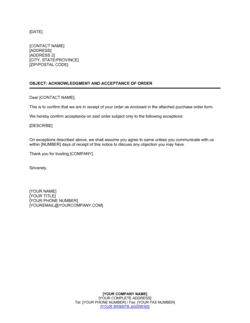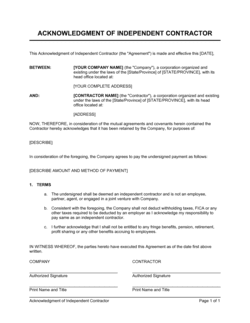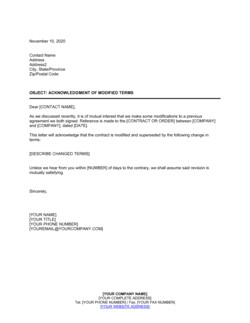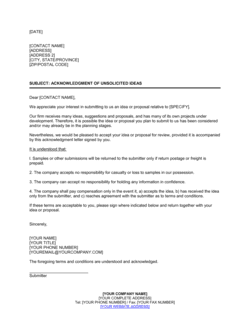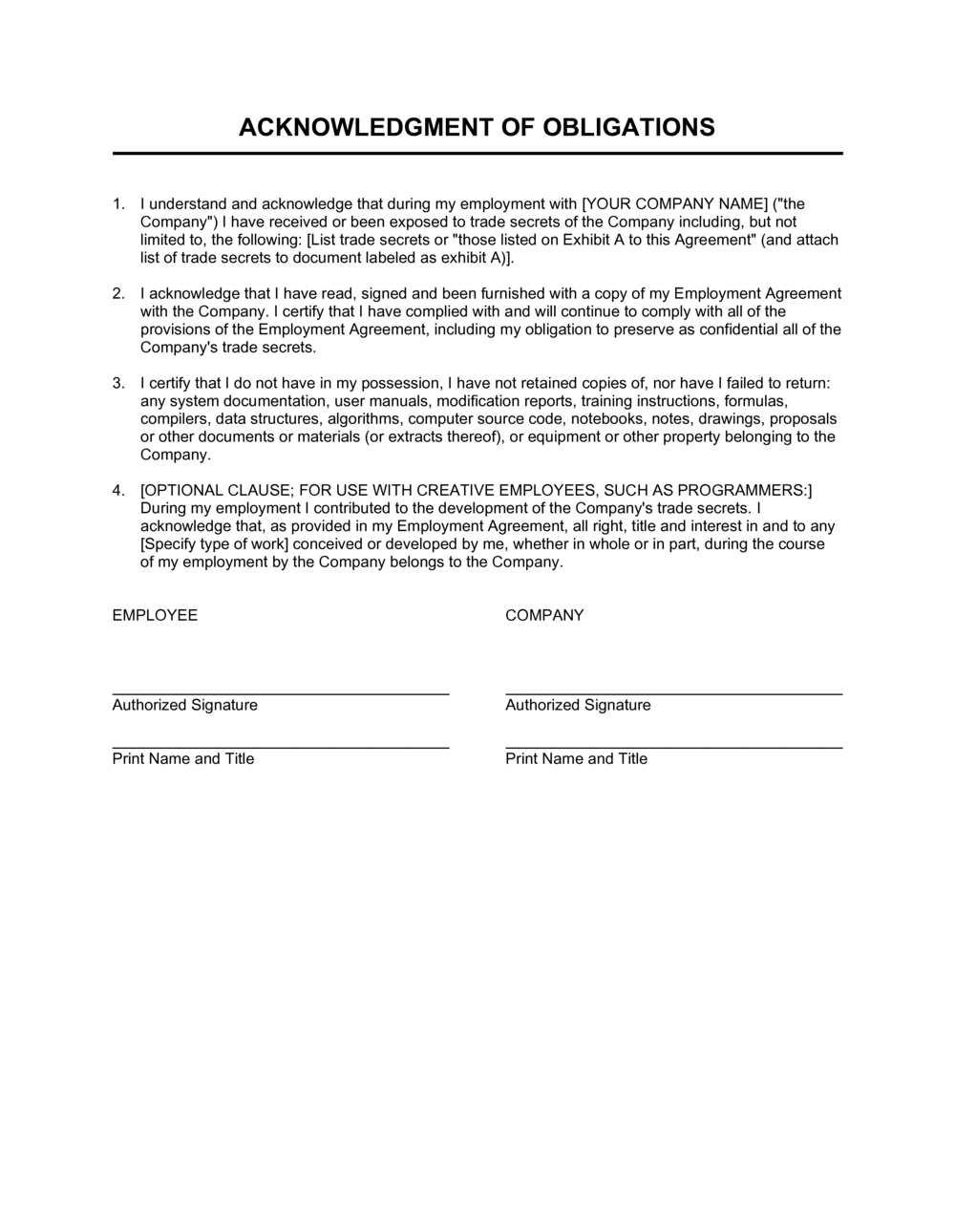
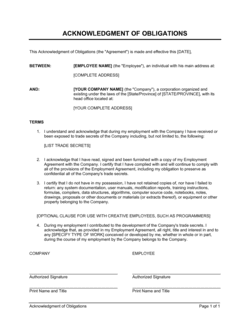
Acknowledgment Of Obligations Template

Free Word download β€’ Edit online β€’ Save & share with Drive β€’ Export to PDF

1 pageβ€’15–25 min to fillβ€’Difficulty: Standard
Learn more ↓
FreeAcknowledgment Of Obligations Template

At a glance

What it is
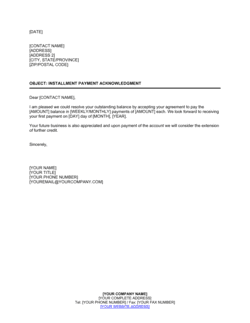
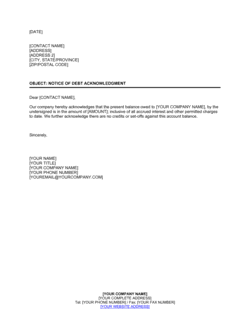
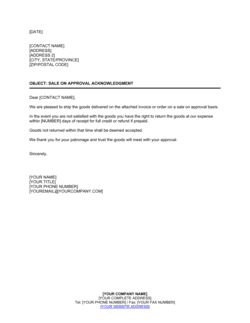
An Acknowledgment of Obligations is a formal business letter in which one party confirms in writing that they have received, read, and understood a specific set of duties, responsibilities, or contractual terms. This free Word download gives you a ready-to-use structure you can edit online and export as PDF to send or retain on file within minutes.
When you need it
Use it whenever you need documented proof that a person or organization has been informed of β€” and has confirmed awareness of β€” specific obligations binding them. Common triggers include onboarding new employees, activating vendor relationships, issuing policy updates, or formalizing the terms of an existing agreement.
What's inside
Sender and recipient details, a clear statement of the obligations being acknowledged, a confirmation of understanding, a reference to the underlying agreement or policy, and a closing with date and contact information.

What is an Acknowledgment of Obligations?

An Acknowledgment of Obligations is a formal business letter in which one party confirms in writing that they have received, reviewed, and understood a specific set of duties or responsibilities β€” typically arising from an employment agreement, vendor contract, company policy, or regulatory requirement. Unlike a contract, it does not create new obligations; it documents that the recipient was formally notified of obligations that already exist. This makes it a straightforward but important tool for building an audit trail, reducing "I didn't know" disputes, and demonstrating good-faith communication between parties.

Why You Need This Document

Without a written acknowledgment on file, proving that an employee, contractor, or vendor was ever formally informed of their obligations becomes a matter of memory and credibility rather than documented fact. When a policy is violated, a confidentiality breach occurs, or a contractual duty goes unmet, the first line of defense is evidence that the party knew what was required of them. An acknowledgment of obligations closes that gap cleanly and quickly. It takes under 15 minutes to complete, requires no legal expertise to issue, and can be filed alongside the underlying agreement as a permanent part of the record. This template gives you the structure to issue a professional, clearly worded acknowledgment letter every time β€” without drafting from scratch.

Which variant fits your situation?

If your situation is…Use this template
Confirming an employee's acknowledgment of a company policy or handbookEmployee Policy Acknowledgment Letter
Notifying a vendor or supplier of their contractual obligationsVendor Obligation Notice
Acknowledging the terms of a non-disclosure agreementNon-Disclosure Agreement Acknowledgment
Confirming receipt and understanding of a code of conductCode of Conduct Acknowledgment
Formally confirming a debt or payment obligationAcknowledgment of Debt
Documenting a party's awareness of confidentiality obligationsConfidentiality Acknowledgment Letter
Confirming compliance obligations under a regulatory frameworkRegulatory Compliance Acknowledgment

Common mistakes to avoid

❌ Vague subject line that omits the agreement name

Why it matters: A subject line reading 'Re: Obligations' gives the recipient no context and creates ambiguity about which duties are being confirmed β€” making the letter nearly useless as evidence.

Fix: Always include the full agreement or policy name and its date in the subject line, e.g., 'Re: Acknowledgment of Obligations under the Vendor Services Agreement dated [DATE].'
❌ Confusing acknowledgment with consent to new terms

Why it matters: If the letter's language implies the recipient is agreeing to obligations they have not previously accepted, it may be read as an attempt to vary the underlying agreement without proper process.

Fix: Use language that confirms awareness only β€” 'acknowledges receipt and understanding of' β€” and include an explicit non-modification clause.

❌ Omitting the effective date

Why it matters: Without a stated effective date, neither party has a clear reference point for when the recipient was formally on notice β€” which is the primary purpose of the letter.

Fix: State the effective date explicitly in its own clause, even if it simply mirrors the letter's issue date.

❌ Referencing obligations only by section number

Why it matters: If the underlying document is later amended, disputed, or unavailable, a bare section reference provides no independent record of what the recipient actually understood at the time.

Fix: Pair every section cross-reference with a one-line plain-language summary of the obligation it covers.

The 9 key clauses, explained

Header and parties block

In plain language: Identifies the sender and recipient by full name and organization, states the date, and includes a clear subject line indicating the purpose of the letter.

Sample language
[DATE] | To: [RECIPIENT FULL NAME], [TITLE], [ORGANIZATION] | From: [SENDER FULL NAME], [TITLE], [ORGANIZATION] | Re: Acknowledgment of Obligations under [AGREEMENT NAME / POLICY NAME]

Common mistake: Using a trade name or department name instead of the individual's full legal name. If the acknowledgment is ever needed as evidence, an unidentified recipient weakens its value.

Opening recital

In plain language: States the purpose of the letter in the first sentence β€” confirming that the recipient has received and reviewed the relevant agreement, policy, or set of obligations.

Sample language
This letter serves as formal confirmation that [RECIPIENT NAME] has received, reviewed, and understands the obligations set out in [AGREEMENT / POLICY NAME], dated [DATE].

Common mistake: Opening with vague language like 'Following our recent discussions...' without naming the specific document. Ambiguity about which agreement is being acknowledged can make the letter useless in a dispute.

Description of obligations

In plain language: Summarizes the specific duties, restrictions, or responsibilities being acknowledged β€” either inline or by reference to a numbered section of the underlying document.

Sample language
The obligations acknowledged herein include, but are not limited to: (a) [OBLIGATION 1], (b) [OBLIGATION 2], and (c) [OBLIGATION 3], as further detailed in Sections [X]–[Y] of the [AGREEMENT NAME].

Common mistake: Referencing obligations only by section number without a plain-language summary. If the underlying document changes or is disputed, a bare cross-reference provides no independent record of what was understood.

Confirmation of receipt and understanding

In plain language: The recipient's affirmative statement that they have received the relevant document and understand what is required of them.

Sample language
[RECIPIENT NAME] hereby confirms receipt of the [AGREEMENT / POLICY] and acknowledges full understanding of the obligations described above and as set out therein.

Common mistake: Conflating acknowledgment with agreement. This clause confirms awareness β€” not consent to new terms. Blurring the distinction can expose the sender to unintended contractual commitments.

Effective date and duration

In plain language: States when the acknowledged obligations take effect and, where applicable, how long they remain in force.

Sample language
These obligations are effective as of [EFFECTIVE DATE] and shall remain in force for [DURATION / until the termination of the [AGREEMENT NAME]].

Common mistake: Omitting the effective date entirely. Without it, there is no fixed reference point for when the party was on notice β€” which matters if a breach is alleged shortly after the letter is issued.

Reference to underlying agreement

In plain language: Cites the full name, version, and date of the document from which the obligations originate, and clarifies that the letter does not modify those terms.

Sample language
This acknowledgment is made in connection with the [FULL AGREEMENT NAME], dated [DATE], between [PARTY A] and [PARTY B]. This letter does not alter, amend, or supersede any term of that agreement.

Common mistake: Failing to include the non-modification statement. Without it, a court or arbitrator might interpret the acknowledgment letter as a variation of the underlying agreement.

Consequences of non-compliance

In plain language: Briefly notes what may result if the recipient fails to meet the acknowledged obligations β€” referencing the remedies already set out in the underlying agreement rather than creating new ones.

Sample language
Failure to comply with the obligations acknowledged herein may result in the remedies set forth in Section [X] of the [AGREEMENT NAME], including [BRIEF DESCRIPTION OF REMEDY β€” e.g., termination, withholding of payment].

Common mistake: Describing consequences in punitive or threatening language not supported by the underlying agreement. This can create grounds for a bad-faith claim and undermine the professional tone of the letter.

Contact information and next steps

In plain language: Provides a point of contact for questions about the obligations and, where applicable, instructs the recipient on any required response or return action.

Sample language
If you have any questions regarding the obligations described in this letter, please contact [NAME] at [EMAIL] or [PHONE]. Please retain a copy of this letter for your records. [If applicable: Please sign and return the enclosed copy by [DATE].]

Common mistake: Omitting a response instruction when a signed copy is expected. If the letter is meant to function as a two-way acknowledgment, failing to request a countersignature leaves the sender without confirmation of receipt.

Closing and sender details

In plain language: Formal closing with the sender's printed name, title, and organization β€” confirming who issued the letter and on whose authority.

Sample language
Sincerely, [SENDER FULL NAME] | [TITLE] | [ORGANIZATION] | [DATE]

Common mistake: Using only a first name or email signature-style closing. A formal printed name and title establish the sender's authority and institutional standing, which matters if the letter is filed or produced in proceedings.

How to fill it out

  1. 1

    Complete the header with full names and date

    Enter the recipient's full legal name, title, and organization, along with your own details and the date of issue. Add a subject line that names the specific agreement or policy.

    πŸ’‘ Include the recipient's direct email address in the header so the letter functions as both a mailed and emailed record.

  2. 2

    Write the opening recital

    State in the first sentence exactly which document the recipient is acknowledging β€” using the full agreement title and the date it was executed or issued.

    πŸ’‘ If the underlying document has a version number or revision date, include it here to prevent future confusion about which version was acknowledged.

  3. 3

    Summarize the key obligations in plain language

    List the two to five most material obligations in plain English, either as numbered sub-points or a short paragraph. Cross-reference the relevant sections of the source document.

    πŸ’‘ Avoid copying entire contract clauses verbatim. A clear plain-language summary is more useful than dense legal text and is more likely to be read and understood.

  4. 4

    State the effective date and duration

    Enter the date on which the obligations take effect and, if they are time-limited, the end date or triggering event that terminates them.

    πŸ’‘ If the obligations run for the duration of an agreement, write 'until the earlier of [END DATE] or the termination of the [AGREEMENT NAME]' to cover both scenarios.

  5. 5

    Add the non-modification statement

    Include a clear sentence confirming that this letter does not change any term of the underlying agreement.

    πŸ’‘ Place this sentence immediately after the reference to the underlying agreement, not in a footnote β€” it needs to be visible, not buried.

  6. 6

    Include contact details and response instructions

    Provide a named contact for questions and, if you need a countersigned copy, instruct the recipient clearly on how and by when to return it.

    πŸ’‘ A specific return deadline β€” 'by [DATE], five business days from the date of this letter' β€” is more effective than 'at your earliest convenience.'

  7. 7

    Send, file, and confirm receipt

    Send the letter by email with a read receipt or by tracked mail. File the sent copy immediately in the relevant employee, vendor, or project record.

    πŸ’‘ For high-stakes acknowledgments, follow up with a brief email confirming dispatch and requesting confirmation of receipt within 24 hours.

Frequently asked questions

What is an acknowledgment of obligations?

An acknowledgment of obligations is a formal letter in which one party confirms in writing that they have received, reviewed, and understood a specific set of duties or responsibilities β€” typically arising from a contract, policy, or regulatory requirement. It does not create new obligations; it documents awareness of existing ones. This makes it a key record in employment, vendor, and compliance contexts.

Is an acknowledgment of obligations legally binding?

On its own, an acknowledgment letter is not a contract and does not create new legal obligations. Its legal significance lies in establishing that a party was formally notified of and confirmed understanding of their duties under an existing agreement. In a dispute, this documented notice can be important evidence that the party cannot claim ignorance of the relevant terms.

When should I use an acknowledgment of obligations?

Use it whenever documented proof of notice matters β€” onboarding a new employee or contractor, activating a vendor relationship, issuing a policy update, or confirming that a party has been informed of compliance requirements. Any situation where 'I didn't know' is a foreseeable defense is a situation where this letter adds value.

Does an acknowledgment of obligations need to be signed?

A signature is not strictly required for the letter to serve its notice function, but a countersignature from the recipient significantly strengthens the audit trail. If the acknowledgment is used in an employment or vendor context where disputes are likely, including a signature line and requesting a signed return copy is worth the extra step.

What is the difference between an acknowledgment of obligations and a contract?

A contract creates new mutual obligations and requires offer, acceptance, and consideration to be binding. An acknowledgment of obligations confirms awareness of duties that already exist under a separate agreement. The acknowledgment is a notice document, not a deal-making one. Blending the two β€” by adding new terms inside an acknowledgment letter β€” creates ambiguity about what the recipient has agreed to.

Can I use this letter for employees and vendors?

Yes. The template is designed to be adapted for both contexts. For employees, reference the employment agreement, employee handbook, or specific workplace policy. For vendors and contractors, reference the service agreement, purchase order terms, or supplier code of conduct. The core structure β€” parties, obligations summary, confirmation, effective date β€” works for either relationship.

How do I prove the recipient received the letter?

Send the letter by email with a read receipt and request a reply confirming receipt. For higher-stakes situations, use tracked mail or a courier service with delivery confirmation. Filing the sent email, delivery receipt, and any reply together creates a complete audit trail. If you use an eSign platform, the timestamp and IP record provide strong evidence of delivery and review.

Should I include the full text of the obligations in the letter?

No β€” including the full text of lengthy contract clauses makes the letter unwieldy and is rarely helpful. Instead, provide a plain-language summary of the key obligations and cross-reference the relevant sections of the underlying document. Attach a copy of the relevant agreement or policy if the recipient may not have easy access to it.

Does this template work for international business relationships?

The template is broadly suitable for international use as a notice document. However, specific obligations β€” particularly those related to data privacy, employment, or regulatory compliance β€” are governed by local law. For relationships spanning multiple jurisdictions, ensure that the obligations summarized in the letter are consistent with the governing law clause of the underlying agreement.

How this compares to alternatives

vs Non-Disclosure Agreement

An NDA is a binding contract that creates new confidentiality obligations between parties. An acknowledgment of obligations confirms awareness of duties that already exist β€” including those in an NDA. Use the NDA to establish the obligation and the acknowledgment letter to document that the relevant party has received and understood it.

vs Acknowledgment of Debt

An acknowledgment of debt is a specific financial document in which a party formally confirms they owe a stated amount to a creditor β€” it can reset the limitation period on a debt in many jurisdictions. An acknowledgment of obligations is broader and non-financial, confirming awareness of duties rather than a monetary liability.

vs Offer Letter

An offer letter creates a proposed employment relationship by setting out compensation and role terms for the candidate to accept. An acknowledgment of obligations is issued after the relationship is established, to confirm the employee's awareness of specific duties. The two documents serve different stages of the employment lifecycle.

vs Employment Contract

An employment contract is the primary binding agreement that establishes all terms of the working relationship. An acknowledgment of obligations is a supplementary letter used to create a documented record that the employee has received and understood specific elements of that contract or related policies. One creates the obligation; the other confirms it was communicated.

Industry-specific considerations

Human Resources

Used during onboarding to confirm employees have read and understood the employee handbook, confidentiality policy, or code of conduct before their first day.

Construction and Trades

Issued to subcontractors before site mobilization to confirm awareness of safety obligations, insurance requirements, and scope limitations.

Financial Services

Used to confirm that advisors, brokers, or agents have acknowledged compliance obligations, client confidentiality duties, and regulatory reporting requirements.

Technology / SaaS

Sent to vendors and integration partners to confirm awareness of data processing obligations, API use restrictions, and security compliance requirements.

Template vs pro β€” what fits your needs?

PathBest forCostTime
Use the templateHR managers, small business owners, and operations teams issuing standard policy or contract acknowledgmentsFree10–15 minutes per letter
Template + professional reviewOrganizations issuing acknowledgments tied to complex compliance programs or regulated industry requirements$100–$300 for a legal or HR consultant review1–2 days
Custom draftedEnterprise compliance programs, multi-jurisdiction vendor networks, or high-stakes employment situations with material liability exposure$300–$1,000+3–5 days

Glossary

Acknowledgment
A written confirmation that a party has received and understood specific information, terms, or obligations β€” without necessarily agreeing to new terms.
Obligation
A duty or responsibility that a party is legally or contractually required to perform or refrain from performing.
Underlying Agreement
The contract, policy, or arrangement whose terms the acknowledgment letter references and confirms awareness of.
Audit Trail
A chronological record of documented communications and confirmations that can demonstrate compliance or notice in a dispute.
Notice
Formal communication to a party informing them of a fact, obligation, or event that has legal or contractual significance.
Counterparty
The other party to an agreement β€” the person or organization to whom the obligations are owed or from whom they originate.
Execution Date
The date on which the letter is signed or issued, establishing when the acknowledgment was formally made.
Good Faith
The expectation that both parties will act honestly and without intent to defraud or mislead when giving or receiving an acknowledgment.
Representations
Statements of fact made in a letter that the issuing party affirms to be true and accurate at the time of writing.
Recital
An introductory statement in a letter or agreement that sets out the background facts and purpose of the document.

Part of your Business Operating System

This document is one of 3,000+ business & legal templates included in Business in a Box.

  • Fill-in-the-blanks β€” ready in minutes
  • 100% customizable Word document
  • Compatible with all office suites
  • Export to PDF and share electronically

Create your document in 3 simple steps.

From template to signed document β€” all inside one Business Operating System.
1
Download or open template

Access over 3,000+ business and legal templates for any business task, project or initiative.

2
Edit and fill in the blanks with AI

Customize your ready-made business document template and save it in the cloud.

3
Save, Share, Send, Sign

Share your files and folders with your team. Create a space of seamless collaboration.

Save time, save money, and create top-quality documents.

β˜…β˜…β˜…β˜…β˜…

"Fantastic value! I'm not sure how I'd do without it. It's worth its weight in gold and paid back for itself many times."

Managing Director Β· Mall Farm
Robert Whalley
Managing Director, Mall Farm Proprietary Limited
β˜…β˜…β˜…β˜…β˜…

"I have been using Business in a Box for years. It has been the most useful source of templates I have encountered. I recommend it to anyone."

Business Owner Β· 4+ years
Dr Michael John Freestone
Business Owner
β˜…β˜…β˜…β˜…β˜…

"It has been a life saver so many times I have lost count. Business in a Box has saved me so much time and as you know, time is money."

Owner Β· Upstate Web
David G. Moore Jr.
Owner, Upstate Web

Run your business with a system β€” not scattered tools

Stop downloading documents. Start operating with clarity. Business in a Box gives you the Business Operating System used by over 250,000 companies worldwide to structure, run, and grow their business.

Free Forever PlanΒ Β·Β No credit card required