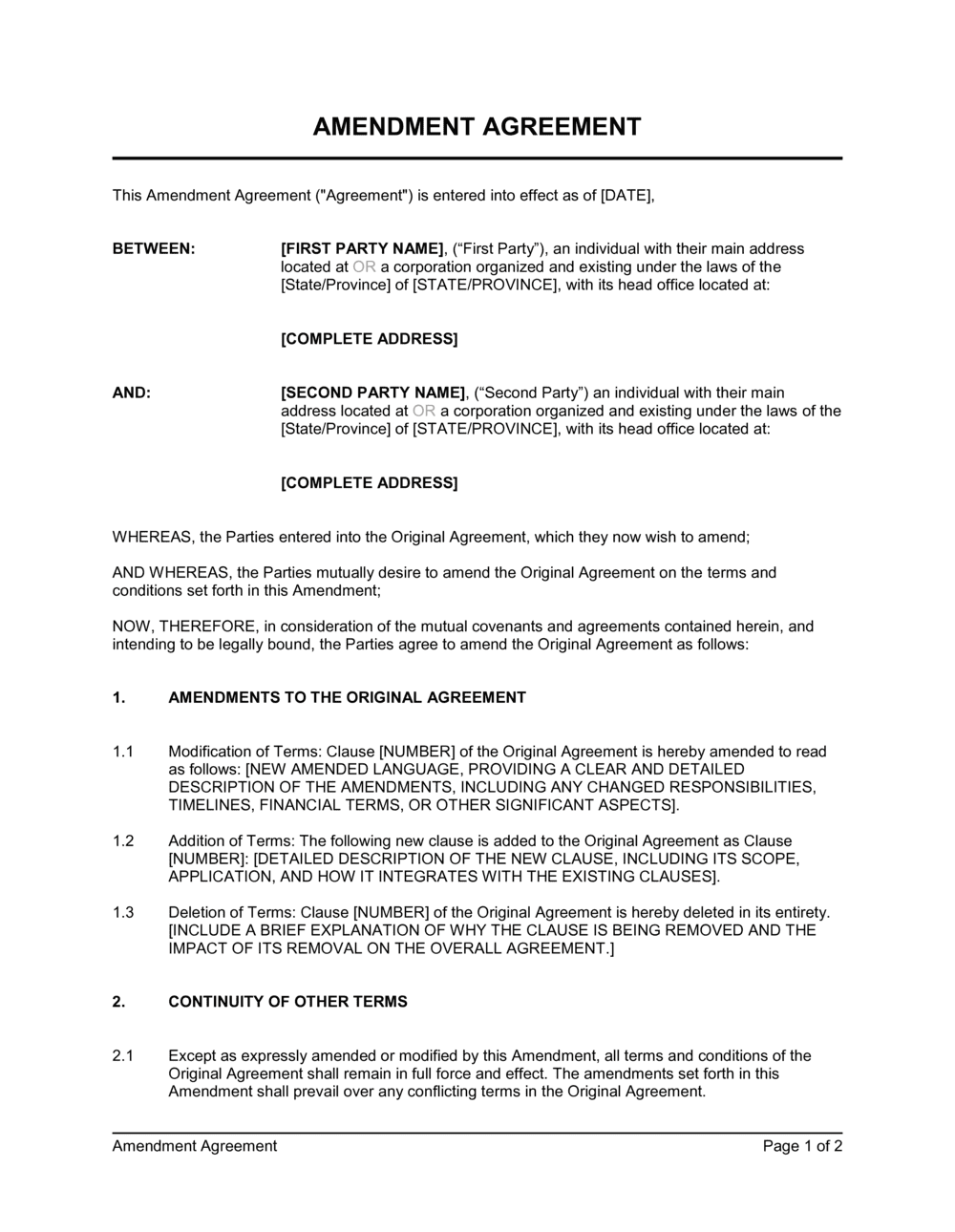
Amendment Agreement Template

Free Word download β€’ Edit online β€’ Save & share with Drive β€’ Export to PDF

2 pagesβ€’20–30 min to fillβ€’Difficulty: Standardβ€’Signature requiredβ€’Legal review recommended
Learn more ↓
FreeAmendment Agreement Template

At a glance

What it is
An Amendment Agreement is a short formal contract that modifies one or more terms of an existing agreement while leaving all unchanged provisions intact. This free Word download lets you reference the original contract, state each specific change clearly, and confirm the rest of the agreement continues in full force β€” all in a single, signable document.
When you need it
Use it whenever you and a counterparty agree to change the price, scope, timeline, or other material terms of a contract already in effect. It is the right tool when multiple provisions need updating at once β€” cleaner and legally more precise than a contract addendum for multi-term changes.
What's inside
Identification of the original agreement and parties, a numbered list of specific amendments replacing old language with new, a confirmation that all other terms remain unchanged, effective date of the amendment, governing law, and signature blocks for all original parties.

What is an Amendment Agreement?

An Amendment Agreement is a short formal contract that modifies one or more specific terms of an existing agreement β€” identifying the original contract, stating the exact language being replaced or removed, and confirming that every other provision remains unchanged and in full force. Unlike a complete contract rewrite or a loosely worded email exchange, an amendment agreement creates a precise, enforceable record of exactly what changed, when it changed, and what the parties agreed the new terms are. It is the preferred instrument when multiple provisions of an active contract need updating at once, because it produces a single, signable document that can be attached to the original and read alongside it without confusion.

Why You Need This Document

Relying on emails, verbal agreements, or informal side letters to document contract changes is one of the most common and costly mistakes in commercial relationships. When a dispute arises, courts look first to the written contract β€” and if your agreed changes are not properly documented in a signed amendment, the original terms control, regardless of what the parties believed they had renegotiated. A missing or poorly drafted amendment can mean paying the old price after agreeing to a new one, performing under superseded scope language, or losing the protection of a liability cap that was quietly removed in an email thread no one saved. This template gives you a legally sound amendment that cites the original agreement precisely, enumerates each change at the section level, and includes the ratification, effective date, and authority clauses that make it enforceable in any major commercial jurisdiction.

Which variant fits your situation?

If your situation is…Use this template
Changing a single minor term such as a due date or notice addressContract Addendum
Modifying multiple provisions of a services agreementAmendment Agreement
Completely replacing an existing contract with updated termsContract Renewal Agreement
Extending the term of an agreement without changing other termsContract Extension Agreement
Adding a new obligation or exhibit to an existing agreementContract Addendum
Amending an employment contract for salary or title changesEmployment Contract Amendment
Modifying a settlement or release agreementAmendment Agreement

Common mistakes to avoid

❌ Amending a contract without all original signatories

Why it matters: An amendment signed by fewer parties than the original is generally unenforceable against those who did not sign it, leaving the old terms in place for those parties.

Fix: Identify every party to the original agreement β€” including guarantors or consent parties β€” and ensure each one executes the amendment before treating it as binding.
❌ Using vague change language without section references

Why it matters: Phrases like 'the payment terms are updated to Net 60' with no section citation create ambiguity about which provision is replaced, potentially leaving both the old and new terms operative.

Fix: Cite the exact section number being amended, quote the old language being deleted, and state the full replacement text for every change.

❌ Omitting the ratification of unchanged terms

Why it matters: Without explicit confirmation that the rest of the original agreement remains in effect, a court may treat the amendment as replacing the entire contract β€” nullifying clauses you intended to keep.

Fix: Always include a ratification clause confirming that all provisions not expressly modified continue in full force and that the amendment controls in any conflict.

❌ Failing to attach the amendment to the original contract

Why it matters: An amendment stored separately from the original is regularly overlooked during contract reviews, audits, and due diligence β€” leading parties to perform under superseded terms.

Fix: Physically or digitally attach the signed amendment to the original contract immediately after execution and update any contract management index to reflect the current amended version.

The 9 key clauses, explained

Recitals and identification of original agreement

In plain language: Names all parties, identifies the original contract being amended (including its title, date, and any prior amendments), and states that the parties agree to modify it on the terms below.

Sample language
This Amendment Agreement ('Amendment') is entered into as of [EFFECTIVE DATE] by and between [PARTY A LEGAL NAME] ('Party A') and [PARTY B LEGAL NAME] ('Party B'). Party A and Party B are parties to that certain [ORIGINAL AGREEMENT TITLE] dated [ORIGINAL DATE] ('Original Agreement'). The parties desire to amend the Original Agreement as set forth herein.

Common mistake: Failing to reference prior amendments when the original contract has already been amended once. Omitting earlier amendments creates ambiguity about which version of a clause is currently operative.

Enumerated amendments

In plain language: Lists each change precisely β€” the section number being amended, the old language being deleted, and the new language replacing it β€” so the amendment and original agreement can be read together without confusion.

Sample language
Section 4.1 of the Original Agreement is hereby amended and restated in its entirety to read as follows: '[NEW SECTION 4.1 LANGUAGE].' Section 7(b) of the Original Agreement is deleted in its entirety and replaced with the following: '[NEW SECTION 7(b) LANGUAGE].'

Common mistake: Using vague language like 'the price is changed to $X' without citing the specific section number. Without a section reference, it is unclear which provision in the original is being replaced, creating overlap and contradictions.

Ratification of remaining terms

In plain language: Confirms that every provision of the original agreement not explicitly changed by this amendment remains in full force and effect, unchanged.

Sample language
Except as expressly amended herein, all terms and conditions of the Original Agreement remain in full force and effect and are hereby ratified and confirmed. In the event of a conflict between this Amendment and the Original Agreement, the terms of this Amendment shall control.

Common mistake: Omitting the conflict-resolution sentence. Without it, a court must guess which document prevails when the amendment and original disagree on a point not directly addressed.

Effective date

In plain language: States the specific date on which the amended terms take effect β€” which may be the signing date, a future date, or a retroactive date agreed by the parties.

Sample language
This Amendment shall be effective as of [EFFECTIVE DATE]. For the avoidance of doubt, obligations accrued under the Original Agreement prior to the Effective Date shall not be affected by this Amendment.

Common mistake: Using the signature date as the effective date without considering whether retroactive effect was intended. If the parties agreed to new pricing starting the prior month, the effective date must reflect that β€” or the amendment will not capture the intended period.

Consideration

In plain language: States the mutual consideration supporting the amendment β€” typically the parties' mutual agreement to the revised terms β€” to ensure the amendment is enforceable as a standalone contract.

Sample language
In consideration of the mutual promises and covenants set forth herein, and for other good and valuable consideration, the receipt and sufficiency of which are hereby acknowledged, the parties agree as follows.

Common mistake: Assuming that the original contract's consideration carries over automatically. Some jurisdictions require fresh consideration for a modification to be enforceable β€” including an express acknowledgment prevents this challenge.

Representations and authority

In plain language: Each party represents that it has the authority to enter into the amendment and that doing so does not violate any other agreement or obligation.

Sample language
Each party represents and warrants that it has full power and authority to enter into this Amendment, that this Amendment has been duly authorized by all necessary corporate or organizational action, and that entry into this Amendment does not violate any other agreement to which it is a party.

Common mistake: Skipping authority representations when one party is a company. An amendment signed by someone without authority to bind the entity may be unenforceable β€” and the other party has no way to know this without a representation.

Governing law and dispute resolution

In plain language: Specifies which jurisdiction's law governs the amendment and how disputes arising from it will be resolved β€” typically matching the original agreement's governing law clause.

Sample language
This Amendment shall be governed by and construed in accordance with the laws of [STATE / PROVINCE / COUNTRY], without regard to its conflict of laws principles. Any dispute arising under this Amendment shall be resolved in accordance with the dispute resolution provisions of the Original Agreement.

Common mistake: Choosing a different governing law than the original contract. Mismatched governing law provisions create uncertainty about which rules apply to the agreement as a whole and may be litigated separately before the merits are reached.

Counterparts and electronic signatures

In plain language: Allows the parties to sign separate copies of the amendment β€” including via electronic signature β€” with each signed copy treated as an original and all copies together forming one binding agreement.

Sample language
This Amendment may be executed in one or more counterparts, each of which shall be deemed an original and all of which together shall constitute one and the same instrument. Electronic signatures shall be deemed valid and binding to the same extent as original signatures.

Common mistake: Omitting the electronic signature clause and then receiving pushback when a party signs via DocuSign or a similar platform. Without this language, the validity of an e-signature may be questioned under older contract language.

Entire agreement and integration

In plain language: States that the original agreement, as modified by this amendment, constitutes the complete and final agreement between the parties on the subject matter, replacing all prior negotiations or understandings.

Sample language
The Original Agreement, as amended by this Amendment, constitutes the entire agreement between the parties with respect to the subject matter hereof and supersedes all prior and contemporaneous negotiations, representations, and understandings of the parties.

Common mistake: Failing to update the integration clause when additional side letters or emails were exchanged during renegotiation. Those communications may be construed as part of the agreement unless expressly excluded.

How to fill it out

  1. 1

    Identify the original agreement precisely

    Enter the full legal title of the contract being amended, the date it was originally executed, and the full legal names of all parties exactly as they appear in the original. If prior amendments exist, list each one by date.

    πŸ’‘ Pull the original contract and copy the parties' names character-for-character β€” even a minor discrepancy in entity name can complicate enforcement.

  2. 2

    Set the effective date deliberately

    Decide whether the changes take effect on the signing date, a future date, or retroactively from an agreed past date. Enter this date explicitly in the effective date clause rather than defaulting to the signature date.

    πŸ’‘ If the amendment corrects a pricing error going back several months, a retroactive effective date is appropriate β€” but note it in the recitals so there is no ambiguity about intent.

  3. 3

    Draft each amendment with section-level precision

    For every term being changed, cite the exact section number in the original agreement, reproduce the old language in full (or note it is deleted), and state the new language that replaces it. Number each amendment sequentially.

    πŸ’‘ Use the format 'Section X.X is hereby amended and restated to read as follows' rather than 'Section X.X is changed.' Courts interpret 'amended and restated' as a clean replacement, removing interpretive ambiguity.

  4. 4

    Confirm the ratification of unchanged terms

    Leave the ratification clause in its standard form unless the original agreement is being terminated in part. The clause should confirm all other provisions remain operative and that the amendment controls in any conflict.

    πŸ’‘ Do not delete this clause to save space β€” it is the single most important protective provision in any amendment agreement.

  5. 5

    Match governing law to the original contract

    Check the governing law clause of the original agreement and use the same jurisdiction in the amendment. If the original contract is silent on governing law, choose the jurisdiction where the contract is primarily performed.

    πŸ’‘ Mismatched governing law between a contract and its amendment is a common drafting error that creates unnecessary litigation risk.

  6. 6

    Confirm signatory authority before sending for signature

    Verify that each person signing the amendment has legal authority to bind their entity β€” check corporate resolutions, operating agreements, or signature authority policies before circulating.

    πŸ’‘ For corporate signatories, ask for a certificate of authority or board resolution if the deal is material. For smaller amendments, a simple email confirmation of authority is sufficient.

  7. 7

    Execute with all original parties and retain a conformed copy

    Every party that signed the original agreement must sign the amendment. Once fully executed, attach the signed amendment to your copy of the original contract so the complete, amended agreement is held in one place.

    πŸ’‘ Use Business in a Box eSign to timestamp execution and store the conformed copy alongside the original in BIB Drive β€” keeping both documents together prevents the amendment from being lost or overlooked.

Frequently asked questions

What is an amendment agreement?

An amendment agreement is a short formal contract that modifies one or more specific terms of an existing agreement while leaving all other provisions unchanged. It identifies the original contract, states the exact language being replaced or added, and confirms that the rest of the agreement continues in full force. Both parties must sign it for the changes to be legally binding.

What is the difference between an amendment and an addendum?

An amendment replaces or deletes existing contract language β€” it substitutes new terms for old ones. An addendum adds entirely new obligations, schedules, or exhibits that did not exist in the original agreement without changing what is already there. If you are updating a price or extending a deadline, use an amendment. If you are appending a new scope of work or exhibit, use an addendum.

Do all parties need to sign an amendment agreement?

Yes. Every party that signed the original agreement must sign the amendment for it to be enforceable against them. An amendment signed by only one party, or by fewer parties than the original, generally does not bind those who did not sign. This includes guarantors or third-party consenting parties named in the original contract.

Does an amendment agreement require new consideration?

In most US jurisdictions, the mutual agreement of both parties to the new terms constitutes sufficient consideration, particularly under the UCC for commercial contracts. In some common-law jurisdictions, however, a modification to a contract must be supported by fresh consideration to be enforceable. Including an express acknowledgment of mutual consideration in the amendment β€” as this template does β€” protects against that challenge in any jurisdiction.

Can an amendment agreement be retroactive?

Yes, parties can agree to an effective date that precedes the signing date, making the amendment retroactive. This is common when correcting a pricing error or formalizing a change that was already being performed in practice. The retroactive date should be stated explicitly in the effective date clause and, ideally, explained briefly in the recitals to document the parties' intent.

What is the difference between an amendment agreement and a contract restatement?

An amendment changes specific identified terms while leaving the rest of the original intact. A restated agreement replaces the entire original document with a new, integrated version that incorporates all prior amendments β€” producing one clean, current contract. Restatements are used when a contract has been amended so many times that the original plus amendments are difficult to read together. For most single or double modifications, an amendment agreement is simpler and faster.

Is an email exchange sufficient to amend a contract?

It depends on the original contract's amendment clause. Many commercial contracts require modifications to be in a signed written instrument, which generally excludes email alone. Courts in some jurisdictions have found email exchanges sufficient when they clearly express mutual assent to specific changes, but this is fact-dependent and inconsistently applied. A signed amendment agreement removes all doubt and is always the safer approach.

Do I need a lawyer to draft an amendment agreement?

For straightforward amendments to standard commercial contracts β€” changing a price, date, or contact information β€” a well-structured template is typically sufficient. Engage a lawyer when the original agreement is complex, the change affects IP ownership or liability caps, the contract has cross-border parties, or the modification is being disputed. A one-hour legal review typically costs $150–$400 and is worthwhile for amendments to high-value or long-term contracts.

How should an amendment be stored and referenced?

Attach the signed amendment directly to the original contract β€” physically or in the same digital folder or contract management system. Update any contract index or summary to note the amendment date and the provisions changed. During due diligence or audits, reviewers who find only the original without amendments will form incorrect conclusions about the current terms, which can create liability or delay a transaction.

How this compares to alternatives

vs Contract Addendum

A contract addendum adds new terms, schedules, or exhibits to an existing agreement without changing what is already written. An amendment agreement replaces or deletes specific existing provisions. When you need to update a price or deadline that already exists in the contract, use an amendment. When you are attaching a new scope of work or new exhibit, use an addendum.

vs Contract Extension Agreement

A contract extension agreement prolongs the term of an existing contract β€” often with the same terms β€” beyond its original end date. An amendment agreement can extend a term but is the right tool when other provisions are also being changed at the same time. For a pure term extension with no other changes, a dedicated extension agreement is simpler and less likely to inadvertently reopen other terms.

vs Memorandum of Understanding

A memorandum of understanding records the parties' intentions and agreed framework before a formal contract is in place. An amendment agreement is a binding contract that modifies an existing binding contract. An MOU is used at the start of a relationship; an amendment is used mid-contract when agreed terms need to change.

vs Restated Agreement

A restated agreement replaces the original contract entirely with a single clean document that incorporates all prior amendments. An amendment agreement is a shorter, faster instrument that patches specific provisions while leaving the rest of the original intact. Use a restatement when a contract has been amended three or more times and the documents are difficult to read together; use an amendment for single or double modifications.

Industry-specific considerations

Technology / SaaS

Amending SaaS subscription pricing, seat counts, service level commitments, or data processing terms mid-contract as a customer's usage grows or as the vendor updates its platform.

Real estate

Modifying purchase price, closing date, inspection contingencies, or financing terms in a signed purchase and sale agreement before closing.

Professional services

Updating a consulting or agency retainer to reflect a revised scope of work, changed deliverables, or renegotiated fee structure after the engagement has begun.

Manufacturing and supply chain

Revising delivery schedules, unit pricing, or minimum order quantities in a supplier or distribution agreement in response to material cost changes or capacity shifts.

Jurisdictional notes

United States

Under the UCC (governing most commercial goods contracts), modifications generally do not require fresh consideration to be enforceable. Common-law contract rules β€” applying to service and other non-goods agreements β€” still require consideration in some states. California and New York enforce no-oral-modification clauses strictly, meaning email or verbal changes are unenforceable if the original contract requires written amendments. State-specific requirements for certain contract types (real estate, employment) may impose additional formalities.

Canada

Canadian common-law jurisdictions generally require fresh consideration for a contract modification to be enforceable β€” mutual agreement to new terms typically suffices. Quebec follows civil law principles under the Civil Code, where amendments are enforceable based on mutual consent without the same consideration requirements. Employment contract amendments carry particular risk in Ontario and BC if they reduce an employee's entitlements without fresh consideration. French-language requirements apply in Quebec for provincially regulated employment.

United Kingdom

English law requires consideration for a contract amendment to be binding β€” the practical requirement of fresh consideration is read broadly, and mutual agreement to changed terms often satisfies it. No-oral-modification clauses (NOM clauses) are expressly enforceable under the UK Supreme Court's decision in Rock Advertising v MWB (2018), meaning amendments must be in writing if the original contract so requires. Electronic signatures are valid under the Electronic Communications Act 2000 and eIDAS-derived UK law.

European Union

EU member states follow civil law principles for most commercial contracts, where amendments are enforceable based on mutual written consent without a separate consideration requirement. GDPR compliance should be reviewed when an amendment changes data processing terms, subprocessors, or data transfer arrangements β€” a Data Processing Agreement amendment may also be required. Certain member states (France, Germany, Italy) impose mandatory form requirements for amendments to specific contract types such as real estate or employment agreements.

Template vs lawyer β€” what fits your deal?

PathBest forCostTime
Use the templateStandard commercial amendments changing price, dates, or contact details on a straightforward agreementFree15–30 minutes
Template + legal reviewAmendments to high-value contracts, changes affecting IP ownership, liability, or cross-border parties$150–$400 for a one-hour legal review1–2 days
Custom draftedComplex multi-party amendments, disputed modifications, regulated industries, or M&A-related contract restructuring$500–$2,500+3–10 days

Glossary

Amendment
A formal change to one or more terms of an existing contract, agreed to by all original parties and documented in writing.
Addendum
A document that adds new terms or obligations to an existing agreement rather than replacing existing ones β€” distinct from an amendment, which substitutes old language for new.
Effective Date
The specific date on which the amended terms take effect, which may differ from the date the amendment is signed.
Governing Law
The jurisdiction whose laws control interpretation and enforcement of the agreement β€” stated explicitly to avoid disputes about which court or legal system applies.
Integration Clause
A provision stating that the original agreement plus the amendment together constitute the entire agreement between the parties, superseding all prior negotiations and representations.
Consideration
Something of value exchanged by both parties to make a contract legally binding β€” in an amendment, this is typically the mutual benefit of the revised terms themselves.
Counterparts
A clause allowing each party to sign a separate copy of the same document, with all signed copies together forming one binding agreement.
Material Change
A modification significant enough to affect the core obligations, price, or risk allocation of the original agreement β€” typically requiring written consent of all parties.
Redline
A marked-up version of a contract showing proposed changes β€” deletions struck through and additions underlined or highlighted β€” used during negotiation before a final amendment is drafted.
Execution
The act of signing a contract or amendment with legal intent, making it enforceable against the signing parties.

Part of your Business Operating System

This document is one of 3,000+ business & legal templates included in Business in a Box.

  • Fill-in-the-blanks β€” ready in minutes
  • 100% customizable Word document
  • Compatible with all office suites
  • Export to PDF and share electronically

Create your document in 3 simple steps.

From template to signed document β€” all inside one Business Operating System.
1
Download or open template

Access over 3,000+ business and legal templates for any business task, project or initiative.

2
Edit and fill in the blanks with AI

Customize your ready-made business document template and save it in the cloud.

3
Save, Share, Send, Sign

Share your files and folders with your team. Create a space of seamless collaboration.

Save time, save money, and create top-quality documents.

β˜…β˜…β˜…β˜…β˜…

"Fantastic value! I'm not sure how I'd do without it. It's worth its weight in gold and paid back for itself many times."

Managing Director Β· Mall Farm
Robert Whalley
Managing Director, Mall Farm Proprietary Limited
β˜…β˜…β˜…β˜…β˜…

"I have been using Business in a Box for years. It has been the most useful source of templates I have encountered. I recommend it to anyone."

Business Owner Β· 4+ years
Dr Michael John Freestone
Business Owner
β˜…β˜…β˜…β˜…β˜…

"It has been a life saver so many times I have lost count. Business in a Box has saved me so much time and as you know, time is money."

Owner Β· Upstate Web
David G. Moore Jr.
Owner, Upstate Web

Run your business with a system β€” not scattered tools

Stop downloading documents. Start operating with clarity. Business in a Box gives you the Business Operating System used by over 250,000 companies worldwide to structure, run, and grow their business.

Free Forever PlanΒ Β·Β No credit card required