Frequently asked questions
Do I need a written partnership agreement?
Technically no, but without one you are governed entirely by your jurisdiction's default partnership laws, which may not reflect what you actually agreed. Default rules typically split profits equally regardless of contribution, give each partner equal management rights, and can dissolve the partnership when one partner leaves. A written agreement overrides those defaults and protects everyone.
What's the difference between a general partnership and a limited partnership?
In a general partnership, all partners share management authority and have unlimited personal liability for the partnership's debts. In a limited partnership, there is at least one general partner with full control and unlimited liability, and one or more limited partners who contribute capital but have liability capped at their investment. Limited partnerships are common in real estate and private equity structures.
Can a partnership agreement be changed after it is signed?
Yes, through a written amendment signed by all parties. Most agreements include an amendment clause that specifies the required consent — typically unanimous for core terms like profit splits and management authority. Oral amendments are generally unenforceable, so changes should always be documented in writing.
What happens if a partner dies or becomes incapacitated?
Without a written agreement that addresses succession, a partner's death often triggers automatic dissolution under default law. A well-drafted partnership agreement includes a buy-sell or succession clause that allows the remaining partners to purchase the deceased partner's interest from their estate at an agreed or formula-based price, keeping the business running.
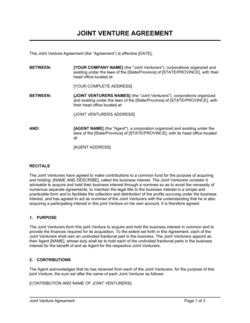
Who owns intellectual property created during a joint venture?
Ownership depends entirely on what the agreement says. Without a specific IP clause, jointly developed IP may be owned equally by all parties in most jurisdictions — which can create problems if the JV ends and both parties want to use it independently. A clear IP ownership clause should specify who owns newly created IP, what license each party has to pre-existing IP, and what happens to shared IP on dissolution.
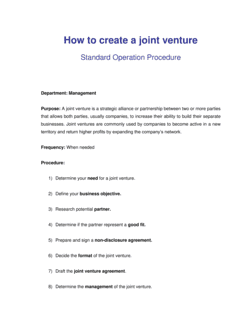
Is a joint venture the same as a partnership?
Not exactly. A joint venture is typically created for a specific project or purpose and has a defined end date. A partnership is an ongoing business relationship without a predetermined end. Both involve shared resources and profit, but a JV is project-scoped while a partnership implies an indefinite business enterprise. The distinction matters for tax treatment and liability in many jurisdictions.
Do partnership agreements need to be notarized?
In most jurisdictions, notarization is not required for a general or limited partnership agreement to be enforceable — authorized signatures are sufficient. However, some jurisdictions require limited partnerships to file a certificate with a state or provincial registry, and real-estate partnerships may require notarization for property-related clauses. Check local requirements before signing.
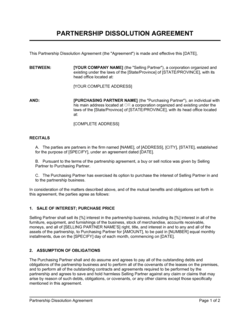
What should a partnership dissolution agreement include?
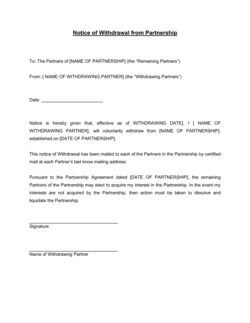
A dissolution agreement should cover: the effective dissolution date, how remaining assets and liabilities are divided, how outstanding contracts and debts are handled, which partner is responsible for winding-down tasks, whether any confidentiality or non-compete obligations survive, and how any jointly held intellectual property is transferred or licensed going forward.
Glossary
- General partnership
- A business structure where all partners share management authority and bear unlimited personal liability for partnership debts.
- Limited partnership
- A structure with at least one general partner (unlimited liability, full control) and one or more limited partners (liability capped at their investment).
- Joint venture (JV)
- A time-limited collaboration between two or more parties for a specific project or purpose, after which the arrangement typically dissolves.
- Capital contribution
- The cash, property, intellectual property, or services a partner commits to contribute to the partnership or venture.
- Profit and loss allocation
- The agreed percentage or formula by which profits earned and losses incurred are divided among the partners.
- Buy-sell agreement
- A clause or separate agreement that governs how a departing partner's interest is valued and purchased by the remaining partners.
- Right of first refusal
- A contractual right giving existing partners the opportunity to purchase a departing partner's interest before it is offered to a third party.
- Dissolution
- The formal process of winding down a partnership or joint venture, settling liabilities, and distributing remaining assets.
- Managing partner
- The partner designated to handle day-to-day operational decisions on behalf of the partnership.
- Deadlock
- A situation where partners cannot reach the required majority or unanimous decision, often resolved by a pre-agreed mechanism such as mediation or a casting vote.
- Sweat equity
- A partner's contribution in the form of labor, expertise, or time rather than cash or assets, which is assigned a monetary value in the agreement.
What is a partnership or joint venture agreement?
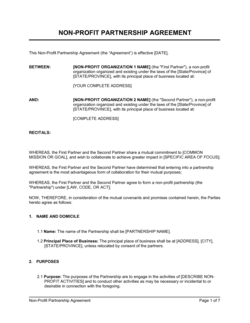
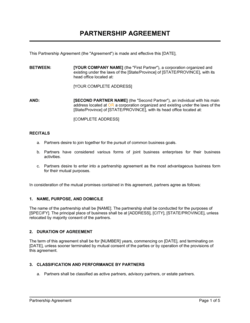
A partnership agreement is a legally binding contract between two or more
parties who agree to carry on a business together, sharing contributions,
profits, losses, and management responsibilities. It converts informal
understandings into enforceable obligations and overrides the default rules
that most jurisdictions impose on partnerships in the absence of a written
contract — rules that rarely match what the partners actually intended.
A joint venture agreement is a related but distinct instrument: it governs
a collaboration between two or more parties for a specific project or purpose,
rather than an ongoing enterprise. When the project concludes, the joint venture
typically dissolves and each party goes its own way. Both documents address
the same core questions — who contributes what, who controls decisions, how
money is shared, and what happens when the relationship ends — but the scope
and duration differ. The right choice depends on whether you are building
something permanent together or combining forces for a defined goal.
Beyond those two core documents, this category includes the full lifecycle of
a business partnership: checklists for drafting, MOU-style strategic alliance
agreements, collaboration and cooperation agreements, real estate partnership
structures, buyout agreements, and formal dissolution instruments.
When you need a partnership or joint venture agreement
The moment two parties agree to share resources, risk, or revenue toward
a common business goal, a written agreement should follow. Without one,
disputes over profits, decision authority, and exits get resolved by courts
applying default rules that may split everything equally regardless of
who contributed more.
Common triggers:
- Two founders launching a business together without incorporating
- A company and a supplier structuring a co-marketing or co-distribution arrangement
- Two real estate investors buying and managing a property together
- A business and a technology firm co-developing a product or platform
- An investor providing capital to an operating partner in a real estate deal
- Two companies teaming up to bid on a government or enterprise contract
- A partner retiring, selling their share, or exiting due to a dispute
- Two parties winding down a business and needing a structured dissolution process
The cost of starting without a written agreement is almost never visible on
day one — it shows up the first time partners disagree about money, control,
or exit. A clear partnership or joint venture agreement, drafted before the
relationship begins, is the least expensive insurance a business relationship
can carry.