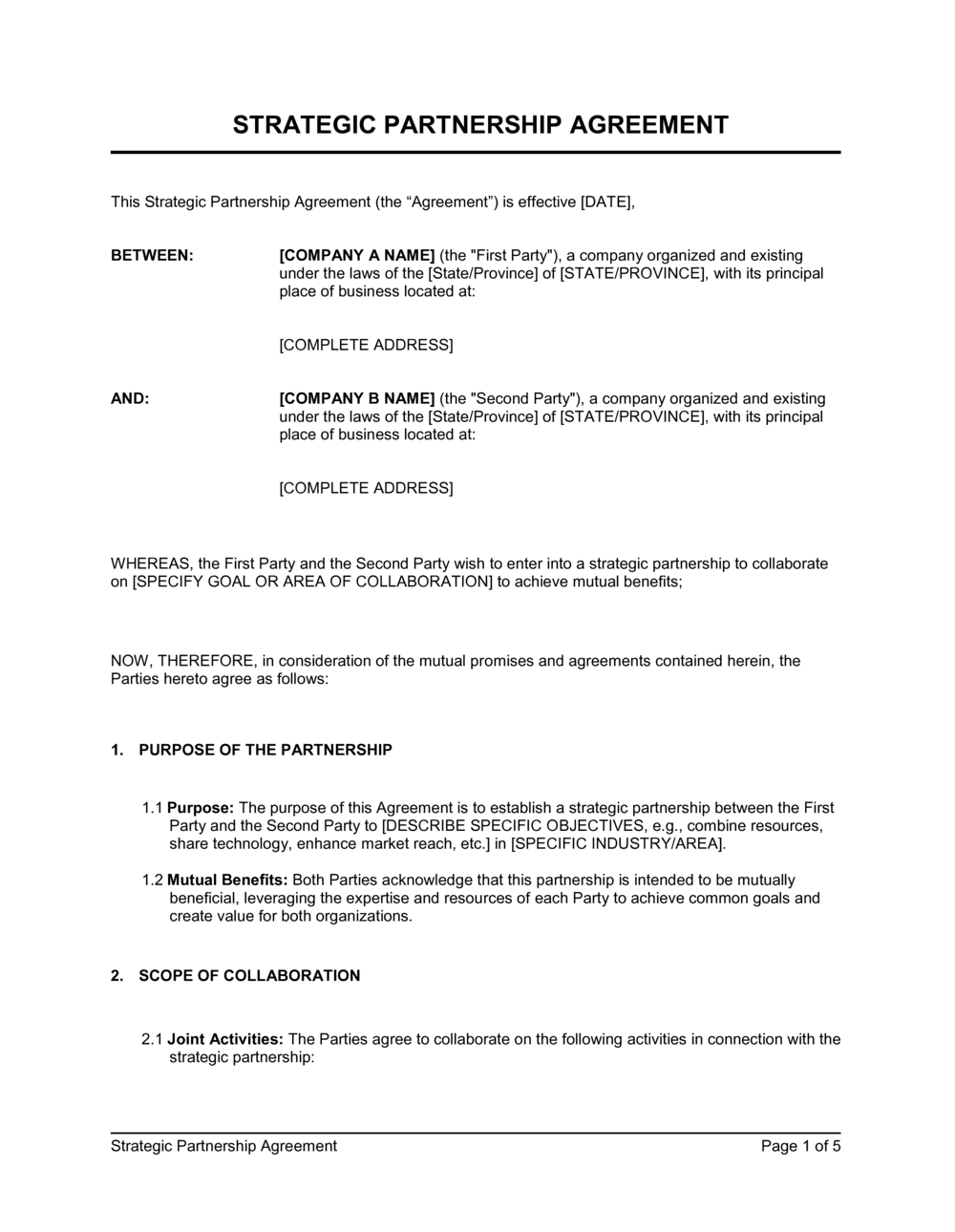
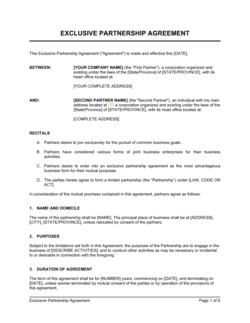
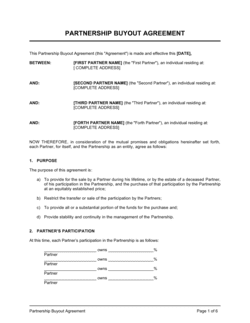
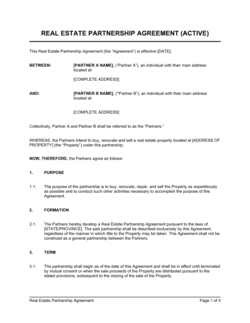
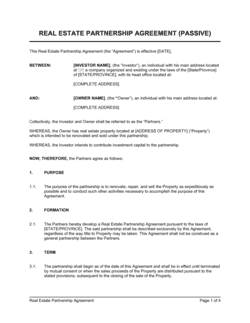
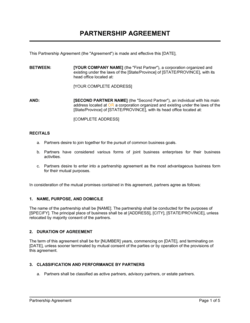
Strategic Partnership Agreement Template

Free Word download β€’ Edit online β€’ Save & share with Drive β€’ Export to PDF

5 pagesβ€’20–30 min to fillβ€’Difficulty: Standard
Learn more ↓
FreeStrategic Partnership Agreement Template

At a glance

What it is
A Strategic Partnership Agreement is a structured operational document that formalizes the terms of a collaboration between two businesses β€” covering shared goals, defined roles, revenue or cost-sharing, IP ownership, exclusivity, and exit conditions. This free Word download is fully editable online and exportable as PDF, giving both parties a clear written foundation before the partnership begins.
When you need it
Use it when two organizations agree to collaborate on sales, marketing, technology integration, distribution, or product development and need to define responsibilities and shared outcomes in writing before committing resources.
What's inside
The template covers partnership objectives and scope, each party's roles and responsibilities, revenue and cost-sharing formulas, intellectual property ownership, exclusivity terms, performance metrics, confidentiality, and termination conditions β€” all in a single structured document.

What is a Strategic Partnership Agreement?

A Strategic Partnership Agreement is a structured operational document that formalizes the terms of a collaboration between two independent businesses pursuing a shared commercial goal. It defines each party's roles, resource contributions, revenue or cost-sharing formula, IP ownership, exclusivity restrictions, performance metrics, and the conditions under which either party can exit β€” all without creating a new legal entity. Unlike a casual MOU or a brief letter of intent, a strategic partnership agreement creates clear, enforceable expectations that both organizations can execute against from day one.

Why You Need This Document

Without a written agreement, strategic partnerships routinely collapse within the first six months β€” not because the commercial logic was wrong, but because the parties operated on different assumptions about who does what, who owns what, and what success looks like. Revenue-sharing disputes are the most common trigger: when the split formula is never written down, each party calculates payouts differently. IP disputes are the most expensive: work created jointly during the partnership can be claimed by either side when no ownership clause exists. A signed strategic partnership agreement closes both gaps, gives both organizations a shared reference point for resolving disagreements, and signals to the market β€” and to investors β€” that the collaboration is governed by more than goodwill. This template gives you a complete, editable starting point in minutes.

Which variant fits your situation?

If your situation is…Use this template
Two companies sharing sales leads and commissions on closed dealsReferral Partner Agreement
Co-developing a product or technology with shared ownershipJoint Venture Agreement
One party distributing another's product in a defined territoryDistribution Agreement
Running a joint promotional campaign with shared spendCo-Marketing Agreement
Licensing technology or brand rights to a partnerTechnology License Agreement
A supplier providing exclusive goods or services to one buyerExclusive Supply Agreement
Two firms sharing staff, facilities, or operational resourcesResource Sharing Agreement

Common mistakes to avoid

❌ Vague scope with no excluded activities

Why it matters: Without explicit boundaries, one party expands activities the other never agreed to, leading to resource disputes and relationship breakdown within the first quarter.

Fix: Add an 'out-of-scope' list to the scope section β€” at least three specific activities or markets the agreement does not cover.

❌ Revenue split based on gross revenue with no cost definition

Why it matters: Each party deducts different costs before calculating gross revenue, producing different payout figures from the same underlying income β€” a leading cause of partnership disputes.

Fix: Define 'net revenue' explicitly in the definitions clause and list every deductible cost category before setting the percentage split.

❌ No KPIs or performance review schedule

Why it matters: Without measurable targets, neither party can objectively determine whether the partnership is delivering value, making it impossible to justify either continuation or exit.

Fix: Attach a Schedule A with at least three KPIs, the measurement method, the review period, and the consequence of missing targets for two or more consecutive periods.

❌ Blanket exclusivity without carve-outs for existing agreements

Why it matters: A broad exclusivity clause can immediately put one party in breach of an existing partnership they entered before this agreement β€” creating legal exposure and damaging trust.

Fix: List all existing partnerships that would otherwise be restricted, carve them out explicitly, and limit new exclusivity to partnerships entered after the effective date.

❌ No post-termination obligations

Why it matters: When the agreement ends, both parties continue to hold each other's IP, customer data, and confidential information β€” with no guidance on what to return, destroy, or stop using.

Fix: Add a post-termination section specifying which obligations survive (confidentiality, IP restrictions, payment settlement) and the timeline for returning or destroying shared assets.

❌ Assigning governance to job titles rather than defined roles

Why it matters: When a contact leaves the business, governance breaks down because neither party knows who has authority to approve decisions or sign amendments.

Fix: Define the Steering Committee by role (e.g., 'VP of Partnerships or equivalent') rather than by name, and require each party to provide written notice of any change in designated representative within 10 business days.

The 9 key sections, explained

Partnership objectives and scope

Roles and responsibilities

Revenue and cost sharing

Intellectual property ownership

Exclusivity terms

Performance metrics and review cadence

Governance and decision-making

Confidentiality

Term and termination

How to fill it out

  1. 1

    Identify both parties and the partnership date

    Enter the full legal entity names, registered addresses, and the effective date of the agreement. Use the registered corporate name, not a trading or brand name.

    πŸ’‘ Confirm both entities' exact legal names from their incorporation documents β€” a mismatch delays execution and can affect enforceability.

  2. 2

    Define the scope and objectives

    Write two to four specific, measurable goals for the partnership and list the activities it covers. Explicitly state what is out of scope to prevent scope creep.

    πŸ’‘ Limit the initial scope deliberately β€” it is easier to expand a working partnership than to walk back expectations from an over-promised one.

  3. 3

    Assign roles and deliverables to each party

    List each party's specific obligations, resource contributions, and deadlines. Assign a named point of contact for each organization.

    πŸ’‘ Use a simple table in Schedule A to map deliverable, responsible party, and due date β€” it reduces ambiguity more than prose alone.

  4. 4

    Set the revenue and cost-sharing formula

    Agree on whether the split is based on gross or net revenue, how costs are defined, and when payment or reimbursement is made. Specify the reporting period and payment timeline.

    πŸ’‘ Define 'net revenue' in the definitions section before the formula clause β€” disagreements about deductions are the most common source of financial disputes.

  5. 5

    Address IP ownership and licenses

    List each party's pre-existing IP that will be used in the partnership. Decide in advance who owns jointly created work and what license each party receives to use it.

    πŸ’‘ If the partnership involves software integrations or co-developed content, get technical and creative leads to list all relevant assets before signing.

  6. 6

    Set KPIs and the review schedule

    Enter at least three measurable KPIs in Schedule A, specify the reporting period (monthly is standard), and confirm the quarterly review date.

    πŸ’‘ Choose KPIs both parties can measure independently β€” if only one party controls the data, the other has no way to verify performance.

  7. 7

    Complete the termination and exit section

    Set the initial term, the notice period for termination for convenience, and the cure period for material breach. Add wind-down obligations: return of assets, final settlement of shared revenue.

    πŸ’‘ Include a 90-day wind-down period after notice β€” partnerships with customer-facing commitments need time to transition without damaging either brand.

  8. 8

    Review with both parties before circulating

    Share a draft with the designated points of contact from both organizations before formal signature. Capture any agreed changes in a single revised draft rather than email threads.

    πŸ’‘ Track changes in Word rather than sending clean copies β€” it creates a clear record of what was negotiated and prevents 'we never agreed to that' disputes later.

Frequently asked questions

What is a strategic partnership agreement?

A strategic partnership agreement is a formal document that defines the terms of a collaboration between two independent businesses. It covers shared goals, each party's roles and contributions, revenue or cost sharing, IP ownership, exclusivity, performance metrics, and how the partnership ends. Unlike a joint venture, the parties remain separate legal entities and do not create a new shared entity.

What is the difference between a strategic partnership agreement and a joint venture agreement?

A strategic partnership agreement governs collaboration between two existing, independent businesses that retain their separate legal identities throughout. A joint venture agreement creates a new, jointly owned entity to execute a specific project or business activity. Use a strategic partnership for co-marketing, referrals, or technology integrations; use a joint venture when the parties are committing capital to a shared enterprise with shared liability.

Do I need a lawyer to draft a strategic partnership agreement?

For straightforward co-marketing or referral arrangements, a well-structured template is typically sufficient. Engage a lawyer when the partnership involves significant IP creation, exclusivity in a large market, material revenue sharing over $500K annually, or when one party is much larger than the other and has presented its own standard form. A 1–2 hour review typically costs $300–$600 and is worthwhile before committing resources to a multi-year arrangement.

What happens if one party does not meet its obligations?

A well-drafted agreement includes a cure period β€” typically 15 to 30 days β€” during which the breaching party can remedy the failure. If the breach is not cured, the non-breaching party can terminate the agreement and pursue damages for losses caused. Including measurable KPIs and a formal remediation process in the agreement makes it far easier to document non-performance if a dispute escalates.

How long should a strategic partnership agreement last?

Initial terms of 12 to 24 months are most common, with an option to renew. Shorter terms (6–12 months) suit pilot collaborations where both parties need flexibility. Longer terms (3–5 years) are appropriate for distribution or technology integrations that require significant upfront investment to justify. Always include a termination-for-convenience clause so either party can exit with reasonable notice if the collaboration stops delivering value.

Who owns IP created during a strategic partnership?

Ownership of jointly created IP must be agreed in writing before the partnership begins β€” it does not default to either party by law. Common approaches are joint ownership (each party holds equal rights), assignment to the party that led development, or a license-back arrangement where one party owns it but grants the other a perpetual license. Leaving this unresolved is one of the most common and costly mistakes in partnership agreements.

Can a strategic partnership agreement include exclusivity?

Yes. Exclusivity clauses prevent one or both parties from entering similar partnerships with competitors in a defined market or geography during the term. Exclusivity is reasonable for distribution and channel partnerships where the partner is investing resources to develop a market. Always carve out existing agreements signed before the effective date and limit the scope of exclusivity to what is actually necessary β€” overly broad restrictions may be unenforceable.

What should the exit provisions cover?

Exit provisions should address three things: how either party initiates termination (notice period and form), what happens to shared assets, data, and IP after termination, and how final revenue and cost settlements are calculated and paid. A 60–90 day wind-down period is standard for partnerships with customer-facing commitments. Confidentiality and post-termination IP restrictions should survive the agreement's end for at least two years.

Is a strategic partnership agreement legally binding?

Yes, when properly executed by authorized representatives of both parties, a strategic partnership agreement is generally enforceable as a commercial contract. The document should be signed by individuals with authority to bind their respective organizations β€” typically a director, officer, or authorized manager β€” and should include governing law and dispute resolution clauses to establish the forum for any disagreements.

How this compares to alternatives

vs Joint Venture Agreement

A joint venture agreement creates a new, jointly owned legal entity to execute a specific project, with shared capital contributions and shared liability. A strategic partnership agreement keeps both parties legally separate and governs collaboration without forming a new entity. Use a strategic partnership for co-marketing, referrals, or integrations; use a joint venture when committing capital to a shared enterprise.

vs Distribution Agreement

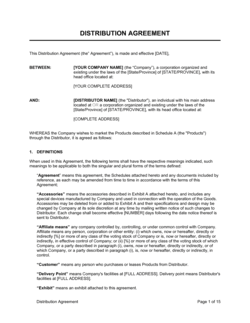
A distribution agreement is a narrow commercial arrangement where one party sells or distributes another's products in a defined territory. A strategic partnership agreement is broader β€” covering shared goals, joint activities, and mutual obligations across multiple workstreams. If the sole purpose is product distribution, use a distribution agreement; if the collaboration involves co-development, co-marketing, or shared resources, use the strategic partnership template.

vs Memorandum of Understanding (MOU)

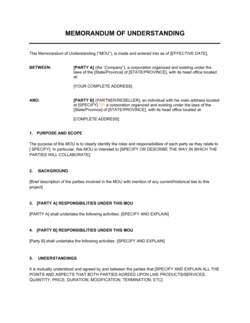
A memorandum of understanding records intent and outlines the parameters of a future arrangement, but is typically non-binding. A strategic partnership agreement is a binding operational document that creates enforceable obligations. Use an MOU to test alignment before committing; use the partnership agreement once terms are agreed and both parties are ready to perform.

vs Non-Disclosure Agreement (NDA)

An NDA protects confidential information shared between parties during discussions β€” it covers only confidentiality and has no operational terms. A strategic partnership agreement includes confidentiality as one section but also governs scope, roles, revenue, IP, and termination. An NDA is appropriate during early exploration; the partnership agreement replaces or supplements it once collaboration begins.

Industry-specific considerations

Technology / SaaS

Technology integration partnerships, co-sell agreements with platform vendors, and API-access arrangements that require joint IP and data-sharing terms.

Retail / E-commerce

Co-branded product launches, shared distribution networks, and affiliate or influencer channel partnerships with defined revenue-sharing formulas.

Professional Services

Referral and subcontracting arrangements between complementary firms β€” such as a law firm and an accounting practice β€” with non-compete and client-ownership clauses.

Healthcare / MedTech

Research collaborations, clinical data-sharing agreements, and distribution partnerships for medical devices that require regulatory compliance and IP protection clauses.

Manufacturing

Supplier co-development agreements, shared-tooling arrangements, and exclusive supply partnerships with volume commitments and cost-sharing formulas.

Nonprofit / Education

Program co-delivery agreements with corporate sponsors, shared-grant arrangements, and accreditation partnerships requiring defined roles, funding allocation, and brand-use restrictions.

Template vs pro β€” what fits your needs?

PathBest forCostTime
Use the templateCo-marketing campaigns, referral arrangements, or technology integrations between SMBs with limited IP at stakeFree1–2 hours to complete
Template + professional reviewPartnerships involving exclusivity, significant revenue sharing, or jointly created IP$300–$600 for a lawyer or business advisor review2–5 days
Custom draftedMulti-year enterprise alliances, regulated industries, cross-border partnerships, or arrangements with over $500K in shared revenue$1,500–$5,000+2–4 weeks

Glossary

Strategic Partnership
A formal, mutually beneficial collaboration between two independent businesses that combines resources, capabilities, or market reach to achieve a shared goal.
Scope of Collaboration
The agreed boundaries of the partnership β€” what activities are included, which markets or customers are covered, and what falls outside the agreement.
Revenue Sharing
A formula that determines how income generated through the partnership is split between the parties, expressed as a percentage or fixed fee.
Exclusivity
A clause restricting one or both parties from entering similar partnerships with third parties in a defined market, geography, or product category.
Intellectual Property (IP) Ownership
The section that defines who owns any new inventions, content, data, or tools created during the partnership β€” and what rights each party retains.
Key Performance Indicator (KPI)
A measurable metric used to evaluate whether the partnership is delivering on its stated objectives β€” such as joint revenue generated or leads exchanged.
Steering Committee
A joint governance body, typically comprising designated representatives from each party, responsible for reviewing performance and resolving disputes.
Confidential Information
Non-public data, trade secrets, customer lists, or business plans shared between partners that neither party may disclose to third parties.
Termination for Convenience
A clause allowing either party to end the agreement without cause by giving a defined notice period, typically 30 to 90 days.
Force Majeure
A provision excusing a party from performance obligations when an extraordinary event beyond its control β€” such as a natural disaster or government action β€” prevents fulfillment.
Part of your Business Operating System

This document is one of 3,000+ business & legal templates included in Business in a Box.

  • Fill-in-the-blanks β€” ready in minutes
  • 100% customizable Word document
  • Compatible with all office suites
  • Export to PDF and share electronically

Create your document in 3 simple steps.

From template to signed document β€” all inside one Business Operating System.
1
Download or open template

Access over 3,000+ business and legal templates for any business task, project or initiative.

2
Edit and fill in the blanks with AI

Customize your ready-made business document template and save it in the cloud.

3
Save, Share, Send, Sign

Share your files and folders with your team. Create a space of seamless collaboration.

Save time, save money, and create top-quality documents.

β˜…β˜…β˜…β˜…β˜…

"Fantastic value! I'm not sure how I'd do without it. It's worth its weight in gold and paid back for itself many times."

Managing Director Β· Mall Farm
Robert Whalley
Managing Director, Mall Farm Proprietary Limited
β˜…β˜…β˜…β˜…β˜…

"I have been using Business in a Box for years. It has been the most useful source of templates I have encountered. I recommend it to anyone."

Business Owner Β· 4+ years
Dr Michael John Freestone
Business Owner
β˜…β˜…β˜…β˜…β˜…

"It has been a life saver so many times I have lost count. Business in a Box has saved me so much time and as you know, time is money."

Owner Β· Upstate Web
David G. Moore Jr.
Owner, Upstate Web

Run your business with a system β€” not scattered tools

Stop downloading documents. Start operating with clarity. Business in a Box gives you the Business Operating System used by over 250,000 companies worldwide to structure, run, and grow their business.

Free Forever PlanΒ Β·Β No credit card required