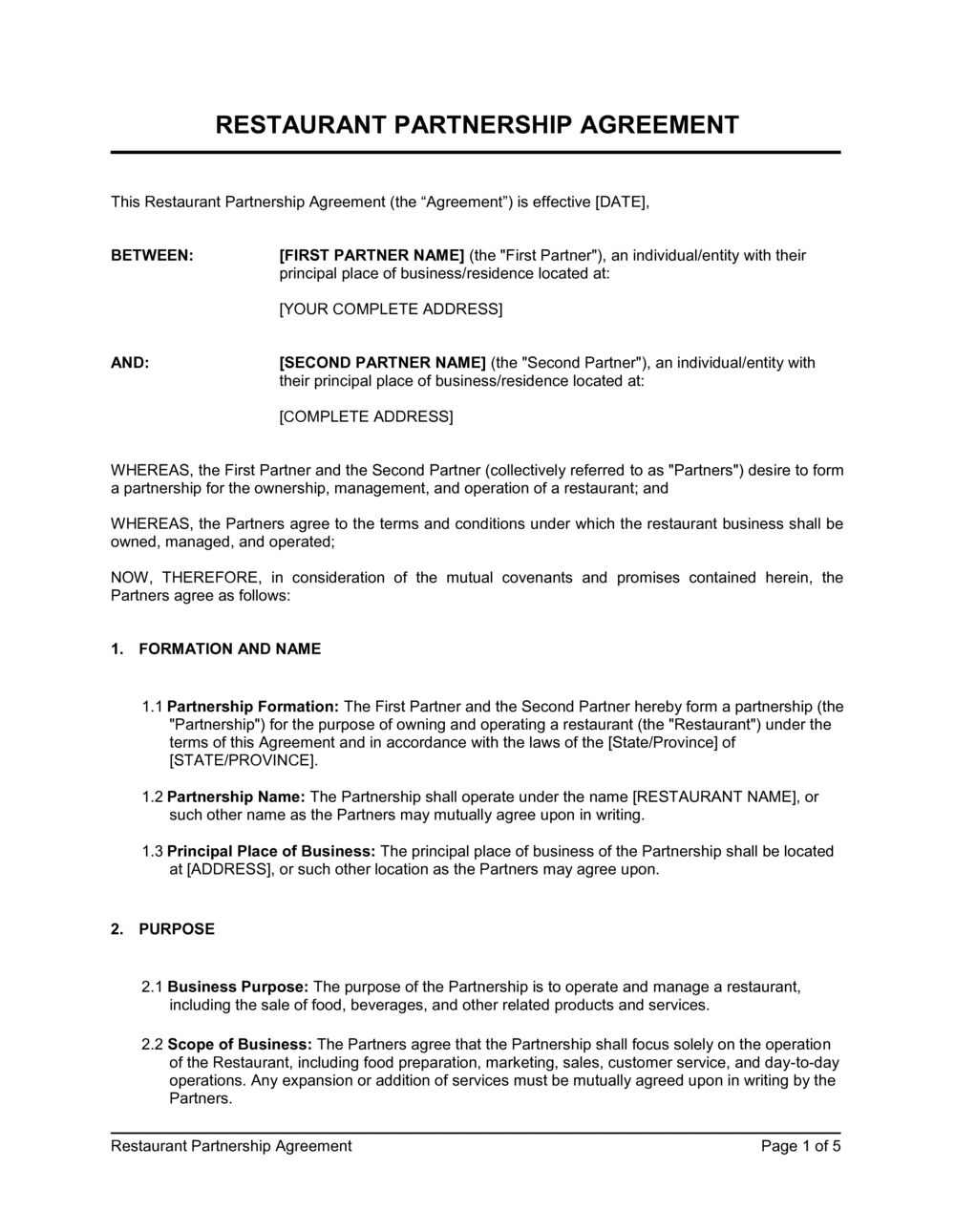
Restaurant Partnership Agreement Template

Free Word download • Edit online • Save & share with Drive • Export to PDF

5 pages25–35 min to fillDifficulty: ComplexSignature requiredLegal review recommended
Learn more ↓
FreeRestaurant Partnership Agreement Template

At a glance

What it is
A Restaurant Partnership Agreement is a legally binding contract between two or more co-owners of a food-and-beverage business that defines each partner's capital contribution, operational role, profit and loss allocation, decision-making authority, and exit rights. This free Word download is tailored to the restaurant industry — covering kitchen leadership, front-of-house management, liquor licensing, tip pool policies, and health-code compliance — and can be edited online and exported as PDF for signing.
When you need it
Use it before opening a new restaurant with a business partner, before one partner buys into an existing operation, or when restructuring roles and ownership percentages in a current multi-owner restaurant. Signing before the first dollar is spent or the first permit is filed protects both parties from the outset.
What's inside
Partner identification, capital and in-kind contribution schedules, ownership percentages, defined operational roles (executive chef, GM, FOH director), profit and loss allocation, bank account and financial controls, licensing and permit responsibilities, tip pool and labor compliance policies, major and day-to-day decision thresholds, partner buy-out and right of first refusal, deadlock resolution, and governing law.

What is a Restaurant Partnership Agreement?

A Restaurant Partnership Agreement is a legally binding contract between two or more co-owners of a food-and-beverage business that governs every material dimension of their shared venture: capital and in-kind contributions, ownership percentages, operational authority by role, profit and loss allocation, licensing responsibilities, tip pool policy, major-decision thresholds, partner buy-out rights, and dissolution procedures. Unlike a generic partnership agreement, a restaurant-specific version addresses the industry's distinct legal exposures — liquor license disclosure requirements, wage-and-hour compliance for tip pools, health permit obligations, and the structural split between front-of-house and back-of-house leadership — that a standard template leaves entirely unaddressed.

Why You Need This Document

Without a signed restaurant partnership agreement, every aspect of your co-ownership defaults to whatever your jurisdiction's partnership statute says — which typically means equal ownership, equal decision-making authority, and unlimited personal liability for each partner's actions, regardless of who contributed more capital or who runs the kitchen. A chef-investor partnership with no written agreement is one unresolvable disagreement away from a court-ordered dissolution and a forced sale at a distressed price. Beyond governance, the stakes are operational: a liquor license application that discloses the wrong ownership structure can trigger rejection or revocation; a tip pool policy that includes ineligible managers generates back-pay liability covering the entire life of the violation; a partner who distributes all available cash in a peak month can leave the business unable to meet payroll three months later. This template closes those gaps with clauses purpose-built for F&B operations, so both partners start with a shared, enforceable understanding of exactly who owns what, who decides what, and what happens when things don't go as planned.

Which variant fits your situation?

If your situation is…Use this template
Two equal partners each contributing capital and a defined operational roleRestaurant Partnership Agreement (50/50)
One partner contributes capital only, the other runs daily operationsSilent Partner Agreement
Three or more partners with tiered ownership percentagesMulti-Partner Restaurant Agreement
Partners operating under an LLC rather than a general partnershipLLC Operating Agreement
One partner buying out the other's interest in an existing restaurantBusiness Purchase Agreement
A chef entering a revenue-share arrangement without equityRevenue Sharing Agreement
Partners operating a food truck rather than a fixed locationFood Truck Partnership Agreement

Common mistakes to avoid

❌ No valuation method for partner buy-outs

Why it matters: When a partner wants to exit, undefined valuation leads to competing appraisals, months of negotiation, and litigation costs that often exceed the business's value.

Fix: Agree on a specific formula at signing — such as 3× trailing 12-month EBITDA or independent appraisal by a mutually selected CPA — and embed it in the agreement before any dispute arises.

❌ Including owners or managers in the tip pool without legal verification

Why it matters: The FLSA and many state laws prohibit managers and employers from participating in tip pools — violations trigger back-pay liability for the full pool amount over the violation period, plus potential penalties.

Fix: Have an employment lawyer confirm which employee categories are legally eligible before finalizing the tip pool clause, and update the policy within 30 days whenever governing law changes.

❌ No deadlock mechanism in a 50/50 partnership

Why it matters: Without a resolution path, a single irresolvable disagreement — over a menu overhaul, a second location, or a key hire — can trigger a court-ordered dissolution and force the sale of the business at a distressed price.

Fix: Include a tiered deadlock clause: mandatory mediation first, followed by a buy-sell election if mediation fails within 30 days.

❌ Undefined contribution schedule for in-kind assets

Why it matters: A partner who contributes a recipe portfolio, equipment, or a personal network without a written valuation can later claim those contributions entitle them to a larger share — creating a dispute that undermines the entire ownership structure.

Fix: Attach a signed Schedule A at closing that lists every non-cash contribution with an agreed dollar value, supported by a third-party appraisal where possible.

❌ No liquor license responsibility clause

Why it matters: Liquor license applications require disclosure of all partners above a minimum ownership threshold, can take 6–18 months, and cost $5,000–$50,000 in some jurisdictions — leaving responsibility unassigned routinely delays or blocks openings.

Fix: Designate a responsible partner, set a filing deadline, allocate the cost between partners, and include a personal-conduct indemnification clause protecting the partnership if one partner's actions jeopardize the license.

❌ Distributing profits without maintaining a working-capital reserve

Why it matters: Restaurants operate on 3–9% net margins and face significant seasonal cash-flow variance — partners who distribute all available cash in peak months frequently face payroll shortfalls in slow periods.

Fix: Define a minimum operating reserve (typically 60–90 days of fixed operating costs) that must remain in the partnership account before any distribution is permitted.

The 10 key clauses, explained

Partner identification and ownership percentages

In plain language: Names each partner as a legal entity or individual, records their ownership stake, and ties that stake to their documented capital contribution.

Sample language
This Agreement is entered into by [PARTNER 1 FULL NAME] ('Partner 1') and [PARTNER 2 FULL NAME] ('Partner 2') (collectively, 'Partners'). Partner 1 holds a [X]% ownership interest; Partner 2 holds a [Y]% ownership interest, in proportion to the capital contributions set out in Schedule A.

Common mistake: Recording ownership percentages that do not match the capital contribution schedule or state entity filing — inconsistencies between documents create disputed ownership claims if the partnership dissolves.

Capital and in-kind contributions

In plain language: Schedules each partner's cash investment and any non-cash assets (equipment, recipes, lease guarantees) with agreed valuations, and states what happens if additional capital calls are needed.

Sample language
Partner 1 shall contribute $[AMOUNT] in cash on or before [DATE]. Partner 2 shall contribute the kitchen equipment listed in Schedule B, valued at $[AMOUNT]. Additional capital calls require a [X]% vote of ownership interests; a partner who declines a capital call shall be diluted pro-rata.

Common mistake: Valuing in-kind contributions informally without a written schedule. Disputed valuations of equipment or recipes are among the most common sources of partnership litigation in the restaurant industry.

Operational roles and authority

In plain language: Defines each partner's title and area of responsibility — typically one partner leads BOH (executive chef / kitchen director) and another leads FOH (general manager / front-of-house director) — and sets the dollar threshold above which day-to-day decisions require joint approval.

Sample language
Partner 1 shall serve as Executive Chef and shall have authority over menu development, kitchen staffing, and vendor selection for food and beverage inventory up to $[AMOUNT] per order. Partner 2 shall serve as General Manager and shall have authority over FOH staffing, reservations, and vendor selection for non-food supplies up to $[AMOUNT] per order.

Common mistake: Leaving operational authority undefined and assuming verbal understanding will hold. When revenue pressures mount, undocumented authority structures collapse and every decision becomes a dispute.

Profit and loss allocation and distributions

In plain language: States how net profit is divided among partners after operating expenses, debt service, and any preferred return — and how often distributions are made.

Sample language
Net profit shall be allocated [X]% to Partner 1 and [Y]% to Partner 2 after payment of a [Z]% preferred annual return to the capital-contributing partner. Distributions shall be made [monthly / quarterly] within [15] days of period close, subject to maintaining a minimum operating reserve of $[AMOUNT].

Common mistake: Distributing profits before maintaining a working-capital reserve. Restaurants operate on thin margins and seasonal cash-flow swings — partners who drain reserves in good months face payroll crises in slow ones.

Licensing, permits, and regulatory compliance

In plain language: Assigns responsibility for obtaining and renewing each required permit — business license, health permit, food handler certifications, and liquor license — and states what happens if a partner's personal conduct jeopardizes a license.

Sample language
Partner 2 shall be the responsible party for the liquor license application and all annual renewals. Each partner shall maintain current food handler certification and shall promptly notify the other of any regulatory investigation, citation, or license suspension. A partner whose conduct results in license revocation shall indemnify the partnership for all resulting losses.

Common mistake: Not addressing who bears the cost and responsibility of a liquor license application. Liquor license applications can cost $5,000–$50,000 and take 6–18 months — leaving this unassigned routinely stalls openings.

Tip pool and labor compliance

In plain language: Documents the restaurant's tip pool policy, identifies which employee categories participate, and confirms the partnership's obligation to comply with the applicable wage-and-hour law governing tip allocation.

Sample language
The Partnership shall maintain a written tip pool policy compliant with [APPLICABLE FEDERAL / STATE / PROVINCIAL LAW]. The tip pool shall include [FOH STAFF / BACK-OF-HOUSE STAFF AS PERMITTED BY LAW]. Partners who are directly tipped employees shall [participate / not participate] in the pool consistent with applicable law. The Managing Partner shall update the policy within [30] days of any change in governing law.

Common mistake: Including managers or partners in the tip pool without confirming they are legally permitted to participate. The FLSA and several state laws prohibit managers from receiving tip pool distributions, exposing the partnership to back-pay liability.

Major decisions requiring unanimous or supermajority consent

In plain language: Lists decisions that cannot be made unilaterally — such as signing a lease, taking on debt above a threshold, adding a new partner, or changing the concept — and sets the approval threshold.

Sample language
The following decisions require the unanimous written consent of all Partners: (a) execution or termination of any lease; (b) incurring debt exceeding $[AMOUNT]; (c) admitting a new partner; (d) changing the restaurant concept, name, or cuisine; (e) filing for bankruptcy. All other operational decisions require approval of Partners holding a majority of ownership interests.

Common mistake: Setting the unanimous-consent threshold too low. Requiring unanimous consent for every decision over $500 paralyzes operations in a high-transaction business like a restaurant.

Partner buy-out, right of first refusal, and transfer restrictions

In plain language: Prevents a partner from selling their interest to an outsider without first offering it to the existing partners at the same price, and sets the valuation formula for a partner buyout.

Sample language
No Partner may transfer any ownership interest without first offering it in writing to the remaining Partners at the proposed transfer price. Remaining Partners shall have [30] days to elect to purchase. If no Partner elects, the transferring Partner may sell to the proposed buyer at no less than the offered price. Partnership interest value for buy-out purposes shall be determined by [AGREED FORMULA / independent appraisal].

Common mistake: No right-of-first-refusal clause at all. Without it, a partner can sell to a competitor, a disruptive third party, or a creditor — leaving the remaining partner in business with a stranger.

Deadlock resolution

In plain language: Provides a structured mechanism for resolving disputes when equal partners cannot agree on a material decision, to avoid operational paralysis or forced dissolution.

Sample language
If the Partners are unable to reach agreement on a Major Decision within [15] business days, either Partner may invoke the deadlock procedure: (1) mediation within [30] days; (2) if mediation fails, either Partner may trigger a buy-sell election by delivering a written offer to purchase the other's interest at a stated price, which the receiving Partner must either accept or purchase the offering Partner's interest at the same price.

Common mistake: No deadlock clause in a 50/50 restaurant partnership. Without one, a single disagreement about a lease renewal or menu change can result in a court-ordered dissolution — destroying the business in the process.

Dissolution and wind-down

In plain language: States the conditions that trigger dissolution — unanimous vote, regulatory closure, death, or disability — and the order in which assets are distributed: creditors, then partners' capital accounts, then remaining surplus pro-rata.

Sample language
The Partnership shall dissolve upon: (a) unanimous written consent of all Partners; (b) revocation of a material license; (c) death or permanent disability of a Partner if the remaining Partner elects not to continue. Upon dissolution, assets shall be applied first to third-party creditors, then to return of Partners' capital accounts, and finally to Partners in proportion to ownership percentages.

Common mistake: Omitting a death or disability trigger. When a chef-partner becomes unable to work, an undefined dissolution process leaves the surviving partner unable to sell, restructure, or wind down the business without litigation.

How to fill it out

  1. 1

    Identify each partner's legal name and entity type

    Enter each partner as an individual (full legal name, address) or a legal entity (LLC or corporation name, registered state, and signing representative). Confirm the names match the state or provincial business registry.

    💡 If a partner is contributing through a personal holding company, use the entity name — not their personal name — to protect personal assets from partnership claims.

  2. 2

    Complete Schedule A: capital and in-kind contributions

    List every cash amount with the transfer date, and every non-cash asset with an agreed dollar valuation signed off by both partners. Tie each contribution to the corresponding ownership percentage in the body of the agreement.

    💡 Have in-kind assets (equipment, recipes, lease guarantees) appraised or valued by a third party before finalizing Schedule A — disputed valuations are the most litigated provision in restaurant partnership agreements.

  3. 3

    Assign operational roles with specific authority thresholds

    Name the partner responsible for BOH and the partner responsible for FOH. Set a specific dollar amount (e.g., $2,500 per vendor order) below which each partner can act unilaterally, and list the decisions that require joint approval.

    💡 Set day-to-day thresholds that reflect your actual operations — a fine-dining restaurant with $15,000 produce orders needs a higher threshold than a quick-service concept.

  4. 4

    Set the profit allocation and distribution schedule

    Enter each partner's profit percentage and any preferred return for the capital-contributing partner. State the distribution frequency (monthly or quarterly) and the minimum operating reserve that must remain in the account before any distribution is made.

    💡 Build the reserve requirement around your worst historical monthly revenue — most restaurant failures happen because partners distribute cash in peak months and have nothing left for slow ones.

  5. 5

    Assign licensing and permit responsibilities

    For each required permit (business license, health permit, liquor license, food handler certifications), name the responsible partner, the target date, and who bears the cost. Add the indemnification language for license jeopardy caused by a partner's personal conduct.

    💡 If your concept requires a liquor license, assign responsibility and budget before signing — the timeline and cost vary dramatically by jurisdiction and can affect your opening date by 6–18 months.

  6. 6

    Document the tip pool policy

    State whether the restaurant operates a tip pool, which employee categories participate, and the applicable federal or state law governing the policy. Confirm whether partners who work the floor are legally permitted to participate.

    💡 Review this clause with an employment lawyer before opening — tip pool rules differ by state and have changed significantly since 2018. An incorrect policy can generate back-pay claims covering the life of the agreement.

  7. 7

    Fill in the buy-out formula and right-of-first-refusal terms

    Choose a valuation method (fixed multiple of trailing EBITDA, independent appraisal, or agreed formula) and set the notice period for a right-of-first-refusal election. Enter the number of days the remaining partner has to respond.

    💡 A trailing 12-month EBITDA multiple (typically 3–5× for a restaurant) is the most practical valuation method — it ties to real business performance and avoids the need for a full appraisal in every scenario.

  8. 8

    Sign before opening or any capital is deployed

    Both parties must sign before the first dollar of partnership capital is spent, any lease is signed, or any permit application is filed. Post-formation signatures raise enforceability questions for restrictive provisions.

    💡 Use a witnessed or notarized execution for any jurisdiction that requires it for real-property-related agreements, and store the fully executed copy in a secure shared location accessible to both partners.

Frequently asked questions

What is a restaurant partnership agreement?

A restaurant partnership agreement is a legally binding contract between two or more co-owners of a restaurant that defines each partner's capital contribution, ownership percentage, operational role, profit and loss allocation, decision-making authority, and exit rights. Unlike a generic partnership agreement, a restaurant-specific version addresses industry issues such as liquor licensing, tip pool compliance, health permits, FOH and BOH leadership, and operating reserves calibrated to thin F&B margins.

Do restaurant partners need a written agreement?

Yes — and ideally before a lease is signed or any capital is deployed. Without a written agreement, courts apply the default partnership rules of the applicable jurisdiction, which typically assume equal ownership and equal decision-making authority regardless of who contributed more cash or does more work. In practice, this means a partner who invested $200,000 has the same legal standing as one who invested $20,000, unless a signed agreement says otherwise.

What should a restaurant partnership agreement cover?

At minimum: each partner's capital and in-kind contributions, ownership percentages, operational roles (BOH vs. FOH leadership), profit and loss allocation, distribution schedule and operating reserve requirements, licensing and permit responsibilities, tip pool policy, major decision thresholds, right-of-first-refusal on ownership transfers, buy-out valuation formula, deadlock resolution, and dissolution triggers. Missing any of these creates gaps that default partnership law fills in ways that rarely match the partners' original intent.

How should profits be split in a restaurant partnership?

Most restaurant partnerships split profits in proportion to ownership percentages, but a pure pro-rata split is not always fair when one partner contributes substantially more capital or takes on more operational risk. A preferred return — typically 6–10% annually on contributed capital — compensates the capital partner before remaining profits are divided pro-rata. The split should also account for a minimum operating reserve so distributions do not hollow out working capital during slow seasons.

Can a chef partner contribute recipes or skills instead of cash?

Yes — non-cash contributions such as recipes, trade secrets, equipment, or sweat equity are called in-kind contributions and can be assigned a monetary value that counts toward the contributing partner's capital account. The key requirement is that both partners agree in writing to the valuation before the agreement is signed, ideally supported by a third-party appraisal. Undocumented in-kind contributions are among the most frequently disputed items in restaurant partnership disputes.

Who should hold the liquor license in a restaurant partnership?

In most jurisdictions, the liquor license is held in the name of the legal entity (LLC or partnership) rather than an individual, but every owner above a minimum ownership threshold — typically 10–20% depending on the state or province — must be disclosed and undergo background checks. The agreement should designate one partner as responsible for the application, renewals, and ongoing compliance, and should include an indemnification clause holding the partnership harmless if one partner's personal conduct triggers a revocation or suspension.

What happens if restaurant partners disagree on a major decision?

Without a deadlock clause, persistent disagreement on a material issue — a second location, a lease renewal, a concept change — can result in a court-ordered dissolution and forced sale of the business. A well-drafted agreement includes a tiered deadlock mechanism: first, mandatory mediation within 30 days; second, if mediation fails, a buy-sell election where either partner can offer to buy the other out at a stated price, which the receiving partner must either accept or match by purchasing the offering partner's interest at the same price.

Are tip pool arrangements affected by a restaurant partnership agreement?

Yes. The agreement should document the restaurant's tip pool policy, identify which employee categories participate, and confirm compliance with applicable wage-and-hour law. Partners who work the floor in a tipped capacity must confirm whether they are legally permitted to participate in the pool — the FLSA and many state laws prohibit managers and employers from receiving tip pool distributions, and violations generate back-pay liability. The agreement should require the managing partner to update the policy within 30 days of any change in governing law.

What is a right of first refusal in a restaurant partnership?

A right of first refusal is a clause that requires a partner who wants to sell their ownership interest to offer it first to the remaining partners at the same price and on the same terms as any third-party offer. It gives existing partners the opportunity to keep the business in their control rather than being forced into partnership with an unknown buyer. Without it, a partner can sell to a competitor, a creditor, or anyone else — leaving the remaining partner with no say over who they are now in business with.

How this compares to alternatives

vs Generic Partnership Agreement

A generic partnership agreement covers capital contributions, profit splits, and basic governance but says nothing about liquor licensing, tip pools, health permits, or FOH/BOH authority — all of which are material operational and legal issues in a restaurant. A restaurant-specific agreement addresses these directly and reduces the risk of gaps that default law fills unfavorably.

vs LLC Operating Agreement

An LLC operating agreement governs the same relationship but within a limited-liability company structure that shields members' personal assets from business debts. A partnership agreement applies to a general or limited partnership, where general partners typically have unlimited personal liability. Most restaurant lawyers recommend forming an LLC and using an operating agreement rather than a general partnership, but a partnership agreement is appropriate when partners have chosen that entity structure deliberately.

vs Joint Venture Agreement

A joint venture agreement is designed for a specific, time-limited project — a pop-up, a catering event, or a single season — rather than an ongoing business. A restaurant partnership agreement governs a continuing operation with employees, leases, and licenses. If the venture is intended to become a permanent restaurant, a partnership agreement is the correct document from the outset.

vs Buy-Sell Agreement

A buy-sell agreement is a standalone document governing the transfer of ownership interest between partners, typically triggered by death, disability, or voluntary exit. Many restaurant partnership agreements incorporate buy-sell provisions inline, which is sufficient for most two-partner restaurants. A standalone buy-sell agreement adds detail on funding mechanisms (life insurance, installment payments) and is worth considering separately when the business has significant value or complex ownership.

Industry-specific considerations

Full-service restaurants

BOH and FOH authority splits are most critical here — executive chef and GM roles carry distinct legal and operational accountability that must be defined to prevent daily conflicts.

Bars and nightclubs

Liquor license disclosure requirements and personal-conduct indemnification clauses are especially important given the heightened regulatory scrutiny and license revocation risk in licensed on-premise alcohol venues.

Fast casual and QSR

High transaction volumes and thin margins make operating reserve requirements and distribution controls more critical than in full-service concepts where average checks are larger.

Catering and event hospitality

Revenue is event-driven and lumpy — profit allocation clauses should address advance deposits, event cancellations, and the timing of distributions relative to event completion.

Jurisdictional notes

United States

Partnership law is state-specific — most states follow the Revised Uniform Partnership Act (RUPA) as a default, but the agreement should explicitly displace defaults (equal splits, mutual agency) where partners intend otherwise. Tip pool compliance is governed by the FLSA and state wage-and-hour laws, which vary significantly; California, New York, and Washington have particularly strict rules. Liquor license disclosure thresholds and timelines vary by state — California ABC and New York SLA processes both require disclosure of all partners above 10% ownership.

Canada

Partnership law is provincial — each province has its own Partnerships Act, and the agreement should state the governing province explicitly. Liquor licensing is provincially administered (e.g., AGCO in Ontario, BCLDB in British Columbia) and requires disclosure of all partners; timelines range from 3 to 12 months. Tip pooling rules vary by province — Ontario's Employment Standards Act requires written tip pool policies and prohibits employers from retaining tips. Quebec-operating restaurants must ensure the agreement is available in French.

United Kingdom

In England and Wales, the Partnership Act 1890 applies as a default and creates joint and several liability for all general partners — a significant exposure in a high-overhead restaurant context. Most UK restaurant lawyers recommend forming an LLP to limit liability. The Premises Licence under the Licensing Act 2003 is premises-specific and must identify a Designated Premises Supervisor (DPS), typically one named partner. National Living Wage and service charge transparency rules (effective 2024) affect how tip pool clauses should be drafted.

European Union

Partnership and business association law varies significantly by member state — France (société en nom collectif), Germany (GbR or OHG), and Spain (sociedad civil) each have distinct default rules on partner liability and dissolution. Tip pooling practices and employer obligations differ by country and are increasingly subject to labor regulation. GDPR applies to any employee data collected as part of tip pool administration or payroll. Cross-border EU partnerships should specify governing law explicitly and consider which jurisdiction's courts will have competence.

Template vs lawyer — what fits your deal?

PathBest forCostTime
Use the templateTwo partners opening a straightforward restaurant concept in a single jurisdiction with equal or clearly agreed ownershipFree1–2 hours
Template + legal reviewPartnerships with in-kind contributions, a liquor license, unequal ownership, or a preferred return structure$500–$1,5003–7 days
Custom draftedMulti-location restaurant groups, complex equity structures, franchise co-ownership, or cross-border partnerships$2,500–$8,000+2–4 weeks

Glossary

Capital Contribution
Cash, equipment, or other assets each partner commits to the restaurant at formation, recorded as the basis for initial ownership percentages.
In-Kind Contribution
Non-cash value contributed by a partner — such as proprietary recipes, equipment, or sweat equity — assigned a monetary value and treated as part of the capital account.
Profit and Loss Allocation
The percentage of net profit or net loss each partner receives or absorbs, which may differ from ownership percentage if the agreement specifies a preferred return.
Managing Partner
The partner designated with authority to make day-to-day operational decisions, sign vendor contracts below a defined dollar threshold, and represent the restaurant with regulators.
Liquor License
A government-issued permit authorizing the sale of alcoholic beverages on the premises, typically held in the entity's name but requiring disclosure of all owners above a specified ownership threshold.
Tip Pool
A formal policy under which a percentage of tips collected by front-of-house staff is redistributed among a defined group of employees, including back-of-house staff in some jurisdictions.
Right of First Refusal
A clause giving existing partners the right to purchase a departing partner's interest at the same price and terms offered by any third-party buyer before an outside sale is permitted.
Deadlock
A situation in which equal partners cannot reach a majority decision on a material issue, triggering a pre-agreed resolution mechanism such as mediation, buy-sell, or coin-flip buyout.
Preferred Return
A minimum annual return paid to a capital-contributing partner before remaining profits are split pro-rata, compensating that partner for the risk of deploying cash upfront.
Buy-Sell Agreement
A mechanism within a partnership agreement that sets the process and price formula for one partner buying out another — typically triggered by death, disability, withdrawal, or deadlock.
Health Permit
A local or state-issued permit confirming the restaurant premises and food-handling practices meet applicable health and safety standards, typically renewed annually.
FOH / BOH
Front of House (dining room, bar, host stand) and Back of House (kitchen, prep, dishwashing) — the two operational divisions most restaurant partnerships divide between managing partners.

Part of your Business Operating System

This document is one of 3,000+ business & legal templates included in Business in a Box.

  • Fill-in-the-blanks — ready in minutes
  • 100% customizable Word document
  • Compatible with all office suites
  • Export to PDF and share electronically

Create your document in 3 simple steps.

From template to signed document — all inside one Business Operating System.
1
Download or open template

Access over 3,000+ business and legal templates for any business task, project or initiative.

2
Edit and fill in the blanks with AI

Customize your ready-made business document template and save it in the cloud.

3
Save, Share, Send, Sign

Share your files and folders with your team. Create a space of seamless collaboration.

Save time, save money, and create top-quality documents.

★★★★★

"Fantastic value! I'm not sure how I'd do without it. It's worth its weight in gold and paid back for itself many times."

Managing Director · Mall Farm
Robert Whalley
Managing Director, Mall Farm Proprietary Limited
★★★★★

"I have been using Business in a Box for years. It has been the most useful source of templates I have encountered. I recommend it to anyone."

Business Owner · 4+ years
Dr Michael John Freestone
Business Owner
★★★★★

"It has been a life saver so many times I have lost count. Business in a Box has saved me so much time and as you know, time is money."

Owner · Upstate Web
David G. Moore Jr.
Owner, Upstate Web

Run your business with a system — not scattered tools

Stop downloading documents. Start operating with clarity. Business in a Box gives you the Business Operating System used by over 250,000 companies worldwide to structure, run, and grow their business.

Start free · No credit card required