Web Content Partnership Agreement Template

Free Word download • Edit online • Save & share with Drive • Export to PDF

6 pages30–40 min to fillDifficulty: ComplexSignature requiredLegal review recommended
Learn more ↓
FreeWeb Content Partnership Agreement Template

At a glance

What it is
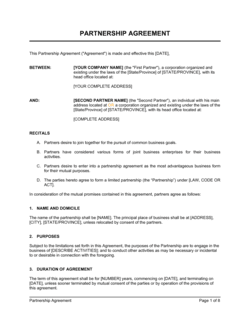
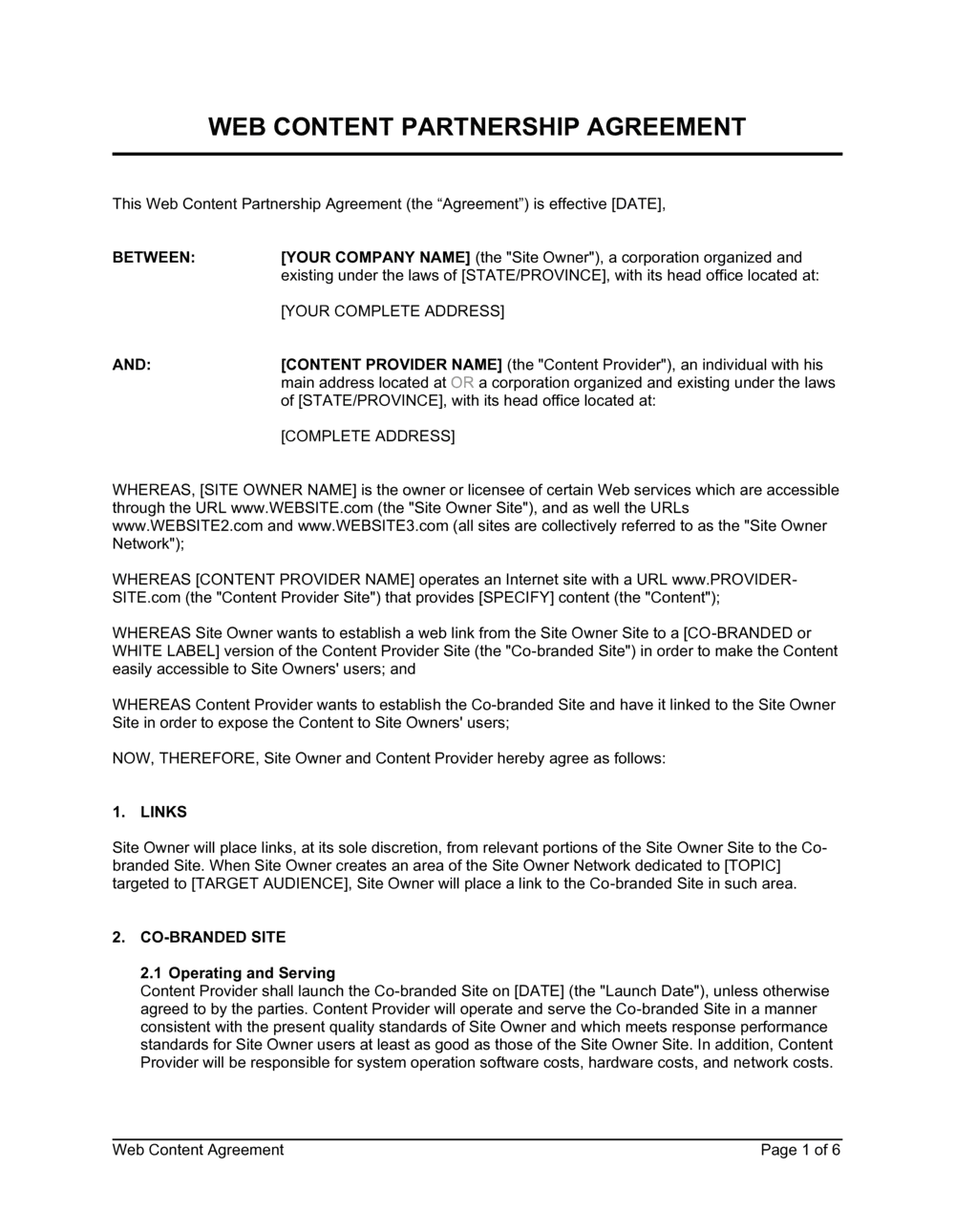
A Web Content Partnership Agreement is a legally binding contract between two or more parties who agree to collaborate on creating, publishing, or distributing digital content across one or more websites or online platforms. This free Word download covers IP ownership, editorial control, revenue sharing, content licensing, and termination in a single document you can edit online and export as PDF.
When you need it
Use it whenever two businesses, a brand and a publisher, or a content creator and a platform agree to co-produce or cross-distribute web content and need enforceable terms governing who owns what, who earns what, and who controls editorial decisions.
What's inside
Defined roles and content obligations for each party, IP assignment and licensing terms, editorial standards and approval rights, revenue or traffic-share mechanics, confidentiality provisions, representations and warranties, and termination conditions including content takedown obligations.

What is a Web Content Partnership Agreement?

A Web Content Partnership Agreement is a legally binding contract between two parties — typically a publisher and a brand, or two co-publishing businesses — that governs the creation, publication, and distribution of digital content across one or more websites or online platforms. It defines each party's content obligations, establishes who owns the IP created through the partnership, sets editorial approval rights, structures compensation or revenue sharing, and specifies what happens to published content if the relationship ends. Unlike a simple content license or a one-sided contractor agreement, a web content partnership agreement creates bilateral obligations and protections for both parties across the full lifecycle of the content relationship.

Why You Need This Document

Operating a content partnership without a written agreement leaves three critical gaps exposed simultaneously. First, without an IP ownership clause, copyright defaults to the individual author under most jurisdictions' laws — meaning a brand that co-funded content production may have no right to republish, modify, or remove it. Second, without a termination and takedown provision, content bearing your brand assets, product claims, or trademarks can remain live on a former partner's site indefinitely after the relationship breaks down. Third, revenue-share arrangements that exist only in email threads are nearly impossible to audit or enforce when a dispute arises over under-reporting. A signed Web Content Partnership Agreement closes all three gaps before the first piece of content is published, for the cost of under an hour's setup and a legal review where the stakes warrant it.

Which variant fits your situation?

If your situation is…Use this template
Syndicating finished articles to a third-party websiteContent Syndication Agreement
Licensing brand assets or trademarks for use in partner contentTrademark License Agreement
Paying a freelancer or agency to produce all content independentlyContent Creation Services Agreement
Collaborating on a joint video or podcast seriesCo-Production Agreement
Sharing affiliate or referral revenue tied to published linksAffiliate Marketing Agreement
A brand sponsoring a publisher's existing content categorySponsorship Agreement
Engaging an influencer to create and publish content on their own channelsInfluencer Marketing Agreement

Common mistakes to avoid

❌ Vague content deliverables with no quantities or deadlines

Why it matters: Without specified quantities, formats, and timelines, neither party can establish a breach when obligations go unmet, making the contract effectively unenforceable on performance.

Fix: Move all deliverable specifications into a Schedule A with explicit counts, word lengths, formats, and submission deadlines, and have both parties initial it at signing.

❌ Defaulting to joint ownership without usage rules

Why it matters: Joint ownership means either party can independently publish, sublicense, or commercialize the content — often leading to one party monetizing work the other created and paid for.

Fix: Assign primary ownership to the creating party and grant the other party a clearly scoped license, or include an explicit joint-ownership protocol stating how each party may exploit the content.

❌ No deemed-approval clause in editorial review provisions

Why it matters: A reviewing party with unlimited time to approve content can stall publication indefinitely, leaving the producing party unable to deliver and unable to claim breach.

Fix: Add a deemed-approval fallback: if the reviewing party does not respond within [X] business days, the content is treated as approved and may be published.

❌ Omitting a revenue-share reporting and audit right

Why it matters: Without a requirement to provide verifiable data, the party receiving a revenue share has no basis to detect or challenge under-reporting — a dispute that is almost impossible to litigate without access to platform analytics.

Fix: Require monthly reports with raw traffic, ad revenue, or affiliate data, and include a right to audit the partner's records once per year with 10 days' notice.

❌ No content takedown obligation on termination

Why it matters: Without a takedown clause, a terminated partner's content — including outdated product claims, ex-partner branding, or content the creating party no longer endorses — can remain published indefinitely after the relationship ends.

Fix: Specify which content must be removed or delicensed, which party is responsible, and the exact number of days following termination within which removal must be completed.

❌ Executing the agreement after content has already been published

Why it matters: IP assignment and indemnification clauses may not apply retroactively to content already published before the agreement was signed, leaving both parties exposed on prior work.

Fix: Execute the agreement before any content goes live. If prior content exists, include a specific retrospective clause covering previously published material with defined IP and indemnification terms.

The 10 key clauses, explained

Parties, Recitals, and Purpose

In plain language: Identifies each party's legal name and role — publisher, brand, or content contributor — and states the purpose and scope of the content partnership.

Sample language
This Web Content Partnership Agreement ('Agreement') is entered into as of [DATE] between [PARTY A LEGAL NAME], a [STATE/COUNTRY] [ENTITY TYPE] ('Publisher'), and [PARTY B LEGAL NAME], a [STATE/COUNTRY] [ENTITY TYPE] ('Brand Partner').

Common mistake: Naming a trade name or website domain instead of the registered legal entity. If the contracting party is not the IP owner, the IP assignment and indemnification clauses may be unenforceable.

Content Obligations and Deliverables

In plain language: Specifies what each party will produce or contribute — article count, word count, format, frequency, and submission deadlines.

Sample language
Publisher shall produce [NUMBER] articles per month of no fewer than [WORD COUNT] words each, in the categories listed in Schedule A. Brand Partner shall supply [ASSETS] within [X] business days of each request.

Common mistake: Describing obligations in vague terms like 'regular content' without specifying quantities or cadence. Vague deliverables make breach impossible to establish and damages impossible to calculate.

Intellectual Property Ownership and License

In plain language: States who owns the content created under the agreement and what rights are granted to the other party — exclusive or non-exclusive, duration, territory, and permitted uses.

Sample language
All Content created solely by Publisher shall remain the exclusive property of Publisher. Publisher hereby grants Brand Partner a non-exclusive, royalty-free license to display and distribute such Content on [PERMITTED CHANNELS] for the Term.

Common mistake: Defaulting to 'all content is jointly owned' without defining how joint owners can each exploit the content. Joint ownership without usage rules creates disputes over republication, licensing, and future commercialization.

Editorial Standards and Approval Rights

In plain language: Defines the content quality standards, brand guidelines, and the approval process — including who has final editorial authority and how disputes over content are resolved.

Sample language
All Content is subject to Brand Partner's brand guidelines set out in Schedule B. Brand Partner shall have [X] business days to approve or request revisions to each submission. Approval shall not be unreasonably withheld.

Common mistake: Granting approval rights without a deemed-approval fallback. If no response is required within a defined period, the reviewing party can stall publication indefinitely.

Compensation, Revenue Share, and Payment Terms

In plain language: Sets out whether content is provided for a flat fee, a revenue share, a traffic-based payment, or for mutual promotional value, and states when and how payments are made.

Sample language
Brand Partner shall pay Publisher a flat fee of $[AMOUNT] per article within [NET 30] days of publication. Revenue generated through embedded affiliate links shall be split [X]% Publisher / [X]% Brand Partner, reported and paid monthly.

Common mistake: Omitting a revenue-share reporting obligation. Without a requirement to provide verifiable traffic, ad revenue, or affiliate data, the payee has no way to confirm they received the correct amount.

Confidentiality

In plain language: Prohibits each party from disclosing the other's trade secrets, financial terms, data, or proprietary information obtained through the partnership.

Sample language
Each party agrees to hold the other's Confidential Information in strict confidence and not to disclose it to any third party without prior written consent. This obligation survives termination for [X] years.

Common mistake: Failing to define what constitutes Confidential Information. Courts apply a reasonableness standard — an overbroad or circular definition can render the clause unenforceable.

Representations, Warranties, and Indemnification

In plain language: Each party warrants that their content and materials do not infringe third-party IP rights, are not defamatory, and comply with applicable law — and agrees to indemnify the other if these warranties are breached.

Sample language
Each party represents and warrants that its Content does not infringe any third-party intellectual property rights, is not defamatory, and complies with all applicable laws. Each party shall indemnify and hold harmless the other from any claims arising from its own breach of these warranties.

Common mistake: Omitting a mutual indemnification provision and relying only on one-sided warranties. If either party's content triggers a third-party infringement claim, the non-indemnifying party bears the full legal cost.

Term and Termination

In plain language: States the agreement's initial duration, renewal mechanics, and the conditions under which either party may terminate — with or without cause — including required notice periods.

Sample language
This Agreement commences on [START DATE] and continues for [12] months, renewing automatically for successive [6]-month terms unless either party provides [30] days' written notice of non-renewal. Either party may terminate for material breach with [15] days' written notice and an opportunity to cure.

Common mistake: No auto-renewal cap or termination-for-convenience right. Partnerships that auto-renew indefinitely can trap a party in an unfavorable arrangement with no exit short of proving material breach.

Content Takedown and Post-Termination Obligations

In plain language: Specifies which content must be removed, unlisted, or delicensed after termination, by which party, and within what timeframe.

Sample language
Within [30] days of termination, Brand Partner shall remove all Content provided by Publisher from its channels. Publisher may retain and republish Content it created, unless terminated for cause, subject to removal of Brand Partner's trademarks and assets.

Common mistake: No takedown obligation at all. Without one, a terminated partner's content — including a competitor's brand assets or outdated product claims — can remain live indefinitely.

Governing Law and Dispute Resolution

In plain language: Specifies which jurisdiction's law governs the agreement and the mechanism for resolving disputes — arbitration, mediation, or litigation.

Sample language
This Agreement is governed by the laws of [STATE / PROVINCE / COUNTRY]. Any dispute not resolved by good-faith negotiation within [30] days shall be submitted to binding arbitration administered by [AAA / JAMS / LCIA] in [CITY].

Common mistake: Choosing a governing law with no connection to where either party operates. Several jurisdictions apply local consumer-protection or IP law regardless of the contractual choice-of-law clause.

How to fill it out

  1. 1

    Identify the parties with their full legal entity names

    Enter the registered legal name — not the website name or brand name — of each party, their entity type, and their state or country of incorporation. Assign a defined role label such as 'Publisher' and 'Brand Partner' for clarity throughout.

    💡 Confirm each party's legal name against a public corporate registry before signing — mismatches between the contract name and the IP-owning entity are the most common cause of unenforceable IP clauses.

  2. 2

    Define content deliverables in Schedule A

    Move all granular content specifications — article count, word count, topic categories, formats, and deadlines — into a Schedule A attached to the agreement. Keep the body of the contract focused on governance, not production specs.

    💡 Using a schedule lets you update content requirements without amending the main contract — have both parties sign the updated schedule rather than reexecuting the full agreement.

  3. 3

    Establish IP ownership and the scope of the license

    Decide up front whether content is owned by the creator with a license to the partner, jointly owned, or commissioned as work for hire. For each category of content, state whether the license is exclusive or non-exclusive, and define the permitted channels, territory, and duration.

    💡 Avoid joint ownership unless you have explicitly drafted how each joint owner may sublicense or commercialize the content — ambiguous joint ownership is litigated more than almost any other content dispute.

  4. 4

    Set editorial approval rights with a deemed-approval timeline

    Grant approval rights to the reviewing party and specify the number of business days to respond. Add a deemed-approval clause: if no response is received within the stated period, the content is treated as approved.

    💡 A 5-business-day review window with a deemed-approval fallback is the standard commercial practice — shorter for social and time-sensitive content, longer for regulated industries.

  5. 5

    Complete the compensation and revenue share terms

    Choose between a flat fee, a revenue share, a traffic-based payment, or a barter arrangement (mutual promotion). For any revenue or traffic share, add a reporting obligation — frequency, format, and audit right — in the same clause.

    💡 For revenue share arrangements, require that reports include raw data (impressions, clicks, or revenue figures) rather than just calculated amounts, so discrepancies can be detected and disputed.

  6. 6

    Draft the termination and takedown provisions

    Set the initial term, the renewal mechanism (automatic or manual), the notice period for non-renewal, and the conditions for early termination with cause. Add a specific content takedown timeline — 15 to 30 days is standard — stating which party is responsible for removing what.

    💡 If brand assets are embedded in the partner's content, include a clause requiring asset replacement rather than full takedown — complete removal is often impractical for large content libraries.

  7. 7

    Select the governing law and dispute resolution mechanism

    Choose a jurisdiction where at least one party is incorporated or where the primary operations occur. Specify arbitration for confidential resolution or litigation for precedent-setting disputes, and name the arbitration body and city.

    💡 For cross-border partnerships, arbitration under LCIA or ICC rules in a neutral city (London, Singapore, New York) is more enforceable internationally than a domestic court clause.

  8. 8

    Execute before content goes live

    Both authorized signatories must sign the agreement before any content is published under the partnership. Publishing first and signing later undermines the enforceability of IP assignment and indemnification clauses.

    💡 Use a timestamped e-signature service so the execution date is independently verified — this matters if a dispute later turns on whether the agreement predated a specific piece of content.

Frequently asked questions

What is a web content partnership agreement?

A web content partnership agreement is a legally binding contract between two parties — typically a publisher and a brand, or two co-publishing businesses — that governs the creation, publication, and distribution of digital content on one or more websites. It defines who owns the content, who controls editorial decisions, how revenue or traffic value is shared, and what happens to the content if the partnership ends.

When do I need a web content partnership agreement?

You need one any time two businesses agree to co-produce, cross-publish, or distribute web content and money, brand assets, or IP rights are involved. Common triggers include sponsored editorial arrangements, content syndication deals, co-marketing blog series, and affiliate-linked content partnerships. Operating without one leaves IP ownership, payment obligations, and termination rights undefined — disputes are then settled by the default rules of whichever jurisdiction applies, rarely in either party's favor.

Who owns the content created under a web content partnership?

Ownership depends entirely on what the agreement says. The three common structures are: the creating party retains ownership and licenses use to the partner; the commissioning party owns all content as work for hire; or both parties hold joint ownership. Each structure has different implications for republication, sublicensing, and post-termination use. Without an explicit clause, default copyright law in most jurisdictions vests ownership in the individual author — which may not reflect either party's commercial intent.

What is the difference between a content partnership agreement and a content license agreement?

A content license agreement grants one party the right to use content already owned by the other — it is a one-directional permission. A web content partnership agreement governs the ongoing collaborative creation and distribution of new content by both parties, including their respective obligations, editorial controls, revenue arrangements, and mutual IP positions. Most partnership agreements contain a license clause within them, but the two documents serve different purposes.

Can a web content partnership agreement include a non-compete clause?

Yes, and many do — particularly where one party is granted exclusivity within a content category or industry vertical. A non-compete in this context typically prevents a publisher from running a similar sponsored content program with a direct competitor of the brand partner for the duration of the agreement. Enforceability depends on jurisdiction and whether the restriction is reasonable in scope, duration, and geography. Overly broad restrictions are regularly struck down or narrowed by courts.

What happens to published content when a web content partnership ends?

What happens at termination is governed by the agreement's takedown and post-termination clauses. Typically, content owned by the creating party reverts to them and may be republished or retained. Content incorporating the brand partner's assets — logos, trademarks, product claims — must usually be updated or taken down within a stated period, commonly 15 to 30 days. Without explicit takedown provisions, content remains live indefinitely under the last agreed license terms.

Does a web content partnership agreement need to be reviewed by a lawyer?

For straightforward domestic arrangements between established businesses, a high-quality template is often sufficient with minor customization. Legal review is advisable when the partnership involves exclusive IP rights, significant revenue-share arrangements, cross-border parties, regulated content categories such as financial or medical content, or when the brand partner is providing trade secrets or proprietary data to the publisher. A one-hour review typically costs $200–$500 and eliminates the most common enforceability gaps.

What governing law should I choose for a web content partnership agreement?

Choose the jurisdiction where at least one party is incorporated or where the primary business operations occur. For cross-border partnerships, a neutral jurisdiction with well-developed commercial law — such as England and Wales, New York, or Singapore — is often preferred. Note that some jurisdictions, particularly in the EU, apply local IP and consumer protection law regardless of the contractual choice-of-law clause, so the governing law selection does not eliminate all local legal exposure.

How is revenue sharing typically structured in a content partnership?

Revenue sharing in content partnerships most commonly takes one of three forms: a flat fee per article or content unit; a percentage split of advertising revenue generated by the content (typically 50–70% to the publisher); or an affiliate commission on sales or leads generated through embedded links. The agreement should specify the reporting frequency, the data the paying party must provide, and whether either party has the right to audit the other's records to verify payment accuracy.

How this compares to alternatives

vs Content License Agreement

A content license agreement grants one party the right to use existing content owned by the other — it is a one-directional permission instrument covering defined content already in existence. A web content partnership agreement governs the ongoing collaborative creation of new content, with mutual obligations, editorial controls, and revenue arrangements. Use a license agreement when you are granting use of finished content; use a partnership agreement when both parties are actively contributing to new content.

vs Affiliate Marketing Agreement

An affiliate marketing agreement focuses narrowly on commission-based referral or sales arrangements — one party promotes the other's products or services in exchange for a percentage of resulting revenue. A web content partnership agreement governs the full editorial and production relationship, including content ownership, approval rights, and brand standards, with revenue share as one component rather than the entire subject. Choose the affiliate agreement when the relationship is purely performance-marketing; choose the partnership agreement when content co-creation and IP rights are involved.

vs Sponsorship Agreement

A sponsorship agreement covers a brand's financial support for a publisher's existing content category or event in exchange for placement and recognition — the publisher creates content independently and the sponsor funds it. A web content partnership agreement involves both parties actively contributing content, assets, or distribution, with shared editorial and commercial obligations. Use a sponsorship agreement when the brand is a financial backer with placement rights; use a partnership agreement when both parties are co-creating or co-distributing content.

vs Independent Contractor Agreement

An independent contractor agreement engages one party to produce content on behalf of another as a service — the commissioning party typically owns the output and the contractor has no ongoing stake in its performance. A web content partnership agreement establishes a bilateral relationship where both parties have rights, obligations, and ongoing interests in the content. Use a contractor agreement when buying content as a work-for-hire service; use a partnership agreement when both parties share in the content's editorial control, distribution, or revenue.

Industry-specific considerations

Media and Publishing

Syndication rights, advertising revenue splits, and editorial independence clauses are central to publisher-brand arrangements in this sector.

SaaS and Technology

Co-marketing content partnerships between complementary platforms often involve mutual content licensing, lead-sharing terms, and non-compete carve-outs for competing product lines.

E-commerce and Retail

Affiliate-linked editorial content partnerships require precise tracking, commission-reporting obligations, and FTC-compliant disclosure language embedded in editorial standards clauses.

Healthcare and Life Sciences

Medical accuracy warranties, regulatory compliance representations covering FDA and ASA advertising rules, and heightened indemnification provisions are essential given the liability exposure of health content.

Financial Services

Content must comply with FINRA, FCA, or ASIC advertising standards; regulatory approval requirements and compliance representations belong in the warranties clause alongside standard IP protections.

Education and E-learning

Curriculum content ownership, instructor attribution rights, platform exclusivity windows, and FERPA-related data-handling obligations shape content partnership terms in this sector.

Jurisdictional notes

United States

US copyright law vests ownership in the individual author by default; work-for-hire doctrine applies only when the content fits one of nine statutory categories or a written agreement designates it as such. FTC guidelines require clear disclosure of sponsored and affiliate content. Non-compete enforceability varies by state — California courts rarely enforce them, while New York and Texas apply a reasonableness standard. The DMCA provides a takedown mechanism for infringing content hosted by third-party platforms.

Canada

The Copyright Act vests initial ownership in the author unless a written work-for-hire agreement exists; employment-created content belongs to the employer. Moral rights — the right to attribution and integrity — cannot be assigned but can be waived in writing, and a waiver clause is standard in Canadian content agreements. Quebec contracts governing provincially regulated matters should be in French. Canada's Anti-Spam Legislation (CASL) may apply if the partnership involves promotional email content.

United Kingdom

UK copyright law recognizes moral rights that the author must expressly waive for commercial content arrangements. The ASA enforces strict rules on advertising disclosure, including sponsored editorial content. Post-Brexit, UK data transfers to EU partners require a UK International Data Transfer Agreement or equivalent safeguard if personal data is involved in content analytics or audience targeting. Contracts should specify England and Wales or Scottish law as these are separate legal systems.

European Union

The EU Copyright Directive (2019/790) significantly expands platform liability for user-generated and partner content, and Article 17 obligations may affect how content is hosted and licensed across member state platforms. GDPR applies if audience data, analytics, or cookies tied to partnership content are shared between parties. Moral rights are strongly protected across EU member states and generally cannot be waived as broadly as in the US. Sponsored content disclosure requirements vary by member state but are broadly required under EU consumer protection law.

Template vs lawyer — what fits your deal?

PathBest forCostTime
Use the templateStandard domestic content partnerships between established businesses with straightforward deliverables and flat-fee compensationFree30–60 minutes
Template + legal reviewPartnerships involving exclusive IP rights, revenue sharing above $10,000 annually, regulated content categories, or one party contributing significant brand assets$200–$6001–3 days
Custom draftedCross-border arrangements, major media brand deals, regulated industries such as healthcare or financial services, or partnerships where content IP is a core business asset$1,500–$5,000+1–3 weeks

Glossary

Content License
A grant of permission from a content owner to another party to use, reproduce, or distribute that content under defined conditions.
Work for Hire
A legal doctrine under which content created by one party on behalf of another is owned by the commissioning party from the moment of creation.
Editorial Control
The contractual right to approve, modify, or reject content before publication — determining which party has final say over what appears on the site.
Revenue Share
A formula dividing income generated by partnership content — such as advertising revenue, subscription revenue, or e-commerce commissions — between the parties.
Moral Rights
An author's non-economic rights to attribution and to object to derogatory treatment of their work, recognized in most jurisdictions outside the US.
Exclusive License
A license that prevents the licensor from granting the same rights to any other party for a defined territory or period.
Syndication
The licensed republication of content originally published on one platform to one or more third-party websites or channels.
Takedown Obligation
A contractual requirement to remove or unpublish specified content within a defined period following termination or a breach notice.
Representations and Warranties
Statements of fact each party makes about itself and its content — such as ownership of IP or absence of plagiarism — that form the basis for indemnification if false.
Indemnification
A contractual promise by one party to cover the other's legal costs and damages arising from a specified breach, such as a third-party IP infringement claim.
Non-Compete Clause
A restriction preventing one or both parties from entering into similar content partnerships with direct competitors for a defined period during or after the agreement.

Part of your Business Operating System

This document is one of 3,000+ business & legal templates included in Business in a Box.

  • Fill-in-the-blanks — ready in minutes
  • 100% customizable Word document
  • Compatible with all office suites
  • Export to PDF and share electronically

Create your document in 3 simple steps.

From template to signed document — all inside one Business Operating System.
1
Download or open template

Access over 3,000+ business and legal templates for any business task, project or initiative.

2
Edit and fill in the blanks with AI

Customize your ready-made business document template and save it in the cloud.

3
Save, Share, Send, Sign

Share your files and folders with your team. Create a space of seamless collaboration.

Save time, save money, and create top-quality documents.

★★★★★

"Fantastic value! I'm not sure how I'd do without it. It's worth its weight in gold and paid back for itself many times."

Managing Director · Mall Farm
Robert Whalley
Managing Director, Mall Farm Proprietary Limited
★★★★★

"I have been using Business in a Box for years. It has been the most useful source of templates I have encountered. I recommend it to anyone."

Business Owner · 4+ years
Dr Michael John Freestone
Business Owner
★★★★★

"It has been a life saver so many times I have lost count. Business in a Box has saved me so much time and as you know, time is money."

Owner · Upstate Web
David G. Moore Jr.
Owner, Upstate Web

Run your business with a system — not scattered tools

Stop downloading documents. Start operating with clarity. Business in a Box gives you the Business Operating System used by over 250,000 companies worldwide to structure, run, and grow their business.

Start free · No credit card required