- Teaming Agreement
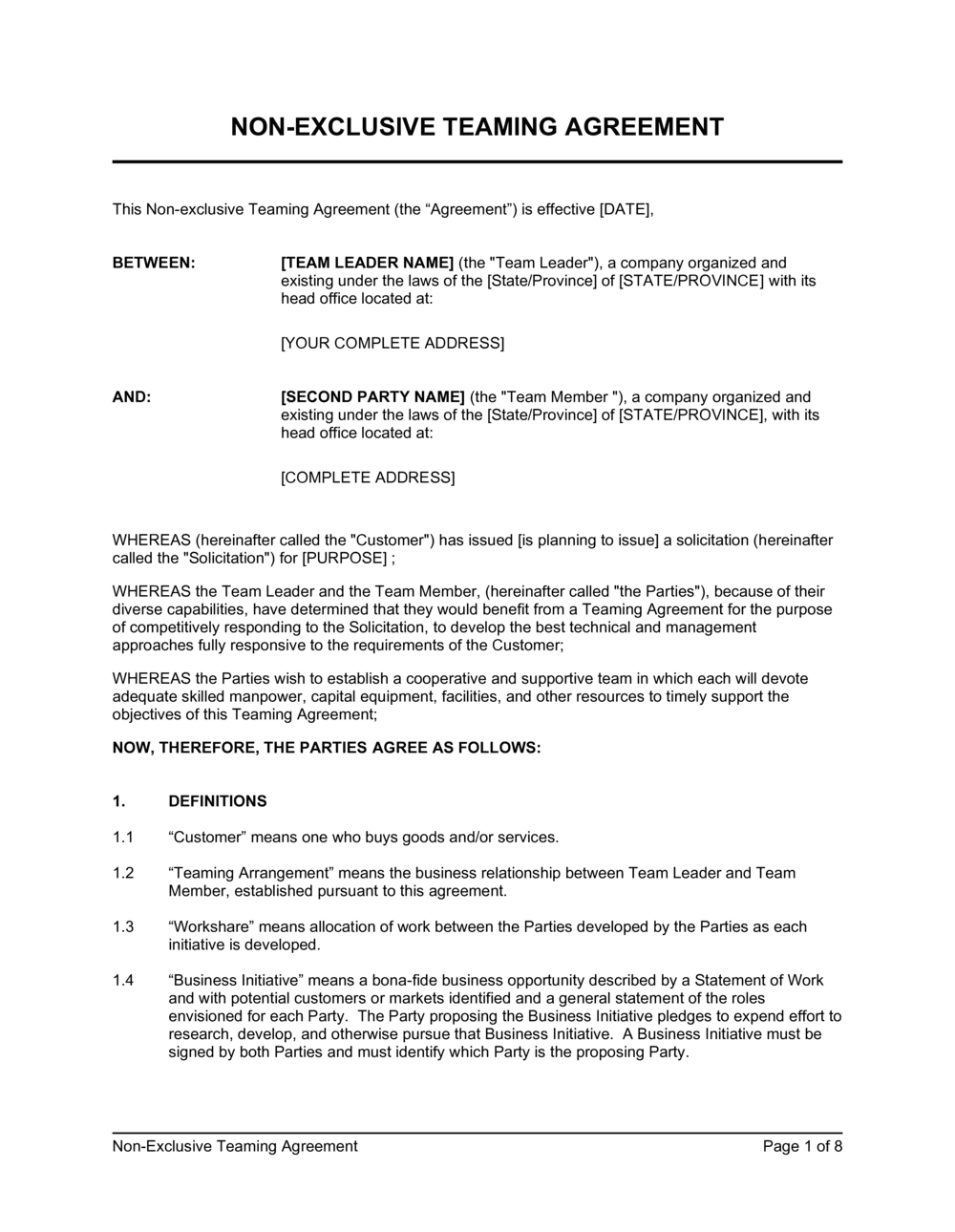
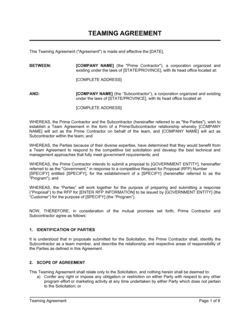
- A contract in which two or more companies agree to collaborate on pursuing and performing a specific opportunity, defining each party's role and obligations.
- Non-Exclusivity Clause
- A provision expressly stating that neither party is prevented from independently pursuing the same or competing opportunities with other partners.
- Prime Contractor
- The party that holds the primary contract with the client and bears direct accountability for performance, typically also leading the proposal effort.
- Subcontractor
- A party engaged by the prime contractor to perform a defined portion of the work under the prime's oversight and contractual responsibility.
- Scope of Work
- A detailed description of the tasks, deliverables, and responsibilities each party commits to perform under the teaming arrangement.
- Opportunity
- The specific bid, solicitation, RFP, or project pursuit that the teaming agreement is structured to address.
- Intellectual Property (IP)
- Proprietary inventions, software, data, processes, or materials that either party brings into or creates during the collaboration.
- Background IP
- Intellectual property owned by a party prior to the teaming arrangement, which is licensed — not transferred — to the other party for use in the collaboration.
- Foreground IP
- New intellectual property created jointly or by one party specifically in the course of the teaming collaboration, the ownership of which must be expressly allocated.
- Proposal Costs
- Expenses incurred by each party in preparing a joint bid or proposal, including labor, materials, and filing fees, typically borne by each party independently unless agreed otherwise.
- Teaming Partner
- Any company that is party to the teaming agreement, regardless of whether it serves as prime or subcontractor in the resulting arrangement.