Option to Acquire Partnership Interests Template

Free Word download β€’ Edit online β€’ Save & share with Drive β€’ Export to PDF

13 pagesβ€’30–45 min to fillβ€’Difficulty: Complexβ€’Signature requiredβ€’Legal review recommended
Learn more ↓
FreeOption to Acquire Partnership Interests Template

At a glance

What it is
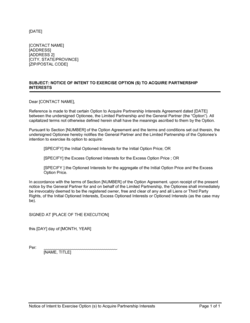
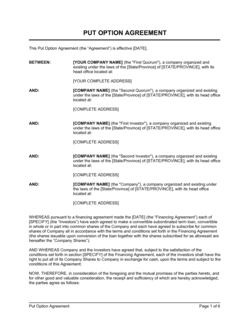
An Option To Acquire Partnership Interests is a legally binding agreement that grants one party the right β€” but not the obligation β€” to purchase a defined percentage of partnership interests from a current partner at a pre-agreed price within a specified timeframe. This free Word download gives you a structured, attorney-ready starting point covering option grant, exercise mechanics, pricing, conditions precedent, and transfer formalities, which you can edit online and export as PDF.
When you need it
Use it when an investor, co-founder, or strategic partner wants to secure the future right to acquire a stake in a partnership without committing capital immediately. It is also commonly used in buy-sell arrangements, joint ventures, and succession planning where timing or financing conditions need to be satisfied before the transfer completes.
What's inside
Option grant and consideration, exercise period and procedure, purchase price or pricing formula, conditions precedent to exercise, representations and warranties by the granting partner, transfer mechanics, right of first refusal interplay, anti-dilution provisions, and governing law with dispute resolution.

What is an Option To Acquire Partnership Interests?

An Option To Acquire Partnership Interests is a legally binding agreement in which a current partner (the grantor) grants another party (the option holder) the exclusive right β€” but not the obligation β€” to purchase a defined percentage of that partner's ownership stake in a partnership at a pre-agreed price or formula within a specified timeframe. The holder pays a non-refundable option fee at signing to secure this right, and in return the grantor is contractually prevented from selling, pledging, or transferring the optioned interests to anyone else during the option period. If the holder chooses not to exercise before the expiry date, the option lapses automatically and the grantor's interest is unencumbered. The agreement covers the full mechanics of the transaction: the exact interests being optioned, the exercise price, the procedure for giving notice of exercise, the conditions that must be satisfied before closing, and the representations the grantor makes about owning the interest free and clear.

Why You Need This Document

Without a written option agreement, the holder has no enforceable right to acquire the interest β€” a verbal commitment to sell is revocable at any time in most jurisdictions. If the grantor receives a better offer from a third party, nothing prevents them from accepting it, leaving the holder with no remedy. An undocumented option also creates serious problems at closing: transfer restrictions in the underlying partnership agreement will not have been addressed, existing partners with right of first refusal rights can void the transfer after the fact, and title defects β€” such as a prior pledge of the interest as loan collateral β€” go undiscovered until it is too late. This template locks in the option terms at the moment of commercial agreement, binds the grantor to the deal, forces a review of the partnership agreement's transfer restrictions, and gives the holder a clear, time-limited window to complete due diligence and secure financing before committing full capital β€” protecting both parties from the uncertainty that an informal understanding cannot resolve.

Which variant fits your situation?

If your situation is…Use this template
Granting an option on a defined percentage of a general partnershipOption To Acquire Partnership Interests
Buying out a departing partner's entire interestPartnership Buyout Agreement
Transferring a limited partnership interest with investor protectionsLimited Partnership Agreement
Granting a right of first refusal on a partner's interestRight of First Refusal Agreement
Structuring a buy-sell trigger on death, disability, or departureBuy-Sell Agreement
Documenting the underlying partnership terms before issuing the optionGeneral Partnership Agreement
Acquiring a membership interest in an LLC rather than a partnershipOption To Acquire LLC Membership Interests

Common mistakes to avoid

❌ No fixed expiry date on the option

Why it matters: An open-ended option permanently encumbers the grantor's interest, making it impossible to sell, pledge, or admit new partners without the option holder's consent β€” potentially for years.

Fix: Always include a hard expiry date and a lapse mechanism: 'If the Option is not exercised by [DATE], it terminates automatically without further action by either party.'

❌ Ambiguous pricing formula with no dispute fallback

Why it matters: If the exercise price depends on EBITDA or fair market value and the parties disagree on the calculation, the option becomes unexercisable β€” turning a commercial agreement into litigation.

Fix: Name a specific accounting firm or independent appraiser as the fallback valuer, and state that their determination is final and binding within 30 days of a dispute notice.

❌ Ignoring existing transfer restrictions in the partnership agreement

Why it matters: Most partnership agreements require unanimous or majority partner consent for interest transfers. An option that ignores these restrictions may be void at exercise even if perfectly drafted.

Fix: Review the partnership agreement before drafting the option. Obtain written consent or ROFR waivers from all other partners at signing, and reference the specific sections being waived.

❌ Omitting anti-dilution protection

Why it matters: If the partnership admits new partners between signing and exercise, the option holder's expected percentage is automatically reduced β€” with no contractual remedy if the clause is missing.

Fix: Include a standard anti-dilution adjustment clause that recalculates the option percentage proportionately whenever new interests are issued prior to exercise.

❌ No representations about clear title to the interest

Why it matters: If the granting partner has previously pledged or encumbered the interest as loan collateral, the option holder may acquire an interest subject to a security interest they did not know about.

Fix: Require the grantor to represent clear and unencumbered title at signing, and include a pre-closing bring-down of those representations on the closing date.

❌ Signing after competing transfer discussions have begun

Why it matters: If the grantor has already entered into an agreement β€” even informal β€” to sell the same interest to a third party, the option may be unenforceable or trigger a priority dispute.

Fix: Include a representation that no competing transfer agreements exist, and execute the option before any third-party discussions begin on the same interest.

The 10 key clauses, explained

Parties and Recitals

In plain language: Identifies the option holder (the party acquiring the right) and the granting partner (the current interest holder), and sets out the background and commercial purpose of the arrangement.

Sample language
This Option Agreement is entered into as of [DATE] between [OPTION HOLDER NAME], a [STATE] [ENTITY TYPE] ('Holder'), and [GRANTING PARTNER NAME], a [STATE] [ENTITY TYPE] ('Grantor'), who together hold interests in [PARTNERSHIP NAME] (the 'Partnership').

Common mistake: Identifying a partner's individual name when the actual holder of the interest is a trust or holding entity β€” this creates a title mismatch that can void the transfer at closing.

Grant of Option

In plain language: The operative clause that grants the option holder the exclusive, irrevocable right to purchase a specified percentage of partnership interests during the exercise period.

Sample language
Grantor hereby grants to Holder an exclusive, irrevocable option (the 'Option') to acquire [X]% of the partnership interests of the Partnership (the 'Interests'), exercisable at any time during the Exercise Period on the terms set forth herein.

Common mistake: Failing to specify whether the option is exclusive β€” a non-exclusive grant allows the grantor to sell the same interest to a third party before the option is exercised.

Option Consideration

In plain language: States the amount paid by the option holder to the grantor at signing to make the option binding β€” typically a nominal sum β€” and confirms it is non-refundable regardless of whether the option is exercised.

Sample language
In consideration of the Option, Holder shall pay Grantor the sum of $[AMOUNT] (the 'Option Fee') upon execution of this Agreement. The Option Fee is non-refundable and shall be credited against the Exercise Price upon exercise.

Common mistake: Omitting consideration entirely and treating the option as a gift β€” without valid consideration, the option may be unenforceable in most common-law jurisdictions.

Exercise Price and Pricing Formula

In plain language: Defines the exact price β€” or the formula for calculating the price β€” at which the option holder may purchase the partnership interests upon exercise.

Sample language
The exercise price for the Interests shall be $[FIXED AMOUNT] (the 'Exercise Price'), OR an amount equal to [MULTIPLE] times the Partnership's trailing twelve-month EBITDA as of the date of the Exercise Notice, as calculated by the Partnership's independent accountant.

Common mistake: Using a subjective valuation method β€” such as 'fair market value as agreed by the parties' β€” without a fallback mechanism. If the parties cannot agree, the option becomes unexercisable and litigation follows.

Exercise Period and Procedure

In plain language: Sets the window during which the option may be exercised and the exact steps the holder must follow β€” written notice, form of notice, and delivery method β€” to validly exercise.

Sample language
The Option may be exercised at any time during the period commencing on [START DATE] and expiring at 11:59 p.m. on [END DATE] (the 'Exercise Period'). To exercise, Holder shall deliver written notice to Grantor at the address set forth herein, specifying the date of intended closing (no fewer than [X] business days after notice).

Common mistake: No expiry mechanism β€” leaving the option open indefinitely encumbers the grantor's interest permanently and may be challenged as an unreasonable restraint on alienation.

Conditions Precedent to Closing

In plain language: Lists all events that must occur before the interest transfer completes after exercise β€” including consent of other partners, regulatory approval, and financing confirmation.

Sample language
Closing is conditioned upon: (a) written consent of all other partners of the Partnership; (b) receipt of any required regulatory approvals; (c) Holder delivering the Exercise Price in cleared funds; and (d) absence of any material adverse change in the Partnership's business.

Common mistake: Including conditions entirely within the grantor's control β€” such as 'grantor's satisfaction with the terms' β€” which effectively allows the grantor to refuse closing without consequence.

Representations and Warranties of the Grantor

In plain language: The granting partner's factual promises at signing: they own the interest free of liens, no conflicting transfer agreements exist, and the partnership agreement does not prohibit the option.

Sample language
Grantor represents and warrants that: (a) Grantor is the sole registered and beneficial owner of the Interests; (b) the Interests are free and clear of all liens, encumbrances, and adverse claims; (c) Grantor has full authority to grant this Option; and (d) no consent of any third party is required except as set forth herein.

Common mistake: No representations at all β€” if the grantor later turns out not to own the interest free and clear, the option holder has no contractual remedy without a warranty to sue on.

Anti-Dilution and Adjustment Provisions

In plain language: Protects the option holder from having their percentage eroded by new interest issuances or restructurings between signing and exercise, by adjusting either the percentage or the exercise price accordingly.

Sample language
If, prior to exercise, the Partnership issues additional interests, splits existing interests, or completes any restructuring that affects the proportionate ownership represented by the Interests, the Option percentage and Exercise Price shall be adjusted proportionately to preserve the economic benefit of this Option.

Common mistake: Omitting this clause in a partnership that expects to admit new partners before the option is exercised β€” the holder may find their expected 20% stake has been diluted to 14% without any adjustment mechanism.

Right of First Refusal Interplay

In plain language: Addresses how the option interacts with any existing right of first refusal in the partnership agreement β€” typically by either waiving the ROFR for this option or requiring ROFR compliance before closing.

Sample language
The parties acknowledge that the Partnership Agreement contains a right of first refusal in favor of the remaining partners. Grantor shall obtain written waivers of such right from all other partners on or before the Exercise Date as a condition to closing.

Common mistake: Ignoring an existing ROFR entirely β€” if the partnership agreement requires a ROFR process and the option bypasses it, existing partners can void the transfer after closing.

Governing Law and Dispute Resolution

In plain language: Specifies which jurisdiction's law governs the agreement and how disputes are resolved β€” binding arbitration, mediation first, or court β€” and where proceedings take place.

Sample language
This Agreement is governed by the laws of [STATE / PROVINCE / COUNTRY], without regard to conflicts of law principles. Any dispute arising under this Agreement shall be resolved by binding arbitration before [AAA / JAMS] in [CITY], except that either party may seek injunctive relief in any court of competent jurisdiction.

Common mistake: Choosing a governing law with no connection to where the partnership operates or the parties are domiciled β€” several US states and EU jurisdictions apply local law regardless of the contractual choice.

How to fill it out

  1. 1

    Identify and verify all parties

    Enter the full legal names and entity types of both the option holder and the granting partner, and confirm that the granting partner is the registered and beneficial owner of the interest being optioned. Cross-check the partnership agreement to confirm ownership percentages.

    πŸ’‘ Request a current copy of the partnership register or certificate of partnership before drafting β€” verbal ownership representations are frequently inaccurate.

  2. 2

    Define the interest being optioned with precision

    State the exact percentage of partnership interests covered by the option β€” not just a dollar amount. Include whether the option covers capital interests, profit interests, or both, as these can have different tax and economic consequences.

    πŸ’‘ In an LP structure, distinguish between general partner and limited partner interests β€” they carry very different liability and governance rights.

  3. 3

    Set the exercise price or pricing formula

    Choose between a fixed exercise price, a formula (e.g., a multiple of EBITDA), or a third-party appraisal mechanism. Whichever method you use, include a fallback dispute resolution process if the parties cannot agree on the calculated figure.

    πŸ’‘ EBITDA multiples and book value formulas both produce very different outcomes β€” model each one with current partnership financials before committing to the formula in the agreement.

  4. 4

    Define the exercise period with a hard expiry date

    Enter both the start date (which can be the signing date or a future trigger event) and the hard expiry date. Include the notice form, delivery method, and minimum closing lead time in days.

    πŸ’‘ A 12–24 month exercise window is standard for most partnership options β€” longer periods introduce more dilution and partnership change risk.

  5. 5

    List all conditions precedent to closing

    Identify every approval, consent, or event that must occur before the interest can transfer β€” partner consents, regulatory filings, financing conditions, and any required ROFR waivers. Assign responsibility for satisfying each condition to a specific party.

    πŸ’‘ Set a longstop date by which all conditions must be satisfied β€” if they are not, the option should lapse or extend by mutual written agreement only.

  6. 6

    Address ROFR and transfer restrictions in the partnership agreement

    Review the existing partnership agreement for transfer restrictions, right of first refusal clauses, and consent requirements. Include a specific clause in the option agreement that either obtains ROFR waivers upfront or requires them as a condition to closing.

    πŸ’‘ Obtain ROFR waivers from all other partners at signing, not at exercise β€” partners who were willing to waive at signing may be far less cooperative 18 months later.

  7. 7

    Include anti-dilution provisions if new partners are expected

    If the partnership plans to admit new partners, issue additional interests, or restructure before the option expires, include an anti-dilution clause that adjusts the option percentage or price automatically.

    πŸ’‘ Attach a cap table showing current ownership percentages as an exhibit β€” this eliminates disputes about the starting baseline for any adjustment calculation.

  8. 8

    Execute before any competing transfer discussions begin

    Both parties must sign the option agreement before any parallel sale or transfer discussions with third parties begin. Ensure the grantor provides the representations and warranties in writing at signing, not later.

    πŸ’‘ Use Business in a Box eSign to timestamp execution and store the fully executed copy securely β€” the date of execution is critical if the option's validity is ever challenged.

Frequently asked questions

What is an option to acquire partnership interests?

An option to acquire partnership interests is a binding contract that gives one party the right β€” but not the obligation β€” to purchase a defined percentage of a partnership's ownership interests at a pre-agreed price within a specified timeframe. The option holder pays a fee to secure this right, and the grantor is bound not to transfer the interest to anyone else during the option period. If the holder elects not to exercise, the option lapses and no transfer occurs.

What is the difference between an option to acquire and a direct purchase agreement?

A direct purchase agreement obligates both parties to complete the transfer β€” buyer and seller are both bound to close on agreed terms. An option creates a right for one party (the holder) without any obligation to exercise it. The holder decides whether to proceed; the grantor cannot back out during the option period. Options are used when the buyer needs time to secure financing, complete due diligence, or wait for a triggering event before committing capital.

What consideration is needed to make an option to acquire partnership interests enforceable?

In common-law jurisdictions β€” including the US, Canada, and the UK β€” an option must be supported by valid consideration to be binding. This is typically a nominal cash payment from the option holder to the grantor at signing, often ranging from $1 to several thousand dollars depending on the commercial context. Without consideration, the option is merely a revocable offer that the grantor can withdraw at any time. Some jurisdictions also accept a deed as a substitute for consideration.

Can an option to acquire partnership interests be transferred or assigned?

Whether the option itself is assignable depends on what the agreement says. Many options are personal to the original holder and expressly prohibit assignment without the grantor's written consent. If you anticipate wanting to assign the option β€” for example, to a fund or holding entity β€” include an explicit assignment right in the agreement. Any assignment should also consider whether the partnership agreement restricts who may become a partner.

How is the exercise price typically determined in a partnership option agreement?

The exercise price is most commonly set as a fixed dollar amount agreed at signing, a formula tied to a financial metric such as a multiple of trailing EBITDA or book value, or a third-party appraisal at the time of exercise. Fixed prices offer certainty but may feel unfair if the partnership's value changes significantly. Formula-based prices are common in commercial arrangements but require a clear fallback dispute mechanism when the parties cannot agree on the calculation.

What happens to the option if the partnership admits new partners before it is exercised?

Without an anti-dilution clause, the option holder's percentage is automatically reduced proportionately when new interests are issued. For example, an option on a 25% interest in a two-partner partnership becomes approximately a 16.7% interest if a third partner joins with a 33% stake. An anti-dilution clause in the option agreement adjusts the percentage or exercise price to preserve the holder's original economic expectation.

Is an option to acquire partnership interests taxable?

Tax treatment depends on jurisdiction and structure. In the US, the option fee paid to the grantor is generally taxable as ordinary income at receipt. On exercise, the transfer of a partnership interest can trigger capital gains, ordinary income on depreciation recapture, or both, depending on the partnership's asset composition under IRC Β§751. In Canada and the UK, similar principles apply with jurisdiction-specific rates and rules. Always consult a tax advisor before signing or exercising.

What should I do if the partnership agreement is silent on options?

Silence in the partnership agreement does not automatically permit options over interests. In many jurisdictions, a general prohibition on transfer without consent is interpreted to cover options as well as direct sales. Before granting or acquiring an option, obtain written confirmation from all partners that the option is permitted, or formally amend the partnership agreement to carve out the specific option being granted. Proceeding without this step creates significant enforceability risk.

How this compares to alternatives

vs Partnership Purchase Agreement

A partnership purchase agreement immediately and unconditionally obligates both parties to complete the interest transfer on agreed terms β€” both buyer and seller are bound to close. An option to acquire gives only the holder the right to purchase; the grantor cannot sell elsewhere but the holder is free to walk away. Use an option when the holder needs time to complete due diligence or secure financing before committing.

vs Buy-Sell Agreement

A buy-sell agreement governs what happens to a partner's interest upon a triggering event β€” death, disability, departure, or bankruptcy β€” and typically obligates a purchase. An option to acquire is a proactive, voluntary grant of a purchase right that the holder may or may not exercise within the option period. Buy-sell agreements provide mandatory exit liquidity; options provide discretionary entry rights.

vs Right of First Refusal Agreement

A right of first refusal is a reactive right that activates only when the interest holder decides to sell β€” it allows the ROFR holder to match a third-party offer before the sale proceeds. An option to acquire is a proactive right the holder can trigger at any time during the option period regardless of whether the grantor wants to sell. Options give the holder more control; ROFRs are less restrictive on the grantor.

vs General Partnership Agreement

A general partnership agreement establishes the partnership itself β€” capital contributions, profit sharing, management rights, and exit procedures for all existing partners. An option to acquire partnership interests is a separate bilateral agreement between the option holder and one granting partner, governing the conditional future acquisition of a specific interest. The option operates alongside, and is constrained by, the underlying partnership agreement.

Industry-specific considerations

Private Equity and Investment

Staged entry structures where an investor acquires an option to increase their stake after a performance milestone, avoiding full capital commitment upfront.

Real Estate

Joint venture partnerships where a developer grants a capital partner an option to acquire a larger interest once a project reaches stabilization or a target occupancy rate.

Professional Services

Law firms, accounting firms, and consulting partnerships granting senior associates an option to buy in as a partner upon meeting defined performance or tenure criteria.

Manufacturing and Distribution

Strategic buyers securing an option to acquire a distribution partner's stake before committing to a full acquisition, with exercise conditioned on regulatory approval or supply chain integration.

Jurisdictional notes

United States

Partnership interests are governed by state law β€” the Revised Uniform Partnership Act (RUPA) applies in most states, but Texas, California, and Delaware have significant variations. Options over interests in tax partnerships trigger IRC Β§751 issues on exercise if the partnership holds 'hot assets' such as inventory or depreciation recapture property. California additionally imposes its own transferability restrictions that may override contractual terms.

Canada

Partnership law is provincial; each province has its own Partnerships Act with differing rules on interest transferability and partner consent requirements. In Quebec, the Civil Code governs contracts of association and imposes unique formality requirements. Tax treatment of partnership interest options is governed by the Income Tax Act, and the exercise of an option over a partnership interest can trigger deemed disposition rules with significant capital gains consequences.

United Kingdom

UK partnership law is governed by the Partnership Act 1890 for general partnerships and the Limited Partnerships Act 1907 for LPs, both of which restrict transfer of partnership interests without unanimous partner consent unless the agreement provides otherwise. Options over partnership interests should be executed as deeds to ensure enforceability without consideration in certain circumstances. Stamp Duty may apply to the transfer of partnership interests on exercise depending on the underlying assets.

European Union

Partnership structures and interest transfer rules vary significantly across EU member states β€” German GbR and KG structures, French SNC and SCS forms, and Spanish partnerships each have distinct consent and transferability rules. Options may require notarization in civil-law jurisdictions including France, Germany, Spain, and Italy to be effective against third parties. GDPR considerations apply if partner personal data is processed as part of the option or closing documentation.

Template vs lawyer β€” what fits your deal?

PathBest forCostTime
Use the templateStraightforward options between known parties in a simple general partnership with no existing transfer restrictionsFree30–60 minutes
Template + legal reviewOptions involving formula-based pricing, LP structures, or partnerships with existing ROFR or transfer restriction clauses$500–$1,5002–5 days
Custom draftedHigh-value acquisitions, multi-partner partnerships, regulated industries, or cross-border arrangements with complex tax implications$2,000–$8,000+1–3 weeks

Glossary

Option
A contractual right to purchase a specified asset at a pre-agreed price within a defined window, without any obligation to do so.
Exercise Price
The price at which the option holder may purchase the partnership interest when exercising the option β€” fixed at signing or determined by a formula.
Exercise Period
The window of time during which the option holder may validly elect to exercise the option; after this period the option lapses.
Option Consideration
The payment made by the option holder to the granting partner in exchange for granting the option right β€” typically a nominal cash amount.
Partnership Interest
A partner's ownership share in a partnership, expressed as a percentage, entitling the holder to a proportionate share of profits, losses, and distributions.
Conditions Precedent
Specific events or approvals β€” such as partner consent, regulatory clearance, or financing β€” that must occur before the option can be validly exercised.
Anti-Dilution Protection
A clause that adjusts the option's exercise price or percentage to protect the option holder if new interests are issued at a lower effective value before exercise.
Right of First Refusal (ROFR)
A pre-existing contractual right held by existing partners to purchase an interest on the same terms before it can be sold to an outsider.
Representations and Warranties
Factual statements made by a party at signing β€” such as clear title to the interest and no conflicting agreements β€” that become contractual obligations.
Transfer Restriction
A provision in the partnership agreement that limits a partner's ability to sell, assign, or encumber their interest without partner consent.
Closing
The formal completion of the interest transfer after the option is exercised β€” when documents are signed, consideration is paid, and ownership changes.
Drag-Along Right
A right allowing majority partners to compel minority partners to join in a sale of the partnership on the same terms and price.

Part of your Business Operating System

This document is one of 3,000+ business & legal templates included in Business in a Box.

  • Fill-in-the-blanks β€” ready in minutes
  • 100% customizable Word document
  • Compatible with all office suites
  • Export to PDF and share electronically

Create your document in 3 simple steps.

From template to signed document β€” all inside one Business Operating System.
1
Download or open template

Access over 3,000+ business and legal templates for any business task, project or initiative.

2
Edit and fill in the blanks with AI

Customize your ready-made business document template and save it in the cloud.

3
Save, Share, Send, Sign

Share your files and folders with your team. Create a space of seamless collaboration.

Save time, save money, and create top-quality documents.

β˜…β˜…β˜…β˜…β˜…

"Fantastic value! I'm not sure how I'd do without it. It's worth its weight in gold and paid back for itself many times."

Managing Director Β· Mall Farm
Robert Whalley
Managing Director, Mall Farm Proprietary Limited
β˜…β˜…β˜…β˜…β˜…

"I have been using Business in a Box for years. It has been the most useful source of templates I have encountered. I recommend it to anyone."

Business Owner Β· 4+ years
Dr Michael John Freestone
Business Owner
β˜…β˜…β˜…β˜…β˜…

"It has been a life saver so many times I have lost count. Business in a Box has saved me so much time and as you know, time is money."

Owner Β· Upstate Web
David G. Moore Jr.
Owner, Upstate Web

Run your business with a system β€” not scattered tools

Stop downloading documents. Start operating with clarity. Business in a Box gives you the Business Operating System used by over 250,000 companies worldwide to structure, run, and grow their business.

Start freeΒ Β·Β No credit card required