Co-Founder Agreement Template

Free Word download • Edit online • Save & share with Drive • Export to PDF

10 pages30–40 min to fillDifficulty: ComplexSignature requiredLegal review recommended
Learn more ↓
FreeCo-Founder Agreement Template

At a glance

What it is
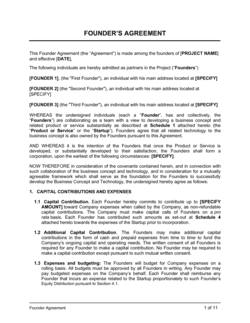
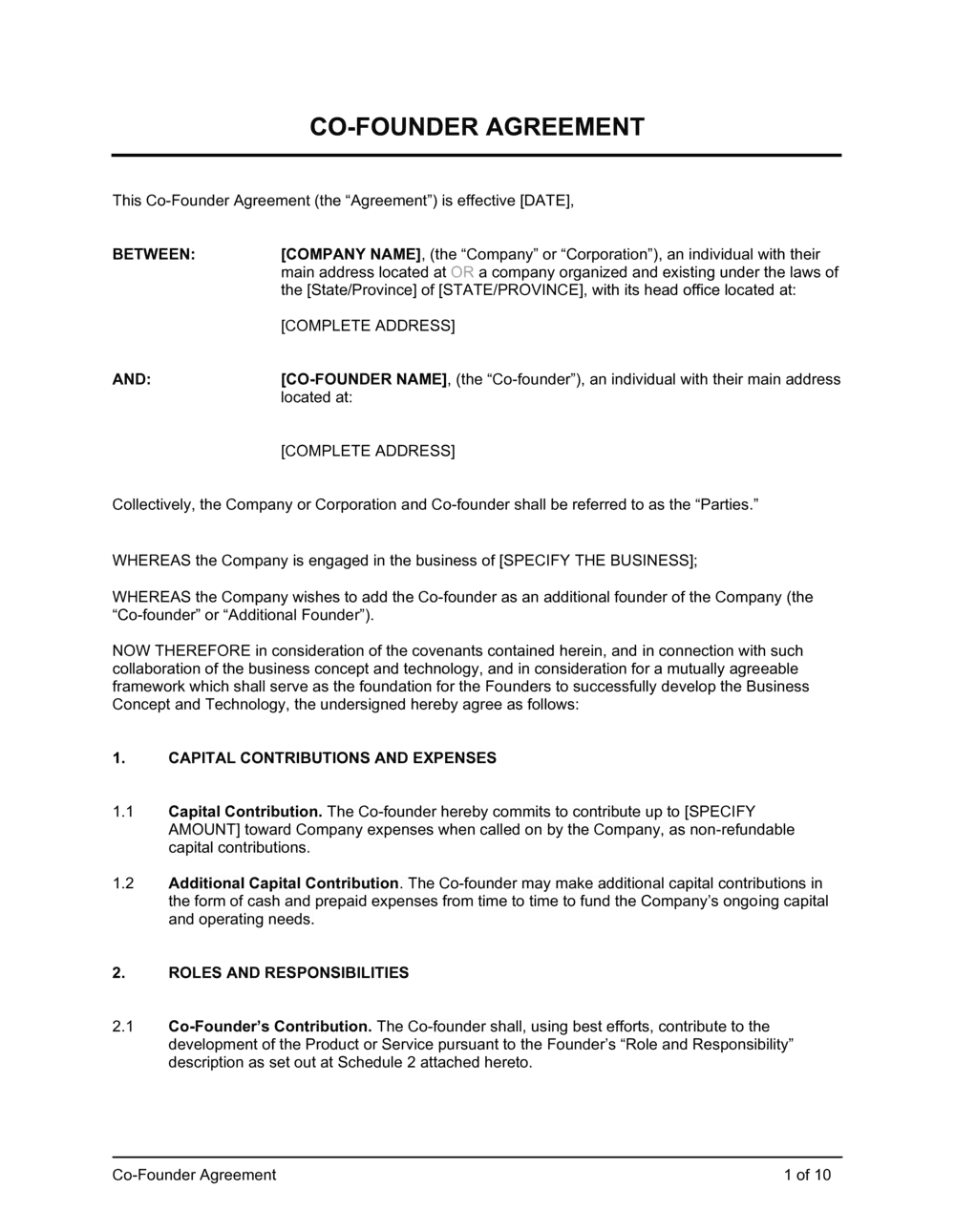
A Co-Founder Agreement is a legally binding contract between two or more startup founders that locks in equity splits, vesting schedules, roles and responsibilities, decision-making authority, IP assignment, and departure provisions before the company raises outside capital. This free Word download gives you a structured, attorney-friendly starting point you can edit online and export as PDF to sign before your first line of code is written or your first dollar is spent.
When you need it
Execute it before co-founders begin working together — ideally on the same day you form the legal entity. Waiting until a conflict arises or a funding round is imminent makes negotiation adversarial and leaves prior contributions legally unresolved.
What's inside
Founder identification and equity allocation, a 4-year vesting schedule with a 1-year cliff, role and title definitions, decision-right thresholds, IP assignment, confidentiality, non-compete and non-solicitation, buyout mechanics on departure, and governing law.

What is a Co-Founder Agreement?

A Co-Founder Agreement is a legally binding contract between two or more startup founders that establishes the foundational terms of their shared venture before outside capital arrives. It covers equity allocation with vesting schedules, each founder's role and decision-making authority, assignment of all intellectual property to the company entity, confidentiality obligations, non-compete and non-solicitation restrictions, and the mechanics of what happens when a founder exits — voluntarily or otherwise. Unlike a handshake arrangement or an informal email chain, a properly drafted co-founder agreement creates enforceable obligations on every party and eliminates the ambiguity that fuels the single most common cause of early-stage startup litigation: a dispute over who owns what.

Why You Need This Document

Without a co-founder agreement, your startup's ownership structure, IP chain of title, and governance authority exist only as informal assumptions — and informal assumptions collapse the moment pressure arrives. A founder who contributes code before the company is incorporated may legally own that IP personally, making it unavailable to investors or acquirers. A 50/50 split with no vesting means a co-founder who leaves after six months keeps half the company indefinitely. A technical co-founder who departs and immediately joins a competitor faces no enforceable restriction without a signed non-compete. Investors conducting pre-seed or Series A diligence will request this document before wiring funds — the absence of it, or a defective version, has killed funding rounds and company relationships alike. This template gives founding teams a structured, attorney-friendly starting point that addresses every one of these failure points in a single document signed before the first line of code is written.

Which variant fits your situation?

If your situation is…Use this template
Two equal co-founders splitting 50/50 with no outside investment yetCo-Founder Agreement (Equal Split)
Three or more founders with unequal equity and staggered start datesMulti-Founder Equity Agreement
Engaging a technical co-founder who will receive equity instead of salaryEquity Compensation Agreement
Bringing on an advisor or early contributor with a small equity stakeAdvisor Agreement with Equity
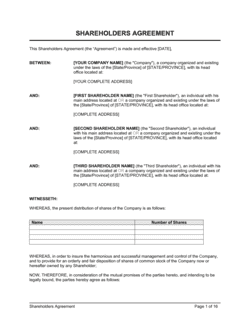
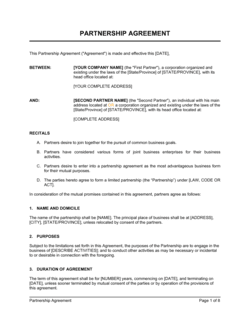
Converting an existing partnership into a corporate entityPartnership Agreement
Documenting founder roles and responsibilities without equity provisionsJoint Venture Agreement
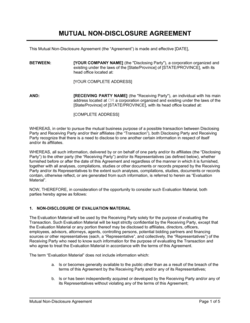
Protecting IP before co-founders have agreed on final equity termsMutual Non-Disclosure Agreement

Common mistakes to avoid

❌ Signing after work and contributions have already begun

Why it matters: Equity and IP discussions become adversarial once one founder has written code, closed customers, or contributed cash. Courts may also void restrictive covenants signed without fresh consideration if significant work preceded the agreement.

Fix: Execute the agreement on or before the date of entity formation or the first day any founder begins work, whichever is earlier. Provide documented additional consideration if signing is unavoidably delayed.

❌ No IP assignment covering pre-incorporation work

Why it matters: The core product technology or domain often exists before the company is formed. Without an explicit retroactive assignment, that IP stays with the individual founder — a disqualifying issue for most Series A investors and acquirers.

Fix: Add Schedule A listing every pre-incorporation asset by name and creation date, and have each founder sign the IP assignment simultaneously with the main agreement.

❌ Omitting a deadlock resolution mechanism in a 50/50 split

Why it matters: Two founders with equal veto power and no resolution path can gridlock the company on any reserved matter, and courts typically will not adjudicate operational disputes between living founders of an active company.

Fix: Include at minimum a mediation-then-arbitration ladder with defined timelines. For high-stakes companies, add a buy-sell provision with a clearly defined valuation methodology.

❌ No vesting acceleration on change of control

Why it matters: A founder acquired mid-vesting schedule who is not retained post-acquisition loses unvested shares without any compensation. Acquirers often terminate founders precisely to capture unvested equity.

Fix: Negotiate double-trigger acceleration before any investor joins the cap table — acquiring companies expect it from sophisticated founders, and it is far harder to insert into a post-funding agreement.

❌ Vague role definitions with no spending authority limits

Why it matters: Founders operating without defined authority can independently commit the company to contracts, hires, or expenditures the other co-founder did not approve, creating legal liability and personal conflict that fractures the relationship.

Fix: Assign each founder a specific functional domain and a monthly unilateral spending cap. All commitments above the cap require written consent of the other founder(s).

❌ Using a percentage-only equity split with no share count anchor

Why it matters: Percentages shift with every new share issuance. A founder who agreed to 50% and receives stock options or a SAFE note converts finds their effective ownership eroded in ways the original agreement did not contemplate.

Fix: State both the percentage and the absolute share count at signing, and include an anti-dilution acknowledgment confirming that future dilution is expected and agreed by all founders.

The 10 key clauses, explained

Founder identification and equity allocation

In plain language: Names each co-founder as a legal party, states their equity percentage, and records the total authorized shares each holds at signing.

Sample language
The Company's founding equity is allocated as follows: [FOUNDER 1 FULL NAME] — [X]%, [FOUNDER 2 FULL NAME] — [X]%, representing [NUMBER] shares each out of [TOTAL AUTHORIZED SHARES] authorized shares.

Common mistake: Stating equity as a percentage without anchoring it to a share count. If new shares are issued before the agreement is updated, percentage ownership dilutes in ways the founders did not intend.

Vesting schedule and cliff

In plain language: Sets the timeline over which each founder earns their equity — typically a 4-year schedule with a 1-year cliff — and specifies whether unvested shares are subject to repurchase or simply forfeited on departure.

Sample language
Each Founder's shares shall vest over 48 months, with 25% vesting on the 12-month anniversary of the Effective Date (the 'Cliff') and 1/48th of the total vesting each month thereafter, subject to continued association with the Company.

Common mistake: Omitting accelerated vesting on a change of control. Founders who don't negotiate single or double-trigger acceleration before a Series A find their unvested shares wiped out in an acquisition.

Roles, titles, and responsibilities

In plain language: Assigns a title and functional domain to each co-founder and makes clear that day-to-day operational decisions within each domain do not require the other founder's consent.

Sample language
[FOUNDER 1] shall serve as Chief Executive Officer, responsible for [FUNCTIONAL AREAS]. [FOUNDER 2] shall serve as Chief Technology Officer, responsible for [FUNCTIONAL AREAS]. Each Founder may act unilaterally within their designated domain up to a monthly expenditure limit of $[AMOUNT].

Common mistake: Leaving roles undefined and assuming informal division of labor will hold. Once money and stress arrive, undefined authority leads to decision paralysis and duplicate — or conflicting — commitments to third parties.

Decision rights and reserved matters

In plain language: Lists the major decisions — raising capital, issuing new equity, selling the company, taking on debt above a threshold — that require unanimous or supermajority founder consent.

Sample language
The following Reserved Matters require the affirmative vote of Founders holding at least [X]% of the outstanding Founder shares: (a) any equity issuance or capital raise; (b) any transaction or commitment exceeding $[AMOUNT]; (c) any sale, merger, or change of control of the Company.

Common mistake: Using a simple 50/50 veto for every decision in a two-founder company. Deadlock on routine matters with no tie-breaking mechanism halts operations — include an escalation procedure or deadlock resolution clause.

Intellectual property assignment

In plain language: Transfers all IP created by founders — before and after signing — in connection with the company's business to the company entity, including prior work directly relevant to the product.

Sample language
Each Founder hereby irrevocably assigns to the Company all right, title, and interest in and to any Intellectual Property created by such Founder (a) during the term of this Agreement, or (b) prior to the Effective Date and directly related to the Company's business, as listed in Schedule A.

Common mistake: No retroactive IP assignment covering work done before incorporation. Pre-incorporation code, designs, or inventions stay with the individual founder personally unless explicitly assigned — a deal-killer for most investors.

Confidentiality

In plain language: Prohibits founders from disclosing or misusing the company's confidential information — technology, financials, customer data, and strategic plans — both during and after their involvement.

Sample language
Each Founder shall hold in strict confidence all Confidential Information of the Company and shall not disclose or use such information for any purpose other than advancing the Company's business, both during and for [X] years following the termination of their involvement with the Company.

Common mistake: Confidentiality clauses with no carve-out for legally compelled disclosure. Without it, a founder subject to a court order could technically be in breach simply by complying with the law.

Departure, buyout, and good leaver / bad leaver

In plain language: Defines what happens when a founder exits — voluntarily or involuntarily — including the price the remaining founders pay for unvested shares and any vested shares subject to a right of first refusal.

Sample language
Upon a Founder's departure: (a) unvested shares are repurchased by the Company at the original issue price; (b) vested shares held by a Good Leaver are subject to a right of first refusal at Fair Market Value; (c) vested shares held by a Bad Leaver are repurchased at the lower of cost or Fair Market Value.

Common mistake: No definition of Fair Market Value or the valuation mechanism. A vague reference to 'fair value' leads to protracted disputes — specify whether FMV is determined by the last funding round price, a 409A valuation, or a named independent appraiser.

Non-compete and non-solicitation

In plain language: Restricts a departing founder from competing directly or poaching the company's employees and customers for a defined period after leaving.

Sample language
For [12] months following a Founder's departure from the Company, such Founder shall not: (a) engage in, or hold any material interest in, a Competing Business within [GEOGRAPHIC SCOPE]; or (b) solicit any employee, contractor, customer, or prospective customer of the Company.

Common mistake: Applying the same non-compete duration and scope to all founders regardless of role. A founding CTO with full access to the codebase warrants stricter and potentially longer restrictions than a founder who leaves before reaching the cliff.

Deadlock resolution

In plain language: Provides a structured escalation process when co-founders cannot agree on a material decision, including mediation, a casting vote mechanism, or a buy-sell provision.

Sample language
If the Founders are unable to resolve a deadlock on a Reserved Matter within [30] days of written notice, the matter shall be submitted to non-binding mediation. If unresolved after [60] days, either Founder may trigger the Buy-Sell Provision in Schedule B.

Common mistake: No deadlock clause at all in a 50/50 company. Courts cannot run a startup — without a contractual resolution mechanism, a prolonged deadlock results in dissolution, destroying value for both founders.

Governing law and dispute resolution

In plain language: Specifies the jurisdiction whose law governs the agreement and whether disputes are resolved by arbitration, mediation, or litigation.

Sample language
This Agreement is governed by the laws of [STATE / PROVINCE / COUNTRY]. Any dispute that cannot be resolved through mediation shall be submitted to binding arbitration administered by [AAA / JAMS / ICDR] in [CITY], except claims for injunctive relief, which may be brought in any court of competent jurisdiction.

Common mistake: Selecting a governing law state with no connection to where the founders or company operate. Several states — Delaware being the notable exception — apply local law regardless of what the contract says, particularly for employment-related restrictions.

How to fill it out

  1. 1

    Identify all founders and their legal names

    List every co-founder as a named party using their full legal name as it appears on government-issued ID. Confirm the company's legal entity name, registration state or province, and entity type (C-Corp, LLC, or Ltd).

    💡 Use the same legal name you will use on stock issuance documents and the cap table — inconsistencies across documents create amendment obligations later.

  2. 2

    Agree on equity splits before filling in percentages

    Have a frank conversation about relative contribution, risk, and future commitment before opening the template. Common frameworks include equal splits for symmetrical contribution, contribution-weighted splits for unequal investment of time or capital, and dynamic equity models for teams with significantly different roles.

    💡 Anchor the equity discussion to future contribution, not past effort. Investors fund what the team will build, not what it has already done.

  3. 3

    Set the vesting schedule and cliff

    Enter the vesting period (standard: 48 months), cliff length (standard: 12 months), and the vesting frequency (monthly after the cliff is the investor-preferred standard). Decide whether to include single-trigger or double-trigger acceleration on a change of control.

    💡 Double-trigger acceleration — which requires both a change of control and a founder's termination — is preferred by acquirers and causes less friction in M&A than single-trigger.

  4. 4

    Define each founder's role and spending authority

    Assign titles, functional domains, and a unilateral spending cap (e.g., $5,000 per month without co-founder approval). List the reserved matters requiring unanimous consent in the decision-rights section.

    💡 Set the spending threshold low at founding and raise it by board resolution later — it is harder to claw back authority than to grant it.

  5. 5

    Complete the IP assignment schedule

    List all pre-incorporation work in Schedule A — repositories, designs, domain names, and patents — that each founder assigns to the company. Be specific: asset name, creation date, and current owner.

    💡 If a founder built the core technology before incorporation, consider a separate IP assignment agreement signed simultaneously with this agreement to create a clean paper trail for investors.

  6. 6

    Define good leaver and bad leaver categories

    List the events that qualify each founder as a good leaver (e.g., resignation with 90 days' notice, permanent disability, death) and bad leaver (e.g., termination for cause, breach of this agreement, competing without consent). Specify the repurchase price for each category.

    💡 Have a valuation methodology agreed upon before signing — 409A, last-round price, or independent appraiser — to avoid disputes at the worst possible time.

  7. 7

    Insert the deadlock resolution mechanism

    Choose between mediation followed by arbitration, a casting vote assigned to one founder for specific categories, or a buy-sell (shotgun) clause. Document the notice period and timeline for each step.

    💡 A shotgun clause — where one founder names a price and the other must buy or sell at that price — resolves deadlocks decisively but favors the cash-richer founder. Use it only if both founders understand the dynamic.

  8. 8

    Sign before work begins and before any money changes hands

    Both parties must sign on or before the date the company is incorporated or the date co-founders begin working together. Circulate the final draft to each founder's independent counsel at least 5 business days before signing.

    💡 Use Business in a Box eSign to timestamp execution and store the fully-executed copy with a copy of the entity formation documents in the same folder.

Frequently asked questions

What is a co-founder agreement?

A co-founder agreement is a legally binding contract between two or more startup founders that establishes the terms of their working relationship before the company raises outside capital. It covers equity allocation, vesting schedules, roles and decision rights, IP ownership, confidentiality, non-compete restrictions, and departure mechanics. It is the foundational document that prevents equity disputes — the single most common cause of early-stage startup failure.

When should co-founders sign a co-founder agreement?

Sign it on or before the date you form the legal entity — ideally before any founder writes a line of code, closes a customer, or contributes cash. Waiting until a funding round is imminent or until a disagreement has already surfaced makes negotiation adversarial and may void certain clauses for lack of fresh consideration. The earlier the agreement is executed, the cleaner the equity and IP history looks to investors.

What equity split should co-founders use?

There is no universally correct split, but the most durable arrangements are grounded in expected future contribution rather than past effort. Equal splits work well when founders have symmetric roles and commitment. Unequal splits should reflect material differences in capital invested, domain expertise critical to the product, or significantly different time commitments. Whatever the split, pair it with a vesting schedule — a 50/50 split with no vesting means a founder who leaves on Month 3 keeps half the company permanently.

What is a standard vesting schedule for co-founders?

The investor-standard schedule is 4 years with a 1-year cliff: 25% of a founder's shares vest on the 12-month anniversary, and 1/48th vests each month thereafter until fully vested at 48 months. This structure aligns founder incentives with the typical venture capital investment horizon and is expected by most institutional investors conducting diligence before a seed or Series A round.

Does a co-founder agreement need to be notarized?

Notarization is generally not required for a co-founder agreement to be legally enforceable in the US, Canada, the UK, or the EU. Both parties signing a clearly dated agreement — ideally with independent witnesses or via a timestamped electronic signature platform — is typically sufficient. Some jurisdictions may require notarization if the agreement is filed alongside real property or patent transfers. Confirm local requirements when operating outside North America.

What happens if a co-founder leaves before vesting?

Under a standard reverse-vesting structure, the company repurchases any unvested shares from the departing founder at the original issue price. The treatment of vested shares depends on whether the founder is classified as a good leaver (typically receives fair market value) or a bad leaver (typically receives cost price or a discounted value). These categories and their pricing mechanics should be explicitly defined in the agreement before signing.

Is a co-founder agreement the same as a shareholders' agreement?

They overlap significantly but are not identical. A co-founder agreement focuses on founder-specific terms — vesting, roles, IP assignment, and departure mechanics — and is typically signed at or near incorporation. A shareholders' agreement governs all shareholders (including investors) and addresses broader governance topics like board composition, drag-along and tag-along rights, and pre-emption rights on share transfers. Once external investors join the cap table, a full shareholders' agreement typically supersedes or supplements the co-founder agreement.

Can a co-founder agreement be amended after it is signed?

Yes, but any amendment requires the written consent of all parties to the original agreement. Material changes — such as adjusting the equity split, modifying vesting terms, or adding a new founder — should be documented in a signed amendment rather than a side letter or email chain. Note that adding restrictive covenants (non-compete, non-solicit) to an existing agreement may require fresh consideration to be enforceable in common-law jurisdictions.

Are non-compete clauses in a co-founder agreement enforceable?

Enforceability depends entirely on the jurisdiction and the reasonableness of the restriction. California, Minnesota, and Oklahoma ban or severely restrict post-departure non-competes even between co-founders. In most other US states, Canada, and the UK, courts enforce restrictions that are proportionate in duration (typically 12 months), geographic scope, and industry breadth. Overbroad clauses may be struck down entirely in some jurisdictions rather than narrowed to a reasonable scope.

How this compares to alternatives

vs Shareholders' Agreement

A shareholders' agreement governs all shareholders — including investors — and addresses board composition, pre-emption rights, drag-along provisions, and investor protections. A co-founder agreement is executed at inception between founders only, before any investor joins the cap table. Once a seed or Series A round closes, a shareholders' agreement typically supersedes or supplements the co-founder agreement.

vs Partnership Agreement

A partnership agreement governs an unincorporated partnership — a legal structure that exposes partners to personal liability for partnership debts. A co-founder agreement is designed for founders of an incorporated entity (C-Corp, LLC, or Ltd) and does not create joint personal liability. Most venture-backed startups incorporate before or simultaneously with signing a co-founder agreement.

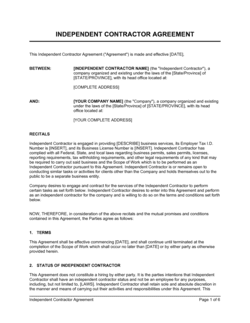
vs Independent Contractor Agreement

An independent contractor agreement engages a self-employed contributor for defined deliverables in exchange for cash — with no equity, no vesting, and no governance rights. A co-founder agreement grants equity ownership and shared governance. Mischaracterizing a co-founder as a contractor creates serious IP ownership gaps and potential employment law liability.

vs Joint Venture Agreement

A joint venture agreement structures a project-specific collaboration between two existing businesses or individuals, often with a defined term and scope. A co-founder agreement governs an ongoing business relationship within a single entity without a defined end date. Joint ventures suit discrete projects; co-founder agreements suit companies built to scale and potentially exit.

Industry-specific considerations

SaaS / Technology

IP assignment covers source code, algorithms, and training data; vesting aligned to a 4-year VC investment horizon; CTO departure provisions address codebase access and repository transfer.

Consumer / E-commerce

Brand assets, domain names, and social accounts explicitly listed in the IP assignment schedule; non-compete scope tailored to specific product categories and geographic markets.

Life Sciences / MedTech

Patent and trade secret assignment especially critical; founder departure provisions address ongoing FDA submission obligations and clinical trial responsibilities that cannot simply be transferred.

Professional Services / Consulting

Client non-solicitation is the most commercially sensitive provision; billing rate and revenue contribution tracked as proxy for equity justification in unequal splits.

Deep Tech / Hardware

Pre-incorporation patent filings and prototype ownership must be explicitly assigned; longer development timelines may warrant modified vesting schedules beyond the standard 48 months.

Creative / Media

Copyright assignment for content, brand identity, and creative IP is foundational; moral rights waivers may be required in jurisdictions that recognize them (Canada, UK, EU).

Jurisdictional notes

United States

Delaware is the preferred incorporation state for venture-backed startups; its Court of Chancery provides a deep body of corporate law. IP assignment clauses must comply with state-specific carve-outs for personal inventions — California Labor Code §2870, for example, limits what employers (and by extension companies) can require founders to assign. Non-compete enforceability varies sharply: California, Minnesota, and Oklahoma ban most post-departure restrictions, while other states enforce reasonable restrictions.

Canada

Co-founder agreements are governed by the law of the province of incorporation — most tech startups incorporate federally (CBCA) or in Ontario or British Columbia. Non-compete clauses are enforceable only if reasonable in scope, duration, and geography; Ontario courts apply a particularly strict standard. Quebec requires contracts to be in French for provincially-regulated companies, and moral rights in creative IP cannot be assigned — only waived. Provincial Employment Standards Acts set minimum notice periods that affect the termination provisions.

United Kingdom

Co-founder agreements in the UK typically sit alongside a shareholders' agreement and the company's Articles of Association — conflicts between documents are resolved in favor of the Articles. Post-termination non-competes are enforceable only if protecting a legitimate business interest and reasonable in scope; courts will not rewrite an overbroad clause. Founders who are also employees have statutory employment rights that cannot be contracted out, including minimum notice periods under the Employment Rights Act 1996. Moral rights in copyright works are inalienable but can be waived.

European Union

EU member states apply widely varying rules on non-compete enforceability — Germany, France, and the Netherlands require financial compensation to the departing founder for the restriction period to be valid (typically 50–100% of last compensation). GDPR applies to any personal data processed in connection with the agreement, including founder identification data. IP assignment must be explicit and cannot override authors' moral rights in most civil law jurisdictions. The EU Transparent and Predictable Working Conditions Directive may apply to founders classified as workers in their member state.

Template vs lawyer — what fits your deal?

PathBest forCostTime
Use the templatePre-revenue co-founders forming their first company in a single US state or Canadian province with straightforward equity and rolesFree2–4 hours
Template + legal reviewFounders with unequal equity splits, pre-existing IP to assign, or operating in a jurisdiction with complex non-compete law (CA, ON, UK)$300–$800 per founder for independent counsel review3–5 business days
Custom draftedCompanies with patent portfolios, cross-border founding teams, founders contributing significant pre-incorporation capital, or prior VC relationships$2,000–$6,000+1–3 weeks

Glossary

Equity Split
The percentage of company ownership allocated to each co-founder, typically expressed as a percentage of fully diluted shares outstanding.
Vesting Schedule
A timeline over which a founder earns their equity — commonly 4 years with a 1-year cliff — to incentivize long-term commitment and protect the company if a founder leaves early.
Cliff
The minimum period a founder must remain with the company before any equity vests — typically 12 months — after which a lump sum of accrued shares vest at once.
Reverse Vesting
A mechanism by which founders receive all shares upfront but the company retains the right to repurchase unvested shares at cost if the founder departs before fully vesting.
IP Assignment
A clause transferring ownership of all intellectual property — code, designs, inventions, and trade secrets — created by founders to the company entity.
Good Leaver / Bad Leaver
Defined categories determining what price a departing founder receives for unvested shares: good leavers (resignation with notice, illness) typically receive fair market value; bad leavers (termination for cause, breach) receive cost price or nothing.
Drag-Along Right
A provision allowing a majority of founders (or shareholders) to force minority holders to sell their shares on the same terms in a company sale.
Tag-Along Right
A right allowing minority founders to sell their shares on the same terms if a majority founder sells — protecting minority holders from being left behind in a transaction.
Decision Threshold
A specified voting percentage required to authorize major company decisions — such as raising capital, selling the business, or admitting a new founder — that cannot be made unilaterally.
Buyout Provision
A mechanism defining how the remaining founders purchase a departing founder's unvested or vested shares, including the valuation method and payment timeline.
Non-Compete Clause
A post-departure restriction preventing a former co-founder from starting or joining a directly competing business within a defined time and geographic scope.

Part of your Business Operating System

This document is one of 3,000+ business & legal templates included in Business in a Box.

  • Fill-in-the-blanks — ready in minutes
  • 100% customizable Word document
  • Compatible with all office suites
  • Export to PDF and share electronically

Create your document in 3 simple steps.

From template to signed document — all inside one Business Operating System.
1
Download or open template

Access over 3,000+ business and legal templates for any business task, project or initiative.

2
Edit and fill in the blanks with AI

Customize your ready-made business document template and save it in the cloud.

3
Save, Share, Send, Sign

Share your files and folders with your team. Create a space of seamless collaboration.

Save time, save money, and create top-quality documents.

★★★★★

"Fantastic value! I'm not sure how I'd do without it. It's worth its weight in gold and paid back for itself many times."

Managing Director · Mall Farm
Robert Whalley
Managing Director, Mall Farm Proprietary Limited
★★★★★

"I have been using Business in a Box for years. It has been the most useful source of templates I have encountered. I recommend it to anyone."

Business Owner · 4+ years
Dr Michael John Freestone
Business Owner
★★★★★

"It has been a life saver so many times I have lost count. Business in a Box has saved me so much time and as you know, time is money."

Owner · Upstate Web
David G. Moore Jr.
Owner, Upstate Web

Run your business with a system — not scattered tools

Stop downloading documents. Start operating with clarity. Business in a Box gives you the Business Operating System used by over 250,000 companies worldwide to structure, run, and grow their business.

Start free · No credit card required