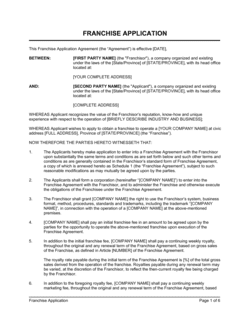
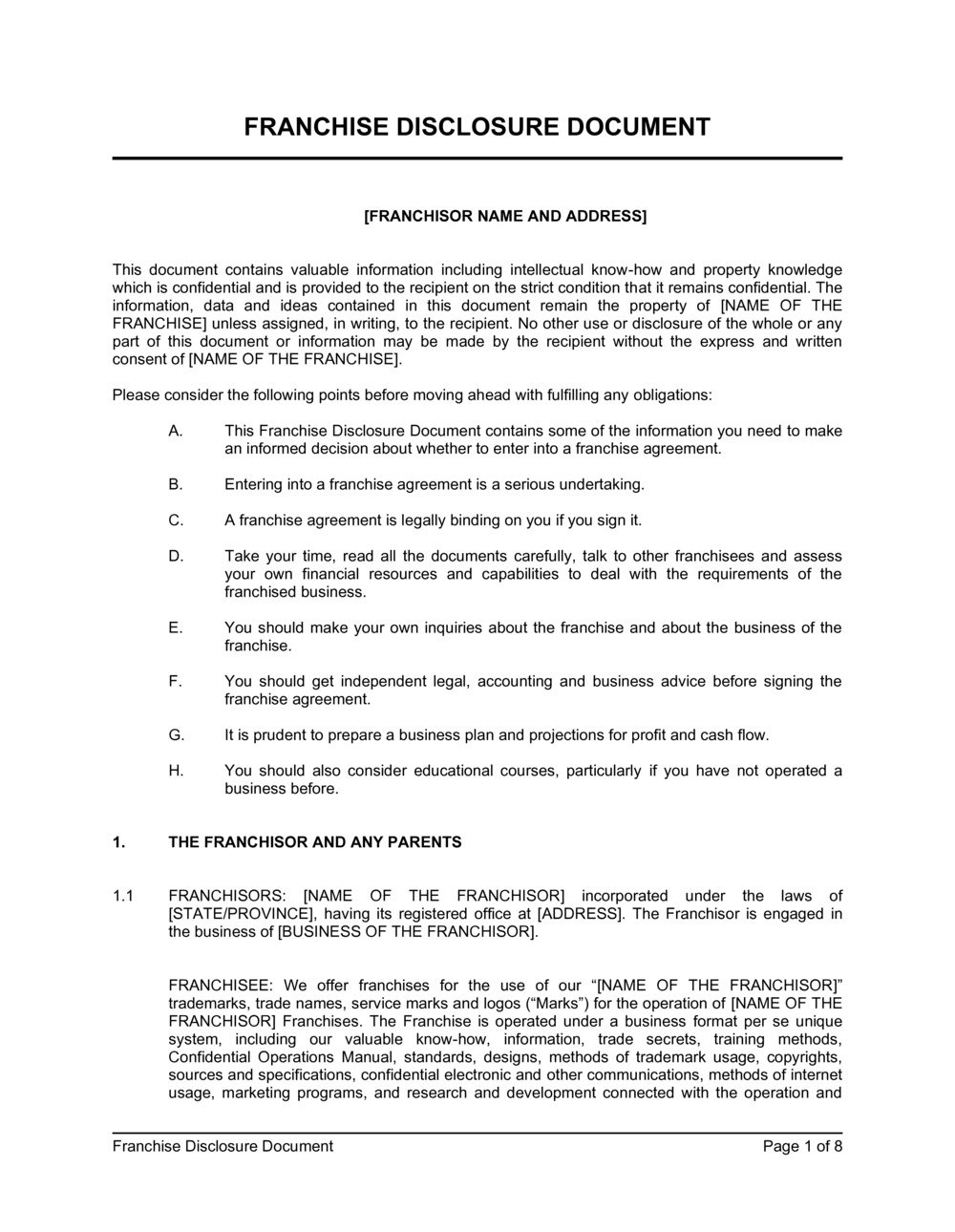
Franchise Disclosure Document Template

Free Word download • Edit online • Save & share with Drive • Export to PDF

8 pages30–40 min to fillDifficulty: ComplexSignature requiredLegal review recommended
Learn more ↓
FreeFranchise Disclosure Document Template

At a glance

What it is
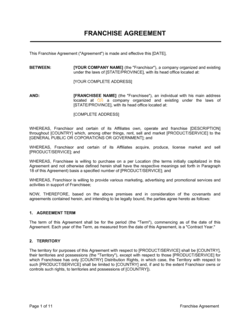
A Franchise Disclosure Document (FDD) is a federally mandated legal document that franchisors in the United States must provide to prospective franchisees before any sale is made or any fees are collected. It contains 23 standardized disclosure items covering the franchisor's history, litigation record, fees, territorial rights, training obligations, and audited financials. This free Word download gives franchisors a structured, FTC-compliant framework they can edit online and export as PDF for legal review and delivery to prospects.
When you need it
A franchisor must deliver the FDD to a prospective franchisee at least 14 calendar days before any franchise agreement is signed or any fee is paid. It is also required whenever an existing franchisee renews or transfers a franchise, and must be updated annually within 120 days of the franchisor's fiscal year end.
What's inside
The document covers 23 items including franchisor background, business experience of key executives, litigation and bankruptcy history, all initial and ongoing fees, franchisee obligations, territory rights, training and support programs, restrictions on products and services, renewal and termination conditions, and two years of audited financial statements. Item 21 financial exhibits and the franchise agreement itself are attached as exhibits.

What is a Franchise Disclosure Document?

A Franchise Disclosure Document (FDD) is a federally mandated pre-sale disclosure document that every franchisor in the United States must provide to a prospective franchisee before any franchise agreement is signed or any fee is collected. Governed by the FTC Franchise Rule (16 CFR Part 436), the FDD contains 23 standardized items that give the prospective franchisee a complete picture of the franchisor's business history, litigation record, fee structure, territorial rights, training obligations, franchisee obligations, and audited financial statements. Unlike many commercial contracts, the FDD is not itself a binding agreement — it is the legally required disclosure that must precede one. Its purpose is to ensure that a prospective franchisee has enough verified, standardized information to make an informed investment decision before committing to the franchise system.

Why You Need This Document

Offering or selling a franchise in the United States without a compliant FDD exposes the franchisor to federal FTC enforcement, individual state regulatory action, and private rescission claims from franchisees — each carrying the potential for significant financial penalties and the obligation to refund every fee collected. In the 14 registration states, a franchisor that uses an unapproved or outdated FDD cannot legally close a sale at all. Beyond regulatory compliance, a well-prepared FDD reduces litigation risk throughout the franchise relationship: franchisees who receive complete, accurate disclosures have far less grounds to claim they were misled about fees, territory, or earning potential. This template gives franchisors the correct 23-item structure and FTC-required format as a starting point for legal counsel to customize, accelerating the drafting process and reducing the time and cost of first-draft preparation.

Which variant fits your situation?

If your situation is…Use this template
Selling franchises in the US under FTC Franchise Rule requirementsFranchise Disclosure Document (FTC-Compliant)
Formalizing the ongoing rights and obligations of both parties after the FDDFranchise Agreement
Granting development rights across multiple territories to a single developerArea Development Agreement
Licensing a brand without a full franchise relationshipLicense Agreement
Documenting operational standards and procedures for franchiseesOperations Manual Template
Transferring an existing franchise unit from one franchisee to anotherFranchise Transfer Agreement
Renewing a franchise relationship at the end of the original termFranchise Renewal Agreement

Common mistakes to avoid

❌ Collecting fees before the 14-day period expires

Why it matters: Accepting any fee — including an application fee or deposit — before 14 calendar days after documented FDD delivery violates the FTC Franchise Rule and triggers rescission rights for the franchisee in most states.

Fix: Document the exact delivery date on the receipt acknowledgment and block the franchise agreement signing date to ensure a minimum of 14 calendar days has elapsed — build this check into your sales process, not just your legal review.

❌ Making verbal earnings claims not supported by Item 19

Why it matters: Any statement about revenue, profits, or ROI made to a prospect outside Item 19 is an unauthorized earnings claim — a per-violation FTC offense that also voids the disclosure in registration states.

Fix: Train every person involved in franchise sales — staff, brokers, area representatives — that no earnings figures may be discussed unless they appear verbatim in the FDD's Item 19.

❌ Failing to update the FDD annually within the required window

Why it matters: An FDD that is more than 120 days past the franchisor's fiscal year end cannot legally be used to sell franchises — continuing to use a stale FDD is a federal violation and creates rescission exposure.

Fix: Set a standing annual deadline to deliver updated financial statements to your CPA, and budget for the 6–10 week audit cycle so the renewed FDD is ready before the 120-day window closes.

❌ Omitting required exhibits from Item 22

Why it matters: Any agreement the franchisee will be required to sign — including personal guarantees, software licenses, or lease addenda — must be listed and attached; missing exhibits invalidate that portion of the disclosure and give franchisees grounds for rescission.

Fix: Audit every agreement in your franchise system against your Item 22 list annually as part of the FDD update process and add any new required agreements before the new FDD is used.

❌ Using reviewed rather than audited financial statements

Why it matters: Reviewed financial statements do not satisfy the Item 21 requirement; using them is grounds for state registration denial and gives prospects a disclosure defect claim.

Fix: Engage a CPA licensed in your state to perform a full GAAP audit — not a review or compilation — and attach the auditor's signed opinion letter as part of the Item 21 exhibit package.

❌ Understating the Item 7 total initial investment

Why it matters: If franchisees consistently spend more than the disclosed high end of the Item 7 range, the FDD is materially misleading — a basis for franchisee rescission claims and state regulatory action.

Fix: Survey your most recently opened franchisees for actual costs, use those figures to set your Item 7 ranges, and update the ranges annually in the FDD refresh cycle.

The 10 key clauses, explained

Items 1–4: Franchisor background and litigation history

In plain language: Identifies the franchisor, its affiliates, and predecessors; summarizes the business and industry; and discloses all pending and prior litigation and bankruptcy events involving the franchisor, its officers, and affiliates.

Sample language
[FRANCHISOR LEGAL NAME] has been offering franchises of the [SYSTEM NAME] system since [YEAR]. During the past 10 fiscal years, no officer or affiliate has been convicted of a felony or filed for bankruptcy except as follows: [NONE / DESCRIBE].

Common mistake: Disclosing only active litigation and omitting settled cases from the past 10 years. The FTC Franchise Rule requires disclosure of all covered actions regardless of outcome, and omissions trigger enforcement actions.

Item 5: Initial fees

In plain language: Lists every fee the franchisee must pay to the franchisor or its affiliates before the business opens — including the franchise fee, training fees, and any required deposits.

Sample language
Initial Franchise Fee: $[AMOUNT], due upon signing. Training Fee: $[AMOUNT] or included. Technology Setup Fee: $[AMOUNT]. Total estimated initial fees payable to [FRANCHISOR]: $[AMOUNT].

Common mistake: Listing only the headline franchise fee and omitting technology fees, training surcharges, or grand-opening advertising contributions that are also paid before opening — these must all be disclosed in Item 5.

Item 6: Other fees

In plain language: Discloses all recurring and non-recurring fees payable during the term — royalties, marketing fund contributions, transfer fees, renewal fees, audit fees, and technology fees.

Sample language
Royalty Fee: [X]% of Gross Sales, due weekly. Brand Marketing Fund: [X]% of Gross Sales. Transfer Fee: $[AMOUNT]. Renewal Fee: $[AMOUNT] or [X]% of then-current franchise fee.

Common mistake: Burying variable or conditional fees in the franchise agreement without disclosing them in Item 6. Every fee the franchisee may be required to pay — even optional or conditional ones — must appear in this item.

Item 7: Estimated initial investment

In plain language: Provides a table of the total estimated investment range required to open and operate the franchise for three months, broken down by category — real estate, equipment, inventory, working capital, and fees.

Sample language
Estimated Total Initial Investment: $[LOW] to $[HIGH]. Real Estate / Lease Deposit: $[X]–$[X]. Equipment and Fixtures: $[X]–$[X]. Initial Inventory: $[X]–$[X]. Working Capital (3 months): $[X]–$[X].

Common mistake: Understating the working capital line to make the total investment look more attractive. If actual experience shows franchisees need 6 months of working capital to reach profitability, disclosing only 3 months creates litigation exposure.

Item 12: Territory

In plain language: Defines whether the franchisee receives an exclusive, protected, or non-exclusive territory; what triggers territorial rights; and whether the franchisor reserves rights to sell through alternate channels — including e-commerce — within the territory.

Sample language
Franchisee is granted a Protected Territory comprising a radius of [X] miles from the Franchised Location. Franchisor will not establish a company-owned or franchised unit within the Protected Territory during the term, except for [CARVE-OUTS, e.g., institutional accounts, e-commerce, other channels].

Common mistake: Granting territorial protection without explicitly carving out the franchisor's online sales, corporate accounts, and alternative-channel rights. Franchisees later claim encroachment; courts have split on whether uncarved-out digital sales violate territorial provisions.

Item 19: Financial performance representations

In plain language: The only section where a franchisor may legally disclose historical or projected sales, revenue, or profit data for the franchise system — and only if the information is substantiated and disclosed here.

Sample language
The following table sets out the average Gross Sales for [X] franchised [UNIT TYPE] that were open and operating for the full fiscal year ended [DATE]. Average: $[X]. Median: $[X]. Highest: $[X]. Lowest: $[X]. [X] of [Y] outlets ([Z]%) met or exceeded the average.

Common mistake: Making verbal earnings representations to prospects that are not reflected in Item 19. Any statement about earnings potential — including statements made by brokers or area representatives — is an 'earnings claim' that must be supported by Item 19 disclosures.

Item 20: Outlets and franchisee information

In plain language: Provides tables showing the number of franchised and company-owned outlets opened, closed, transferred, and terminated over the past three fiscal years, plus contact information for current and former franchisees.

Sample language
At the end of fiscal year [YEAR]: [X] franchised outlets open. During [YEAR]: [X] new outlets opened, [X] terminated, [X] transferred, [X] not renewed. Former franchisee contacts are listed in Exhibit [X].

Common mistake: Providing outdated or incomplete franchisee contact lists. Regulators and prospective franchisees use Item 20 to conduct validation calls — omissions or stale contacts are among the most commonly cited FDD deficiencies in state audits.

Item 21: Financial statements

In plain language: Attaches the franchisor's audited financial statements — typically two to three years of balance sheets, income statements, and cash flow statements — certified by an independent CPA.

Sample language
Attached hereto as Exhibit [X] are the audited financial statements of [FRANCHISOR LEGAL NAME] for the fiscal years ended [DATE 1], [DATE 2], and [DATE 3], prepared in accordance with GAAP and audited by [CPA FIRM NAME], a licensed independent certified public accountant.

Common mistake: Attempting to substitute internally prepared or reviewed financial statements for audited ones. Reviewed statements are not sufficient — GAAP-audited financials are required, and their absence is grounds for state denial of registration.

Item 22: Contracts

In plain language: Lists and attaches every agreement the franchisee will be required to sign — including the franchise agreement, lease addendum, non-compete agreement, personal guarantee, and any software or technology agreements.

Sample language
Franchisee will be required to execute the following agreements: Franchise Agreement (Exhibit [A]); Personal Guarantee (Exhibit [B]); Software License Agreement (Exhibit [C]); Lease Addendum (Exhibit [D]).

Common mistake: Omitting a required exhibit — such as a personal guarantee or sublease — from Item 22. Any agreement the franchisee must sign must be listed and attached; missing exhibits void the disclosure for that component and may trigger rescission rights.

Acknowledgment of receipt and disclosure period

In plain language: A signed acknowledgment from the prospective franchisee confirming the date on which they received the FDD, establishing the 14-day disclosure clock and creating a paper trail of regulatory compliance.

Sample language
I, [FRANCHISEE NAME], acknowledge receipt of this Franchise Disclosure Document on [DATE OF RECEIPT]. I understand that I may not sign a franchise agreement or pay any fee to [FRANCHISOR NAME] until at least 14 calendar days after this date.

Common mistake: Collecting the acknowledgment signature and the franchise agreement signature on the same date without documenting that 14 calendar days elapsed between FDD delivery and signing. This is the single most commonly cited FDD compliance deficiency.

How to fill it out

  1. 1

    Compile your franchisor entity and officer information

    Enter the franchisor's full legal name, state of incorporation, principal business address, and the name, title, and 10-year business background of each officer, director, and general partner who will be named in Items 1–3.

    💡 Pull officer backgrounds directly from LinkedIn and cross-reference against state bar records or professional licensing databases — inaccuracies in Item 2 are a common registration comment from California and New York examiners.

  2. 2

    Document all litigation and bankruptcy history

    Review a 10-year period for all covered persons — the franchisor, its predecessors, affiliates, and each named officer. Disclose every felony conviction, civil action alleging fraud or unfair business practices, and any bankruptcy filing, regardless of outcome.

    💡 Err on the side of over-disclosure in Items 3 and 4 — omitting a settled case that later surfaces gives franchisees rescission rights in most registration states.

  3. 3

    Build the complete fee tables for Items 5, 6, and 7

    List every fee — initial and ongoing — in the format required by the FTC Franchise Rule: fee name, amount or formula, due date, and refundability. Then build the Item 7 investment table from actual cost data, citing sources for each range.

    💡 Interview your two or three most recently opened franchisees for actual opening cost data — their receipts are more defensible than estimates and help justify the Item 7 ranges in state registration review.

  4. 4

    Define territorial rights precisely in Item 12

    State whether the territory is exclusive, protected, or non-exclusive. Define the geographic boundaries precisely — radius in miles, zip codes, or a named area. List every channel and circumstance the franchisor reserves the right to operate within the territory.

    💡 Explicitly reserve e-commerce, corporate account, and alternate-channel rights even if you do not currently use them — retrofitting these carve-outs into an existing FDD triggers material modification disclosure obligations.

  5. 5

    Prepare Item 19 financial performance representations if disclosing

    Decide whether to include an Item 19 disclosure. If yes, compile historical gross sales data from your existing units broken down by unit age, format, and geography. Include the number and percentage of units that met or exceeded the stated figures.

    💡 Never make verbal earnings claims to prospects if you do not include a corresponding Item 19 — every number you state outside the FDD is an unlicensed earnings claim and a regulatory violation.

  6. 6

    Complete Item 20 with current and former franchisee contacts

    Build three years of outlet tables — openings, closings, transfers, and terminations by state and year. Compile a current list of all franchisees with addresses and phone numbers, and a separate list of every franchisee who left the system in the past 3 years.

    💡 Verify franchisee contact information within 30 days of your FDD effective date — prospects who reach a disconnected number on your Item 20 list generate immediate credibility problems.

  7. 7

    Attach audited financials and all required exhibits

    Obtain GAAP-audited financial statements from a licensed CPA for the most recent two fiscal years. Compile and label all Item 22 exhibits — franchise agreement, personal guarantee, lease addendum, and any other required contracts.

    💡 Engage your auditor at least 90 days before your target FDD effective date — audited statements take 6–10 weeks to complete for franchisors without existing audit relationships.

  8. 8

    Deliver the FDD and collect the dated receipt acknowledgment

    Provide the complete FDD to the prospective franchisee and obtain a signed, dated acknowledgment of receipt. Record the delivery date. Do not schedule any franchise agreement signing until at least 14 calendar days after the documented delivery date.

    💡 Use a delivery method that creates a timestamped record — email with read receipt, DocuSign delivery log, or certified mail — so the 14-day clock is provable if a compliance question arises.

Frequently asked questions

What is a Franchise Disclosure Document?

A Franchise Disclosure Document (FDD) is a legally mandated pre-sale disclosure document that franchisors in the United States must provide to prospective franchisees before any agreement is signed or fee is paid. It contains 23 standardized items covering the franchisor's background, litigation history, all fees, territory rights, training obligations, franchisee obligations, and audited financial statements. The FTC Franchise Rule requires delivery at least 14 calendar days before signing or payment.

Who is required to provide an FDD?

Any franchisor offering or selling franchises in the United States must comply with the FTC Franchise Rule and provide an FDD to each prospective franchisee. This applies regardless of the size of the franchise system or whether the franchise is sold in a registration state or a non-registration state. Franchisors operating exclusively outside the US are not subject to the FTC rule but may be subject to equivalent disclosure laws in Canada, Australia, and the EU.

What are the 23 items in an FDD?

The 23 items cover: (1) the franchisor and its parents; (2) business experience of key persons; (3) litigation history; (4) bankruptcy history; (5) initial fees; (6) other fees; (7) estimated initial investment; (8) restrictions on sources of products; (9) franchisee's obligations; (10) financing; (11) franchisor's assistance and training; (12) territory; (13) trademarks; (14) patents and proprietary information; (15) obligation to participate; (16) restrictions on what may be sold; (17) renewal, termination, and transfer; (18) public figures; (19) financial performance representations; (20) outlet information; (21) financial statements; (22) contracts; and (23) receipt acknowledgment.

What is the 14-day rule for FDD delivery?

The FTC Franchise Rule requires that a prospective franchisee receive the complete FDD at least 14 calendar days before signing any agreement or paying any fee. The clock starts on the day the franchisee receives the document — not the day it is sent. Collecting an application fee, deposit, or reservation fee before this period expires violates federal law and typically gives the franchisee the right to rescind the agreement and receive a refund.

What is Item 19 and does a franchisor have to include it?

Item 19 governs financial performance representations — any data about actual or projected revenues, sales, or earnings of franchise units. Franchisors are not required to include an Item 19 disclosure, but if they choose not to, they cannot make any verbal or written earnings claims to prospects. Many franchisors include Item 19 because prospects and brokers increasingly expect it, and a strong Item 19 is a meaningful sales differentiator. Any Item 19 figures must be substantiated with actual historical data.

Which US states require FDD registration?

Fourteen states impose their own franchise registration or disclosure requirements in addition to the federal FTC Franchise Rule: California, Hawaii, Illinois, Indiana, Maryland, Michigan, Minnesota, New York, North Dakota, Oregon, Rhode Island, Virginia, Washington, and Wisconsin. These states require the franchisor to file the FDD with a state agency and receive approval — or a notice of effectiveness — before offering franchises to residents of that state. Registration renewal is typically required annually.

How often does an FDD need to be updated?

The FTC Franchise Rule requires franchisors to update their FDD within 120 days after the close of each fiscal year. In addition, a material change — such as a new fee, a significant litigation event, or a change in ownership — requires a prompt amendment to the FDD before continued franchise sales. In registration states, material amendments must be filed with and approved by the state agency before the amended FDD is used.

Can a prospective franchisee waive the 14-day waiting period?

No. The FTC Franchise Rule does not permit waivers of the 14-day disclosure period. Any clause in a franchise agreement purporting to waive or shorten this period is unenforceable. Some registration states impose additional protections and also prohibit waiver of other franchisee rights — provisions that appear enforceable under federal law may be void in California, Minnesota, or other relationship-law states.

Do I need a lawyer to prepare an FDD?

The FDD is among the most technically regulated disclosure documents in US commercial law. While a high-quality template provides the correct 23-item structure and format, the actual content — particularly Items 19, 21, and the attached franchise agreement — requires legal counsel experienced in franchise law to review before any franchise is offered or sold. Filing errors in registration states result in denial; substantive errors in non-registration states create rescission exposure. Most franchise attorneys charge $15,000–$40,000 for an initial FDD preparation.

How this compares to alternatives

vs Franchise Agreement

The FDD is a pre-sale disclosure document delivered to the prospect before any agreement is signed — it creates no binding obligations between the parties. The franchise agreement is the binding contract that follows after the disclosure period, governing every aspect of the ongoing relationship. The FDD must be provided before the franchise agreement is executed, and the franchise agreement is attached as a required exhibit to the FDD.

vs License Agreement

A license agreement grants rights to use intellectual property — a trademark, software, or content — without the system of support, training, and operational controls that define a franchise. If a license includes a marketing plan, fees, and operational controls, the FTC may classify it as a franchise requiring FDD disclosure. The distinction determines whether federal and state franchise disclosure laws apply.

vs Joint Venture Agreement

A joint venture creates a shared-ownership business entity between two or more parties, typically with shared profits and shared control. A franchise is a licensed business model in which the franchisor retains brand control and the franchisee operates independently. Joint ventures involve equity; franchises involve fees and royalties. FDD disclosure requirements do not typically apply to true joint ventures.

vs Distribution Agreement

A distribution agreement grants rights to sell a supplier's products in a defined market without the operational control and system-level support that characterize a franchise. If the distributor pays for the right to distribute and is subject to a marketing or operational system, the arrangement may trigger FDD disclosure obligations — the line between distribution and franchising is fact-specific and jurisdiction-dependent.

Industry-specific considerations

Food and Beverage

Item 7 investment ranges are particularly detailed given high build-out costs; Item 8 restrictions on approved suppliers are extensive; Item 19 disclosures on average unit volume are heavily scrutinized by prospects and brokers.

Retail

Territorial exclusivity and e-commerce carve-outs in Item 12 are critical given online channel conflict; Item 16 product restrictions define the approved product mix and sourcing standards franchisees must follow.

Professional Services

Licensing and certification requirements are embedded in franchisee obligations (Item 9); non-compete and non-solicitation provisions in Item 17 are heavily negotiated given the relationship-based nature of client retention.

Healthcare and Wellness

Regulatory licensing prerequisites appear in Item 9 obligations; HIPAA compliance obligations are referenced in the franchise agreement; state-specific scope-of-practice rules affect territorial definitions in Item 12.

Fitness and Personal Services

High franchisee turnover data in Item 20 is closely reviewed; membership-model unit economics in Item 19 require clear disclosure of ramp-up timelines to average membership levels.

Home Services and Maintenance

Mobile or territory-based service models require precise Item 12 territory definitions; vehicle, equipment, and tool investment ranges drive the complexity of Item 7 tables.

Jurisdictional notes

United States

The FTC Franchise Rule (16 CFR Part 436) governs FDD content and delivery nationwide and requires a 14-calendar-day disclosure period. Fourteen states — including California, New York, Illinois, and Maryland — impose additional registration requirements and must approve the FDD before it can be used to offer franchises to their residents. State examiners in California and New York are among the most active reviewers; Item 19 and Item 20 disclosures receive the most scrutiny. FDD registration must typically be renewed annually in each registration state.

Canada

Canada does not have a federal franchise disclosure law, but Alberta, British Columbia, Manitoba, New Brunswick, Ontario, and Prince Edward Island each have provincial franchise legislation requiring disclosure documents equivalent to the US FDD. Ontario's Arthur Wishart Act requires a disclosure document — including audited financials — to be delivered at least 14 days before signing or payment. Franchisors active in Quebec must also comply with French-language requirements under the Charter of the French Language for consumer-facing materials.

United Kingdom

The United Kingdom has no standalone franchise disclosure statute equivalent to the FTC Franchise Rule. Franchise relationships are governed by general contract law, with the British Franchise Association (BFA) providing a voluntary code of ethics that includes pre-sale disclosure best practices. Post-Brexit, EU disclosure regulations no longer apply in Great Britain. Franchisors operating in the UK are strongly advised to provide a disclosure document as a matter of good practice and to reduce misrepresentation claims under the Misrepresentation Act 1967.

European Union

The EU does not have a harmonized franchise disclosure directive. Disclosure obligations vary by member state: France requires pre-contractual disclosure under the Doubin Law at least 20 days before signing; Italy, Spain, Belgium, and Sweden have their own franchise-specific disclosure statutes. Germany and the Netherlands rely on general pre-contractual information obligations under civil law. Franchisors expanding into the EU should obtain country-specific legal advice before offering franchises in any member state, as the content and timing requirements differ materially from the US FDD framework.

Template vs lawyer — what fits your deal?

PathBest forCostTime
Use the templateFranchisors reviewing FDD structure, understanding disclosure requirements, or preparing materials for legal counselFree2–4 hours to review and annotate
Template + legal reviewEmerging franchisors in non-registration states with an existing franchise agreement and audited financials ready for counsel review$5,000–$15,000 for attorney review and customization3–6 weeks
Custom draftedAny franchisor actively selling franchises, entering registration states, or updating an FDD with material changes$15,000–$40,000 for initial preparation; $3,000–$8,000 for annual updates6–12 weeks for initial draft; 4–8 weeks for annual update

Glossary

Franchise Disclosure Document (FDD)
A federally mandated pre-sale disclosure document containing 23 standardized items that a franchisor must deliver to a prospective franchisee at least 14 days before signing or payment.
FTC Franchise Rule
The Federal Trade Commission regulation (16 CFR Part 436) that governs the content, format, and delivery timing of franchise disclosures in the United States.
Item 19 (Financial Performance Representations)
The optional but highly scrutinized FDD item where franchisors may disclose historical or projected revenue, sales, or earnings data for existing franchise units.
Franchise Fee
A one-time upfront payment made by the franchisee to the franchisor upon signing the franchise agreement, granting the right to operate under the system.
Royalty Fee
An ongoing periodic payment — typically a percentage of gross sales, often 4–8% — paid by the franchisee to the franchisor throughout the term.
Franchise Registration State
One of the 14 US states (including California, New York, and Illinois) that require franchisors to register their FDD with a state agency before offering franchises in that state.
Earnings Claim
Any representation about actual or potential sales, revenues, income, or profits of a franchise — permissible only if disclosed in Item 19 of the FDD with supporting data.
Material Modification
A change to the franchise system significant enough to require an updated FDD disclosure and, in registration states, re-registration before continued franchise sales.
Effective Date
The date on which the FDD may first be used to offer franchises — for registration states, this is the date of state approval; for non-registration states, it is the date the document is prepared.
Territorial Protection
A provision granting a franchisee an exclusive or protected geographic area within which the franchisor agrees not to open competing units or grant competing franchises.
Audited Financial Statements
Financial statements — typically two to three years of P&L, balance sheet, and cash flow — prepared and certified by an independent CPA, required as Item 21 exhibits to the FDD.
Disclosure Period
The mandatory 14-calendar-day waiting period after FDD delivery during which the prospective franchisee must have the opportunity to review the document before signing or paying.

Part of your Business Operating System

This document is one of 3,000+ business & legal templates included in Business in a Box.

  • Fill-in-the-blanks — ready in minutes
  • 100% customizable Word document
  • Compatible with all office suites
  • Export to PDF and share electronically

Create your document in 3 simple steps.

From template to signed document — all inside one Business Operating System.
1
Download or open template

Access over 3,000+ business and legal templates for any business task, project or initiative.

2
Edit and fill in the blanks with AI

Customize your ready-made business document template and save it in the cloud.

3
Save, Share, Send, Sign

Share your files and folders with your team. Create a space of seamless collaboration.

Save time, save money, and create top-quality documents.

★★★★★

"Fantastic value! I'm not sure how I'd do without it. It's worth its weight in gold and paid back for itself many times."

Managing Director · Mall Farm
Robert Whalley
Managing Director, Mall Farm Proprietary Limited
★★★★★

"I have been using Business in a Box for years. It has been the most useful source of templates I have encountered. I recommend it to anyone."

Business Owner · 4+ years
Dr Michael John Freestone
Business Owner
★★★★★

"It has been a life saver so many times I have lost count. Business in a Box has saved me so much time and as you know, time is money."

Owner · Upstate Web
David G. Moore Jr.
Owner, Upstate Web

Run your business with a system — not scattered tools

Stop downloading documents. Start operating with clarity. Business in a Box gives you the Business Operating System used by over 250,000 companies worldwide to structure, run, and grow their business.

Free Forever Plan · No credit card required