1
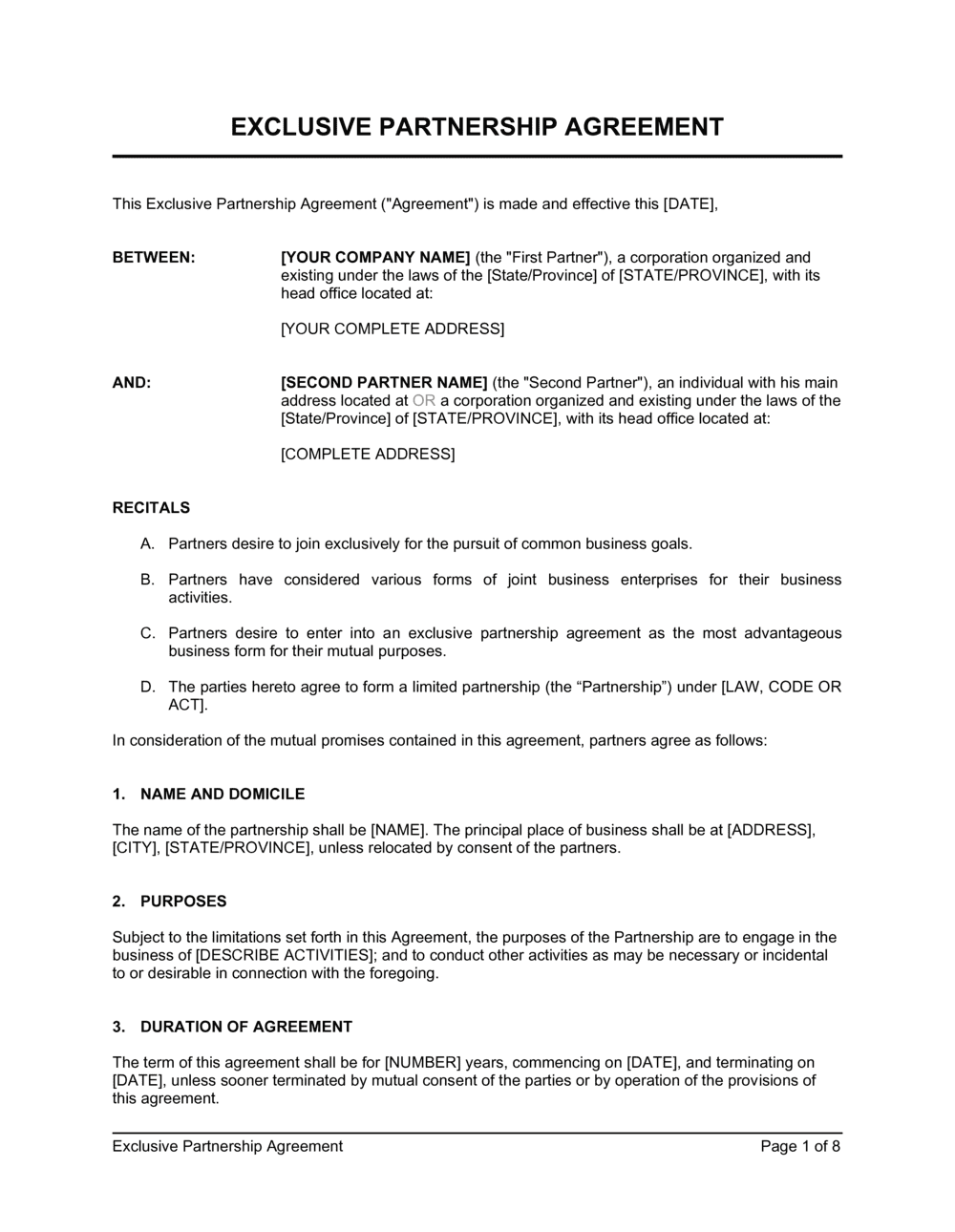
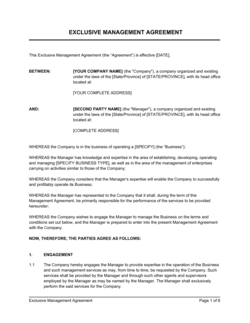
Identify parties using full legal entity names
Enter each party's registered legal name, entity type, and jurisdiction of formation. Confirm these against official corporate registry records before execution.
💡 Cross-reference the signing authority — the person signing must have authority to bind the entity. A title alone (e.g., 'CEO') is not enough if board approval is required under the party's governing documents.
2
Define the exclusivity scope precisely
Describe the exact products, services, or activities that are exclusive, the geographic territory or market segment, and any carve-outs the granting party is reserving. Attach a detailed Schedule A for anything too granular for the body of the agreement.
💡 If the territory includes multiple countries, list each country explicitly rather than using regional shorthand like 'Asia-Pacific' — jurisdictional boundaries are litigated frequently when the region is ambiguous.
3
Set performance benchmarks with automatic consequences
Enter specific minimum revenue, volume, or activity targets for each contract year. Define the consequence of missing them — conversion to non-exclusive status, right to terminate, or renegotiation — and the notice period required to trigger each remedy.
💡 Set Year 1 benchmarks conservatively based on actual market data, not aspirational projections. Unrealistic targets create immediate disputes and encourage the exclusive partner to treat the agreement as effectively non-exclusive.
4
Complete the revenue sharing and payment terms
Define the revenue share percentage, the base (gross vs. net, and what deductions are permitted), the payment cycle, and the audit rights each party holds. State the currency explicitly if parties are in different countries.
💡 Include a late payment interest rate — typically 1.5% per month — to give the payment obligation commercial teeth without requiring litigation for every delayed payment.
5
Allocate intellectual property ownership
Confirm that each party retains ownership of their pre-existing IP and specify who owns jointly developed IP, improvements, and any co-branded materials created during the partnership. Grant the licenses each party needs to operate.
💡 If the partnership involves technology integration or co-developed tools, attach a separate IP Schedule rather than trying to describe it in the body — courts interpret ambiguous IP clauses against the drafter.
6
Calibrate the non-compete and non-solicitation terms
Set the geographic scope and duration proportionate to the exclusivity scope granted. For most commercial partnerships, 12 months post-termination is enforceable in most jurisdictions; durations beyond 24 months invite challenges.
💡 Match the non-compete scope precisely to the exclusivity scope — a non-compete that is broader than the exclusivity grant is routinely struck down as disproportionate and may void the entire restrictive covenant.
7
Set the term, renewal conditions, and right of first refusal
Enter the initial term, the automatic renewal period and notice requirement to prevent renewal, and any right of first refusal on competing offers. Include a benchmark reset at each renewal to prevent underperforming partners from locking in exclusivity indefinitely.
💡 A 90-day non-renewal notice period gives both parties enough lead time to either renegotiate or find alternatives without operational disruption.
8
Execute before the partnership activities begin
Both parties must sign before any exclusive activity commences — distributing products, sharing customer lists, or co-developing materials under the agreement. Post-commencement signatures may create fresh-consideration problems for restrictive covenants in common-law jurisdictions.
💡 Use a digital signing platform that timestamps execution and stores the fully executed copy in a shared document repository accessible to both parties' legal teams.