Co-Branding Agreement Template

Free Word download β€’ Edit online β€’ Save & share with Drive β€’ Export to PDF

8 pagesβ€’30–40 min to fillβ€’Difficulty: Complexβ€’Signature requiredβ€’Legal review recommended
Learn more ↓
FreeCo-Branding Agreement Template

At a glance

What it is
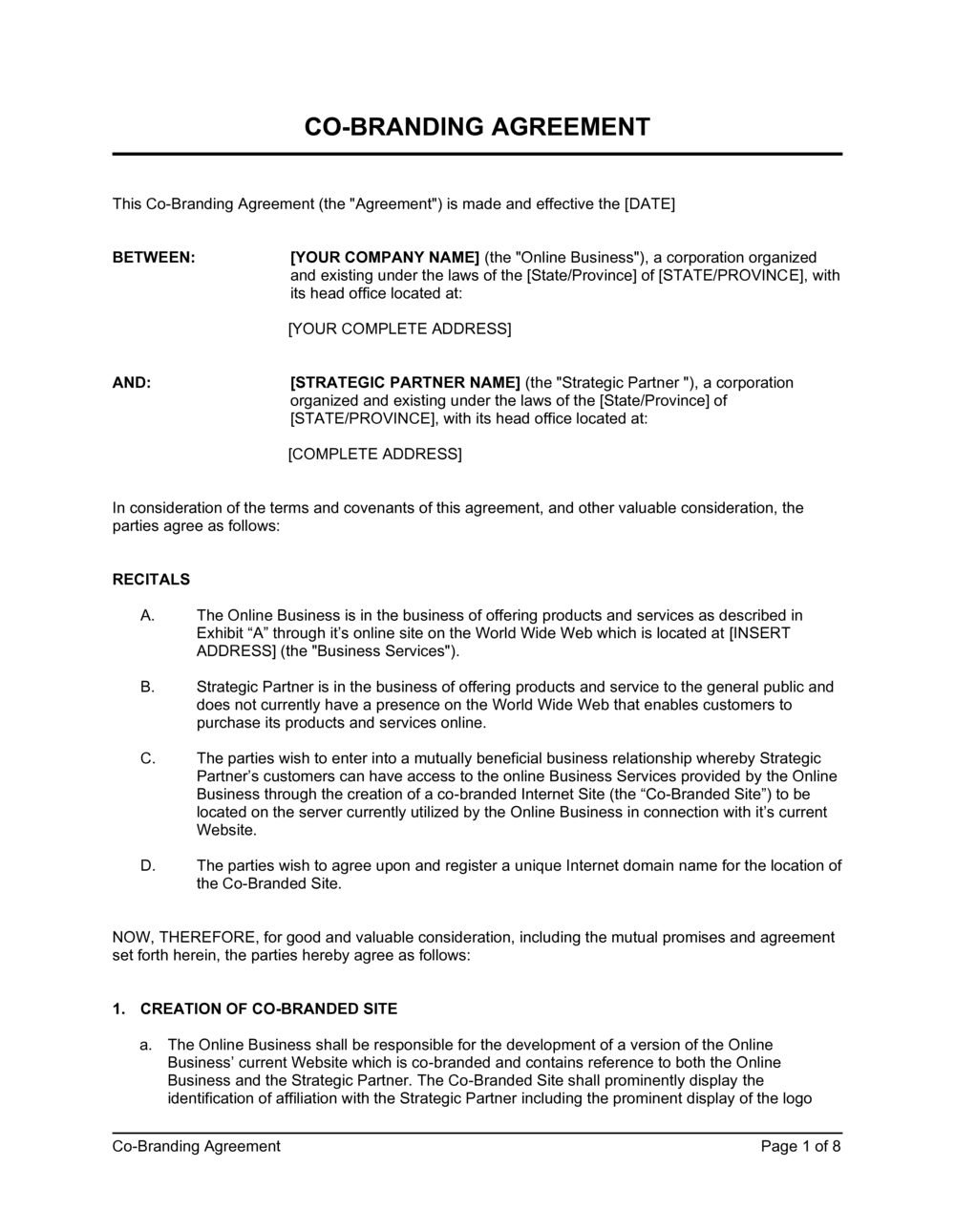
A Co-Branding Agreement is a legally binding contract between two companies that authorizes each party to use the other's brand, trademarks, and logos in connection with a jointly promoted product, service, or campaign. This free Word download gives you a structured, attorney-reviewed starting point you can edit online and export as PDF before executing with your partner.
When you need it
Use it before launching any joint marketing initiative, co-branded product, or partnership campaign where both companies' names, logos, or trademarks will appear together in public-facing materials. It is also required when a licensing or distribution partner wants to use your brand in their own promotional channels.
What's inside
Brand license grants and usage restrictions, approval workflows for co-branded materials, revenue and cost-sharing terms, intellectual property ownership, quality control standards, exclusivity provisions, indemnification, and termination procedures with post-termination brand wind-down obligations.

What is a Co-Branding Agreement?

A Co-Branding Agreement is a legally binding contract between two companies that authorizes each party to use the other's trademarks, logos, and brand identity in connection with a jointly promoted product, service, or marketing campaign. Unlike a one-way trademark license, a co-branding agreement is mutual β€” each company both grants and receives brand usage rights β€” and adds a layer of commercial structure covering creative approval workflows, quality control standards, revenue sharing, and ownership of any intellectual property developed through the collaboration. It defines the boundaries of the partnership clearly enough that both brands can appear together in public without either party inadvertently acquiring rights beyond what was intended or exposing the other's trademark to legal risk.

Why You Need This Document

Without a co-branding agreement in place, every piece of joint creative material that goes live represents unauthorized use of the other company's trademark β€” creating infringement exposure for both parties before a single product is sold or a single ad is published. More specifically, a trademark licensor who fails to maintain documented quality control over how its mark is used can lose trademark protection entirely under the "naked license" doctrine recognized in the US, Canada, and the UK. Beyond legal risk, the absence of a written agreement leaves revenue allocation, cost responsibilities, and post-termination inventory handling to verbal understandings that quickly become disputed when the partnership ends or the numbers disappoint. This template gives both parties a structured framework that protects each brand's IP, establishes enforceable quality standards, resolves new IP ownership before it becomes a dispute, and creates a clean off-ramp when the partnership runs its course.

Which variant fits your situation?

If your situation is…Use this template
Two brands jointly developing and selling a new productCo-Branding Agreement (Product)
Brands collaborating on a marketing campaign only, not a productCo-Marketing Agreement
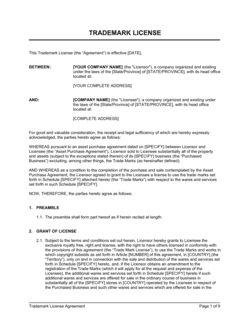
One brand licensing its name to another for use on their productsTrademark License Agreement
Two companies forming a longer-term strategic brand allianceStrategic Alliance Agreement
Brands partnering to refer customers to each otherReferral Partner Agreement
A brand allowing a third-party manufacturer to use its name on white-label goodsManufacturing License Agreement
Two agencies collaborating on a client project under a joint brand identityJoint Venture Agreement

Common mistakes to avoid

❌ No quality control clause

Why it matters: A trademark license without quality control is legally classified as a 'naked license,' which can result in the licensor losing trademark rights β€” courts have found that the mark was abandoned due to lack of oversight.

Fix: Include a quality control clause that grants the licensor inspection rights, defines minimum quality standards, and specifies a cure period before the licensor may terminate for non-compliance.

❌ Omitting a definition of 'Net Revenue'

Why it matters: When revenue share is calculated on undefined 'net revenue,' each party applies its own deductions β€” returns, chargebacks, fulfillment costs, platform fees β€” leading to payment disputes that frequently end partnerships early.

Fix: Define Net Revenue as gross sales minus a specific, exhaustive list of permitted deductions, and attach a worked numerical example as an exhibit.

❌ Leaving new co-developed IP ownership unresolved

Why it matters: Under default copyright law in most jurisdictions, jointly created works are owned equally β€” meaning neither party can commercialize, license, or sell the asset without the other's consent, even after the agreement ends.

Fix: Assign ownership of every co-developed asset explicitly in the agreement, or grant each party a perpetual, royalty-free license to use jointly owned IP independently after termination.

❌ No wind-down period for co-branded inventory

Why it matters: A licensee holding finished co-branded product at termination is immediately in breach if the contract requires instant cessation β€” yet destroying or recalling inventory is costly and operationally disruptive.

Fix: Allow a sell-through period of 60–90 days post-termination for inventory manufactured before the termination date, with a reporting obligation to confirm inventory levels at termination.

❌ Overly broad exclusivity without a competitive category definition

Why it matters: Agreeing not to 'co-brand with any other company' can accidentally block entirely unrelated partnerships β€” a food brand agreeing to co-brand with a retailer should not inadvertently lose the right to partner with a beverage company.

Fix: Define exclusivity by specific competitive category, geography, and channel β€” and list any pre-existing partnerships that are carved out from the restriction.

❌ Executing the agreement after co-branded materials are already live

Why it matters: Any co-branded materials published before the agreement is signed represent unauthorized trademark use by both parties β€” creating infringement exposure and potential loss of quality control claims.

Fix: Treat the signed co-branding agreement as a prerequisite to any creative development work, not a formality to handle after the campaign launches.

The 10 key clauses, explained

Parties, Recitals, and Definitions

In plain language: Identifies the two companies entering the agreement, states the commercial purpose of the co-branding partnership, and defines key terms used throughout.

Sample language
This Co-Branding Agreement ('Agreement') is entered into as of [DATE] by and between [COMPANY A LEGAL NAME], a [STATE/COUNTRY] [ENTITY TYPE] ('Party A'), and [COMPANY B LEGAL NAME], a [STATE/COUNTRY] [ENTITY TYPE] ('Party B'). The parties wish to collaborate on [DESCRIPTION OF CO-BRANDED INITIATIVE].

Common mistake: Describing the partnership purpose too vaguely β€” phrases like 'mutual marketing activities' without specifying the product, campaign, or channel leave scope disputes open from day one.

Brand License Grant

In plain language: Each party grants the other a limited, non-exclusive (or exclusive) license to use its trademarks, logos, and brand assets specifically for the co-branded initiative described in the agreement.

Sample language
Party A hereby grants to Party B a non-exclusive, non-transferable, royalty-free license to use Party A's Marks (as defined in Schedule A) solely in connection with the Co-Branded Materials approved under Section [X] during the Term.

Common mistake: Granting a license without attaching a schedule listing the specific marks approved for use. A generic grant covering 'all trademarks' can unintentionally license marks the owner never intended to share.

Brand Usage Standards and Guidelines

In plain language: Requires each party to follow the other's brand guidelines β€” covering logo sizing, color, placement, and prohibited modifications β€” as a condition of the license.

Sample language
Each party shall use the other's Marks strictly in accordance with the Brand Guidelines attached as Schedule B and shall not alter, distort, or create derivative works of the other's Marks without prior written consent.

Common mistake: Referencing brand guidelines 'as provided from time to time' without specifying a process for notifying the other party of updates. A partner can unknowingly violate new standards they were never formally told about.

Approval of Co-Branded Materials

In plain language: Establishes a written approval process β€” typically a defined review period β€” before any co-branded creative, packaging, or advertising may be published or distributed.

Sample language
All Co-Branded Materials shall be submitted to the other party for written approval at least [15] business days prior to the intended publication date. Approval shall not be unreasonably withheld. Failure to respond within [15] business days shall constitute deemed approval.

Common mistake: Omitting a deemed-approval clause. Without it, a partner who goes silent effectively holds veto power indefinitely, stalling the entire campaign.

Quality Control

In plain language: Grants the licensor the right to audit co-branded products or materials for quality compliance, and requires the licensee to remedy deficiencies within a defined cure period.

Sample language
Party B shall maintain quality standards no less than those described in Schedule C. Party A may inspect Co-Branded Products upon [10] days' written notice. If a material deficiency is identified, Party B shall remedy it within [30] days or Party A may terminate the license under Section [X].

Common mistake: Skipping quality control entirely to keep the agreement simple. A trademark license without quality control can constitute a 'naked license,' putting the licensor's trademark registration at risk of cancellation.

Revenue and Cost Sharing

In plain language: Defines how revenues from co-branded sales are split, which party bears which costs (production, marketing, distribution), and the reporting and payment schedule.

Sample language
Net Revenue from Co-Branded Products shall be allocated [X]% to Party A and [X]% to Party B. Party A shall bear the cost of [COST ITEM]; Party B shall bear the cost of [COST ITEM]. Each party shall provide monthly sales reports within [15] days of month-end and remit payment within [30] days.

Common mistake: Defining revenue share without defining 'Net Revenue.' Disputes over which deductions are permissible β€” returns, chargebacks, fulfillment costs β€” are the most common financial conflict in co-branding arrangements.

Intellectual Property Ownership

In plain language: Confirms that each party retains sole ownership of its own existing IP and specifies ownership of any new IP (packaging designs, creative assets, co-developed product formulations) created during the collaboration.

Sample language
Each party retains all right, title, and interest in its own Pre-Existing IP. All Co-Developed IP shall be jointly owned, with each party holding an undivided [50]% interest, unless the parties agree otherwise in writing.

Common mistake: Leaving new co-developed IP ownership unaddressed. When the agreement ends, neither party can commercialize jointly owned IP without the other's consent β€” unless ownership and post-termination rights are explicitly resolved in the contract.

Exclusivity

In plain language: States whether either party is restricted from entering similar co-branding arrangements with competitors during the term, and defines the specific competitive category covered.

Sample language
During the Term, Party A agrees not to enter into a co-branding arrangement with any [COMPETITOR CATEGORY] in [GEOGRAPHIC TERRITORY] without Party B's prior written consent. This restriction does not apply to Party A's existing partnerships listed in Schedule D.

Common mistake: Agreeing to exclusivity without defining the competitive category precisely. An overly broad definition can prevent either party from pursuing unrelated partnerships that were never the subject of the agreement.

Termination and Post-Termination Wind-Down

In plain language: Specifies the notice period for termination without cause, grounds for immediate termination for cause, and the wind-down period during which the non-owning party may continue using co-branded materials.

Sample language
Either party may terminate this Agreement without cause on [90] days' written notice. Upon expiration or termination, Party B shall cease all use of Party A's Marks within [60] days, except for inventory already manufactured as of the termination date, which may be sold for up to [90] days post-termination.

Common mistake: No wind-down period for manufactured inventory. A licensee holding finished co-branded product at termination faces an impossible situation β€” and the licensor faces the risk of unauthorized brand use β€” if this is not addressed.

Indemnification and Limitation of Liability

In plain language: Each party agrees to indemnify the other against third-party claims arising from its own breach, negligence, or IP infringement, and caps each party's total liability at a defined amount.

Sample language
Each party shall indemnify, defend, and hold harmless the other from any third-party claims arising from its own breach of this Agreement or infringement of third-party IP. In no event shall either party's aggregate liability exceed [AMOUNT] or the total fees paid under this Agreement in the prior [12] months, whichever is greater.

Common mistake: A mutual indemnification clause with no carve-outs for gross negligence or willful misconduct. Without carve-outs, a party that deliberately infringes a third-party mark can still invoke the mutual indemnity, shifting costs to the innocent partner.

How to fill it out

  1. 1

    Identify both parties with their full legal entity names

    Enter each company's registered legal name, entity type (LLC, Inc., Ltd.), and jurisdiction of formation. Do not use trade names or DBA names as the contracting party.

    πŸ’‘ Cross-check both parties' names against their state or national corporate registry filings before execution β€” a name mismatch can complicate enforcement.

  2. 2

    Define the scope of the co-branded initiative

    Specify the exact product, service, or campaign the agreement covers β€” including channel (retail, digital, events), geography, and duration. Attach a project brief as a schedule if the scope is complex.

    πŸ’‘ The narrower the scope definition, the less room there is for disputes about what activities are covered. Resist the urge to write broad catch-all language.

  3. 3

    List approved marks and attach brand guidelines

    Enumerate every trademark, logo variant, and tagline each party is authorizing the other to use, and attach each party's current brand guidelines as a schedule.

    πŸ’‘ Version-stamp the brand guidelines schedules (e.g., 'Brand Guidelines v2.1, April 2026') so you can demonstrate which version was in effect at any given time.

  4. 4

    Set the approval workflow with specific timelines

    Define how co-branded materials are submitted for review, what format submissions must take, and exactly how many business days each party has to approve, reject, or request revisions. Include a deemed-approval fallback.

    πŸ’‘ 14–21 business days is a typical review window. Tighter timelines increase speed but reduce the quality of review β€” calibrate to your campaign cadence.

  5. 5

    Negotiate and document the revenue and cost split

    Define 'Net Revenue' precisely β€” listing every permitted deduction β€” and state each party's percentage share. Specify who invoices whom, payment timelines, and the reporting format.

    πŸ’‘ If revenue reporting is complex, attach a calculation example as an exhibit to eliminate disputes about the math before they arise.

  6. 6

    Resolve new IP ownership in writing

    Decide before signing whether co-developed creative assets (packaging, product formulas, campaigns) will be jointly owned, owned by one party, or assigned to a new joint entity. Document the outcome explicitly.

    πŸ’‘ Joint ownership sounds fair but creates practical problems β€” neither party can license or sell jointly owned IP without the other's consent. Consider assigning ownership to one party with a license back to the other.

  7. 7

    Set termination notice periods and wind-down rules

    Choose a without-cause notice period (typically 60–90 days for a brand partnership) and specify exactly how long the licensee may continue selling existing co-branded inventory after termination.

    πŸ’‘ 90 days is a practical minimum wind-down period for physical co-branded products that have already entered the supply chain.

  8. 8

    Have both parties sign before any materials are published

    Obtain signatures from authorized representatives β€” typically VP-level or above β€” before either party begins creating, distributing, or publishing any co-branded content.

    πŸ’‘ Use electronic signature with a timestamp to establish the exact execution date, which anchors the effective date of the license grant.

Frequently asked questions

What is a co-branding agreement?

A co-branding agreement is a legally binding contract between two companies that governs how each party may use the other's brand, trademarks, and logos in connection with a jointly promoted product, service, or marketing campaign. It defines the scope of the license, quality control obligations, revenue sharing, IP ownership, and termination procedures β€” protecting both brands and providing a clear operational framework for the partnership.

When do I need a co-branding agreement?

You need one before any joint initiative where both companies' names or logos will appear together in public-facing materials β€” product packaging, digital advertising, event signage, or social media campaigns. Even informal partnerships that place both brands on the same landing page create trademark exposure that requires a written agreement. Execute the contract before any creative development begins, not after materials are already live.

What is the difference between a co-branding agreement and a trademark license agreement?

A trademark license agreement is a one-way grant β€” one party licenses its mark to another. A co-branding agreement is mutual: each party licenses certain marks to the other for use in a shared commercial context. Co-branding agreements also typically address revenue sharing, joint creative approval, and co-developed IP β€” elements that a standard trademark license does not cover.

Does a co-branding agreement need to be exclusive?

Exclusivity is negotiated, not required. Many co-branding agreements are non-exclusive, allowing both parties to run separate partnerships with other brands simultaneously. When exclusivity is agreed, it should be narrowly scoped to a specific competitive category, geographic territory, and channel β€” not a blanket prohibition on all other partnerships. Overly broad exclusivity is one of the most common sources of co-branding disputes.

Who owns content created during a co-branding partnership?

Without an explicit clause, jointly created content is typically co-owned under copyright law in most jurisdictions β€” meaning neither party can use, license, or sell it without the other's consent. The agreement should explicitly assign ownership of every co-developed asset or grant each party a perpetual, royalty-free license to use jointly owned materials independently after the partnership ends.

What happens to co-branded inventory when the agreement terminates?

Unless the agreement specifies otherwise, using another party's trademark after termination constitutes infringement. A well-drafted agreement includes a wind-down period β€” typically 60–90 days β€” during which the licensee may sell through inventory that was already manufactured before termination, with a reporting obligation to document inventory levels at the termination date.

Can a co-branding agreement put my trademark at risk?

Yes, if the agreement lacks a quality control clause. Trademark law in the US, Canada, and the UK requires that a licensor maintain control over the quality of goods or services sold under its mark. A license without quality control is classified as a 'naked license,' and courts have held that naked licenses result in abandonment of the trademark β€” permanently stripping it of legal protection. Always include quality control provisions with inspection rights and a cure period.

Do I need a lawyer to draft a co-branding agreement?

For straightforward co-marketing campaigns between businesses of similar size, a well-structured template is often sufficient. Engage a lawyer when the partnership involves significant revenue sharing, jointly developed IP, exclusivity in a core market, or parties in different jurisdictions. The cost of a 2–3 hour attorney review β€” typically $600–$1,500 β€” is modest compared to the exposure created by an unaddressed quality control or IP ownership gap.

What should a co-branding agreement include?

At minimum: both parties' legal entity names, a defined scope of the initiative, a list of approved trademarks and brand guidelines, a creative approval workflow, quality control provisions with inspection rights, revenue and cost sharing terms, IP ownership of co-developed assets, exclusivity provisions (if any), a termination clause with notice period, a post-termination wind-down period for inventory, and mutual indemnification with a liability cap.

How this compares to alternatives

vs Trademark License Agreement

A trademark license agreement is a one-directional grant from a licensor to a licensee, typically in exchange for royalties. A co-branding agreement is mutual β€” both parties license marks to each other β€” and adds revenue sharing, joint approval workflows, and co-developed IP terms. Use a trademark license when only one brand is being placed on another party's products; use a co-branding agreement when both brands appear together.

vs Strategic Alliance Agreement

A strategic alliance agreement governs a broad, long-term business collaboration covering joint development, distribution, or investment β€” often without brand placement. A co-branding agreement is narrower, focused specifically on the authorized use of each party's brand assets in defined materials. Many strategic alliances include a co-branding addendum rather than treating them as interchangeable documents.

vs Joint Venture Agreement

A joint venture agreement creates a new legal entity or shared business structure with pooled assets, shared governance, and joint liability. A co-branding agreement leaves each company legally separate and simply authorizes limited trademark use for a defined initiative. If two brands are forming a company together, use a joint venture agreement; if they are running a joint campaign while remaining independent, use a co-branding agreement.

vs Co-Marketing Agreement

A co-marketing agreement governs joint promotional activities β€” lead sharing, content collaboration, event sponsorship β€” without a trademark license. A co-branding agreement is required when each party's actual brand marks and logos will appear on the other's materials or products. If both logos appear on a joint advertisement, you need a co-branding agreement, not just a co-marketing one.

Industry-specific considerations

Consumer Goods and Retail

Co-branded product packaging, joint promotional campaigns with retail partners, and licensed product lines require precise quality control schedules and sell-through wind-down provisions.

Food and Beverage

Ingredient co-branding (e.g., branded flavor components on packaging) demands FDA/CFIA labeling compliance alongside trademark license terms and quality audit rights.

Technology and SaaS

Technology co-branding typically involves joint product integrations or marketplace listings, where IP ownership of jointly developed features and API documentation must be explicitly addressed.

Financial Services

Co-branded credit cards, loyalty programs, and fintech partnerships require regulatory compliance clauses, consumer data governance terms, and approval from relevant financial regulators alongside the trademark provisions.

Jurisdictional notes

United States

US trademark law under the Lanham Act requires licensors to maintain quality control over licensed marks or risk losing trademark protection through 'naked license' abandonment. Non-exclusive co-branding agreements are not required to be recorded with the USPTO but recording trademark licenses is advisable for franchise and broad licensing arrangements. State laws vary on non-compete and exclusivity provisions that may be attached to the agreement.

Canada

Canadian trademark law under the Trademarks Act similarly requires a licensor to have direct or indirect control over the character or quality of goods and services associated with the licensed mark. Trademark licenses may be registered with the Canadian Intellectual Property Office. Quebec-based parties must ensure all co-branded materials, including packaging and advertising, comply with the Charter of the French Language, requiring French-language presentation.

United Kingdom

Under the UK Trade Marks Act 1994, trademark licenses should ideally be recorded at the UK Intellectual Property Office to protect the licensee's rights against third parties. Post-Brexit, UK and EU trademark registrations are separate β€” a co-branding agreement covering both territories should address each registration independently. Quality control obligations remain essential to avoid invalidation of the mark on grounds of deceptive use.

European Union

EU trademark licenses granted under European Union Trademark (EUTM) registrations can be recorded at the EUIPO and are effective across all member states. GDPR implications arise when co-branded campaigns involve sharing customer data between the two parties β€” a data processing agreement or data sharing addendum is typically required alongside the co-branding contract. Some member states impose additional formality requirements for trademark licenses affecting local consumers.

Template vs lawyer β€” what fits your deal?

PathBest forCostTime
Use the templateCo-marketing campaigns between domestic companies of similar size with limited revenue sharing and no jointly developed IPFree30–60 minutes
Template + legal reviewPartnerships involving revenue share, co-developed product IP, or exclusivity in a meaningful market segment$600–$1,5003–7 days
Custom draftedHigh-value brand partnerships, cross-border agreements, regulated industries (financial services, food and drug), or arrangements with significant IP development$3,000–$10,000+2–4 weeks

Glossary

Co-Branding
A marketing arrangement in which two or more companies display their respective brands together on a product, service, or promotional material.
Trademark License
A grant of rights allowing one party to use another party's registered trademark under defined conditions and within agreed limits.
Brand Guidelines
A set of rules governing how a brand's logo, colors, typography, and name may be used, typically attached as a schedule to the agreement.
Quality Control Provision
A clause requiring the licensee to maintain a defined standard for co-branded materials to protect the licensor's brand reputation and trademark validity.
Exclusivity
A restriction preventing one or both parties from entering into similar co-branding arrangements with competing brands during the agreement term.
Indemnification
A contractual obligation by one party to cover the other's losses, legal fees, and damages arising from a specified breach or third-party claim.
Approval Workflow
The defined process β€” typically requiring written sign-off within a set number of business days β€” by which each party reviews and approves co-branded creative materials before publication.
Revenue Share
The agreed percentage or formula by which net revenues from co-branded products or campaigns are divided between the parties.
Naked License
A trademark license without quality control provisions β€” legally dangerous because courts can find that the trademark owner has abandoned the mark, stripping it of protection.
Wind-Down Period
A defined period after termination during which the non-owning party may continue using co-branded materials while transitioning to a solo brand identity.
Brand Equity
The commercial value derived from consumer perception of and loyalty to a brand name, which co-branding can enhance or damage depending on the partner's reputation.

Part of your Business Operating System

This document is one of 3,000+ business & legal templates included in Business in a Box.

  • Fill-in-the-blanks β€” ready in minutes
  • 100% customizable Word document
  • Compatible with all office suites
  • Export to PDF and share electronically

Create your document in 3 simple steps.

From template to signed document β€” all inside one Business Operating System.
1
Download or open template

Access over 3,000+ business and legal templates for any business task, project or initiative.

2
Edit and fill in the blanks with AI

Customize your ready-made business document template and save it in the cloud.

3
Save, Share, Send, Sign

Share your files and folders with your team. Create a space of seamless collaboration.

Save time, save money, and create top-quality documents.

β˜…β˜…β˜…β˜…β˜…

"Fantastic value! I'm not sure how I'd do without it. It's worth its weight in gold and paid back for itself many times."

Managing Director Β· Mall Farm
Robert Whalley
Managing Director, Mall Farm Proprietary Limited
β˜…β˜…β˜…β˜…β˜…

"I have been using Business in a Box for years. It has been the most useful source of templates I have encountered. I recommend it to anyone."

Business Owner Β· 4+ years
Dr Michael John Freestone
Business Owner
β˜…β˜…β˜…β˜…β˜…

"It has been a life saver so many times I have lost count. Business in a Box has saved me so much time and as you know, time is money."

Owner Β· Upstate Web
David G. Moore Jr.
Owner, Upstate Web

Run your business with a system β€” not scattered tools

Stop downloading documents. Start operating with clarity. Business in a Box gives you the Business Operating System used by over 250,000 companies worldwide to structure, run, and grow their business.

Start freeΒ Β·Β No credit card required