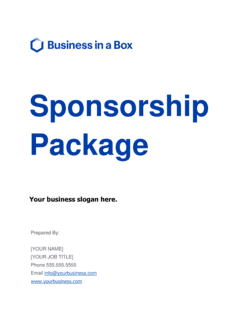
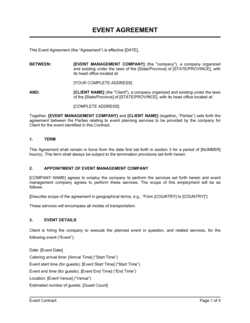
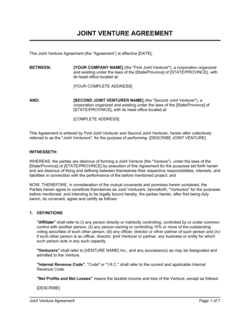
Sponsorship Package Template

Free Word download β€’ Edit online β€’ Save & share with Drive β€’ Export to PDF

7 pagesβ€’25–35 min to fillβ€’Difficulty: Complexβ€’Signature requiredβ€’Legal review recommended
Learn more ↓
FreeSponsorship Package Template

At a glance

What it is
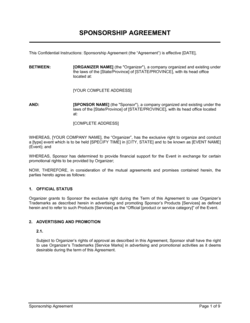
A Sponsorship Package is a binding legal agreement between a sponsoring company and an event organizer, sports team, nonprofit, or media property that defines the financial contribution, the specific benefits delivered in return, and the obligations of both parties. This free Word download gives you a fully editable, professional template you can customize and export as PDF to present to prospective sponsors or execute with confirmed ones.
When you need it
Use it before accepting any sponsorship payment or activating a sponsor's branding β€” whether for a one-day conference, a season-long sports sponsorship, a podcast series, or a charity gala. A signed package prevents disputes over what was promised and protects both parties if the event is cancelled or the sponsor withdraws.
What's inside
Sponsor and property details, sponsorship tier and fees, itemized benefit schedule, exclusivity provisions, intellectual property and branding rights, payment terms, cancellation and refund policy, liability limitations, and governing law. A Schedule A benefit matrix is included as an attachment.

What is a Sponsorship Package?

A Sponsorship Package is a binding legal agreement between a sponsoring company and a property β€” an event organizer, sports team, media program, or nonprofit β€” that formally documents the financial contribution the sponsor will make and the specific marketing rights and benefits the property will deliver in return. It converts an informal proposal into an enforceable contract by defining the sponsorship tier and fee, itemizing every deliverable in a benefit schedule, granting limited IP and branding rights, establishing exclusivity within a defined category, and spelling out what happens if the event is cancelled, the sponsor withdraws, or either party fails to perform. This free Word template is fully editable online and can be exported as PDF for immediate use with prospective or confirmed sponsors.

Why You Need This Document

Operating without a signed sponsorship package exposes both parties to significant risk. A sponsor who pays without a written agreement has no enforceable entitlement to specific logo placements, social media exposure, or exclusivity β€” leaving them with a breach-of-contract claim that is difficult to prove when the only record is an email chain and a slide deck. For the property, accepting payment without documenting the benefit schedule means any shortfall in delivery β€” a smaller crowd than projected, a last-minute venue change, a social post that underperformed β€” becomes a refund dispute with no contractual framework to resolve it. Cancellations and postponements without a written policy default to unpredictable common-law remedies that are expensive to litigate. A properly executed sponsorship package eliminates these gaps in 30 to 60 minutes, gives both parties a single enforceable reference document, and protects the relationship β€” and the event β€” from disputes that have nothing to do with the quality of the experience itself.

Which variant fits your situation?

If your situation is…Use this template
Securing a single presenting or title sponsor for a major eventTitle Sponsorship Agreement
Offering multiple tiered tiers (Gold, Silver, Bronze) to several sponsorsTiered Sponsorship Package
Sponsoring a nonprofit program or charitable campaignCharitable Sponsorship Agreement
Naming rights for a venue, arena, or buildingNaming Rights Agreement
Media or podcast brand sponsorship with deliverable-based paymentsMedia Sponsorship Agreement
Sports team or athlete endorsement with performance conditionsAthlete Sponsorship Agreement
In-kind or product sponsorship with no cash paymentIn-Kind Sponsorship Agreement

Common mistakes to avoid

❌ Vague benefit descriptions in Schedule A

Why it matters: Language like 'prominent branding' or 'social media exposure' is unverifiable β€” sponsors routinely dispute delivery when no metric was defined, leading to refund demands and reputational damage.

Fix: Quantify every benefit: logo dimensions in centimeters, minimum audience reach per post, number of email inclusions, and booth square footage. If you cannot measure it, rewrite it.

❌ Activating sponsor benefits before the contract is signed

Why it matters: Running a sponsor's logo before execution means the property has already partially performed β€” giving the sponsor leverage to renegotiate terms or withhold payment with no breach on their part.

Fix: Make a signed agreement a hard prerequisite for any logo placement, social post, or brand mention. Issue a written hold-off notice to your team until the countersigned document is received.

❌ No cancellation or postponement clause

Why it matters: Without it, both parties default to jurisdiction-specific common law on force majeure and frustration of contract β€” which is expensive to litigate and produces unpredictable outcomes.

Fix: Include a tiered refund schedule distinguishing property-initiated cancellation, postponement beyond a defined threshold, and force majeure events, with a specific dollar or percentage outcome for each.

❌ Category exclusivity defined too broadly

Why it matters: An exclusivity clause covering 'technology' or 'financial services' blocks legitimate sponsors in adjacent categories and can expose the property to breach claims when a second sponsor is signed.

Fix: Define the exclusivity category by reference to a specific product type, service offering, and customer segment β€” narrow enough to protect the anchor sponsor, wide enough to remain commercially useful.

❌ No IP approval requirement for sponsor mark usage

Why it matters: A sponsor with unrestricted license to use the property's logo can produce materials β€” advertisements, merchandise, social posts β€” that violate brand guidelines or create conflicts with other sponsors.

Fix: Add a written approval clause requiring the property to review and approve any sponsor-produced material bearing property marks within 5 business days of submission.

❌ Omitting a liability cap

Why it matters: Without a cap, a property that fails to deliver a benefit package could face a claim for consequential damages β€” lost sales, lost marketing ROI β€” far exceeding the sponsorship fee itself.

Fix: Cap the property's total liability to the sponsor at the total sponsorship fee paid, and exclude consequential, indirect, and punitive damages explicitly.

The 10 key clauses, explained

Parties, Property, and Term

In plain language: Identifies the sponsoring company and the property owner as legal entities, describes the event or program being sponsored, and states the agreement's start and end dates.

Sample language
This Sponsorship Agreement is entered into on [DATE] between [SPONSOR LEGAL NAME], a [STATE/COUNTRY] [ENTITY TYPE] ('Sponsor'), and [PROPERTY OWNER LEGAL NAME], a [STATE/COUNTRY] [ENTITY TYPE] ('Property'). This Agreement covers the [EVENT/PROGRAM NAME] scheduled for [DATE(S)] at [LOCATION] ('Event').

Common mistake: Describing the event by its working title rather than a defined term. If the event is renamed or rescheduled, ambiguity about whether the agreement still applies can void it.

Sponsorship Tier and Fee

In plain language: States the sponsorship level (e.g., Title, Gold, Silver), the total fee payable, the payment schedule, and accepted payment methods.

Sample language
Sponsor has selected the [TIER NAME] sponsorship level at a total fee of $[AMOUNT]. Payment schedule: [X]% ($[AMOUNT]) due upon signing; [X]% ($[AMOUNT]) due no later than [DATE]. Payment shall be made by [ACH / wire / check] to the account specified in Schedule B.

Common mistake: Accepting payment in full before the benefit schedule is attached and signed. If the event under-delivers, the sponsor has no documented entitlement to enforce.

Benefit Schedule and Deliverables

In plain language: Lists every specific benefit the property will provide β€” logo placement locations and sizes, social media posts, mentions, tickets, booth space, speaking slots β€” and ties them to verifiable delivery dates.

Sample language
Property shall deliver to Sponsor the benefits set out in Schedule A, including: [X] logo impressions on event signage (minimum [SIZE]), [X] mentions in email communications to [LIST SIZE]+ subscribers, [X] complimentary event passes, and [X] social media posts (minimum [REACH]) by [DATES].

Common mistake: Writing benefits in vague, aspirational language β€” 'prominent logo placement' or 'significant social media exposure.' Courts and sponsors alike need measurable, specific commitments.

Exclusivity and Category Protection

In plain language: Grants the sponsor sole rights within its product or service category for the event and defines the category precisely enough to avoid disputes.

Sample language
Property grants Sponsor exclusive rights as the official [CATEGORY β€” e.g., 'non-alcoholic beverage'] sponsor of the Event. Property shall not enter into sponsorship agreements with any other brand whose primary business falls within [CATEGORY DEFINITION] during the Term.

Common mistake: Defining the exclusivity category too broadly (e.g., 'technology') or too narrowly (e.g., 'cloud-based HR software for companies with 500+ employees'). An overly broad definition blocks legitimate sponsors; an overly narrow one fails to protect the sponsor it was meant to serve.

Intellectual Property and Branding Rights

In plain language: Grants each party a limited license to use the other's marks for event promotion β€” and sets the approval process for how those marks may be used.

Sample language
Each party grants the other a limited, non-exclusive, royalty-free license to use its name, logo, and marks solely for promoting the Event during the Term. All uses of a party's marks require prior written approval, not to be unreasonably withheld, within [5] business days of submission.

Common mistake: No approval requirement for mark usage. Without one, a sponsor can run advertisements using the property's branding in ways that conflict with the property's own brand guidelines or existing sponsor relationships.

Payment Terms and Late Fees

In plain language: Specifies when each installment is due, what happens if a payment is missed, and whether the property can suspend benefits for non-payment.

Sample language
Payments not received within [10] days of the due date shall accrue interest at [1.5]% per month on the outstanding balance. Property reserves the right to suspend Sponsor's benefits β€” including logo placement and activations β€” until all overdue amounts are paid in full.

Common mistake: No late-fee or suspension clause. Without one, a sponsor who misses an installment faces no contractual consequence, and the property has no leverage short of litigation.

Cancellation, Postponement, and Refund Policy

In plain language: Defines what happens to the sponsorship fee if the event is cancelled, postponed, or materially changed β€” including the refund formula and any force majeure carve-out.

Sample language
If Property cancels the Event for reasons within its control, Sponsor shall receive a refund of [X]% of fees paid, less [AMOUNT] in non-refundable production costs. If the Event is postponed by more than [90] days, Sponsor may elect to roll fees to the rescheduled event or receive a [X]% refund. Cancellations due to Force Majeure are governed by Clause [X].

Common mistake: A blanket 'no refunds' policy regardless of cause. Courts in most jurisdictions will not enforce a refund waiver for cancellations attributable to the property's own negligence or breach.

Liability, Indemnification, and Insurance

In plain language: Caps the property's liability to the sponsor for benefit non-delivery, requires each party to indemnify the other for its own conduct, and specifies minimum insurance coverage.

Sample language
Property's total liability to Sponsor under this Agreement shall not exceed the total Sponsorship Fee paid. Each party shall maintain commercial general liability insurance of not less than $[AMOUNT] per occurrence and shall name the other party as an additional insured upon request.

Common mistake: No mutual indemnification β€” or one that only protects the property. A sponsor whose logo is misused by a third party authorized by the property has no recourse without a reciprocal indemnity clause.

Termination and Default

In plain language: Specifies what events constitute a material breach, how much cure time is allowed before the non-breaching party may terminate, and what the consequences of termination are.

Sample language
Either party may terminate this Agreement on [30] days' written notice if the other party materially breaches any provision and fails to cure the breach within [15] days of written notice. Upon termination by Sponsor for Property's uncured breach, Property shall refund [X]% of fees paid.

Common mistake: No cure period before termination. Allowing immediate termination for any breach β€” including minor administrative ones β€” exposes both parties to premature contract dissolution and disputed refunds.

Governing Law and Dispute Resolution

In plain language: Specifies which jurisdiction's law governs the agreement and how disputes are handled β€” mediation first, then arbitration or court.

Sample language
This Agreement is governed by the laws of [STATE / PROVINCE / COUNTRY]. Any dispute arising under this Agreement shall first be submitted to non-binding mediation. If unresolved within [30] days, disputes shall be resolved by binding arbitration administered by [AAA / JAMS / ICDR] in [CITY], except claims for injunctive or equitable relief.

Common mistake: Choosing the event's host city as the governing jurisdiction without considering where the sponsor is incorporated. If the sponsor is a national brand and the property is a local organization, a neutral jurisdiction or the sponsor's home state may be more enforceable.

How to fill it out

  1. 1

    Enter the legal entity names and define the event

    Use the full registered corporate name for both the sponsor and the property owner β€” not trade names or brands. Define the event with a formal name, date range, and location so the agreement is unambiguous if the event is rescheduled.

    πŸ’‘ Cross-check both entity names against corporate registry filings before execution β€” a name mismatch can make the contract unenforceable against the intended party.

  2. 2

    Select and name the sponsorship tier

    Choose a tier level (Title, Presenting, Gold, Silver, Bronze, or a custom name) and enter the corresponding fee, payment installments, and due dates in the fee clause.

    πŸ’‘ List the due dates as specific calendar dates, not 'X days before the event' β€” relative dates create ambiguity if the event is rescheduled.

  3. 3

    Build the benefit schedule in Schedule A

    List every deliverable the property will provide β€” logo sizes and placements, social posts with minimum reach, email inclusions, tickets, booth dimensions, and speaking time β€” as measurable commitments, not aspirational descriptions.

    πŸ’‘ Assign a delivery date or milestone to each benefit so both parties can verify completion without a dispute about timing.

  4. 4

    Define the exclusivity category precisely

    Write out the sponsor's category in specific, industry-standard language. Reference SIC or NAICS codes if the category boundary is likely to be contested by other sponsors.

    πŸ’‘ Have the sponsor review and approve the exclusivity definition before signing β€” their legal team will catch ambiguities your team may miss.

  5. 5

    Set the IP approval workflow

    Specify the approval turnaround time for mark usage (5 business days is standard), who the approval contact is on each side, and what deemed-approved means if no response is received within the window.

    πŸ’‘ Name a specific email address for approval submissions β€” not a department or role β€” to prevent disputes over whether a request was received.

  6. 6

    Draft the cancellation and refund policy

    Decide the refund percentage for property-initiated cancellations, the postponement threshold that triggers a refund option, and the force majeure terms. Confirm the refund formula is commercially reasonable for your event's actual cost structure.

    πŸ’‘ Separate cancellation refunds from force majeure refunds β€” the two have different moral and legal weight and should not be treated identically.

  7. 7

    Confirm insurance minimums and attach certificates

    Enter the minimum commercial general liability coverage amount, require additional insured endorsements where applicable, and specify that certificates of insurance must be delivered within 10 days of signing.

    πŸ’‘ Check whether your event venue requires a minimum coverage amount from all sponsors β€” venue requirements can exceed contract minimums.

  8. 8

    Execute before any benefit is activated or payment is received

    Both parties must sign the agreement β€” and the sponsor must initial Schedule A β€” before logo placement begins, social posts go live, or any payment changes hands. Activation without a signed agreement removes all contractual protections.

    πŸ’‘ Use a timestamped eSign tool to create an irrefutable execution record, especially for out-of-state or international sponsors.

Frequently asked questions

What is a sponsorship package?

A sponsorship package is a binding legal agreement between a sponsor and a property β€” an event, sports team, media program, or nonprofit β€” that sets out the financial contribution the sponsor will make and the specific marketing benefits and rights the property will deliver in return. It replaces informal proposals with enforceable obligations on both sides, covering fees, benefit schedules, exclusivity, IP rights, and what happens if the event is cancelled or the sponsor withdraws.

What should a sponsorship package include?

At minimum: the legal names of both parties, a clear description of the event or program, the sponsorship tier and total fee with payment schedule, an itemized benefit schedule (Schedule A) with measurable deliverables, exclusivity provisions with a defined category, IP and branding approval rights, a cancellation and refund policy, liability limitations, and governing law. Missing any of these creates gaps that routinely lead to disputes over what was promised and what is owed if circumstances change.

Is a sponsorship package the same as a sponsorship proposal?

No. A sponsorship proposal is a marketing document sent to prospective sponsors to generate interest β€” it describes tiers, pricing, and benefits but creates no binding obligations. A sponsorship package (or sponsorship agreement) is the legally binding contract executed once a sponsor commits. The proposal gets the sponsor to the table; the package binds both parties to specific, enforceable terms.

Does a sponsorship agreement need to be signed to be valid?

Yes β€” in virtually every jurisdiction, a sponsorship agreement should be executed in writing with signatures from both parties before any benefits are activated or payments are accepted. While oral agreements can technically be enforceable in some contexts, they are nearly impossible to prove in a dispute. Activating a sponsor's logo or accepting a deposit before signature creates an implied agreement on uncertain terms.

How do I structure sponsorship tiers?

Most events use three to five tiers β€” typically Title or Presenting (one exclusive sponsor), then Gold, Silver, and Bronze. Each tier should have a defined fee, a specific benefit package in Schedule A, and a stated cap on the number of sponsors allowed at that level. Title tier benefits typically include category exclusivity, premium logo placement, speaking rights, and the highest ticket allotment. Lower tiers receive reduced exposure with no exclusivity.

What happens if the event is cancelled after the sponsor has paid?

The refund obligation depends entirely on what the sponsorship agreement says. Without a written policy, the property typically owes a full refund less verifiable production costs already incurred β€” under the common-law doctrine of unjust enrichment. A well-drafted agreement should specify a refund schedule for property-initiated cancellations, a separate policy for force majeure events, and a postponement option with a defined threshold (e.g., 90 days) beyond which the sponsor may elect a full or partial refund.

Can a sponsorship agreement include exclusivity?

Yes, and for most premium sponsors it is a standard expectation. Category exclusivity prevents the property from accepting a competing brand in the same product or service category during the term of the agreement. It should be defined by specific category boundaries β€” not broad industry labels β€” and should be priced into the tier. Unlimited exclusivity across all categories at a single tier would make the event commercially unviable, so the scope must be carefully balanced.

Who owns the IP created during a sponsored event?

Ownership of event-created IP β€” photographs, videos, recordings, branded content β€” should be explicitly addressed in the agreement. Typically, the property retains ownership of event content but grants the sponsor a limited license to use event-related media featuring their branding for a defined period. Without a clear clause, both parties may claim rights to the same content, leading to disputes over post-event marketing use.

Do I need a lawyer to prepare a sponsorship package?

For straightforward event sponsorships with standard tiers and domestic sponsors, a high-quality template is typically sufficient. Engaging a lawyer is advisable when the sponsorship fee exceeds $25,000, when naming rights or venue branding are involved, when the sponsor is an international brand with complex IP requirements, or when the event is in a regulated industry such as alcohol, cannabis, or financial services. A one-hour template review typically costs $250–$500 and is worthwhile for any anchor sponsorship.

How this compares to alternatives

vs Sponsorship Proposal

A sponsorship proposal is a marketing document presenting tiers, pricing, and benefits to attract potential sponsors β€” it creates no binding obligations. A sponsorship package is the executed contract that formalizes the relationship once a sponsor commits. The proposal is the pitch; the package is the deal. Both documents are needed for a complete sponsorship process.

vs Event Planning Agreement

An event planning agreement governs the relationship between an event organizer and an event planner or vendor β€” covering deliverables, timelines, and fees for planning services. A sponsorship package governs the relationship between the organizer and a corporate sponsor who contributes money or value in exchange for marketing rights. They address entirely different parties and purposes within the same event.

vs Advertising Agreement

An advertising agreement covers the purchase of defined ad placements β€” banner ads, print insertions, broadcast spots β€” with no association between the advertiser and the property's brand or identity. Sponsorship creates a deeper brand integration: exclusivity, co-branding rights, on-site presence, and audience engagement that advertising does not provide. Sponsors are partners; advertisers are buyers.

vs Partnership Agreement

A partnership or joint venture agreement creates an ongoing business relationship with shared profits, liabilities, and governance obligations. A sponsorship package is a time-limited, fee-for-benefits transaction with no shared ownership or ongoing liability beyond the event term. If the arrangement involves revenue sharing or co-ownership of the event, a joint venture agreement is more appropriate than a sponsorship package.

Industry-specific considerations

Events and Entertainment

Multi-tier sponsor stacking, on-site activation rights, logo placement hierarchy on printed and digital collateral, and post-event report obligations tied to impressions delivered.

Nonprofit and Charitable Organizations

Cause-marketing language, charitable tax receipt implications (sponsors may not be entitled to a donation receipt if benefits are received), and donor acknowledgment versus sponsor recognition distinctions.

Sports and Athletics

Season-long versus per-event terms, jersey and kit branding rights, broadcast and streaming IP considerations, and athlete appearance obligations tied to the sponsor relationship.

Media, Podcasts, and Content

Deliverable-based payment tied to episode release dates, host-read versus produced ad unit distinctions, exclusivity windows by episode or content category, and content approval rights for brand-safety compliance.

Jurisdictional notes

United States

Sponsorship agreements are governed by general contract law at the state level β€” there is no federal sponsorship statute. Non-cash or in-kind sponsorships of nonprofit events may trigger IRS charitable contribution rules: if the sponsor receives substantial benefits in return, the contribution may not qualify as a charitable deduction. Alcohol and cannabis sponsors face additional state-level advertising and promotional restrictions that must be addressed in the agreement.

Canada

Sponsorship of registered charities in Canada is subject to CRA rules distinguishing a sponsorship (commercial arrangement) from a donation (no material benefit received). Quebec's Charter of the French Language requires all contracts and public-facing materials to be available in French for provincially-regulated entities. Alcohol sponsorships at public events must comply with provincial liquor authority regulations, which vary significantly between provinces.

United Kingdom

UK sponsorship agreements must comply with the UK Code of Non-broadcast Advertising and Promotions (CAP Code) and, for broadcast events, the BCAP Code administered by the ASA. Charitable event sponsorships must distinguish commercial participation from Gift Aid-eligible donations under HMRC rules. Post-Brexit, EU state aid rules no longer apply, but public-sector event sponsors must comply with the UK Subsidy Control Act 2022.

European Union

GDPR applies when sponsor activations involve collecting attendee personal data β€” consent mechanisms, data processing agreements, and retention schedules must be addressed in the sponsorship package or a separate data processing addendum. EU member states have varying restrictions on tobacco, alcohol, and gambling sponsorships at public events. Cross-border sponsorships with EU entities should specify the governing member state law, as contract enforcement and consumer protection rules differ materially between France, Germany, and Spain.

Template vs lawyer β€” what fits your deal?

PathBest forCostTime
Use the templateEvent organizers, nonprofits, and content creators with standard domestic sponsorships under $25,000Free30–60 minutes
Template + legal reviewAnchor or title sponsorships, events with multiple international sponsors, or agreements including naming rights or IP licensing$250–$7501–3 days
Custom draftedMulti-year sponsorships exceeding $100,000, regulated-industry sponsors (alcohol, cannabis, financial services), or broadcast and streaming rights$1,500–$5,000+1–3 weeks

Glossary

Sponsorship Fee
The cash amount the sponsor pays in exchange for the agreed benefits package, stated in the contract with a payment schedule.
Benefit Schedule
An itemized attachment listing every deliverable the property owes the sponsor β€” logo placements, mentions, tickets, signage, digital impressions β€” tied to each sponsorship tier.
Exclusivity
A provision preventing the property from accepting competing sponsors in the same product or service category for the duration of the agreement.
Category Exclusivity
Exclusivity limited to a defined industry segment β€” for example, a single airline or a single software company β€” rather than all sponsors across all categories.
Activation
The on-site or digital activities a sponsor executes to engage the audience and extract value from the sponsorship beyond passive logo placement.
IP License
The limited grant allowing the sponsor to use the property's name, logo, and marks in its own marketing materials for a defined period.
Naming Rights
A sponsorship arrangement in which the sponsor's name is attached to the event, venue, or program itself β€” the most premium and most expensive sponsorship category.
Force Majeure
A clause that excuses both parties from performance obligations if the event is cancelled or materially altered due to circumstances outside either party's control, such as a natural disaster or government order.
Right of First Refusal
A provision giving the current sponsor priority to renew the sponsorship at the same or improved terms before the property offers it to a third party.
Clutter Policy
A limit on the total number of sponsors permitted at a given tier or across the entire event, protecting the value of each sponsor's investment.
Contra Deal
A sponsorship arrangement where a sponsor provides goods or services instead of cash, valued at an agreed amount and credited against the sponsorship fee.

Part of your Business Operating System

This document is one of 3,000+ business & legal templates included in Business in a Box.

  • Fill-in-the-blanks β€” ready in minutes
  • 100% customizable Word document
  • Compatible with all office suites
  • Export to PDF and share electronically

Create your document in 3 simple steps.

From template to signed document β€” all inside one Business Operating System.
1
Download or open template

Access over 3,000+ business and legal templates for any business task, project or initiative.

2
Edit and fill in the blanks with AI

Customize your ready-made business document template and save it in the cloud.

3
Save, Share, Send, Sign

Share your files and folders with your team. Create a space of seamless collaboration.

Save time, save money, and create top-quality documents.

β˜…β˜…β˜…β˜…β˜…

"Fantastic value! I'm not sure how I'd do without it. It's worth its weight in gold and paid back for itself many times."

Managing Director Β· Mall Farm
Robert Whalley
Managing Director, Mall Farm Proprietary Limited
β˜…β˜…β˜…β˜…β˜…

"I have been using Business in a Box for years. It has been the most useful source of templates I have encountered. I recommend it to anyone."

Business Owner Β· 4+ years
Dr Michael John Freestone
Business Owner
β˜…β˜…β˜…β˜…β˜…

"It has been a life saver so many times I have lost count. Business in a Box has saved me so much time and as you know, time is money."

Owner Β· Upstate Web
David G. Moore Jr.
Owner, Upstate Web

Run your business with a system β€” not scattered tools

Stop downloading documents. Start operating with clarity. Business in a Box gives you the Business Operating System used by over 250,000 companies worldwide to structure, run, and grow their business.

Start freeΒ Β·Β No credit card required