Agile Team Agreement Template

Free Word download β€’ Edit online β€’ Save & share with Drive β€’ Export to PDF

3 pagesβ€’25–30 min to fillβ€’Difficulty: Complexβ€’Signature requiredβ€’Legal review recommended
Learn more ↓
FreeAgile Team Agreement Template

At a glance

What it is
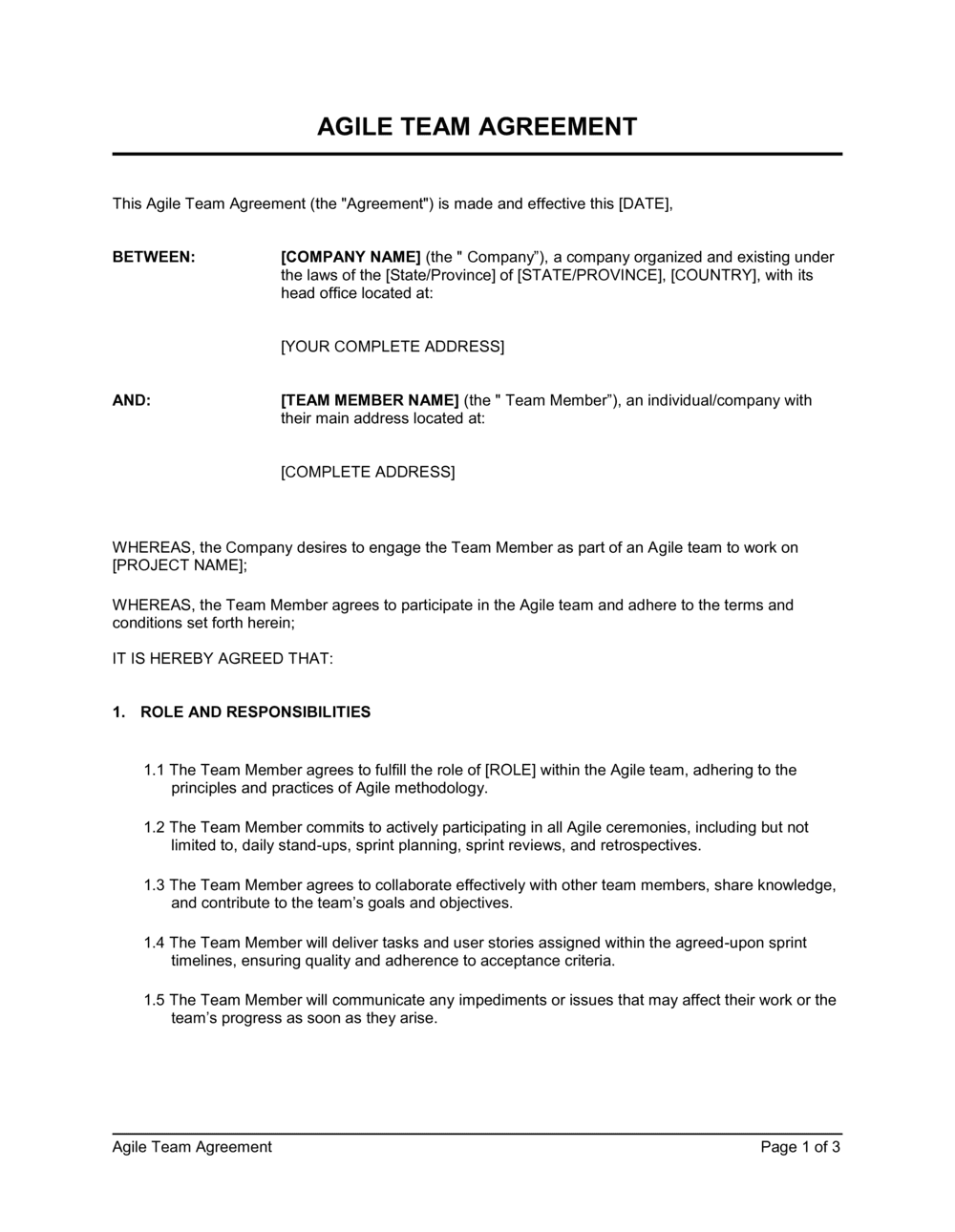
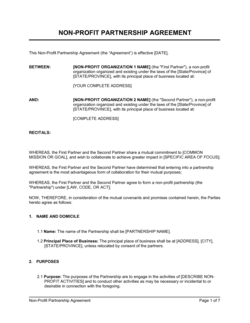
An Agile Team Agreement is a binding document that formalizes the operating rules, roles, responsibilities, and legal obligations of a cross-functional team working under an agile or scrum methodology. This free Word download lets you define sprint cadence, IP ownership, confidentiality, and dispute resolution in a single signed document you can edit online and export as PDF before a project kicks off.
When you need it
Use it when assembling a new product or software development team that includes contractors, freelancers, or employees from different organizations β€” or any time multiple parties must share deliverables, IP, and decision-making authority under an iterative delivery framework.
What's inside
Party identification and roles, sprint and ceremony cadence, definition of done, IP assignment, confidentiality obligations, change management process, dispute resolution, and governing law β€” covering both the operational norms and the legal obligations that hold the team accountable.

What is an Agile Team Agreement?

An Agile Team Agreement is a legally binding contract that formalizes the operating rules, roles, and mutual obligations of a cross-functional team working under an agile or scrum delivery framework. It goes beyond an informal set of team norms by establishing enforceable terms for IP ownership, confidentiality, sprint cadence, acceptance criteria, change management, fees, and dispute resolution β€” in a single document signed before the first sprint begins. Where an informal working agreement captures how a team prefers to collaborate, an Agile Team Agreement creates legal accountability for what is delivered, who owns it, how changes are governed, and what happens when the engagement ends.

Why You Need This Document

Without a signed Agile Team Agreement, every sprint your team completes creates unresolved legal exposure. IP produced by contractors does not automatically transfer to the client in most jurisdictions β€” work can be delivered, paid for, and still legally owned by the developer who wrote it. Scope creep goes unbilled because there is no baseline to measure against. Sprint output sits in a legal gray area until a product owner formally accepts it β€” and without a defined acceptance window, that moment never comes. When an engagement ends abruptly, teams leave without transferring repositories, credentials, or documentation because no handover obligation exists. Each of these gaps is a dispute waiting to happen. This template closes all of them before sprint one, giving both the client and the delivery team a clear, enforceable record of what was agreed β€” so the focus stays on shipping product rather than litigating who owns it.

Which variant fits your situation?

If your situation is…Use this template
Engaging an external agency to deliver a product on an agile sprint modelSoftware Development Agreement
Formalizing a single freelancer's contribution to a scrum teamIndependent Contractor Agreement
Documenting team norms without legal enforcement (internal teams only)Team Charter
Governing a multi-party joint venture building a shared productJoint Venture Agreement
Hiring a full-time scrum team member as a permanent employeeEmployment Contract
Protecting shared IP and trade secrets across all team membersNon-Disclosure Agreement
Defining service-level commitments in a client-facing agile engagementService Level Agreement

Common mistakes to avoid

❌ Starting the first sprint before the agreement is signed

Why it matters: Any work delivered before signing has no enforceable IP assignment, confidentiality protection, or payment obligation. A client who receives sprint output before signing can dispute ownership or refuse to pay with no binding recourse.

Fix: Treat the signed agreement as a prerequisite for sprint day one β€” block the first planning session in your calendar until execution is confirmed.

❌ No attached initial backlog

Why it matters: Without a documented baseline scope, every addition looks like a continuation of the original work rather than a change. Agencies routinely absorb months of unbilled scope expansion because they cannot prove what was in versus out of scope at signing.

Fix: Attach the backlog as Schedule A at signing, date-stamp it, and require a signed Change Order for any item added after that date.

❌ Verbal change approvals during sprint planning

Why it matters: Sprint planning calls are fast-moving β€” what sounds like a quick addition often represents hours of additional work. Verbal approvals are routinely disputed at invoicing, leaving the team unpaid for completed work.

Fix: Include an explicit clause requiring written Change Orders for all scope modifications and enforce it consistently from sprint one.

❌ IP transfer conditioned on final project completion

Why it matters: Agile engagements frequently end before full project completion. If IP only transfers at project end, a client who terminates mid-project has paid for delivered work but received no legally assignable assets.

Fix: Tie IP assignment to sprint-level payment so ownership transfers incrementally as work is delivered and paid for.

❌ Omitting the acceptance window for sprint deliverables

Why it matters: Without a defined deadline for the product owner to accept or reject sprint output, teams cannot close sprints, invoice, or begin the next sprint with confidence. Disputes about whether work was 'actually accepted' stall payment for weeks.

Fix: Set a specific acceptance window β€” typically 3 to 5 business days after the sprint review β€” and include a silence-equals-acceptance clause if the window lapses without response.

❌ No offboarding obligations clause

Why it matters: When an engagement ends, teams that have not contractually committed to handover routinely leave without transferring repositories, documentation, credentials, or institutional knowledge β€” costing the client weeks of recovery time.

Fix: Specify in the agreement exactly what must be transferred at offboarding, the format, and the deadline β€” typically 10 business days after the termination date.

The 10 key clauses, explained

Parties, roles, and team composition

In plain language: Identifies every party to the agreement β€” client, agency, individual contributors β€” and assigns a formal role (product owner, scrum master, developer) to each.

Sample language
This Agile Team Agreement ('Agreement') is entered into on [DATE] between [CLIENT LEGAL NAME] ('Client') and [AGENCY / CONTRACTOR LEGAL NAME] ('Service Provider'). The team shall consist of the following roles: Product Owner β€” [NAME]; Scrum Master β€” [NAME]; Development Team β€” [NAMES OR TITLES].

Common mistake: Listing team members by first name only, without their legal entity or employment relationship. When a dispute arises, it becomes unclear which party bears responsibility for a specific contributor's work product or actions.

Scope of work and backlog ownership

In plain language: Defines the initial product backlog, who owns and prioritizes it, and the boundaries of what is in and out of scope for the engagement.

Sample language
The initial Product Backlog is set out in Schedule A. The Product Owner retains sole authority to re-prioritize backlog items between sprints. Work items outside Schedule A require a written Change Order signed by both parties before work begins.

Common mistake: Failing to attach the initial backlog as a schedule. Scope creep in agile engagements is the most common source of billing disputes, and an undefined starting backlog leaves no baseline to measure against.

Sprint cadence and delivery ceremonies

In plain language: Sets the sprint length, the dates and format of planning, review, and retrospective ceremonies, and the team's standard working hours and communication channels.

Sample language
Sprints shall run for [2] calendar weeks, commencing [DAY]. The following ceremonies are mandatory: Sprint Planning ([DAY, TIME, LOCATION/LINK]); Sprint Review ([DAY, TIME]); Retrospective ([DAY, TIME]). The team's core hours are [START TIME] to [END TIME] [TIMEZONE].

Common mistake: Treating ceremony schedules as informal β€” omitting them from the agreement entirely and relying on calendar invites. When a party claims the team failed to deliver reviews or planning sessions, there is nothing to point to as the agreed standard.

Definition of done and acceptance criteria

In plain language: Documents the shared criteria that must be satisfied before any deliverable is considered complete, and the process for the client to formally accept or reject sprint output.

Sample language
A deliverable is 'Done' when it meets all criteria in Schedule B ('Definition of Done'). The Product Owner shall provide written acceptance or rejection within [5] business days of a Sprint Review. Silence after [5] business days constitutes acceptance.

Common mistake: Omitting the acceptance window entirely. Without a defined deadline for client feedback, development teams are left in limbo β€” unable to invoice, close sprints, or move forward with dependent work.

Intellectual property assignment

In plain language: Assigns ownership of all work product, code, designs, and deliverables created during the engagement to the designated party, effective upon full payment.

Sample language
Upon receipt of full payment for each sprint, Service Provider irrevocably assigns to Client all right, title, and interest in and to all work product, code, and deliverables created under this Agreement, including all associated intellectual property rights.

Common mistake: Conditioning IP transfer on final project completion rather than sprint-by-sprint payment. If the engagement ends early, the client may have paid for months of work but received no assignable IP.

Confidentiality and data handling

In plain language: Prohibits team members from disclosing the client's business information, source code, product roadmap, and customer data β€” during and after the engagement.

Sample language
Each party shall hold in strict confidence all Confidential Information of the other party and shall not disclose it to any third party without prior written consent. 'Confidential Information' includes, without limitation, source code, product roadmaps, customer data, and financial information.

Common mistake: Using the same confidentiality clause for both a three-person internal team and a 20-person cross-company program. The clause should define who within each organization may access confidential information β€” a general 'employees only' carve-out is too broad for large distributed teams.

Change management and scope modification

In plain language: Establishes the formal process for requesting, evaluating, pricing, and approving any changes to scope, timeline, or budget beyond the agreed backlog.

Sample language
Either party may request a scope change by submitting a written Change Order to the other party. Change Orders must specify the requested modification, estimated effort in story points or hours, adjusted timeline, and additional fees. No change is effective until signed by both parties.

Common mistake: Allowing verbal change approvals during sprint planning calls. Verbal scope expansions are routinely disputed at invoicing; a signed Change Order requirement eliminates the ambiguity.

Fees, payment schedule, and invoicing

In plain language: States the fee structure (fixed per sprint, time-and-materials, or retainer), the invoicing trigger, the payment window, and the late-fee penalty.

Sample language
Client shall pay Service Provider [$X] per sprint, invoiced on the last day of each sprint. Payment is due within [15] business days of invoice. Overdue balances accrue interest at [1.5]% per month. Service Provider may suspend work after [10] business days of non-payment.

Common mistake: Tying invoicing to project milestones rather than sprint completion. Milestone-based billing in agile engagements routinely stalls because milestones shift β€” sprint-based billing keeps cash flow predictable for both parties.

Term, termination, and offboarding

In plain language: Sets the agreement's duration, the notice required to terminate, what happens to in-progress sprints on termination, and the handover obligations of each party.

Sample language
This Agreement commences on [START DATE] and continues until the Product Backlog is complete or either party provides [30] days' written notice of termination. On termination, Service Provider shall deliver all completed work product and documentation within [10] business days. Client shall pay for all work completed through the termination date.

Common mistake: No offboarding obligation clause. When an engagement ends abruptly, teams routinely leave without transferring code repositories, documentation, or credentials β€” creating weeks of recovery work and operational disruption for the client.

Governing law and dispute resolution

In plain language: Specifies which jurisdiction's law governs the agreement and the mechanism for resolving disputes β€” typically negotiation, then mediation, then arbitration or litigation.

Sample language
This Agreement is governed by the laws of [STATE/PROVINCE/COUNTRY]. Any dispute not resolved within [30] days of written notice shall be submitted to binding arbitration administered by [AAA/JAMS/ICAC] in [CITY]. Either party may seek injunctive relief in court without this requirement.

Common mistake: Selecting a governing jurisdiction with no connection to where either party operates or where the work is performed. Courts in some jurisdictions refuse to honor choice-of-law clauses that are purely strategic and lack any nexus to the parties or the work.

How to fill it out

  1. 1

    Identify all parties and assign formal roles

    Enter the full legal name of every organization and individual contributor bound by the agreement. Assign a specific agile role β€” product owner, scrum master, developer, QA lead β€” to each party or representative.

    πŸ’‘ For contractors and freelancers, confirm whether they are contracting individually or through a corporate entity β€” this determines which name appears on the agreement and who carries liability.

  2. 2

    Attach the initial product backlog as Schedule A

    Export your current backlog from your project management tool (Jira, Linear, Trello) and attach it as Schedule A. At minimum, include the top 20 prioritized items with brief descriptions and estimated effort.

    πŸ’‘ Mark Schedule A with the export date so both parties know the baseline scope at signing β€” any addition after that date requires a Change Order.

  3. 3

    Set the sprint cadence and ceremony schedule

    Enter the sprint length (1, 2, or 4 weeks), the day sprints start and end, and the recurring dates, times, and video links for planning, review, and retrospective ceremonies.

    πŸ’‘ Lock the sprint length for at least the first three sprints β€” teams that change sprint length mid-engagement consistently underperform on velocity predictability.

  4. 4

    Define the definition of done in Schedule B

    List the specific criteria every deliverable must meet β€” code reviewed and merged, tests written and passing, documentation updated, product owner demo completed. Attach as Schedule B.

    πŸ’‘ Write the definition of done in plain English, not engineering jargon, so the client can independently verify completion without a technical translator.

  5. 5

    Complete the IP assignment and payment linkage

    Confirm that IP transfers sprint by sprint upon payment, not at project end. Enter the sprint fee, invoice trigger date, and the number of days the client has to pay before late fees accrue.

    πŸ’‘ Sprint-level IP transfer creates a clear audit trail β€” if a dispute arises mid-project, each party knows exactly which deliverables are legally owned by whom.

  6. 6

    Tailor the confidentiality clause to team size

    Define which team members on each side have access to confidential information and add a named-personnel list if the team is large or includes subcontractors.

    πŸ’‘ If any team members are in the EU, add a GDPR-compliant data processing addendum β€” handling personal data without one exposes both parties to regulatory risk.

  7. 7

    Complete the termination and offboarding terms

    Enter the notice period (30 days is standard), the sprint completion obligation on notice, and the specific deliverables required at offboarding β€” code repo access, credentials, documentation, and handover sessions.

    πŸ’‘ Specify the exact format for credential handover (e.g., password manager export or designated handover meeting) to avoid disputes about whether handover was 'complete.'

  8. 8

    Sign before the first sprint begins

    Both parties must execute the agreement before sprint day one. Unsigned agreements mean IP assignment and confidentiality clauses are unenforceable for any work already delivered.

    πŸ’‘ Use an e-signature tool to timestamp execution and distribute signed copies automatically β€” execution delays are the single most common reason teams start work unprotected.

Frequently asked questions

What is an Agile Team Agreement?

An Agile Team Agreement is a binding contract that formalizes the operating rules, roles, and legal obligations of a team working under an agile or scrum framework. It covers sprint cadence, definition of done, IP ownership, confidentiality, change management, fees, and dispute resolution in a single signed document. Unlike an informal team charter, it creates enforceable obligations for all parties β€” including contractors, agencies, and client-side contributors.

Is an Agile Team Agreement legally binding?

Yes, when properly executed, an Agile Team Agreement is generally enforceable as a contract in most jurisdictions. It must include the standard elements of a binding contract: offer, acceptance, and consideration β€” typically the exchange of services for fees. Signatures from authorized representatives of each party are required; e-signatures are generally accepted under laws such as the US ESIGN Act, Canada's PIPEDA, and the EU eIDAS Regulation.

What is the difference between an Agile Team Agreement and a working agreement?

A working agreement is an informal set of team norms β€” communication preferences, meeting etiquette, and collaboration practices β€” that teams create collaboratively but typically do not sign. An Agile Team Agreement is a formal legal contract covering IP assignment, confidentiality, payment terms, and dispute resolution. Working agreements govern behavior; team agreements govern obligations. Teams that include contractors or external agencies need the legal contract; purely internal teams may find a working agreement sufficient.

Who should sign an Agile Team Agreement?

Any party with a formal role and legal obligation under the engagement should sign β€” typically the client organization, the agency or primary contractor, and any key individual contributors who are not employees of either primary party. Employees of a signatory organization are bound through their employment relationship and generally do not need to sign separately, though adding a confidentiality acknowledgment for team members with access to sensitive data is a common practice.

Does an Agile Team Agreement replace a Statement of Work or Service Agreement?

Not necessarily. An Agile Team Agreement governs the team's operating model, process norms, and legal obligations for the duration of the engagement. A Statement of Work (SOW) typically defines a specific deliverable, timeline, and price for a discrete project. For large engagements, both documents are used together β€” the master service agreement or Agile Team Agreement sets overarching terms, and individual SOWs define sprint-level or phase-level scope under those terms.

How should intellectual property be handled in an Agile Team Agreement?

IP should transfer from the service provider to the client on a sprint-by-sprint basis, conditioned on full payment for that sprint. This protects both parties: the client receives assignable IP incrementally as they pay, and the service provider retains a lien on unpaid work. The agreement should also address pre-existing IP β€” tools, frameworks, and libraries the agency brings to the engagement β€” which typically remain with the service provider under a license grant to the client.

What notice period is standard for terminating an Agile Team Agreement?

Thirty days is the most common notice period for agile engagements, aligning with typical two-week sprint cycles and allowing one full sprint to complete in-progress work and begin knowledge transfer. Some longer engagements use 60-day notice periods for senior or highly specialized team configurations. Either party should be able to terminate for material breach on shorter notice β€” typically 10 business days after written notice of breach if the breach is not cured.

Can a client unilaterally change the product backlog during the engagement?

The product owner typically holds the right to re-prioritize backlog items between sprints, which is a core feature of agile methodology. However, adding significant new work items β€” beyond re-prioritizing existing ones β€” should require a signed Change Order. The agreement should distinguish between routine backlog refinement, which the product owner controls, and material scope additions, which require mutual written agreement and a fee adjustment.

Do I need a lawyer to draft an Agile Team Agreement?

For straightforward domestic engagements between two parties with standard IP and payment terms, a high-quality template is typically sufficient. Legal review is advisable when the engagement involves parties in multiple jurisdictions, sensitive data subject to regulatory requirements (HIPAA, GDPR), significant IP value, or complex equity or revenue-sharing arrangements. A 1 to 2 hour lawyer review typically costs $300 to $600 and is worthwhile for engagements exceeding $50,000 in total contract value.

How this compares to alternatives

vs Independent Contractor Agreement

An Independent Contractor Agreement governs the relationship between a single contractor and a client β€” covering deliverables, rate, IP, and termination for one individual. An Agile Team Agreement governs an entire multi-role team operating under a shared process framework. Use the contractor agreement for a sole contributor; use the team agreement when two or more parties must align on sprint norms, joint IP, and shared delivery obligations.

vs Software Development Agreement

A Software Development Agreement defines the scope, price, and delivery terms for a specific software product β€” typically with fixed milestones and a defined acceptance process. An Agile Team Agreement is process-oriented, governing how an ongoing team operates across sprints rather than a single deliverable. For long-running agile engagements, the team agreement is the governing document; a software development agreement is better suited to fixed-scope, milestone-based projects.

vs Service Level Agreement

A Service Level Agreement (SLA) quantifies uptime, response times, and performance standards for a delivered service β€” typically post-launch. An Agile Team Agreement governs the delivery process itself, not the operational performance of what is built. In practice, both documents are often used together: the team agreement covers the build phase, and the SLA governs the live product.

vs Joint Venture Agreement

A Joint Venture Agreement creates a new legal entity or formal profit-sharing arrangement between two organizations building something together. An Agile Team Agreement creates a working relationship with defined process norms and IP terms but does not create a new legal entity or shared ownership structure. If two companies are co-developing a product and intend to share revenue or equity, a joint venture agreement is the appropriate instrument.

Industry-specific considerations

Software and SaaS

Sprint-level IP assignment for proprietary code, pre-existing library license carve-outs, and data processing addenda for SaaS platforms handling user data.

Financial services

Regulatory compliance obligations (SOC 2, PCI-DSS) referenced by the confidentiality clause, audit access rights for client security teams, and enhanced data handling restrictions.

Healthcare and MedTech

HIPAA Business Associate Agreement incorporated by reference, strict access controls on patient data, and FDA software validation obligations tied to the definition of done.

Professional services and consulting

Client non-solicitation of team members post-engagement, billing by story point or hour with sprint-level reconciliation, and deliverable-based acceptance tied to client sign-off.

E-commerce and retail technology

Integration with third-party platforms (Shopify, Salesforce) governed by a sub-licensing clause, seasonal sprint velocity adjustments, and payment gateway security compliance.

Government and public sector

Security clearance and background check requirements attached as conditions of team membership, mandatory open-source compliance, and procurement-compliant invoicing formats.

Jurisdictional notes

United States

IP assignment clauses must be explicit β€” courts in most states do not imply assignment from a work-for-hire relationship unless the contributor is a W-2 employee. California Labor Code Β§2870 limits the scope of IP assignment for work performed off company premises on personal time; tailor the clause if any team members are California-based. Non-solicitation clauses for team members are generally enforceable in most states but unenforceable in California.

Canada

Canada's Copyright Act vests copyright in the creator by default for independent contractors β€” explicit written assignment is required to transfer ownership to the client. Provincial employment standards do not apply to independent contractors, but misclassification risk is significant; ensure the agreement clearly establishes the contractor relationship. Quebec law requires that contracts intended to bind Quebec parties be available in French.

United Kingdom

Under the Copyright, Designs and Patents Act 1988, works created by employees in the course of employment automatically vest in the employer, but contractor-created work does not β€” written assignment is essential. IR35 rules may treat certain contractor arrangements as disguised employment, affecting tax obligations for both the engaging client and the contractor. Post-Brexit, GDPR equivalents under the UK GDPR apply to any personal data handled by the team.

European Union

GDPR requires a Data Processing Agreement (DPA) whenever personal data is shared between parties β€” for agile teams handling user data, the DPA should be attached as a schedule to this agreement. IP assignment rules vary by member state; in Germany and France, moral rights cannot be fully waived, which may affect how deliverables are credited. The EU's Transparent and Predictable Working Conditions Directive may impose written information obligations for certain contractor relationships depending on the member state.

Template vs lawyer β€” what fits your deal?

PathBest forCostTime
Use the templateDomestic single-jurisdiction engagements between two parties with standard IP and payment termsFree30 minutes
Template + legal reviewEngagements over $50,000, cross-border teams, or projects involving sensitive data under GDPR or HIPAA$300–$6001–3 days
Custom draftedComplex multi-party programs, joint IP development, revenue-sharing arrangements, or regulated industries requiring bespoke compliance clauses$1,500–$4,000+1–3 weeks

Glossary

Agile Methodology
An iterative approach to project delivery that breaks work into short cycles called sprints, prioritizes continuous feedback, and adapts scope based on learning.
Sprint
A fixed-length development cycle β€” typically 1 to 4 weeks β€” during which a team commits to delivering a specific set of work items.
Definition of Done
A shared, documented checklist that specifies the criteria a deliverable must meet before the team considers it complete and releasable.
Product Backlog
An ordered list of all desired work items for a product, maintained by the product owner and continuously refined based on priority and feedback.
Scrum Master
The team member responsible for facilitating agile ceremonies, removing blockers, and ensuring the team adheres to the agreed process.
Intellectual Property Assignment
A contractual clause transferring ownership of work product, code, and inventions created by team members to a designated party β€” typically the client or employer.
Velocity
The average amount of work a team completes in a sprint, measured in story points or hours, used to forecast delivery timelines.
Retrospective
A ceremony held at the end of each sprint where the team reviews what went well, what didn't, and what process changes to implement next sprint.
Acceptance Criteria
Specific, pre-agreed conditions that a deliverable must satisfy for the product owner or client to formally accept it as complete.
Change Control
A formal process for evaluating, approving, and documenting any modifications to agreed scope, timeline, or budget during an agile engagement.
Governing Law
The jurisdiction whose laws apply to interpret and enforce the agreement β€” typically the state, province, or country where the primary party operates.

Part of your Business Operating System

This document is one of 3,000+ business & legal templates included in Business in a Box.

  • Fill-in-the-blanks β€” ready in minutes
  • 100% customizable Word document
  • Compatible with all office suites
  • Export to PDF and share electronically

Create your document in 3 simple steps.

From template to signed document β€” all inside one Business Operating System.
1
Download or open template

Access over 3,000+ business and legal templates for any business task, project or initiative.

2
Edit and fill in the blanks with AI

Customize your ready-made business document template and save it in the cloud.

3
Save, Share, Send, Sign

Share your files and folders with your team. Create a space of seamless collaboration.

Save time, save money, and create top-quality documents.

β˜…β˜…β˜…β˜…β˜…

"Fantastic value! I'm not sure how I'd do without it. It's worth its weight in gold and paid back for itself many times."

Managing Director Β· Mall Farm
Robert Whalley
Managing Director, Mall Farm Proprietary Limited
β˜…β˜…β˜…β˜…β˜…

"I have been using Business in a Box for years. It has been the most useful source of templates I have encountered. I recommend it to anyone."

Business Owner Β· 4+ years
Dr Michael John Freestone
Business Owner
β˜…β˜…β˜…β˜…β˜…

"It has been a life saver so many times I have lost count. Business in a Box has saved me so much time and as you know, time is money."

Owner Β· Upstate Web
David G. Moore Jr.
Owner, Upstate Web

Run your business with a system β€” not scattered tools

Stop downloading documents. Start operating with clarity. Business in a Box gives you the Business Operating System used by over 250,000 companies worldwide to structure, run, and grow their business.

Start freeΒ Β·Β No credit card required