Limited Partnership Agreement Template

Free Word download • Edit online • Save & share with Drive • Export to PDF

13 pages30–45 min to fillDifficulty: ComplexSignature requiredLegal review recommended
Learn more ↓
FreeLimited Partnership Agreement Template

At a glance

What it is
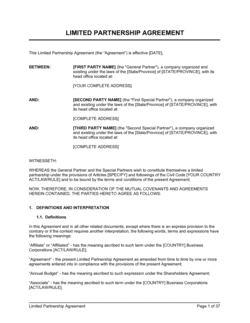
A Limited Partnership Agreement is a legally binding contract between one or more general partners (GPs) and one or more limited partners (LPs) that governs the formation, operation, capital structure, profit distribution, and dissolution of a limited partnership entity. This free Word download gives you a structured, attorney-reviewed starting point you can edit online and export as PDF for signing by all partners.
When you need it
Use it when forming a limited partnership to raise investment capital, structure a real estate venture, launch a private equity or venture fund, or bring on passive investors while retaining management control as the general partner.
What's inside
Partnership formation details, GP and LP roles and obligations, capital contribution schedules, profit and loss allocation, distribution waterfall, voting rights, transfer restrictions, management authority, admission of new partners, and dissolution and winding-up procedures.

What is a Limited Partnership Agreement?

A Limited Partnership Agreement is a legally binding contract between one or more general partners (GPs) and one or more limited partners (LPs) that establishes and governs a limited partnership entity. The agreement defines each party's role — the GP manages operations and bears unlimited personal liability, while LPs contribute capital and remain passive, their liability capped at the amount invested. Beyond roles, the agreement sets out capital contribution schedules, profit and loss allocations, the distribution waterfall, management authority, transfer restrictions, and the process for admitting new partners or dissolving the entity. Without this document, the partnership is governed by default statutory rules that almost never reflect what the parties actually negotiated.

Why You Need This Document

Forming a limited partnership without a written agreement exposes every party to serious legal and financial risk. In most jurisdictions, an unfiled or undocumented LP defaults to a general partnership — meaning every investor bears unlimited personal liability for business debts, regardless of their intent to be passive. Even with a state filing in place, the absence of a written agreement leaves profit sharing, management authority, and exit rights governed by statutory defaults that are rarely aligned with what GPs and LPs actually agreed. Disputes over waterfall calculations, GP removal rights, or LP transfer restrictions are among the most expensive commercial litigation matters in private equity and real estate — and they almost always trace back to ambiguous or missing agreement language. A properly drafted limited partnership agreement, executed before any capital is transferred, closes these gaps, protects LP liability shields, and gives both parties a clear, enforceable framework from day one.

Which variant fits your situation?

If your situation is…Use this template
Two or more active business partners with equal management rightsGeneral Partnership Agreement
Single-purpose real estate acquisition with passive investorsReal Estate Limited Partnership Agreement
Venture capital or private equity fund formationInvestment Fund LP Agreement
Family wealth consolidation with estate-planning objectivesFamily Limited Partnership Agreement
Two members seeking LLC protections rather than LP structureOperating Agreement (LLC)
Short-term joint project without ongoing entity formationJoint Venture Agreement
LP interest transfer to an existing partner or third partyPartnership Interest Transfer Agreement

Common mistakes to avoid

❌ Signing before filing the state certificate

Why it matters: An unfiled LP operates as a general partnership by default in most jurisdictions, exposing every partner — including intended LPs — to unlimited personal liability for partnership debts.

Fix: File the Certificate of Limited Partnership with the Secretary of State and obtain confirmation before executing the agreement or accepting any capital contributions.

❌ Drafting the distribution waterfall without modeling it

Why it matters: Errors in catch-up and carried-interest language are the most common cause of GP/LP disputes — small drafting ambiguities can shift hundreds of thousands of dollars between parties at exit.

Fix: Build a spreadsheet model of the waterfall under three scenarios (base, upside, downside) before finalizing the clause language, and have counsel review the math against the text.

❌ Giving the GP unlimited management authority

Why it matters: LPs retain no contractual protection against self-dealing, excessive fees, or related-party transactions if the agreement grants the GP unchecked authority.

Fix: Include a defined list of major decisions requiring LP consent — typically asset dispositions above a threshold, debt incurrence above a cap, and GP removal — with a clear voting threshold for each.

❌ Omitting a clawback provision in fund structures

Why it matters: Without a clawback, the GP can receive carried interest on early profitable exits and keep it even if the overall fund loses money — a structural unfairness that sophisticated LPs will reject.

Fix: Include a clawback clause requiring the GP to return excess carried interest at final liquidation, net of taxes already paid by the GP on those distributions.

❌ Using identical profit and loss allocation percentages without tax analysis

Why it matters: The IRS substantial economic effect rules under Treasury Regulations §1.704-1 require allocations to reflect genuine economic arrangements — mismatched allocations designed only for tax benefit can be reallocated by the IRS.

Fix: Have a tax advisor review the allocation structure before finalizing. Ensure capital account maintenance, liquidation-per-capital-accounts, and deficit restoration provisions are consistent with the chosen allocation method.

❌ No mechanism for replacing the general partner

Why it matters: If the GP dies, becomes incapacitated, or is removed for cause and no successor mechanism exists, the partnership is forced into judicial dissolution — a process that can take 12–24 months and consume significant value.

Fix: Include a named successor GP or an LP vote mechanism (e.g., 66.7% of LP interests) to appoint a replacement GP within 90 days of a vacancy, with capital calls suspended during the transition period.

The 10 key clauses, explained

Formation, Name, and Registered Agent

In plain language: Establishes the partnership as a legal entity, states its full name, principal place of business, registered agent, and the jurisdiction of formation.

Sample language
[PARTNERSHIP NAME], a limited partnership formed under the laws of the State of [STATE], is hereby organized. The registered agent is [AGENT NAME] at [ADDRESS]. The principal place of business is [ADDRESS].

Common mistake: Using an unregistered trade name instead of the legally filed partnership name. If the name on the agreement doesn't match the state filing, third-party contracts and bank accounts become difficult to enforce.

Partners, Roles, and Capital Contributions

In plain language: Lists every general and limited partner by legal name, designates their GP or LP status, and specifies each partner's initial capital contribution amount, form, and due date.

Sample language
General Partner: [GP LEGAL NAME], Capital Contribution: $[AMOUNT]. Limited Partners: [LP 1 NAME], Capital Contribution: $[AMOUNT], due [DATE]; [LP 2 NAME], Capital Contribution: $[AMOUNT], due [DATE].

Common mistake: Describing contributions as 'services to be rendered' without assigning a dollar value. Unvalued service contributions create ambiguous capital accounts and complicate tax reporting on Schedule K-1.

Partnership Term

In plain language: States the duration of the partnership — either a fixed end date or an indefinite term — and the conditions under which the term may be extended.

Sample language
The Partnership shall continue until [DATE], unless sooner dissolved pursuant to this Agreement or extended by unanimous written consent of all Partners.

Common mistake: Omitting a term provision entirely in open-ended investment partnerships. Without a defined term or extension mechanism, disagreements about when to exit underlying assets have no contractual resolution path.

Profit, Loss, and Tax Allocation

In plain language: Specifies how net profits and losses are allocated among partners for both accounting and tax purposes — typically pro rata to capital account balances or by a defined waterfall.

Sample language
Net profits and losses shall be allocated [X]% to the General Partner and [X]% to the Limited Partners pro rata to their respective capital contributions, subject to the distribution waterfall in Section [X].

Common mistake: Using identical allocation percentages for profits and losses without considering the tax consequences. Allocating 100% of early losses to LPs for tax deductions while reversing that allocation on profits triggers IRS substantial economic effect scrutiny.

Distribution Waterfall

In plain language: Sets the priority order for distributing cash: return of capital to LPs, preferred return to LPs, catch-up to GP, then carried interest split.

Sample language
Distributions shall be made in the following order: (1) return of LP capital contributions; (2) [X]% preferred return to LPs; (3) [X]% catch-up to GP until GP has received [Y]% of total distributions; (4) [GP CARRY]% to GP and [LP RESIDUAL]% to LPs pro rata.

Common mistake: Drafting a catch-up clause that inadvertently awards the GP more than their stated carry percentage. Model the waterfall mathematically before finalizing — errors here are the most common source of partner disputes in fund structures.

Management Authority and GP Powers

In plain language: Grants the general partner exclusive authority to manage partnership operations and lists specific actions that require LP consent or a supermajority vote.

Sample language
The General Partner shall have full authority to manage the business of the Partnership. The following actions require the prior written consent of LPs holding at least [X]% of LP interests: [LIST OF MAJOR DECISIONS].

Common mistake: Granting the GP unlimited authority with no major-decision consent rights for LPs. Courts in many jurisdictions will still protect LPs from GP self-dealing, but contractual consent rights are faster and cheaper to enforce than litigation.

Transfer Restrictions and Right of First Refusal

In plain language: Prohibits partners from transferring their interest without GP approval and grants existing partners a right of first refusal before any interest is sold to a third party.

Sample language
No Partner shall sell, assign, transfer, pledge, or encumber any partnership interest without the prior written consent of the General Partner. Before any transfer to a third party, the selling Partner shall offer the interest to existing Partners at the same price and terms.

Common mistake: Omitting a right-of-first-refusal period. Without a defined response window — typically 30 days — the clause is unworkable and a partner can claim the offer was constructively refused.

Admission of New Partners

In plain language: Defines the process for admitting additional limited partners after formation, including consent requirements, minimum investment, and capital account treatment.

Sample language
New Limited Partners may be admitted upon the written consent of the General Partner and LPs holding [X]% of LP interests, execution of a counterpart signature page, and payment of a capital contribution of not less than $[MINIMUM].

Common mistake: Allowing the GP to admit new partners unilaterally without LP consent. Diluting existing LP interests without their approval exposes the GP to breach-of-fiduciary-duty claims.

Dissolution, Winding Up, and Liquidation

In plain language: Lists the triggering events for dissolution, names the liquidating trustee, and sets the order in which assets are distributed on wind-up — creditors first, then partners per the waterfall.

Sample language
The Partnership shall dissolve upon: (a) expiration of the term; (b) unanimous written consent; (c) entry of a judicial dissolution order; or (d) removal or withdrawal of the General Partner without a replacement. Upon dissolution, assets shall be applied in the following order: [CREDITORS, THEN WATERFALL].

Common mistake: Not specifying what happens if the GP is the only partner triggering dissolution. Without a successor GP mechanism, the partnership may be forced into judicial dissolution — a costly and time-consuming process.

Governing Law and Dispute Resolution

In plain language: States the jurisdiction whose partnership law governs the agreement and whether disputes go to arbitration, mediation, or court.

Sample language
This Agreement is governed by the laws of the State of [STATE]. Any dispute shall be resolved by binding arbitration administered by [AAA / JAMS] in [CITY], except claims for injunctive relief, which may be brought in state or federal court in [COUNTY].

Common mistake: Selecting a governing state with no meaningful connection to where the partnership operates or where partners reside. Several states — Delaware and California in particular — have LP statutes that apply local rules regardless of the agreement's choice-of-law clause in some circumstances.

How to fill it out

  1. 1

    Identify all partners and confirm entity status

    List every general partner and limited partner by their full legal name — use the registered name for any entity partner. Confirm each partner's tax ID (EIN or SSN) before finalizing, as it is needed for Schedule K-1 filings.

    💡 If a partner is contributing through a trust or LLC, use that entity's legal name and have the authorized signatory confirmed in writing before execution.

  2. 2

    File the certificate of limited partnership with your state

    Most states require a Certificate of Limited Partnership to be filed with the Secretary of State before or concurrently with signing the agreement. The agreement alone does not create the LP entity.

    💡 Delaware LP formation fees are $200 and processing takes 1–2 business days — choose Delaware if your LPs expect institutional-grade governance, regardless of where you operate.

  3. 3

    Set capital contribution amounts and due dates

    Enter each partner's contribution amount, the acceptable form (cash, property, or valued services), and the specific funding deadline. For multi-close funds, use a capital call schedule in an exhibit.

    💡 State the currency explicitly for any partner contributing from outside the US. Dollar amounts denominated in a foreign currency create ambiguity on exchange-rate fluctuations.

  4. 4

    Draft and model the distribution waterfall

    Define the preferred return rate, the GP catch-up percentage, and the carried interest split. Build a simple spreadsheet model to confirm the waterfall math before inserting the final language.

    💡 A 2×2 sensitivity table — varying IRR and hold period — will reveal whether your catch-up clause accidentally over-allocates to the GP in short-hold scenarios.

  5. 5

    Define GP authority and LP consent thresholds

    List all major decisions that require LP consent and the required threshold — typically 50%, 66.7%, or 75% of LP interests. Standard major decisions include asset sales above a threshold, incurring debt above a cap, and GP removal.

    💡 Set the GP removal threshold at a level that is achievable in a genuine misconduct scenario — a 90% supermajority effectively makes removal impossible in a diversified LP base.

  6. 6

    Set transfer restrictions and the ROFR window

    Prohibit transfers without GP consent and specify a right-of-first-refusal period — 30 days is standard. Include a carve-out for transfers to affiliates or estate-planning vehicles to avoid blocking routine tax planning.

    💡 Add a lock-up period of 12–24 months from closing during which no transfers are permitted, to prevent early exits that disrupt fund operations.

  7. 7

    Complete the dissolution and succession provisions

    Name a successor GP mechanism — either a named individual or an LP vote process — to avoid mandatory dissolution if the GP withdraws or becomes incapacitated.

    💡 Include a key-person clause: if a named individual within the GP dies or becomes incapacitated, LPs should have the right to suspend capital calls and vote on a replacement.

  8. 8

    Execute before any capital is transferred

    All partners must sign before any capital contributions are made. Post-contribution signatures raise enforceability questions on contribution obligations and transfer restrictions.

    💡 Use a counterpart signature block so partners in different locations can sign electronically — confirm your state accepts electronic signatures for LP agreements before proceeding.

Frequently asked questions

What is a limited partnership agreement?

A limited partnership agreement is a legally binding contract between one or more general partners (GPs) and one or more limited partners (LPs) that governs the formation, management, profit sharing, and dissolution of a limited partnership. The GP manages operations and bears unlimited liability; LPs are passive investors whose liability is capped at their capital contribution. The agreement is the controlling document for all partner rights and obligations.

What is the difference between a general partner and a limited partner?

A general partner manages the partnership's day-to-day operations and bears unlimited personal liability for partnership debts. A limited partner is a passive investor who contributes capital but takes no active management role — in exchange, their liability is limited to the amount they invested. If a limited partner participates in management decisions, they risk losing their liability protection in many jurisdictions.

Is a limited partnership agreement required by law?

Most jurisdictions require filing a Certificate of Limited Partnership with the state or provincial authority to create the LP entity, but a written limited partnership agreement is not always legally mandated. However, operating without one is highly inadvisable — without a written agreement, the partnership is governed by default statutory rules that rarely match the parties' intentions, particularly on profit sharing, management authority, and dissolution.

What is a distribution waterfall in a limited partnership?

A distribution waterfall is the contractual sequence in which the partnership distributes cash to partners. A typical private equity or real estate waterfall returns LP capital first, then pays a preferred return to LPs (often 6–8% per year), then a catch-up to the GP, and finally splits remaining profits between GP and LPs — commonly 20%/80% (carried interest). The specific structure is negotiated at formation and governs every distribution for the life of the fund.

What is carried interest and how is it calculated?

Carried interest is the GP's share of partnership profits above a defined return threshold — typically 20% of profits after LPs have received their capital back plus a preferred return. It is calculated at the fund level over the entire investment period, not deal by deal. In the US, carried interest is taxed at long-term capital gains rates if the underlying assets are held more than three years, a treatment that has been the subject of ongoing legislative debate.

How is a limited partnership different from an LLC?

Both structures offer pass-through taxation and limited liability for passive owners, but they differ in governance and liability exposure. An LLC has members who can all be active and protected by the liability shield. A limited partnership requires at least one GP with unlimited liability, making it most suitable for fund structures where the GP is itself a liability-shielded entity (e.g., an LLC or corporation). LLCs are generally simpler to form and manage for operating businesses.

Can a limited partner lose more than their investment?

Generally no — limited liability is the core protection offered to LPs. However, an LP can lose that protection if they participate in the management of the partnership. In most US states, participating in management converts the LP into a general partner with unlimited liability. Modern LP statutes in Delaware and other states have narrowed this risk, but LPs should still avoid any direct management role.

Do I need a lawyer to draft a limited partnership agreement?

For straightforward structures with a small number of sophisticated partners, a high-quality template is a sound starting point. Legal review is strongly recommended for fund structures raising capital from multiple investors, any arrangement involving carried interest and a waterfall, cross-border partnerships, or partnerships in regulated industries. A typical attorney review of a template runs $1,500–$3,000; a fully custom-drafted fund agreement can cost $10,000–$50,000 for institutional-grade documentation.

What happens when a limited partnership dissolves?

Dissolution triggers a winding-up process: the partnership stops new business, liquidates assets, pays creditors in priority order, and then distributes remaining proceeds to partners per the waterfall. The GP (or a court-appointed liquidating trustee) manages this process. In most jurisdictions, a Certificate of Cancellation must be filed with the state after winding up to formally terminate the entity and extinguish ongoing filing and tax obligations.

How this compares to alternatives

vs General Partnership Agreement

A general partnership agreement governs a structure where all partners share management authority and bear unlimited personal liability. A limited partnership agreement separates management (GP) from passive investment (LP) and limits LP liability to their capital contribution. Choose a general partnership only when all partners are actively involved in operations and each accepts unlimited liability.

vs LLC Operating Agreement

An LLC operating agreement governs a limited liability company where all members can be active and protected by the liability shield, with no requirement for a partner bearing unlimited liability. A limited partnership requires at least one GP with unlimited liability (typically itself an LLC or corporation). LLCs are generally simpler for operating businesses; LPs are preferred for investment fund structures.

vs Joint Venture Agreement

A joint venture agreement structures a short-term collaboration between parties for a specific project without creating a permanent entity or admitting passive investors. A limited partnership is a formal, registered entity designed for an ongoing investment or operating structure with defined GP/LP economics. Use a joint venture for a single project; use a limited partnership when you need a capital-raising vehicle with multiple passive investors.

vs Shareholders Agreement

A shareholders agreement governs the relationship between equity owners in a corporation — a fundamentally different entity type with directors, officers, share classes, and corporate formalities. A limited partnership agreement governs partners in an LP structure, with pass-through taxation and no corporate formalities. Corporations are preferred when issuing stock options or planning a public offering; LPs are preferred for tax-efficient investment fund structures.

Industry-specific considerations

Real Estate

Single-asset or multi-asset acquisition funds with GP as operator and LPs as passive equity investors, with waterfalls tied to property-level IRR and equity multiple targets.

Private Equity and Venture Capital

Closed-end fund structures with defined investment periods, management fee calculations, carried interest, clawback provisions, and key-person clauses governing the fund managers.

Entertainment and Film

Production company LPs where the GP controls creative decisions and LPs provide financing in exchange for defined profit participation after recoupment of production costs.

Energy and Natural Resources

Oil and gas working-interest partnerships where the GP operates the well or field and LPs share in revenue net of operating costs, with complex depletion and intangible drilling cost tax allocations.

Jurisdictional notes

United States

Limited partnerships are governed by state law — Delaware is the dominant choice for investment funds due to its flexible LP Act, well-developed case law, and Court of Chancery. Most states follow the Revised Uniform Limited Partnership Act (RULPA) or the 2001 Uniform Limited Partnership Act (ULPA). A Certificate of Limited Partnership must be filed in the formation state. GP liability is unlimited unless the GP is itself a liability-shielded entity such as an LLC. Federal tax treatment is pass-through by default under Subchapter K of the Internal Revenue Code.

Canada

Limited partnerships in Canada are governed by provincial legislation — the Ontario Limited Partnerships Act and the British Columbia Partnership Act are most commonly used for fund structures. A Declaration of Limited Partnership must be filed in the relevant province. Quebec civil law differs materially from common-law provincial rules. The LP's pass-through tax treatment flows to partners via T5013 slips rather than US-style K-1s. Non-resident LPs face Canadian withholding tax on certain distributions.

United Kingdom

UK limited partnerships are governed by the Limited Partnerships Act 1907, with significant amendments introduced by the Economic Crime and Corporate Transparency Act 2023 adding enhanced registration and transparency requirements. Scottish Limited Partnerships (SLPs) are a distinct legal entity with separate legal personality. UK fund managers using LP structures must comply with FCA authorisation requirements under AIFMD if managing alternative investment funds. Registration at Companies House is mandatory.

European Union

There is no harmonised EU limited partnership form — each member state has its own equivalent structure. Luxembourg's SCSp (Special Limited Partnership) and the Netherlands' CV are the most commonly used vehicles for pan-European fund structures. The EU Alternative Investment Fund Managers Directive (AIFMD) imposes registration, disclosure, and capital requirements on fund managers regardless of the LP's formation jurisdiction. GDPR governs the processing of LP personal data, requiring a data processing addendum if the GP handles LP information.

Template vs lawyer — what fits your deal?

PathBest forCostTime
Use the templateTwo to four sophisticated partners forming a straightforward LP for a single real estate asset or small operating businessFree2–4 hours
Template + legal reviewFund structures with 5–15 LPs, carried interest waterfalls, or cross-state operations requiring jurisdiction-specific compliance$1,500–$3,0003–7 days
Custom draftedInstitutional fund raises above $5M, multi-jurisdiction LPs, SEC-registered offerings, or complex carried interest and clawback structures$10,000–$50,000+3–8 weeks

Glossary

General Partner (GP)
The partner who manages day-to-day operations of the limited partnership and bears unlimited personal liability for partnership debts and obligations.
Limited Partner (LP)
A passive investor whose liability is capped at the amount of their capital contribution, provided they do not participate in management.
Capital Contribution
The cash, property, or services each partner contributes to the partnership in exchange for their partnership interest.
Distribution Waterfall
The contractually specified order in which partnership cash flows are distributed — typically returning LP capital first, then preferred return, then carried interest to the GP.
Carried Interest
The GP's share of profits above a defined return threshold — commonly 20% — earned as compensation for managing the partnership.
Preferred Return
A minimum annual return — typically 6–8% — that LPs are entitled to receive before the GP participates in profit sharing.
Capital Account
An individual ledger for each partner tracking their contributions, allocated profits and losses, and distributions received over the life of the partnership.
Clawback Provision
A clause requiring the GP to return previously received carried interest if total fund performance falls below the agreed return threshold at final liquidation.
Transfer Restrictions
Contractual limits on a partner's ability to sell, assign, or pledge their partnership interest without GP consent or a right-of-first-refusal process.
Dissolution
The formal winding-up of the limited partnership, triggered by a specified end date, unanimous vote, or a disqualifying event affecting the general partner.
Pro Rata
Allocation or distribution proportional to each partner's ownership percentage or capital account balance.
Substitute Limited Partner
A transferee of an LP interest who has been formally admitted to the partnership with full LP rights, as distinguished from a mere assignee who receives economic rights only.

Part of your Business Operating System

This document is one of 3,000+ business & legal templates included in Business in a Box.

  • Fill-in-the-blanks — ready in minutes
  • 100% customizable Word document
  • Compatible with all office suites
  • Export to PDF and share electronically

Create your document in 3 simple steps.

From template to signed document — all inside one Business Operating System.
1
Download or open template

Access over 3,000+ business and legal templates for any business task, project or initiative.

2
Edit and fill in the blanks with AI

Customize your ready-made business document template and save it in the cloud.

3
Save, Share, Send, Sign

Share your files and folders with your team. Create a space of seamless collaboration.

Save time, save money, and create top-quality documents.

★★★★★

"Fantastic value! I'm not sure how I'd do without it. It's worth its weight in gold and paid back for itself many times."

Managing Director · Mall Farm
Robert Whalley
Managing Director, Mall Farm Proprietary Limited
★★★★★

"I have been using Business in a Box for years. It has been the most useful source of templates I have encountered. I recommend it to anyone."

Business Owner · 4+ years
Dr Michael John Freestone
Business Owner
★★★★★

"It has been a life saver so many times I have lost count. Business in a Box has saved me so much time and as you know, time is money."

Owner · Upstate Web
David G. Moore Jr.
Owner, Upstate Web

Run your business with a system — not scattered tools

Stop downloading documents. Start operating with clarity. Business in a Box gives you the Business Operating System used by over 250,000 companies worldwide to structure, run, and grow their business.

Free Forever Plan · No credit card required