Consortium Agreement Template

Free Word download • Edit online • Save & share with Drive • Export to PDF

4 pages25–35 min to fillDifficulty: ComplexSignature requiredLegal review recommended
Learn more ↓
FreeConsortium Agreement Template

At a glance

What it is
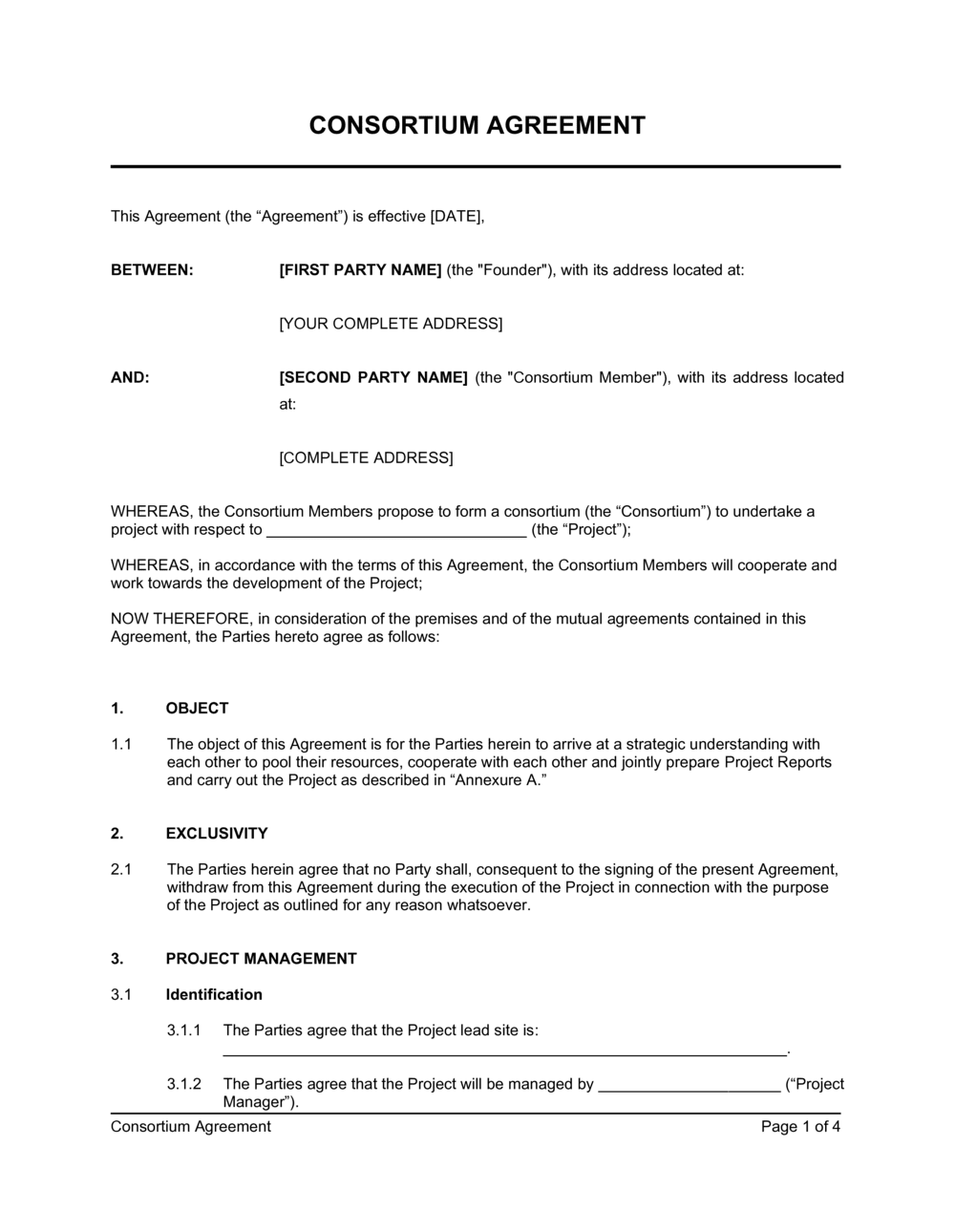
A Consortium Agreement is a legally binding multi-party contract among two or more independent organizations that agree to collaborate toward a shared, defined objective — a joint bid for a government contract, a collaborative research project, or a shared infrastructure build — without forming a separate legal entity. This free Word download covers governance structure, member contributions, IP ownership, decision-making, exclusivity, liability allocation, and exit mechanisms in a single document you can edit online and export as PDF for execution by all parties.
When you need it
Use it before submitting a joint bid, beginning collaborative research, or pooling resources with partner organizations for any project where roles, contributions, and IP rights need to be formally established before work begins. It is also the appropriate instrument when parties want the benefits of cooperation without the tax and regulatory obligations of a formal joint venture entity.
What's inside
Consortium purpose and term, member roles and financial contributions, governance and voting structure, lead member authority, IP ownership and licensing, confidentiality, exclusivity, liability cap and indemnification, member withdrawal and termination, and governing law. A Schedule of Contributions and a Schedule of Deliverables are included as appendices.

What is a Consortium Agreement?

A Consortium Agreement is a legally binding multi-party contract among two or more independent organizations that agree to collaborate toward a specific, defined objective — a joint government bid, a collaborative research program, or a shared infrastructure project — without creating a new legal entity. Each member retains its own corporate identity, assets, and liabilities while the agreement governs how the group makes decisions, allocates contributions, owns intellectual property, manages revenues and costs, and handles the exit of a member or the wind-down of the project. Because no new entity is formed, a consortium is structurally lighter than a joint venture while still creating enforceable obligations among all parties.

Why You Need This Document

Without a signed consortium agreement, every assumption about who contributes what, who owns jointly created IP, and who is liable if the project fails is an unwritten expectation waiting to become a dispute. A handshake consortium that wins a government contract can fracture immediately over cost overruns, scope changes, or a member's insolvency — leaving the lead member holding full liability and no legal remedy against its partners. Clients and funders increasingly require a signed consortium agreement as a condition of bid submission, meaning an absent document can disqualify the group before a single deliverable is produced. This template gives you a complete, enforceable framework covering governance, contributions, IP allocation, liability caps, exclusivity, and exit — so that the collaboration your consortium is built on is protected by more than goodwill.

Which variant fits your situation?

If your situation is…Use this template
Two companies bidding jointly on a single government contractConsortium Agreement (Joint Bid)
Multiple universities and companies sharing research funding and IPResearch Consortium Agreement
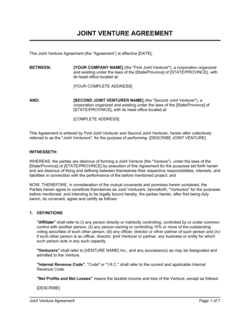
Two companies forming a lasting combined entity rather than a project-based groupJoint Venture Agreement
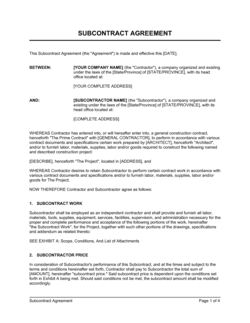
One company subcontracting portions of work to another after winning a bidSubcontractor Agreement
Partners sharing technology development costs and resulting IPTechnology Collaboration Agreement
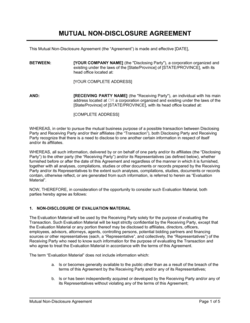
Multiple parties sharing confidential information before agreeing on full termsMutual Non-Disclosure Agreement
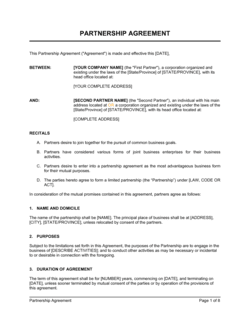
Consortium members needing to define equity stakes and profit distributionPartnership Agreement

Common mistakes to avoid

❌ Vague consortium purpose language

Why it matters: An agreement that covers 'technology services generally' rather than a named bid can unexpectedly bind members to share future opportunities and trigger exclusivity disputes on unrelated contracts.

Fix: Name the specific opportunity, tender reference, or project in the purpose clause. Use a separate agreement for each distinct project, or draft a framework agreement if ongoing collaboration is intended.

❌ Missing or unsigned Schedule of Contributions

Why it matters: Without a signed schedule specifying each member's contributions and percentages, cost-sharing and revenue-distribution obligations are unenforceable and disputes default to each party's self-serving recollection.

Fix: Complete and attach Schedule A before execution. Have all members initial the schedule separately at signing to confirm it was reviewed and agreed as part of the overall agreement.

❌ Defaulting to joint IP ownership without specifying exploitation rights

Why it matters: In most common-law jurisdictions, joint IP owners may independently exploit the IP without accounting to co-owners. A competitor member could commercialize jointly developed technology or license it to third parties without sharing revenue.

Fix: Explicitly state each member's rights to exploit foreground IP — including whether commercialization requires consent of co-owners — or assign ownership to a single designated member with licensing back to the others.

❌ Requiring unanimity for all consortium decisions

Why it matters: With three or more members, requiring unanimous consent for routine matters creates deadlock that stalls project delivery, frustrates the client, and may trigger breach of the prime contract.

Fix: Reserve unanimity for fundamental decisions (amending the agreement, admitting new members, committing funds above a defined threshold). Use simple majority or weighted vote for operational decisions.

❌ No forced-exit trigger for insolvency or change of control

Why it matters: A member that becomes insolvent or is acquired by a competitor can remain in the consortium indefinitely, sharing confidential information and blocking decisions, if the agreement only covers voluntary withdrawal.

Fix: Include explicit forced-exit triggers: insolvency, appointment of a receiver, acquisition by a named competitor category, or loss of required licenses. Define the IP and cost consequences of forced exit separately from voluntary withdrawal.

❌ Signing after the bid submission deadline

Why it matters: Government and institutional clients typically require a signed consortium agreement or teaming declaration as part of the bid package. A post-submission signature may disqualify the entire bid and expose the lead member to client claims.

Fix: Build in a signing deadline at least 48 hours before bid submission. Use electronic signature tools to eliminate courier delays when members are in different cities or countries.

The 10 key clauses, explained

Consortium purpose and term

In plain language: Defines exactly what the consortium exists to do — the named opportunity, project, or program — and the period during which the agreement is in force.

Sample language
The Members agree to form a consortium for the sole purpose of [DESCRIBE PROJECT / BID REFERENCE / PROGRAM NAME] ('the Project'). This Agreement commences on [START DATE] and terminates on [END DATE] or upon earlier completion or abandonment of the Project, unless extended by unanimous written agreement.

Common mistake: Defining the purpose too broadly — e.g., 'technology services' rather than a named tender. A vague purpose clause can make the agreement apply to future opportunities neither party intended to share, triggering exclusivity disputes.

Member roles and contributions

In plain language: Lists each member, their designated role in the consortium, and their specific financial, resource, or service contributions — cross-referenced to a Schedule of Contributions.

Sample language
[MEMBER A] shall serve as Lead Member and shall contribute [DESCRIPTION OF CONTRIBUTION / $ AMOUNT]. [MEMBER B] shall serve as [ROLE] and shall contribute [DESCRIPTION OF CONTRIBUTION / $ AMOUNT]. Full details are set out in Schedule A (Schedule of Contributions).

Common mistake: Leaving contributions described only in general terms in the body and promising a schedule that is never attached. Courts treat missing schedules as omitted terms, making contribution obligations unenforceable.

Lead member authority

In plain language: Grants the lead member specific powers to act on behalf of the consortium — signing the prime contract, issuing invoices, and managing client communications — while limiting those powers to consortium-approved decisions.

Sample language
[LEAD MEMBER NAME] is authorized to execute the prime contract with [CLIENT NAME] on behalf of the Consortium, issue invoices, receive payments, and communicate with the Client on day-to-day project matters. [LEAD MEMBER NAME] may not amend the prime contract scope or price without prior written approval of the Consortium Committee.

Common mistake: Granting the lead member unlimited authority to bind the consortium. This exposes passive members to obligations they did not approve — including scope changes, penalty clauses, and liability extensions.

Governance and decision-making

In plain language: Establishes a Consortium Committee with one representative per member, defines meeting frequency, sets the voting thresholds for different categories of decisions, and provides a tie-breaking mechanism.

Sample language
The Consortium Committee shall meet [monthly / at least quarterly] and make ordinary decisions by [simple majority / weighted vote per Schedule B]. The following decisions require unanimous consent: amendment of this Agreement, admission of new members, commitment of funds exceeding $[AMOUNT], and settlement of third-party claims.

Common mistake: Requiring unanimity for all decisions. With three or more members, a unanimity requirement for routine matters creates deadlock and delays project delivery. Reserve unanimity for fundamental changes only.

Financial management and cost sharing

In plain language: Sets out how consortium revenues are received and distributed, how shared costs are allocated across members, and the process for approving consortium expenditures.

Sample language
Revenues received from [CLIENT] shall be distributed to each Member in proportion to their Contribution Percentage as set out in Schedule A within [10] business days of receipt. Shared consortium costs shall be borne by Members in the same proportions and invoiced monthly with [30]-day payment terms.

Common mistake: Distributing revenue before deducting shared costs. Without a clear order of operations — deduct shared costs, then distribute — disagreements arise about whether distributions are net or gross, creating cash-flow disputes mid-project.

Intellectual property ownership and licensing

In plain language: Distinguishes background IP (each member's pre-existing IP, which remains theirs) from foreground IP (jointly created IP), allocates ownership of foreground IP, and grants each member any licenses needed to perform the project.

Sample language
Each Member retains all rights in its Background IP. Background IP is licensed to the other Members on a non-exclusive, royalty-free basis solely for the purposes of the Project. Foreground IP shall be owned [jointly by all Members in proportion to contribution / solely by [MEMBER] as set out in Schedule C]. Each Member is hereby granted a [non-exclusive / exclusive] license to use Foreground IP for [PURPOSE].

Common mistake: Defaulting to joint ownership of foreground IP without specifying each owner's exploitation rights. In most jurisdictions, joint IP owners can each exploit the IP independently — meaning a competitor member could commercialize jointly developed technology without sharing revenue.

Confidentiality

In plain language: Requires members to keep confidential information shared within the consortium — technical data, pricing, client communications — and restricts use to consortium purposes only.

Sample language
Each Member shall keep confidential all Confidential Information received from other Members and shall use it solely for the purposes of this Agreement. 'Confidential Information' means all non-public technical, commercial, and financial information disclosed in connection with the Project. This obligation survives termination of this Agreement for [3] years.

Common mistake: Using identical confidentiality language for a consortium agreement and a bilateral NDA. Consortium confidentiality must account for multi-directional disclosure — each member is simultaneously a discloser and a recipient — and must specify whether members can share information with their own subcontractors.

Exclusivity

In plain language: Prevents members from participating in a competing bid or consortium for the same opportunity during the agreement's term, protecting the consortium's ability to present a unified offering.

Sample language
During the term of this Agreement, no Member shall, directly or indirectly, participate in, support, or submit a competing bid or proposal for [DESCRIBE OPPORTUNITY / BID REFERENCE] without the prior written consent of all other Members.

Common mistake: Applying the exclusivity clause only to the primary bid without covering substantially similar opportunities. A member who bids independently on a closely related contract — or joins a competitor's consortium for a related lot — may not technically breach a narrowly worded clause.

Liability allocation and indemnification

In plain language: Specifies whether members have joint-and-several or several liability to the client and to each other, caps each member's maximum exposure, and requires each member to indemnify the others for losses arising from their own default.

Sample language
As between Members, liability is several and not joint. Each Member's aggregate liability to the other Members under this Agreement shall not exceed [its Contribution Percentage × the total contract value]. Each Member ('Indemnifying Party') shall indemnify and hold harmless the other Members from any loss, claim, or expense arising from the Indemnifying Party's breach of this Agreement or negligent acts.

Common mistake: Failing to specify several versus joint-and-several liability between members. If the prime contract with the client imposes joint and several liability on the consortium, members may assume their internal agreement does the same — leaving a defaulting member's shortfall to be absorbed by solvent partners.

Withdrawal, termination, and wind-down

In plain language: Defines the circumstances under which a member may voluntarily withdraw or be expelled, the consequences for project obligations, IP rights, and cost recovery, and the process for winding down the consortium at the end of the project.

Sample language
A Member may withdraw voluntarily on [60] days' written notice, subject to completing its outstanding obligations. The Consortium Committee may expel a Member for material breach unremedied after [30] days' written notice, insolvency, or Change of Control. On withdrawal or expulsion, the exiting Member's license to Foreground IP terminates and its Contribution Percentage is reallocated [pro rata among remaining Members / as agreed by the Consortium Committee]. On termination of this Agreement, Members shall cooperate to complete any surviving client obligations and settle shared costs within [90] days.

Common mistake: No exit clause at all, or an exit clause that only covers voluntary withdrawal. Forced-exit triggers — insolvency, change of control, or acquisition by a competitor — are the scenarios most likely to destabilize an active consortium and must be addressed explicitly.

How to fill it out

  1. 1

    Identify all consortium members and assign roles

    List every participating organization by its full legal entity name, jurisdiction of incorporation, and registered address. Designate the lead member and confirm that designation in writing before completing any other section.

    💡 Confirm that each entity name matches its government registry filing exactly — a mismatch between the agreement name and the registered name can complicate enforcement and delay contract award by the client.

  2. 2

    Define the consortium purpose with precision

    Name the specific opportunity, bid reference number, research program, or infrastructure project. Do not use general descriptions. Attach the relevant RFP or project brief as an exhibit if one exists.

    💡 Narrow purpose language protects each member from being bound to share future opportunities. If the parties intend ongoing collaboration, use a framework agreement rather than a single-purpose consortium agreement.

  3. 3

    Complete Schedule A — contributions and percentages

    List each member's specific contribution: cash, in-kind resources, staff hours, equipment, or IP licenses. Assign each member a Contribution Percentage that will govern cost sharing and revenue distribution throughout the project.

    💡 Tie contribution percentages to objective metrics where possible — e.g., percentage of total project labor hours or contract value delivered — rather than negotiated round numbers. This makes reallocation calculations straightforward if a member exits.

  4. 4

    Set the governance and voting thresholds

    Configure the Consortium Committee composition, meeting cadence, and voting rules. Identify the categories of decision that require unanimity versus simple majority versus weighted vote, and document them in a table for clarity.

    💡 Test every governance scenario you can imagine — what happens if two of three members vote to extend the timeline and one dissents? — before finalizing the thresholds. Edge cases are far cheaper to resolve at drafting stage than mid-project.

  5. 5

    Allocate background IP and foreground IP

    List each member's background IP that will be used in the project and confirm the license terms. Then decide foreground IP ownership — joint, proportional, or assigned to one member — and document any commercialization rights or revenue-sharing provisions.

    💡 If the client contract requires the client to own all project IP, address this in the consortium agreement before signing. Members may need to agree in advance to assign foreground IP to the client as a condition of award.

  6. 6

    Configure the liability and indemnification caps

    Decide whether internal liability between members is several or joint-and-several. Set an aggregate liability cap for each member — typically expressed as a multiple of that member's contribution or share of contract value. Draft the indemnification obligation so it mirrors the risk each member actually controls.

    💡 Review the prime contract with the client first. If the client contract imposes joint and several liability on the consortium as a whole, the internal agreement should include a clear mechanism for the solvent members to recover from a defaulting member.

  7. 7

    Draft the exclusivity and non-compete terms

    Specify the exact opportunity covered by the exclusivity clause, the duration (typically the bid period plus 6–12 months post-award), and whether the restriction covers related lots or substantially similar procurements.

    💡 Exclusivity that extends beyond contract award is often resisted by members with competing business lines. Limit post-award exclusivity to the specific scope of the consortium's work rather than the broader market.

  8. 8

    Execute before submitting the bid or beginning the project

    Circulate the final agreement for signature by authorized signatories of each member before any external submission or commencement of shared work. Store a fully executed copy with all signatures and schedules attached.

    💡 Many government clients require a signed consortium agreement or teaming declaration as part of the bid submission. Confirm the client's format and timing requirements and use Business in a Box eSign to timestamp execution ahead of the deadline.

Frequently asked questions

What is a consortium agreement?

A consortium agreement is a legally binding contract among two or more independent organizations that agree to collaborate on a specific project or bid without forming a separate legal entity. It governs each member's roles, financial contributions, governance rights, IP ownership, confidentiality obligations, and exit rights for the duration of the shared objective. Unlike a joint venture, a consortium typically dissolves when the project or bid cycle ends.

What is the difference between a consortium and a joint venture?

A joint venture typically involves creating a new legal entity — a company or partnership — owned by the founding parties. A consortium keeps each member as an independent organization and does not create a new entity. Consortiums are common for single projects, joint bids, or research programs where the parties want to collaborate without the tax, regulatory, and administrative overhead of a new company. If the relationship is intended to be permanent or involves shared equity, a joint venture agreement is usually more appropriate.

Do consortium members have joint and several liability?

This depends entirely on the terms of both the consortium agreement and the prime contract with the client. Many government contracts impose joint and several liability on consortium members externally, meaning the client can pursue any one member for the full value of a claim regardless of individual fault. Internally, the consortium agreement can allocate liability on a several basis — each member bears only its own share — and include indemnification obligations so the defaulting member reimburses solvent partners who are forced to cover its shortfall.

Who should be the lead member of a consortium?

The lead member is typically the organization with the largest contribution, the strongest relationship with the client, or the relevant prime contractor license required by the procurement. The lead member signs the prime contract on behalf of the group, issues invoices, and manages day-to-day client communications. Because the role carries greater administrative responsibility and potential liability exposure, the consortium agreement should clearly define the limits of the lead member's authority to bind the other members.

How should foreground IP be owned in a consortium?

The most common structures are: (1) joint ownership with explicit commercialization restrictions requiring co-owner consent; (2) ownership by the member who created the IP, with a license-back to the others for defined purposes; or (3) assignment to a single designated member with defined royalty or revenue-sharing terms. In research consortiums funded by government grants, the funder may mandate specific IP ownership arrangements. Defaulting to unqualified joint ownership is the riskiest option because each co-owner may independently exploit the IP without accounting to the others in most jurisdictions.

Does a consortium agreement need to be signed before submitting a bid?

In most government and institutional procurements, yes — the solicitation documents typically require either a signed consortium agreement or a signed teaming declaration as part of the bid package. A missing or unsigned agreement is grounds for disqualification in many jurisdictions. Even where the client does not require it, executing the agreement before bid submission protects each member by establishing agreed terms before the stakes are highest.

Can a member leave a consortium mid-project?

A member can withdraw if the consortium agreement contains a withdrawal clause specifying the required notice period, the obligations that survive exit (typically completing work-in-progress and maintaining confidentiality), and the consequences for IP rights and cost recovery. Without a withdrawal clause, a member who leaves may be in breach of contract. Forced-exit triggers — insolvency, acquisition by a competitor, or loss of a required license — should also be addressed separately from voluntary withdrawal.

Is a consortium agreement legally binding?

Yes, a properly executed consortium agreement is generally enforceable as a binding contract in most jurisdictions, provided it meets the standard requirements: offer and acceptance, consideration (typically each member's contribution), and intention to create legal relations. Courts in the US, Canada, the UK, and the EU have consistently enforced consortium agreements as commercial contracts. Clarity of terms — particularly on contributions, governance, and IP — significantly affects how quickly and cheaply disputes can be resolved.

What happens to the consortium if the bid is unsuccessful?

Unless the agreement provides otherwise, an unsuccessful bid typically triggers termination of the consortium agreement, with each member retaining its own background IP and the parties settling any shared pre-bid costs. Some agreements include a re-bid clause allowing members to extend the agreement if the opportunity is re-tendered within a defined period. Post-termination confidentiality obligations and any exclusivity restrictions on re-bidding independently should be explicitly addressed in a termination consequences clause.

How this compares to alternatives

vs Joint Venture Agreement

A joint venture agreement creates a new legal entity — a company or partnership — owned by the founding parties, which takes on its own contractual obligations, employs staff, and files its own taxes. A consortium agreement leaves each member as an independent organization with no new entity. Choose a joint venture when the collaboration is intended to be permanent, involves shared equity, or requires a single contracting entity with its own credit and regulatory standing.

vs Partnership Agreement

A partnership agreement creates an ongoing profit-and-loss sharing relationship among parties, typically with unlimited personal liability in a general partnership. A consortium agreement is project-specific, does not create a new business entity, and can be structured to limit each member's liability to its own contributions. Consortiums are the preferred structure when parties want defined, time-limited collaboration without long-term profit sharing or shared ownership.

vs Subcontractor Agreement

A subcontractor agreement is bilateral — one party engages another to perform a defined scope of work under a prime contract. A consortium agreement is multi-party and positions all members as co-principals bidding or delivering together. If one organization is clearly the prime and others are simply delivering work packages under its direction, a subcontractor agreement is more appropriate than a consortium structure.

vs Mutual Non-Disclosure Agreement

A mutual NDA covers only the confidentiality of information shared between parties during early-stage discussions. It creates no obligation to collaborate, contribute, or share IP. A consortium agreement includes confidentiality but also governs governance, contributions, IP, exclusivity, liability, and exit. An NDA is typically signed first, before the parties commit to forming the consortium, and is then superseded by the consortium agreement upon execution.

Industry-specific considerations

Government contracting and defence

Compliance with procurement rules requiring subcontracting plans, security clearance sharing protocols, and mandatory flow-down clauses from the prime contract are standard consortium agreement additions.

Construction and infrastructure

Bonding and insurance contributions, performance security arrangements, and lien waiver coordination among member firms require specific financial provisions beyond a standard consortium template.

Academic and research institutions

Grant funder IP requirements, publication rights, student and postdoctoral researcher ownership carve-outs, and data-sharing protocols make research consortium agreements significantly more complex than commercial ones.

Technology and standards bodies

FRAND licensing commitments, patent pool arrangements, and antitrust compliance obligations are central to technology standards consortium agreements and require specialist legal review.

Professional services and consulting

Client conflict checks across member firms, fee-sharing arrangements, and professional indemnity insurance coordination are the primary operational issues in professional-services consortiums.

Energy and utilities

Regulatory approval requirements, environmental liability allocation, and long-term offtake or cost-sharing arrangements frequently extend consortium agreements well beyond standard project timelines.

Jurisdictional notes

United States

US consortiums bidding on federal contracts must comply with FAR teaming and subcontracting requirements, including small-business subcontracting plans. Antitrust exposure is a significant concern for technology standards consortiums — DOJ and FTC scrutiny applies to agreements that restrict competition, set prices, or allocate markets. IP ownership of federally funded research may be subject to the Bayh-Dole Act, which grants universities and small businesses the right to retain title to inventions developed with federal funding.

Canada

Canadian consortium agreements should specify whether Ontario, British Columbia, or Quebec law governs, as provincial differences in contract interpretation and IP law are material. Quebec requires that agreements with a Quebec-based member be available in French for provincially regulated activities. Federal procurement consortiums must comply with the Canadian Free Trade Agreement and, for defence, Public Services and Procurement Canada teaming policies. Research consortiums receiving NSERC or SSHRC funding are subject to tri-agency IP and publication rules.

United Kingdom

UK consortium agreements must be reviewed for competition law compliance under the Competition Act 1998, particularly information-sharing provisions that could constitute concerted practice. Government procurement consortiums are subject to the Procurement Act 2023 and the associated transparency and integrity requirements. IP created in UK-funded research programs may be subject to UK Research and Innovation grant conditions that restrict member commercialization rights.

European Union

EU consortium agreements — particularly those involving research funding under Horizon Europe — must comply with the model grant agreement's IP, access rights, and exploitation obligations. GDPR applies to any personal data shared among consortium members, including staff and subcontractor data, requiring a data-sharing annex or inter-controller agreement. Horizontal cooperation agreements must be reviewed for compatibility with Article 101 TFEU, which prohibits anticompetitive agreements between competing undertakings.

Template vs lawyer — what fits your deal?

PathBest forCostTime
Use the templateTwo or three organizations forming a consortium for a single, well-defined bid or project with straightforward contributions and no novel IPFree1–3 hours to complete
Template + legal reviewConsortiums with three or more members, significant foreground IP, government procurement requirements, or cross-border membership$800–$2,500 for a commercial lawyer review3–7 days
Custom draftedLarge infrastructure projects, defence contracts, technology standards bodies, or research consortiums with grant-funder IP mandates$5,000–$20,000+2–6 weeks

Glossary

Consortium
A temporary association of two or more independent organizations that collaborate on a specific project or purpose without forming a new legal entity.
Lead Member
The designated consortium party responsible for external communications, contract execution with the client, and day-to-day coordination on behalf of the group.
Consortium Purpose
The specific, defined objective for which the consortium is formed — typically a named project, bid reference, or research program — beyond which the agreement does not apply.
Background IP
Intellectual property owned by a member before the consortium was formed, which may be licensed to the consortium for the project but is not transferred to other members.
Foreground IP
New intellectual property created during and as a result of the consortium's joint activities, whose ownership must be explicitly allocated among members.
Decision-Making Threshold
The voting rule — simple majority, supermajority, or unanimity — required for the consortium to take binding decisions on specific categories of matters.
Consortium Committee
The governing body composed of representatives from each member organization that oversees project delivery, approves budgets, and resolves disputes.
Exclusivity Clause
A restriction preventing a member from participating in a competing bid, project, or consortium for the same opportunity during a defined period.
Several Liability
A liability structure in which each member is responsible only for its own obligations and share of costs — not the obligations of other members.
Joint and Several Liability
A liability structure in which each member can be held fully responsible for the entire group's obligations, regardless of individual fault or contribution.
Withdrawal Event
A defined circumstance — insolvency, material breach, change of control — that triggers a member's forced or voluntary exit from the consortium.
Teaming Agreement
A lightweight pre-bid document that establishes basic roles and exclusivity while a full consortium agreement is being negotiated — often superseded by the consortium agreement upon award.

Part of your Business Operating System

This document is one of 3,000+ business & legal templates included in Business in a Box.

  • Fill-in-the-blanks — ready in minutes
  • 100% customizable Word document
  • Compatible with all office suites
  • Export to PDF and share electronically

Create your document in 3 simple steps.

From template to signed document — all inside one Business Operating System.
1
Download or open template

Access over 3,000+ business and legal templates for any business task, project or initiative.

2
Edit and fill in the blanks with AI

Customize your ready-made business document template and save it in the cloud.

3
Save, Share, Send, Sign

Share your files and folders with your team. Create a space of seamless collaboration.

Save time, save money, and create top-quality documents.

★★★★★

"Fantastic value! I'm not sure how I'd do without it. It's worth its weight in gold and paid back for itself many times."

Managing Director · Mall Farm
Robert Whalley
Managing Director, Mall Farm Proprietary Limited
★★★★★

"I have been using Business in a Box for years. It has been the most useful source of templates I have encountered. I recommend it to anyone."

Business Owner · 4+ years
Dr Michael John Freestone
Business Owner
★★★★★

"It has been a life saver so many times I have lost count. Business in a Box has saved me so much time and as you know, time is money."

Owner · Upstate Web
David G. Moore Jr.
Owner, Upstate Web

Run your business with a system — not scattered tools

Stop downloading documents. Start operating with clarity. Business in a Box gives you the Business Operating System used by over 250,000 companies worldwide to structure, run, and grow their business.

Start free · No credit card required