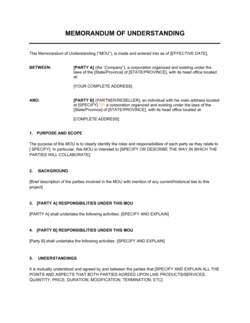
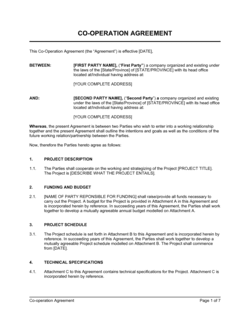
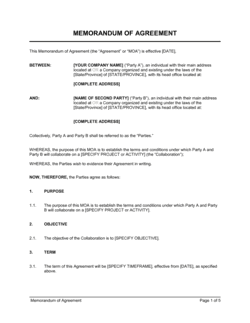
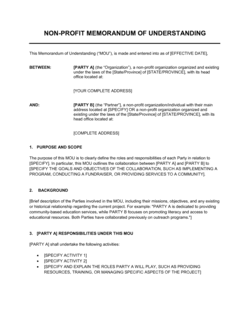
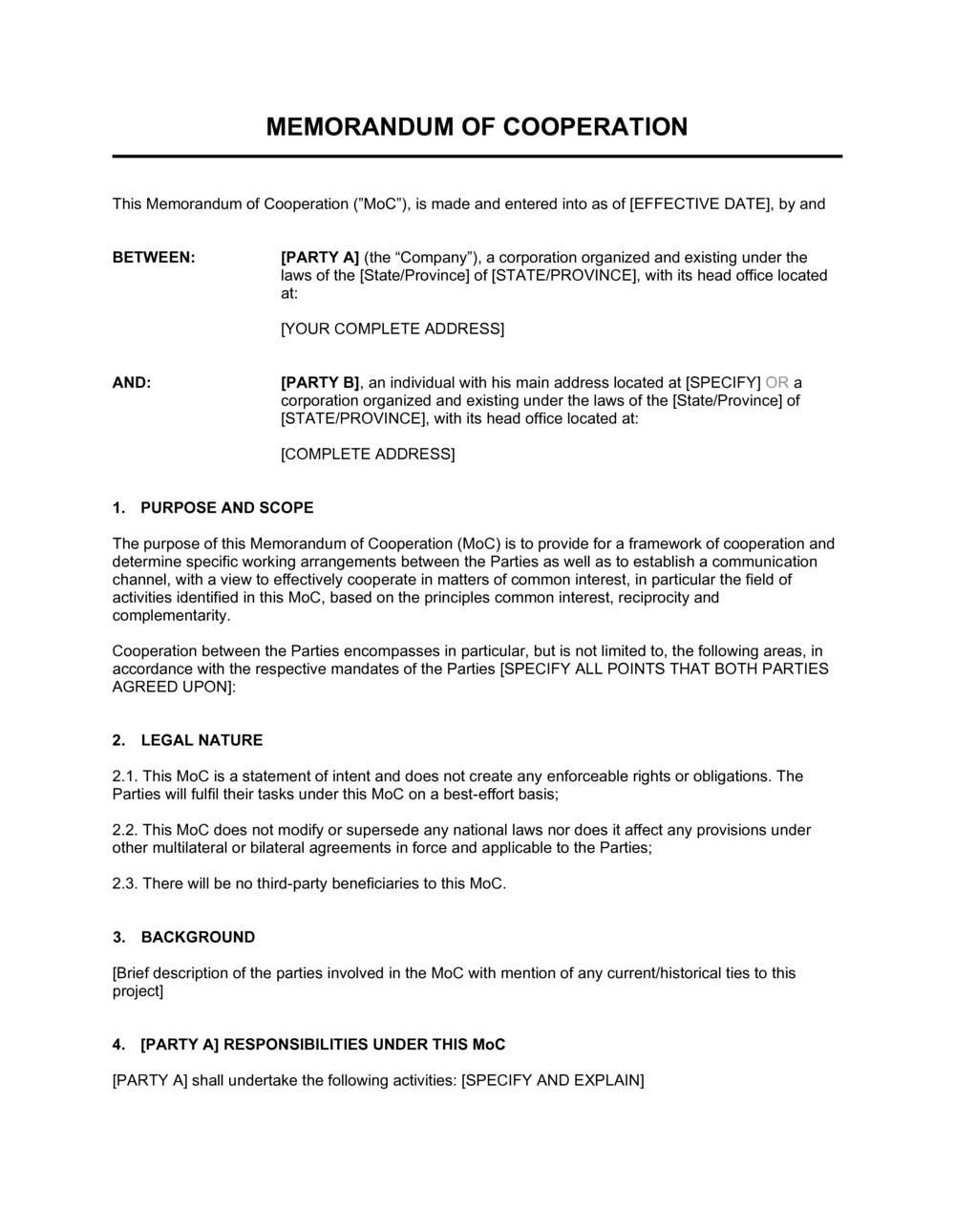
Memorandum of Cooperation Template

Free Word download β€’ Edit online β€’ Save & share with Drive β€’ Export to PDF

2 pagesβ€’20–30 min to fillβ€’Difficulty: Standardβ€’Signature requiredβ€’Legal review recommended
Learn more ↓
FreeMemorandum of Cooperation Template

At a glance

What it is
A Memorandum of Cooperation is a binding legal document that formalizes the terms under which two or more parties agree to collaborate toward a shared goal β€” whether a joint project, a strategic partnership, or an ongoing interagency relationship. This free Word download gives you a structured, lawyer-reviewed starting point you can edit online and export as PDF to execute with partners, government bodies, or institutional counterparties.
When you need it
Use it when two or more organizations need to document their mutual commitments, roles, and responsibilities before beginning a collaborative initiative that carries real operational or financial stakes.
What's inside
Party identification, purpose and scope of cooperation, roles and responsibilities of each party, resource and financial commitments, governance and decision-making structure, confidentiality obligations, term and termination provisions, and governing law.

What is a Memorandum of Cooperation?

A Memorandum of Cooperation is a binding legal agreement between two or more parties that formalizes their mutual commitment to collaborate on a defined shared objective β€” whether a joint commercial project, an interagency program, a research initiative, or a strategic alliance. Unlike a Memorandum of Understanding, which often signals intent without creating enforceable duties, an MOC establishes specific obligations for each party: what they will contribute, what they are responsible for delivering, how decisions will be made, and what happens if the cooperation ends. Despite its informal-sounding name, courts in most jurisdictions treat an MOC as a contract when it contains definite terms and signatures from authorized representatives.

Why You Need This Document

Operating a cooperation without a signed MOC exposes every party to the same four risks simultaneously. First, without defined roles, disputes about who is responsible for what arise within weeks of the cooperation starting β€” and without a written record, each party's version of the original agreement becomes a credibility contest. Second, any IP jointly developed under the cooperation may be jointly owned by default, leaving neither party free to use it independently. Third, a party that wants to exit has no clean legal mechanism without a termination clause, creating the choice between breaching the informal arrangement or continuing indefinitely. Fourth, confidential information exchanged during the cooperation has no contractual protection once the relationship deteriorates. A properly executed MOC eliminates all four risks before the first meeting takes place β€” and this template gives you a lawyer-reviewed structure you can adapt and execute in under an hour.

Which variant fits your situation?

If your situation is…Use this template
Two private companies agreeing to cooperate on a specific commercial projectMemorandum of Cooperation
Parties want to signal intent without creating binding obligationsMemorandum of Understanding
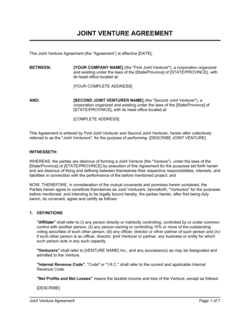
Cooperation involving shared revenue, costs, and a distinct legal entityJoint Venture Agreement
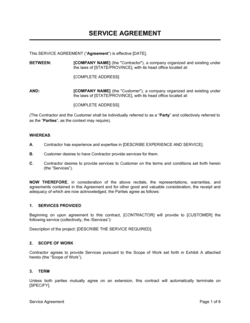
One company providing services to another under the cooperationService Agreement
Cooperation requiring exchange of sensitive business informationNon-Disclosure Agreement
Two or more parties sharing technology or intellectual propertyTechnology Partnership Agreement
Academic or research institutions formalizing a research collaborationResearch Collaboration Agreement

Common mistakes to avoid

❌ Treating the MOC as non-binding by default

Why it matters: A Memorandum of Cooperation is generally binding when it contains specific obligations, consideration, and signatures β€” courts do not automatically treat the 'memorandum' label as evidence of non-binding intent.

Fix: If you intend the document to be non-binding, use an MOU with an explicit 'this document creates no legal obligations' clause. If obligations exist, treat the MOC as a contract and draft it accordingly.

❌ Vague scope with no exclusions

Why it matters: An undefined scope expands under the pressure of a working relationship β€” each party adds assumptions about what 'cooperation' covers until the gap between expectations creates a dispute.

Fix: Define at least two explicit exclusions in the scope clause and include a change-control provision requiring written amendment for any scope expansion.

❌ Omitting IP ownership for jointly developed outputs

Why it matters: When two parties create a product, dataset, or process together and the agreement is silent on ownership, both parties may have concurrent IP rights β€” leaving neither free to use the output independently.

Fix: Include a Foreground IP clause allocating ownership of jointly developed work product, with a cross-license if both parties need to use the output.

❌ No cure period in the termination-for-cause clause

Why it matters: Immediate termination for any breach β€” without a notice and cure period β€” exposes the terminating party to a wrongful-termination claim if the breach was inadvertent or minor.

Fix: Set a written-notice requirement and a 10–15 business day cure window before termination for cause takes effect, with immediate termination reserved for fraud, insolvency, or gross misconduct.

❌ Failing to specify confidentiality survival after termination

Why it matters: Without a survival clause, a party's confidentiality obligation may be interpreted to end on the agreement's expiry date β€” leaving trade secrets, financial data, and strategic plans unprotected.

Fix: Add explicit survival language: 'The obligations of Sections [X] (Confidentiality) and [Y] (IP) shall survive termination of this Agreement for a period of [2] years.'

❌ Signing the MOC after cooperation activities have already started

Why it matters: Work performed before signing may not be covered by the agreement's IP, confidentiality, or liability provisions β€” creating an unprotected window that can be exploited in a dispute.

Fix: Execute the MOC before any joint work, shared access, or information exchange begins. If back-dating is considered, consult a lawyer β€” in most jurisdictions it carries legal risk.

The 10 key clauses, explained

Parties and recitals

In plain language: Identifies all signing parties by their full legal names and entity types, and briefly states the background and mutual rationale for entering the cooperation.

Sample language
This Memorandum of Cooperation ('Agreement') is entered into as of [DATE] by and between [PARTY A LEGAL NAME], a [ENTITY TYPE] organized under the laws of [JURISDICTION] ('Party A'), and [PARTY B LEGAL NAME], a [ENTITY TYPE] organized under the laws of [JURISDICTION] ('Party B').

Common mistake: Using a trade name or brand name instead of the registered legal entity name β€” if the agreement needs to be enforced, the named party must match public corporate records.

Purpose and scope of cooperation

In plain language: States the shared objective the parties are pursuing and defines the boundaries of what is in and out of scope for the cooperation.

Sample language
The purpose of this Agreement is to establish a framework for cooperation between the parties in connection with [DESCRIPTION OF JOINT ACTIVITY] ('Project'). This Agreement does not extend to [EXCLUDED ACTIVITIES OR GEOGRAPHIES].

Common mistake: Leaving the scope vague to preserve flexibility β€” an undefined scope creates disputes about what each party is obligated to do and exposes both sides to unlimited creep.

Roles and responsibilities

In plain language: Specifies what each party is responsible for delivering, managing, or contributing under the cooperation, with enough specificity to be measurable.

Sample language
Party A shall be responsible for [SPECIFIC OBLIGATION, e.g., providing technical infrastructure and staff training]. Party B shall be responsible for [SPECIFIC OBLIGATION, e.g., securing regulatory approvals and customer-facing communications].

Common mistake: Listing responsibilities at the category level without distinguishing which party owns each task β€” 'both parties shall collaborate on marketing' assigns accountability to no one.

Resource and financial commitments

In plain language: Documents any money, personnel, equipment, or in-kind resources each party agrees to contribute, including timing and conditions.

Sample language
Party A shall contribute [RESOURCE / AMOUNT] no later than [DATE]. Party B shall contribute [RESOURCE / AMOUNT] no later than [DATE]. Neither party shall incur costs on behalf of the other without prior written approval.

Common mistake: Omitting this clause entirely when the cooperation involves unequal resource contributions β€” without it, the under-contributing party has no written obligation, making recovery for shortfalls nearly impossible.

Governance and decision-making

In plain language: Establishes how decisions will be made during the cooperation β€” who has authority, how disputes between the parties are escalated, and whether a steering committee or liaison structure is required.

Sample language
Each party shall designate a Liaison: Party A Liaison: [NAME / TITLE]; Party B Liaison: [NAME / TITLE]. Material decisions requiring both parties' consent shall be approved in writing. Deadlocks shall be escalated to each party's [CEO / EXECUTIVE DIRECTOR] within [10] business days.

Common mistake: No escalation path for disagreements β€” without one, minor operational disputes can stall the entire cooperation indefinitely.

Confidentiality

In plain language: Obligates each party to protect the other's non-public information shared during the cooperation and restricts its use to the purpose of the agreement.

Sample language
Each party ('Receiving Party') shall keep confidential all non-public information disclosed by the other party ('Disclosing Party') in connection with this Agreement and shall not use it for any purpose other than performing its obligations hereunder. This obligation survives termination for [2] years.

Common mistake: Failing to specify a survival period after termination β€” without it, confidentiality obligations may be interpreted to end on the agreement's expiry date, leaving sensitive information unprotected.

Intellectual property

In plain language: Allocates ownership of any IP, work product, or data created during the cooperation and grants any licenses needed for the joint work to proceed.

Sample language
Each party retains ownership of its pre-existing IP ('Background IP'). Any IP jointly developed under this Agreement ('Foreground IP') shall be owned [jointly / by Party A / as specified in Schedule A], subject to a royalty-free license to [Party B] for [PURPOSE].

Common mistake: Using a generic 'each party retains its own IP' clause when the cooperation will produce jointly developed outputs β€” this leaves ownership of the most valuable asset undefined.

Term and renewal

In plain language: States the start and end date of the agreement, whether it auto-renews, and the conditions or notice required to prevent renewal.

Sample language
This Agreement commences on [START DATE] and continues for [INITIAL TERM, e.g., 12 months] ('Initial Term'), unless earlier terminated. It shall automatically renew for successive [12-month] periods unless either party provides written notice of non-renewal at least [30] days before the end of the then-current term.

Common mistake: No auto-renewal provision and no defined end date β€” agreements that simply 'continue until terminated' create ambiguity about whether ongoing conduct amounts to a binding extension.

Termination

In plain language: Sets out the conditions and procedure for ending the agreement early β€” for convenience with notice, or for cause following a material breach and cure period.

Sample language
Either party may terminate this Agreement for convenience upon [30] days' written notice. Either party may terminate for cause if the other commits a material breach and fails to cure it within [15] business days of written notice describing the breach.

Common mistake: Only including termination for cause and omitting termination for convenience β€” parties that need to exit a deteriorating relationship without provable cause are left without a clean legal exit.

Governing law and dispute resolution

In plain language: Specifies which jurisdiction's law governs the agreement and how disputes will be resolved β€” negotiation, mediation, arbitration, or litigation.

Sample language
This Agreement is governed by the laws of [STATE / PROVINCE / COUNTRY], without regard to conflict-of-laws principles. Any dispute not resolved by good-faith negotiation within [30] days shall be submitted to binding arbitration administered by [AAA / ICC / LCIA] in [CITY], except claims for injunctive relief.

Common mistake: Choosing a governing law that has no connection to either party's location or operations β€” courts in some jurisdictions may refuse to enforce choice-of-law clauses with no rational nexus to the agreement.

How to fill it out

  1. 1

    Identify all parties with full legal names

    Enter each party's registered legal name, entity type (LLC, corporation, government body, etc.), and jurisdiction of incorporation or establishment in the opening clause.

    πŸ’‘ Verify each party's legal name against its most recent public filing β€” trade names and abbreviations create enforcement ambiguity.

  2. 2

    Define the purpose and scope with precision

    Write a one-paragraph purpose statement that identifies the shared goal and a separate scope statement that names at least two activities that are explicitly excluded from the cooperation.

    πŸ’‘ Explicit exclusions prevent scope creep disputes more effectively than a narrow inclusion list β€” specify what you are not agreeing to do together.

  3. 3

    Assign specific responsibilities to each party

    List each material obligation under the party responsible for it β€” avoid joint ownership of tasks. For complex cooperations, attach a Schedule A with a full responsibility matrix.

    πŸ’‘ Each listed obligation should be specific enough to fail a binary test: either the party did it or it did not.

  4. 4

    Document resource and financial contributions

    Enter each party's committed resources with a monetary value or unit quantity, the delivery date, and any conditions. If no financial contribution is required, include an explicit statement to that effect.

    πŸ’‘ Unequal contributions should be acknowledged and documented β€” silence on an imbalance creates resentment and litigation.

  5. 5

    Establish a governance and liaison structure

    Name the designated liaison for each party, their contact details, and the escalation path for unresolved disagreements. Specify whether a steering committee will meet and at what frequency.

    πŸ’‘ Build a 10-business-day escalation clock into the governance clause β€” open-ended escalation paths become permanent stalemates.

  6. 6

    Set the term and renewal mechanics

    Enter a specific start date, initial term length, and the notice period required to prevent auto-renewal. Confirm that the term aligns with the cooperation's natural project lifecycle.

    πŸ’‘ For cooperation arrangements tied to a specific project, consider a fixed end date with a no-auto-renewal structure rather than an evergreen term.

  7. 7

    Confirm the governing law and dispute resolution mechanism

    Select a governing jurisdiction that has a genuine connection to at least one party's operations. Choose an arbitration body and seat city that are practically accessible to both parties.

    πŸ’‘ For cross-border cooperations, ICC or UNCITRAL arbitration is typically more neutral and enforceable than domestic court litigation.

  8. 8

    Sign before cooperation activities begin

    Both parties must sign and date the agreement before any joint activities, resource sharing, or confidential information exchange takes place.

    πŸ’‘ Collect signatures on the same document in the same session where possible β€” counterpart execution is valid but creates version-control risks if not managed carefully.

Frequently asked questions

What is a Memorandum of Cooperation?

A Memorandum of Cooperation is a formal written agreement between two or more parties that documents their commitment to work together on a shared goal β€” defining each party's roles, responsibilities, and obligations. Unlike a Memorandum of Understanding, which is often expressly non-binding, an MOC typically creates enforceable obligations when it contains specific commitments and is signed by authorized representatives of each party. It is widely used in business partnerships, government interagency programs, research collaborations, and international commercial arrangements.

Is a Memorandum of Cooperation legally binding?

Generally, yes β€” a Memorandum of Cooperation is considered legally binding when it contains offer, acceptance, consideration, and sufficiently definite terms, and is signed by parties with authority to bind their organizations. The label 'memorandum' does not automatically make it non-binding. Courts in most jurisdictions look at the substance of the document rather than its title. If you want the document to be non-binding, include an explicit clause stating that no legal obligations arise from it β€” though that would convert it into a Memorandum of Understanding rather than a Memorandum of Cooperation.

What is the difference between a Memorandum of Cooperation and a Memorandum of Understanding?

An MOU typically signals mutual intent and alignment without creating enforceable commitments β€” it is often used as a precursor to a full agreement. A Memorandum of Cooperation goes further by documenting specific, binding obligations for each party: resource contributions, deliverables, governance, and termination conditions. In practice the line can blur, which is why the enforceability clause in each document matters more than the title.

What is the difference between a Memorandum of Cooperation and a Joint Venture Agreement?

A joint venture agreement typically creates a new legal entity or a formal profit-sharing structure in which the parties share revenue, costs, and liability. A Memorandum of Cooperation governs collaborative activity without forming a separate entity β€” each party remains legally independent and bears its own costs and liabilities. Use an MOC when cooperation is operational and project-based; use a joint venture agreement when the parties are sharing financial upside and risk.

Who should sign a Memorandum of Cooperation?

The agreement should be signed by an authorized representative of each party β€” typically an officer, director, or executive with the authority to bind the organization. For government bodies or nonprofits, confirm that the signatory has board or agency authorization before execution. Signing by an unauthorized individual may render the agreement void or voidable at the other party's election.

How long should a Memorandum of Cooperation last?

The term should match the expected duration of the cooperation. For project-based cooperations, a fixed term of 12–36 months with a defined end date is typical. For ongoing strategic relationships, an initial 12-month term with auto-renewal and a 30-day non-renewal notice is common. Avoid open-ended agreements that simply 'continue until terminated' β€” they create uncertainty about whether ongoing conduct constitutes a binding extension of expired terms.

Can a Memorandum of Cooperation be terminated early?

Yes β€” a well-drafted MOC should include both a termination-for-convenience clause (allowing either party to exit with advance written notice, typically 30–90 days) and a termination-for-cause clause (allowing exit after a material breach that is not cured within a defined period). Without a termination-for-convenience provision, a party that needs to exit a deteriorating relationship without provable breach may have no clean legal exit.

Does a Memorandum of Cooperation need to be notarized?

Notarization is not required for a standard Memorandum of Cooperation in most jurisdictions. Valid signatures by authorized representatives are sufficient to make the agreement enforceable. Notarization may be required in specific contexts β€” for example, when the MOC is part of a real estate transaction or must be registered with a government authority in certain countries. Check the requirements of the governing jurisdiction if the cooperation involves regulated activities or public entities.

Should a Memorandum of Cooperation include a confidentiality clause?

Yes, in almost all cases. Parties entering a cooperation arrangement typically share strategic plans, financial data, customer information, or technical processes that they would not want disclosed publicly or used for purposes outside the cooperation. A confidentiality clause in the MOC covers this exchange without requiring a separate NDA β€” though for cooperations involving highly sensitive IP or data, a standalone NDA executed before the MOC is often advisable.

Do I need a lawyer to draft a Memorandum of Cooperation?

For straightforward domestic cooperations between two private companies, a high-quality template reviewed by the parties is often sufficient. Engage a lawyer when the cooperation involves government counterparties, cross-border parties in multiple jurisdictions, significant financial commitments, jointly developed IP, or when the cooperation is a precursor to a major transaction. A 1–2 hour legal review typically costs $300–$800 and is worthwhile for any cooperation with material operational or financial stakes.

How this compares to alternatives

vs Memorandum of Understanding

An MOU typically signals intent without creating binding obligations and is used as a precursor to a full agreement. An MOC establishes enforceable commitments β€” specific roles, contributions, and remedies. Use an MOU when you are still negotiating; use an MOC when you are ready to commit. The boundary can blur depending on drafting, so the enforceability clause in each document matters more than the label.

vs Joint Venture Agreement

A joint venture agreement creates a profit-and-loss sharing structure, often with a new legal entity, in which parties bear shared financial risk and reward. An MOC governs cooperation between legally independent parties with no shared entity or profit pool. Use an MOC for project-level collaboration; use a joint venture agreement when the parties are committing capital and sharing financial upside.

vs Service Agreement

A service agreement governs a one-directional relationship in which one party provides defined services to another for payment. An MOC governs a bilateral or multi-party relationship in which all parties contribute and cooperate toward a shared goal. If the cooperation involves one party predominantly delivering services, a service agreement may be more appropriate β€” or both documents can run concurrently.

vs Non-Disclosure Agreement

An NDA protects confidential information but creates no cooperative obligations β€” it is a single-purpose document. An MOC covers the full cooperation framework, including a confidentiality clause, so a standalone NDA may be redundant once an MOC is in place. However, parties often execute an NDA before and independently of the MOC to protect information shared during preliminary negotiations.

Industry-specific considerations

Technology and SaaS

Foreground IP ownership for jointly developed integrations and APIs is the critical clause; data-sharing and processing terms must align with applicable privacy law.

Government and Public Sector

Interagency MOCs often require explicit authorization references, procurement compliance, and budget-year funding conditions that automatically lapse if appropriations are not renewed.

Healthcare and Life Sciences

Patient data sharing under an MOC must comply with HIPAA or equivalent national health privacy law; regulatory approval conditions are typically a prerequisite to the cooperation commencing.

Education and Research

Publication rights, student and researcher IP ownership, and academic credit allocation are institution-specific issues that must be resolved explicitly rather than deferred to institutional policy.

Jurisdictional notes

United States

In the US, an MOC is treated as a binding contract if it satisfies the standard elements of offer, acceptance, and consideration β€” the 'memorandum' label carries no special legal weight. State contract law governs; Delaware, New York, and California are the most common governing law choices for commercial arrangements. Government-to-government or government-to-private MOCs may trigger federal or state procurement rules, including appropriations-limitation clauses.

Canada

Canadian courts apply common-law contract principles in all provinces except Quebec, where the Civil Code governs. An MOC with sufficiently definite terms and consideration is enforceable regardless of its label. French-language requirements apply to documents in Quebec under the Charter of the French Language; MOCs involving provincially regulated Quebec entities must be available in French. Federal government MOCs must comply with the Financial Administration Act.

United Kingdom

English law requires offer, acceptance, consideration, and intention to create legal relations for a binding contract. UK courts have enforced MOCs as binding agreements where the language is sufficiently certain, even when the parties intended informality. Post-Brexit, EU law no longer applies to UK-only cooperations; however, cross-border UK-EU arrangements must consider both legal systems. Government MOCs in the UK are typically subject to Treasury and Cabinet Office guidance.

European Union

Enforceability of an MOC varies significantly by member state β€” civil-law countries (France, Germany, Spain, Italy) assess binding intent differently from common-law traditions. Cooperations involving personal data exchange must comply with the GDPR, which requires a data-sharing or data-processing agreement that may need to be embedded in or annexed to the MOC. Cross-border EU cooperations involving public bodies often require compliance with the EU Public Procurement Directive.

Template vs lawyer β€” what fits your deal?

PathBest forCostTime
Use the templateTwo domestic private companies entering a straightforward project-based cooperation with no shared IP or material financial commitmentsFree30–60 minutes
Template + legal reviewCooperations involving government counterparties, cross-border parties, jointly developed IP, or financial contributions above $50,000$300–$8001–3 days
Custom draftedMulti-party international cooperations, regulated industries (healthcare, financial services), or arrangements that are the precursor to a major transaction or joint venture$1,500–$5,000+1–3 weeks

Glossary

Memorandum of Cooperation (MOC)
A binding agreement between two or more parties that formalizes their intent and obligations to work together toward a defined shared objective.
Memorandum of Understanding (MOU)
A non-binding or partially binding document that records mutual intent and broad alignment between parties before full contractual terms are negotiated.
Scope of Cooperation
The defined boundary of the joint activity β€” specifying what the parties agree to do together, what is excluded, and the geographic or sector limits.
Governing Law
The jurisdiction whose laws apply to interpret and enforce the agreement in the event of a dispute.
Force Majeure
A clause excusing a party from performance when an extraordinary event beyond its control β€” such as a natural disaster or government action β€” makes performance impossible.
Confidentiality Obligation
A binding duty to protect and not disclose non-public information received from the other party during the course of cooperation.
Term
The defined duration of the agreement β€” the start date and end date, or the conditions that trigger automatic renewal or expiry.
Termination for Convenience
A provision allowing either party to end the agreement without cause by giving a defined notice period β€” typically 30 to 90 days.
Termination for Cause
A provision allowing immediate or accelerated termination when the other party commits a material breach and fails to remedy it within a defined cure period.
Liaison
A designated contact person at each party responsible for day-to-day coordination, communication, and escalation under the cooperation arrangement.
Entire Agreement Clause
A provision stating that the written document supersedes all prior negotiations, emails, and representations, preventing outside evidence from modifying its terms.

Part of your Business Operating System

This document is one of 3,000+ business & legal templates included in Business in a Box.

  • Fill-in-the-blanks β€” ready in minutes
  • 100% customizable Word document
  • Compatible with all office suites
  • Export to PDF and share electronically

Create your document in 3 simple steps.

From template to signed document β€” all inside one Business Operating System.
1
Download or open template

Access over 3,000+ business and legal templates for any business task, project or initiative.

2
Edit and fill in the blanks with AI

Customize your ready-made business document template and save it in the cloud.

3
Save, Share, Send, Sign

Share your files and folders with your team. Create a space of seamless collaboration.

Save time, save money, and create top-quality documents.

β˜…β˜…β˜…β˜…β˜…

"Fantastic value! I'm not sure how I'd do without it. It's worth its weight in gold and paid back for itself many times."

Managing Director Β· Mall Farm
Robert Whalley
Managing Director, Mall Farm Proprietary Limited
β˜…β˜…β˜…β˜…β˜…

"I have been using Business in a Box for years. It has been the most useful source of templates I have encountered. I recommend it to anyone."

Business Owner Β· 4+ years
Dr Michael John Freestone
Business Owner
β˜…β˜…β˜…β˜…β˜…

"It has been a life saver so many times I have lost count. Business in a Box has saved me so much time and as you know, time is money."

Owner Β· Upstate Web
David G. Moore Jr.
Owner, Upstate Web

Run your business with a system β€” not scattered tools

Stop downloading documents. Start operating with clarity. Business in a Box gives you the Business Operating System used by over 250,000 companies worldwide to structure, run, and grow their business.

Free Forever PlanΒ Β·Β No credit card required