Sales and Purchase Agreement Templates
★★★★★4.7from 280+ reviews· Trusted by 20M+ businesses
Document every transaction clearly — from business acquisitions and share sales to real estate, goods, and assets.
WordEditable onlinePDF91+ sales and purchase templates
Other Legal Agreements categories
Share and equity transactions
Checklists, tools, and supporting documents
More sales and purchase agreement templates
Showing 60 of 91 templates
Looking for something else?
Search all 91 templates in this category by name or keyword.
Or browse by category
Business-in-a-Box has all 91 in this category, plus the rest of the library, ready to edit. See what's inside
250K+Clients
20M+Free users
20+Years
190+Countries
10,000+Law firms
50M+Downloads
Trusted across review platforms
- Capterra★★★★☆4.649 reviews
- G2★★★★☆4.713 reviews
- GetApp★★★★☆4.649 reviews
- Google Play★★★★☆4.6179 ratings
- Google Reviews★★★★☆4.567 reviews
Frequently asked questions
What is a sales and purchase agreement?
A sales and purchase agreement is a binding contract between a buyer and a seller that records the terms under which ownership of an asset, business, shares, or property transfers from one party to another. It sets out the price, payment terms, conditions, warranties, and closing mechanics. Without a written agreement, the parties have no reliable record of what was agreed and no clear remedy if the deal breaks down.
When do I need a purchase and sale agreement instead of just an invoice?
An invoice records that a payment was made or is owed. A purchase and sale agreement governs the terms under which the underlying transaction occurs — conditions, warranties, title transfer, and remedies. For high-value or complex transactions involving a business, real estate, shares, or large quantities of goods, a written agreement is essential. For simple, low-value transactions, a purchase order or invoice may suffice.
What is the difference between an asset sale and a share sale?
In an asset sale, specific assets are transferred and the legal entity remains with the seller. The buyer chooses which assets and liabilities to assume. In a share sale, the buyer acquires the company itself — including all its history, contracts, employees, liabilities, and assets. Asset sales offer buyers more control over what they acquire; share sales are simpler in that the company continues operating without re-contracting with customers or suppliers.
Is a purchase agreement legally binding?
Yes, a properly executed purchase agreement is generally enforceable when it contains an offer, acceptance, consideration (the purchase price), and is signed by parties with authority to bind themselves or their organizations. Agreements for real estate typically must be in writing to be enforceable under the Statute of Frauds in most jurisdictions. Consider having a lawyer review any high-value or complex transaction.
What is a buy sell agreement and when should I create one?
A buy sell agreement is a contract among business co-owners that pre-determines how one owner's interest will be valued and transferred if they die, become disabled, retire, or are forced out. It prevents ownership from passing to unintended parties — such as a deceased owner's estate — and avoids costly disputes about valuation. The best time to create one is at company formation, before any triggering event occurs.
Do I need a lawyer to draft a sales and purchase agreement?
For straightforward transactions — a small asset sale, a simple goods purchase — a professional template reviewed by the parties is often sufficient. For transactions involving a business, real estate, or share transfers above a few thousand dollars, legal review is advisable. A lawyer can flag jurisdiction-specific requirements, tax implications, and warranty risks that templates cannot anticipate.
What is a condition precedent in a purchase agreement?
A condition precedent is an event that must occur before a party is obligated to complete the purchase. Common examples include satisfactory due diligence, financing approval, regulatory clearance, and landlord consent. If a condition is not met by the agreed deadline, either party may typically terminate the agreement without penalty, unless the agreement says otherwise.
What documents typically accompany a purchase and sale agreement?
Supporting documents commonly include a due diligence request list, a disclosure schedule listing known liabilities or exceptions to warranties, a bill of sale (for assets), a share transfer certificate (for shares), closing statements, and any required regulatory filings. Checklists for buying or selling a business can help ensure nothing is missed before or at closing.
Sales And Purchase Agreement vs. related documents
An asset purchase agreement transfers specific named assets (equipment, inventory, IP, contracts) while the legal entity stays with the seller. A share purchase agreement transfers ownership of the entire company, including all assets, liabilities, and legal history. Buyers often prefer asset deals to avoid inheriting unknown liabilities; sellers often prefer share deals for cleaner tax treatment. The right choice depends on deal structure, tax advice, and risk appetite.
A buy sell agreement is a standing arrangement between co-owners that pre-determines how one owner's interest will be bought out upon death, disability, retirement, or departure. A purchase and sale agreement is a one-time transaction document used when a specific deal has been agreed. Use a buy sell agreement proactively at company formation; use a purchase and sale agreement when a transaction is ready to close.
A letter of intent (LOI) is a non-binding document that outlines the key terms a buyer and seller intend to agree on before a full agreement is drafted. A purchase agreement is binding and governs the actual transfer. LOIs move deals forward and enable due diligence; purchase agreements close them. Always replace an LOI with a signed purchase agreement before any money or title changes hands.
A bill of sale is a short document that confirms a transfer of ownership has already occurred — it is typically signed at or after closing. A purchase agreement is signed before closing and governs all conditions that must be met for the sale to proceed. Both may be used together: the purchase agreement governs the deal; the bill of sale evidences the transfer.
Key clauses every Sales And Purchase Agreement contains
Regardless of what is being sold, every sales and purchase agreement is built from the same core clauses — adapted in scope and detail to match the complexity of the transaction.
- Identification of parties. Names the buyer and seller with their full legal entity names, addresses, and signing authority.
- Description of the subject matter. Precisely identifies what is being sold — assets, shares, property, or goods — to avoid any ambiguity at closing.
- Purchase price and payment terms. States the agreed price, the currency, payment schedule, deposit amount, and any earn-out or deferred payment structure.
- Representations and warranties. Each party makes factual statements about themselves and the subject matter that the other party relies on to enter the deal.
- Conditions precedent. Lists events that must occur — due diligence sign-off, regulatory approval, financing — before either party is obligated to close.
- Closing mechanics. Specifies the closing date, location, deliverables required at closing, and what constitutes a completed transfer.
- Indemnification. Determines which party bears the cost if a warranty is breached or a hidden liability emerges after closing.
- Governing law and dispute resolution. Names the jurisdiction whose laws apply and how disputes will be resolved — litigation, arbitration, or mediation.
How to write a sales and purchase agreement
A well-drafted agreement protects both parties by leaving nothing to memory or assumption. Follow these steps before any money or title changes hands.
1
Identify all parties precisely
Use the full registered legal name of each buyer and seller — not trading names — and confirm signing authority.
2
Describe exactly what is being sold
List all assets, shares, or property included in the transaction and explicitly exclude anything that is not included.
3
State the price and payment structure
Specify the total purchase price, deposit, payment schedule, and any conditions tied to deferred or contingent payments.
4
Draft representations and warranties
Each party should warrant the accuracy of the information they are relying on — ownership, title, absence of undisclosed liabilities.
5
Set the conditions precedent
List every event that must happen — financing approval, due diligence completion, regulatory clearance — before the parties are bound to close.
6
Specify closing date and deliverables
Name the closing date, the location, and every document or payment that must be exchanged to complete the transaction.
7
Include indemnification and dispute resolution
Allocate post-closing risk clearly and specify whether disputes go to arbitration, mediation, or the courts of a named jurisdiction.
8
Have authorized representatives sign and retain copies
Both parties should sign in their legal capacity, and each should retain a fully executed copy for their records.
At a glance
- What it is
- A sales and purchase agreement is a legally binding contract that records the terms under which a buyer acquires an asset, business, property, or shares from a seller. It captures the purchase price, payment terms, conditions precedent, representations, and warranties that protect both parties.
- When you need one
- Any time ownership of a business, asset, real estate, or shares changes hands, a written sales and purchase agreement protects both the buyer and seller from disputed terms, hidden liabilities, and failed closings.
Which Sales And Purchase Agreement do I need?
The right template depends on what is being sold — an entire business, its assets, its shares, real property, goods, or a combination. Pick the scenario that matches your transaction.
Your situation
Recommended template
Two co-owners setting up a buy-out plan if one owner exits
Governs how a departing owner's interest is valued and acquired by remaining owners.Buy Sell Agreement
Acquiring or selling the assets of a business, not the legal entity
Transfers named assets and liabilities while leaving the corporate shell behind.Agreement of Purchase and Sale of Business Assets
Buying or selling all issued shares of a private company
Transfers full share ownership including all rights, obligations, and history.Agreement of Purchase and Sale of Shares
A single shareholder selling their personal stake to another party
Designed for individual shareholder dispositions rather than company-level deals.Agreement of Purchase and Sale of Shares by Shareholder
Buying or selling a parcel of land or vacant property
Covers title, conditions, deposit, and closing terms specific to land transactions.Land Purchase Agreement
Purchasing or selling a residential or commercial property
Includes fixtures, inspection contingencies, and real estate closing mechanics.Real Estate Purchase Agreement
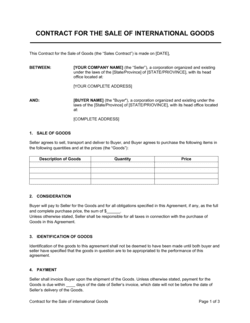
Selling goods to a buyer in another country
Addresses shipping terms, currency, customs, and cross-border legal requirements.Quick, straightforward purchase of goods or services with no complexity
Streamlined one-page format for simple transactions with minimal conditions.Glossary
- Purchaser / buyer
- The party acquiring the asset, shares, property, or business under the agreement.
- Vendor / seller
- The party transferring ownership in exchange for the agreed purchase price.
- Purchase price
- The total amount agreed between buyer and seller as consideration for the transfer.
- Conditions precedent
- Events that must occur before either party is legally obligated to close the transaction.
- Representations and warranties
- Factual statements made by each party about themselves or the subject matter that the other party relies on to enter the deal.
- Indemnification
- A contractual obligation by one party to compensate the other for losses arising from a breach of warranty or undisclosed liability.
- Closing
- The point at which all conditions have been met, money changes hands, and ownership is formally transferred.
- Due diligence
- The buyer's investigation of the seller's business, assets, or financials to verify that representations are accurate before closing.
- Earn-out
- A portion of the purchase price paid after closing, contingent on the acquired business meeting agreed performance targets.
- Bill of sale
- A document signed at or after closing that evidences the completed transfer of a specific asset from seller to buyer.
- Consideration
- Something of value — typically money — exchanged between the parties to make the contract legally binding.
- Title
- Legal ownership of an asset or property, transferred from seller to buyer at closing.
What is a sales and purchase agreement?
A sales and purchase agreement is a legally binding contract that records the
terms under which a buyer acquires an asset, business, property, or shares from a
seller. It documents the purchase price, payment structure, conditions that must be
satisfied before closing, representations each party makes about the subject matter,
and the mechanics of how ownership is transferred. Without a written agreement,
both parties are exposed to disputes over price, scope, liability, and timing that
can unwind or delay even straightforward transactions.
Sales and purchase agreements cover a broad spectrum of transactions. At one end,
a short-form purchase agreement may govern the sale of a single piece of equipment
between two businesses. At the other, a multi-schedule agreement of purchase and
sale of shares may govern the acquisition of an entire private company, complete
with representations about tax compliance, employee obligations, customer contracts,
and undisclosed liabilities. The common thread is that all of them put the deal on
paper before any money or title changes hands.
When you need a sales and purchase agreement
Any time ownership of something valuable moves from one party to another, a written
agreement protects both sides. The verbal agreement that seemed clear at the time
rarely survives a dispute about what was included, what was excluded, or who bears
the cost of a problem that surfaces after closing.
Common triggers:
- Two business partners want a standing plan for how one can buy the other out
- A company is acquiring a competitor's customer list, equipment, and IP
- An investor is purchasing shares from an existing shareholder
- A founder is selling the entire business — assets, contracts, and goodwill
- A buyer is purchasing land or a commercial property from a developer
- A manufacturer is selling goods to a distributor in another country
- A startup is issuing shares to a venture capital fund under agreed terms
- An owner wants to document the internal transfer of shares among shareholders
The risk of skipping a written agreement is not just legal — it is practical.
Closing a business sale without documented representations means the buyer has
no contractual recourse if the financials turn out to be inaccurate. Transferring
shares without a signed agreement means there is no agreed record of price, terms,
or conditions. A professional template gets the deal in writing quickly, and gives
both parties a clear foundation to negotiate from.
Award-winning platform
- Great Place to Work 2025
- BIG Award — Product of the Year 2025
- Smartest Companies 2025
- Global 100 Excellence 2026
- Best of the Best 2025
Create your document in 3 simple steps.
From template to signed document — all inside one Business Operating System.
1
Download or open template
Access over 3,000+ business and legal templates for any business task, project or initiative.
2
Edit and fill in the blanks with AI
Customize your ready-made business document template and save it in the cloud.
Share your files and folders with your team. Create a space of seamless collaboration.
Save time, save money, and create top-quality documents.
★★★★★
"Fantastic value! I'm not sure how I'd do without it. It's worth its weight in gold and paid back for itself many times."
Managing Director · Mall Farm
RW
Robert Whalley
Managing Director, Mall Farm Proprietary Limited
★★★★★
"I have been using Business in a Box for years. It has been the most useful source of templates I have encountered. I recommend it to anyone."
Business Owner · 4+ years
MF
Dr Michael John Freestone
Business Owner
★★★★★
"It has been a life saver so many times I have lost count. Business in a Box has saved me so much time and as you know, time is money."
Owner · Upstate Web
DM
David G. Moore Jr.
Owner, Upstate Web