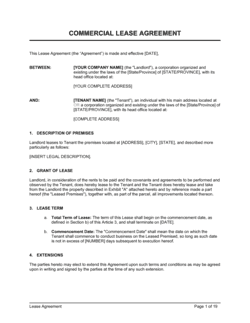
Asset Purchase Agreement For a Garage Template

Free Word download • Edit online • Save & share with Drive • Export to PDF

28 pages35–50 min to fillDifficulty: ComplexSignature requiredLegal review recommended
Learn more ↓
FreeAsset Purchase Agreement For a Garage Template

At a glance

What it is
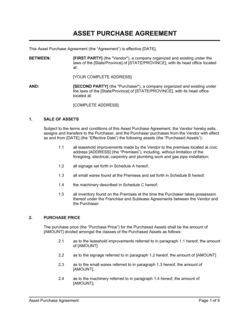
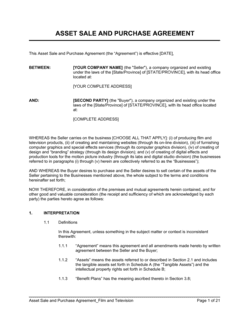
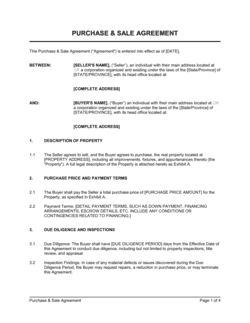
An Asset Purchase Agreement for a Garage is a legally binding contract that governs the sale and transfer of the physical assets, inventory, equipment, customer records, and goodwill of a garage or auto repair business from a seller to a buyer. This free Word download covers every core clause — from the list of purchased assets to representations, warranties, and closing conditions — and can be edited online and exported as PDF for execution.
When you need it
Use it when buying or selling a garage, auto repair shop, body shop, or service station as a going concern, where the transaction transfers specific assets rather than the ownership entity itself. It is also appropriate when a buyer wants to acquire the operational elements of a garage while leaving the seller's corporate shell and its liabilities behind.
What's inside
Identification of purchased assets and excluded assets, purchase price and payment terms, assumed and excluded liabilities, representations and warranties by both parties, closing conditions and deliverables, non-compete and non-solicitation provisions, and governing law. A schedule of tangible assets and equipment is included as an attachment.

What is an Asset Purchase Agreement for a Garage?

An Asset Purchase Agreement for a Garage is a legally binding contract that governs the structured transfer of a garage or auto repair business from a seller to a buyer through the sale of specific assets rather than the sale of the owning corporate entity. It identifies every tangible and intangible asset being conveyed — vehicle lifts, diagnostic equipment, tools, parts inventory, customer service records, and goodwill — and sets out the purchase price, liability allocation, representations and warranties, closing conditions, and post-closing restrictions such as non-compete covenants. Because the buyer acquires only the listed assets, pre-existing liabilities of the seller's business — tax arrears, environmental contamination, employment claims — remain with the seller unless explicitly assumed.

Why You Need This Document

Buying or selling a garage without a comprehensive written asset purchase agreement exposes both parties to serious financial and legal risk. Without explicit allocation of assets and liabilities, a buyer may unknowingly inherit the seller's outstanding equipment loans, environmental remediation orders, or back-pay claims from former employees. A seller without clear representations and indemnification provisions has no contractual recourse if the buyer later claims a lift was misrepresented or an inventory count was inflated. Disputes over which tools and equipment were included in the sale — absent a detailed Schedule A — are the most litigated issue in small business asset transfers. Post-closing, an unenforceable or missing non-compete clause means the seller can open a competing shop across the street the day after closing, wiping out the goodwill the buyer paid for. This template closes every one of those gaps: it covers asset identification, purchase price allocation, lien-release conditions, environmental and employment representations, non-compete scope, and indemnification — giving both parties a clear, enforceable record of exactly what changed hands and on what terms.

Which variant fits your situation?

If your situation is…Use this template
Buying all assets of a garage as a complete going concernAsset Purchase Agreement for a Garage
Acquiring the ownership entity of the garage, not just its assetsStock Purchase Agreement
Purchasing only specific equipment without goodwill or customer listsEquipment Purchase Agreement
Taking over a garage lease along with the business assetsLease Assignment Agreement
Combining asset purchase with owner financing by the sellerAsset Purchase Agreement with Seller Financing
Selling only the garage's vehicle inventory and parts stockBill of Sale for Business Assets
Acquiring a garage franchise location's assets from a franchiseeFranchise Asset Transfer Agreement

Common mistakes to avoid

❌ Vague or incomplete Schedule A asset list

Why it matters: Post-closing disputes over which tools, lifts, or inventory items were included are the single most common source of litigation in garage asset sales. Without serial numbers and descriptions, every item becomes contestable.

Fix: Conduct a joint walkthrough before signing and attach a photographed, itemised Schedule A signed by both parties at the same time as the main agreement.

❌ No purchase price allocation across asset classes

Why it matters: The IRS (Form 8594) and CRA (Form T2057) require both buyer and seller to report how the purchase price is allocated. Mismatched filings draw audits; no allocation forces the tax authority to assign one that may be unfavourable.

Fix: Negotiate and document the allocation in Schedule E of the agreement before signing, and confirm each party's tax advisor has reviewed it.

❌ Broad or undefined assumed liabilities language

Why it matters: Courts have held buyers responsible for pre-closing environmental remediation, employee back-pay claims, and CRA/IRS payroll tax arrears when liability assumption language was drafted too broadly.

Fix: List every assumed liability individually in Schedule C. Include a catch-all exclusion: 'All liabilities not expressly listed in Schedule C remain the sole obligation of Seller.'

❌ Skipping a lien search on garage equipment

Why it matters: Vehicle lifts, diagnostic equipment, and compressors are commonly financed — a buyer who closes without a UCC or PPSA search may take title subject to the seller's outstanding equipment loans.

Fix: Order a lien search in the seller's name and entity name in every jurisdiction where the equipment is located at least five business days before closing, and require lien releases as a closing condition.

❌ Non-compete scope disproportionate to the transaction

Why it matters: An overly broad non-compete — covering an entire state, or running 10 years — will be struck down entirely in most jurisdictions, leaving the buyer with no protection for the goodwill it paid for.

Fix: Tie the geographic scope to the garage's actual customer catchment area, verified by reviewing the customer address records being transferred. Keep duration at 2–3 years unless the seller's personal reputation drives a significant portion of revenue.

❌ No survival period on representations and warranties

Why it matters: Without a survival clause, warranty claims expire at closing — leaving the buyer without recourse for defects in title, environmental issues, or undisclosed liabilities discovered six months later.

Fix: Set a survival period of 18–24 months for general representations and a longer period (3–5 years or indefinitely) for tax, environmental, and IP ownership warranties.

The 10 key clauses, explained

Identification of parties and recitals

In plain language: Names the seller and buyer as legal entities, describes the garage business being sold, and states the parties' intent to complete the transaction on the terms set out in the agreement.

Sample language
This Asset Purchase Agreement ('Agreement') is entered into as of [DATE] by and between [SELLER LEGAL NAME], a [STATE/PROVINCE] [ENTITY TYPE] ('Seller'), and [BUYER LEGAL NAME], a [STATE/PROVINCE] [ENTITY TYPE] ('Buyer'). Seller operates an automotive repair business located at [ADDRESS] (the 'Business').

Common mistake: Using a trade name instead of the registered legal entity name for either party. If the entity name does not match ownership records for the assets, title transfer can be challenged.

Purchased assets and excluded assets

In plain language: Lists every asset being transferred — tools, equipment, inventory, customer records, phone numbers, website, leasehold improvements, and goodwill — and explicitly identifies what the seller keeps.

Sample language
Buyer hereby purchases all right, title, and interest in the assets listed in Schedule A ('Purchased Assets'), including all tools, lifts, diagnostic equipment, spare parts inventory, customer records, and goodwill. Excluded Assets are those listed in Schedule B, including Seller's personal vehicle and all accounts receivable outstanding as of the Closing Date.

Common mistake: Failing to attach a detailed Schedule A with serial numbers and descriptions for each piece of equipment. Vague asset lists lead to post-closing disputes about which items were included.

Purchase price and payment terms

In plain language: States the total consideration, how it is structured — lump sum, deposit plus balance at closing, or seller financing — and the timing of each payment.

Sample language
The aggregate purchase price for the Purchased Assets is [AMOUNT] ([WRITTEN AMOUNT]) ('Purchase Price'). Buyer shall pay a deposit of [DEPOSIT AMOUNT] within [X] business days of signing. The balance of [BALANCE AMOUNT] shall be paid by wire transfer on the Closing Date.

Common mistake: Not allocating the purchase price across asset classes (equipment, inventory, goodwill, non-compete) in the agreement. The IRS and CRA require allocation disclosure — misaligned allocations trigger audit risk for both parties.

Assumed and excluded liabilities

In plain language: Defines which of the seller's existing obligations — such as ongoing vendor contracts or equipment leases — the buyer takes on, and confirms that all other liabilities stay with the seller.

Sample language
Buyer shall assume only the liabilities expressly listed in Schedule C ('Assumed Liabilities'). All other liabilities of Seller, including any pre-Closing tax obligations, environmental liabilities, pending litigation, and undisclosed debts, are Excluded Liabilities and remain the sole obligation of Seller.

Common mistake: Using broad language that leaves ambiguity about which liabilities transfer. Courts have found buyers liable for pre-closing environmental contamination and employment claims when the exclusion language was imprecise.

Representations and warranties of the seller

In plain language: The seller confirms factual matters about ownership, financial condition, equipment condition, absence of liens, compliance with environmental and safety laws, and no pending claims against the business.

Sample language
Seller represents and warrants that: (a) Seller has full legal title to the Purchased Assets, free and clear of all liens and encumbrances except as disclosed in Schedule D; (b) the financial statements provided to Buyer fairly present the Business's financial condition; (c) Seller is in compliance with all applicable environmental and workplace safety laws.

Common mistake: Accepting seller representations without a corresponding disclosure schedule. Undisclosed liens, pending environmental orders, or equipment defects discovered after closing become expensive to unwind without a clear warranty-breach remedy.

Representations and warranties of the buyer

In plain language: The buyer confirms it has authority to enter the agreement, has the financial capacity to close, and has conducted its own due diligence.

Sample language
Buyer represents and warrants that: (a) Buyer is duly organized and has full authority to execute this Agreement; (b) Buyer has conducted its own independent investigation of the Business and the Purchased Assets; (c) Buyer has adequate financing to fund the Purchase Price.

Common mistake: Omitting buyer representations entirely. If the buyer fails to close due to financing issues, seller needs a warranty-breach pathway and forfeiture of the deposit — otherwise recovery is limited to a costly lawsuit.

Closing conditions and deliverables

In plain language: Sets out the conditions each party must satisfy before closing — such as landlord consent to lease assignment, transfer of regulatory licences, and delivery of a signed Bill of Sale — and the target closing date.

Sample language
Closing shall occur on [DATE] or such other date as the parties agree in writing. Conditions to Closing include: (a) Landlord's written consent to assignment of the Premises Lease; (b) transfer of [JURISDICTION] automotive repair licences to Buyer; (c) delivery of a Bill of Sale executed by Seller.

Common mistake: Setting a firm closing date without a short extension mechanism. If a licence transfer is delayed by a regulatory body, a rigid closing date can put the whole deal in default unnecessarily.

Non-compete and non-solicitation

In plain language: Prevents the seller from opening a competing garage or soliciting the transferred customer base within a defined geographic radius and time period after closing.

Sample language
For a period of [X] years following the Closing Date, Seller shall not, directly or indirectly, own, operate, or be employed by any automotive repair business within [X] miles/kilometres of [ADDRESS], nor solicit any customer whose records were transferred as Purchased Assets.

Common mistake: Setting the geographic radius too broadly for the local market or the duration too long for the jurisdiction. Courts in several states and provinces routinely void non-competes that exceed what is reasonably necessary to protect the goodwill being purchased.

Indemnification

In plain language: Establishes each party's obligation to compensate the other for losses arising from a breach of representations, warranties, or covenants, and typically caps the seller's indemnification exposure.

Sample language
Seller shall indemnify and hold harmless Buyer from any losses, claims, or damages arising from (a) any breach of Seller's representations, warranties, or covenants; or (b) any Excluded Liability. Seller's aggregate indemnification obligation shall not exceed the Purchase Price.

Common mistake: No indemnification cap or survival period. Without a cap, the seller's exposure is unlimited; without a survival period, stale claims can surface years after closing.

Governing law and dispute resolution

In plain language: Specifies which jurisdiction's law governs interpretation of the agreement and how disputes will be resolved — arbitration, mediation, or litigation in a named court.

Sample language
This Agreement shall be governed by the laws of the State/Province of [JURISDICTION]. Any dispute arising hereunder shall be resolved by binding arbitration administered by [AAA/ICDR] in [CITY], except that either party may seek injunctive relief in a court of competent jurisdiction.

Common mistake: Choosing a governing jurisdiction with no meaningful connection to where the garage operates or the parties are located. Local courts are generally more predictable and accessible for disputes involving a physical business location.

How to fill it out

  1. 1

    Enter the parties' legal entity names and the business address

    Use the registered legal name of both the seller entity and the buyer entity — not trade names or personal names. Include the full street address of the garage.

    💡 Pull the seller's entity name from your state or provincial corporate registry to ensure it exactly matches the name on title documents for the equipment and lease.

  2. 2

    Draft a detailed Schedule A of purchased assets

    List every tangible asset being transferred: vehicle lifts, diagnostic computers, air compressors, hand tools, inventory, vehicles, and any software licences. Include make, model, and serial number for equipment valued over $500.

    💡 Walk the premises with the buyer and cross-reference the list against the garage's most recent insurance schedule — the insurer has already catalogued every significant asset.

  3. 3

    Set the purchase price and allocate it across asset classes

    State the total price and break it into categories: tangible equipment, inventory, customer records and goodwill, and the non-compete covenant. Both parties will need this allocation for their tax filings.

    💡 In the US, both parties must file IRS Form 8594 to report asset class allocations — mismatched filings trigger IRS scrutiny, so agree on the allocation in the contract and keep a copy.

  4. 4

    Define assumed liabilities precisely in Schedule C

    List only the specific obligations the buyer is taking on — for example, the remaining term of an equipment finance agreement or a transferable vendor supply contract. Everything not listed stays with the seller.

    💡 Order a UCC or PPSA lien search on the seller's assets before signing. Any undisclosed secured liens will cloud title to the equipment the buyer is purchasing.

  5. 5

    Complete the representations and warranties disclosure schedules

    For each seller warranty, attach a disclosure schedule noting any exceptions — known equipment defects, pending regulatory orders, or existing encumbrances. Disclosed exceptions are carved out of warranty-breach claims.

    💡 A Phase 1 Environmental Site Assessment for the garage property should be completed before signing if there is any history of fuel storage, oil disposal, or chemical use on the premises.

  6. 6

    Set closing conditions and the target closing date

    List every condition that must be satisfied before the deal closes — landlord consent, licence transfers, lien releases — and set a realistic target date with a 10–15 business day extension mechanism.

    💡 Contact the relevant licensing authority early to confirm the transfer timeline for automotive repair licences in your jurisdiction — delays here are the most common reason closings slip.

  7. 7

    Calibrate the non-compete scope to the local market

    Set the geographic radius based on the actual catchment area of the garage — typically 5–15 miles for an urban location, up to 25 miles for a rural shop. Duration of 2–3 years is typically enforced; 5+ years courts scrutinize closely.

    💡 If the seller will remain as an employee or consultant after closing, structure the non-compete as part of the employment arrangement rather than the asset purchase — it has a stronger legal foundation in most jurisdictions.

  8. 8

    Sign before the closing date and notarise where required

    Both parties must sign the agreement and all schedules before the closing date. Some jurisdictions require notarisation for the Bill of Sale that accompanies the transfer of registered vehicles or certain equipment.

    💡 Use a sequential signing process: buyer signs first, then seller — this ensures the seller reviews a fully executed buyer commitment before releasing any assets or records.

Frequently asked questions

What is an asset purchase agreement for a garage?

An asset purchase agreement for a garage is a legally binding contract that transfers specific business assets — tools, equipment, inventory, customer records, and goodwill — from a garage or auto repair shop seller to a buyer. Unlike a share purchase, the buyer acquires only the listed assets, not the seller's corporate entity or its historic liabilities. It is the standard transaction structure for buying or selling a small-to-medium garage business.

What is the difference between an asset purchase and a share purchase for a garage?

In an asset purchase, the buyer selects exactly which assets and liabilities to take on and leaves the seller's corporate entity — and its history of tax, environmental, and employment obligations — behind. In a share purchase, the buyer acquires the entire company, including all historical liabilities. Most garage buyers prefer asset purchases because they can exclude pre-existing debts, environmental contamination, and unknown claims. Sellers sometimes prefer share sales for tax reasons — notably the capital gains exemption available on qualifying small business corporation shares in Canada.

What assets are typically included in a garage asset purchase?

A typical garage asset purchase includes vehicle lifts and jacks, diagnostic and scan equipment, air compressors and pneumatic tools, hand and power tools, parts and consumables inventory, office equipment and software, the customer database and service history records, the business phone number and website, signage, leasehold improvements, and goodwill associated with the business name and customer relationships. What is included or excluded must be listed explicitly in Schedule A and Schedule B of the agreement.

Do I need a lawyer to complete an asset purchase agreement for a garage?

For a straightforward single-location garage sale under $150,000, a well-structured template reviewed by a lawyer for a few hundred dollars is typically sufficient. For transactions above that threshold, where real estate or a long-term lease is involved, where environmental risk is present, or where the seller is financing part of the purchase price, engaging a commercial lawyer for full drafting and due diligence is strongly recommended. The cost of legal counsel ($1,500–$5,000) is modest relative to the risk of a poorly structured asset transfer.

How should the purchase price be allocated in a garage asset purchase?

The purchase price should be allocated across asset classes: tangible personal property (equipment and tools), inventory, customer-based intangibles (records and goodwill), and the non-compete covenant. In the US, both parties must file IRS Form 8594 to report the agreed allocation. In Canada, the allocation affects each party's capital gains and recaptured depreciation calculations. Buyers typically prefer to allocate more value to depreciable equipment (faster write-off); sellers often prefer goodwill allocation for capital gains treatment. The allocation must be negotiated and documented in the contract.

What environmental issues should I check before buying a garage?

Garages are high-risk sites for soil and groundwater contamination due to fuel storage, used oil disposal, antifreeze, and solvent use. Before signing, order a Phase 1 Environmental Site Assessment from a qualified environmental consultant. If the Phase 1 identifies recognized environmental conditions, a Phase 2 (soil and groundwater sampling) is necessary before closing. Environmental remediation costs can reach hundreds of thousands of dollars — obtaining an environmental indemnity from the seller and confirming it is backed by adequate financial resources is essential.

What happens to employees when a garage is sold as an asset purchase?

In an asset purchase, the buyer is generally not obligated to hire the seller's employees. However, in most Canadian provinces and in the UK and EU, employment law may deem the transaction a business transfer that requires the buyer to offer continued employment on comparable terms. In the US, WARN Act notice obligations may apply for larger workforces. The agreement should clearly state whether the buyer is assuming any employment obligations and should list any employees whose positions are being offered as part of the transition.

Can the seller keep receiving payments on existing repair jobs after closing?

Accounts receivable for work completed before closing typically remain with the seller as an excluded asset, unless specifically listed in Schedule A as a purchased asset. Work in progress — vehicles currently being repaired — requires a specific allocation in the agreement: either the seller completes and collects, or the buyer completes and the purchase price is adjusted to reflect the cost of completing that work. Leaving this unaddressed is a common source of post-closing friction.

How long should a non-compete clause last in a garage asset purchase?

A duration of 2–3 years is most commonly enforced in North American and UK courts for a garage business sale. A 5-year restriction is enforceable in some jurisdictions when the seller had a strong personal reputation driving a significant share of revenue. Geographic scope should be limited to the garage's realistic customer catchment area — typically a 5–15 mile radius in urban markets. Courts in California and a small number of other jurisdictions limit even business-sale non-competes, so governing law selection matters.

How this compares to alternatives

vs Stock Purchase Agreement

A stock purchase agreement transfers the entire corporate entity, including all historic liabilities — tax arrears, environmental obligations, and pending litigation. An asset purchase agreement transfers only selected assets, leaving unwanted liabilities with the seller. Garage buyers almost always prefer asset purchases; sellers with significant built-in capital gains may prefer a share sale for tax reasons.

vs Bill of Sale for Business Assets

A bill of sale is a short document that conveys title to individual items at the moment of transfer. It does not cover representations and warranties, non-competes, indemnification, or closing conditions. An asset purchase agreement governs the entire transaction and generates the bill of sale as one of its closing deliverables. For any garage sale involving goodwill or ongoing customer relationships, a full asset purchase agreement is required.

vs Business Purchase Agreement

A general business purchase agreement covers the acquisition of any type of business and is not tailored to the specific assets, environmental risks, licensing requirements, and customer-record considerations that arise in an automotive repair context. An asset purchase agreement for a garage includes garage-specific schedules and representations that a generic business purchase agreement typically omits.

vs Equipment Purchase Agreement

An equipment purchase agreement covers only the physical tools and machinery — it does not transfer goodwill, customer records, the business phone number, or the right to operate under the business name. If the goal is to acquire a working garage as a going concern rather than just its hardware, an asset purchase agreement is the correct instrument.

Industry-specific considerations

Automotive repair and service

Equipment schedules must itemise lifts, alignment machines, and diagnostic tools by VIN or serial number; environmental indemnity for fuel and oil storage is standard.

Franchise and branded service networks

Franchisor consent to the asset transfer and rebranding obligations must be addressed as closing conditions before the agreement is executed.

Commercial real estate and property investment

Where the garage premises are owned rather than leased, a separate real property transfer must run alongside the asset purchase and coordinate closing conditions.

Private equity and business acquisitions

Roll-up acquirers typically use a standardised asset purchase template across multiple garage locations and negotiate a uniform non-compete and earnout structure.

Jurisdictional notes

United States

Both parties must file IRS Form 8594 to report the agreed purchase price allocation across asset classes — mismatched filings trigger IRS audit risk. UCC lien searches are required in the state where the equipment is located. Environmental liability under CERCLA can attach to buyers of contaminated commercial property even in an asset purchase if the buyer is deemed an operator. California and a small number of other states restrict non-competes even in business sale contexts.

Canada

The seller may be eligible for the Lifetime Capital Gains Exemption on qualifying small business corporation shares — a factor that frequently drives negotiations toward a share rather than asset structure. In asset sales, CRA requires both parties to file a joint election (Form T2057) to govern the tax treatment of goodwill and depreciable property. In Ontario, Quebec, and British Columbia, employment standards legislation may deem garage employees to have continuity of employment with the buyer regardless of asset-purchase structure.

United Kingdom

TUPE (Transfer of Undertakings — Protection of Employment) Regulations 2006 typically apply to garage asset sales that constitute a transfer of a business as a going concern, requiring the buyer to offer continued employment to all transferring employees on their existing terms. Environmental permitting for waste oil and fuel storage must be transferred to or reissued in the buyer's name before operating. Stamp Duty Land Tax applies to any real property element of the transaction.

European Union

The EU Acquired Rights Directive (implemented locally in each member state) mirrors TUPE and generally requires employee continuity on a business asset transfer. Customer data transferred as part of a garage sale — service records, contact details — constitutes personal data under GDPR; the agreement should include a data processing clause and the seller must notify affected customers of the transfer. VAT treatment of the asset sale varies by member state — many jurisdictions treat the transfer of a going concern as outside the scope of VAT, but local confirmation is required.

Template vs lawyer — what fits your deal?

PathBest forCostTime
Use the templateStraightforward garage sales under $150,000 with no real property, no environmental concerns, and no seller financingFree2–4 hours to complete and review
Template + legal reviewTransactions between $150,000 and $500,000, where a lease assignment, equipment liens, or seller financing is involved$800–$2,500 for a commercial lawyer review3–7 business days
Custom draftedMulti-location acquisitions, transactions above $500,000, real property transfer, environmental risk, or complex earnout structures$3,000–$10,000+2–4 weeks

Glossary

Purchased Assets
The specific tangible and intangible assets listed in the agreement that transfer from the seller to the buyer at closing.
Excluded Assets
Assets the seller retains after the transaction closes — such as personal vehicles, certain receivables, or the corporate entity itself.
Assumed Liabilities
Specific obligations of the seller that the buyer agrees to take on as part of the transaction, typically limited to those expressly listed.
Excluded Liabilities
All liabilities that remain with the seller after closing — including pre-closing taxes, undisclosed debts, and any claims not expressly assumed.
Goodwill
The intangible value of an established business — customer relationships, reputation, trade name, and workforce — above the book value of its physical assets.
Representations and Warranties
Factual statements made by each party about the condition of the assets, ownership, financial status, and legal standing, which form the basis of the deal.
Closing Conditions
Events or deliverables that must occur before the transaction can legally close, such as landlord consent to lease assignment or regulatory approvals.
Earnest Money Deposit
A sum paid by the buyer at signing to demonstrate serious intent; it is typically applied to the purchase price or forfeited if the buyer walks away without cause.
Non-Compete Clause
A post-closing restriction preventing the seller from opening or working at a competing garage within a defined geographic area and time period.
Prorated Items
Costs such as prepaid rent, utilities, or annual licenses that are split between seller and buyer based on the fraction of the period each party occupies.
Bill of Sale
A companion document signed at closing that formally conveys title to each individual tangible asset listed in the purchase agreement.
Material Adverse Change
A significant negative event affecting the garage's business, assets, or financial condition that may give the buyer the right to renegotiate or exit the deal.

Part of your Business Operating System

This document is one of 3,000+ business & legal templates included in Business in a Box.

  • Fill-in-the-blanks — ready in minutes
  • 100% customizable Word document
  • Compatible with all office suites
  • Export to PDF and share electronically

Create your document in 3 simple steps.

From template to signed document — all inside one Business Operating System.
1
Download or open template

Access over 3,000+ business and legal templates for any business task, project or initiative.

2
Edit and fill in the blanks with AI

Customize your ready-made business document template and save it in the cloud.

3
Save, Share, Send, Sign

Share your files and folders with your team. Create a space of seamless collaboration.

Save time, save money, and create top-quality documents.

★★★★★

"Fantastic value! I'm not sure how I'd do without it. It's worth its weight in gold and paid back for itself many times."

Managing Director · Mall Farm
Robert Whalley
Managing Director, Mall Farm Proprietary Limited
★★★★★

"I have been using Business in a Box for years. It has been the most useful source of templates I have encountered. I recommend it to anyone."

Business Owner · 4+ years
Dr Michael John Freestone
Business Owner
★★★★★

"It has been a life saver so many times I have lost count. Business in a Box has saved me so much time and as you know, time is money."

Owner · Upstate Web
David G. Moore Jr.
Owner, Upstate Web

Run your business with a system — not scattered tools

Stop downloading documents. Start operating with clarity. Business in a Box gives you the Business Operating System used by over 250,000 companies worldwide to structure, run, and grow their business.

Free Forever Plan · No credit card required