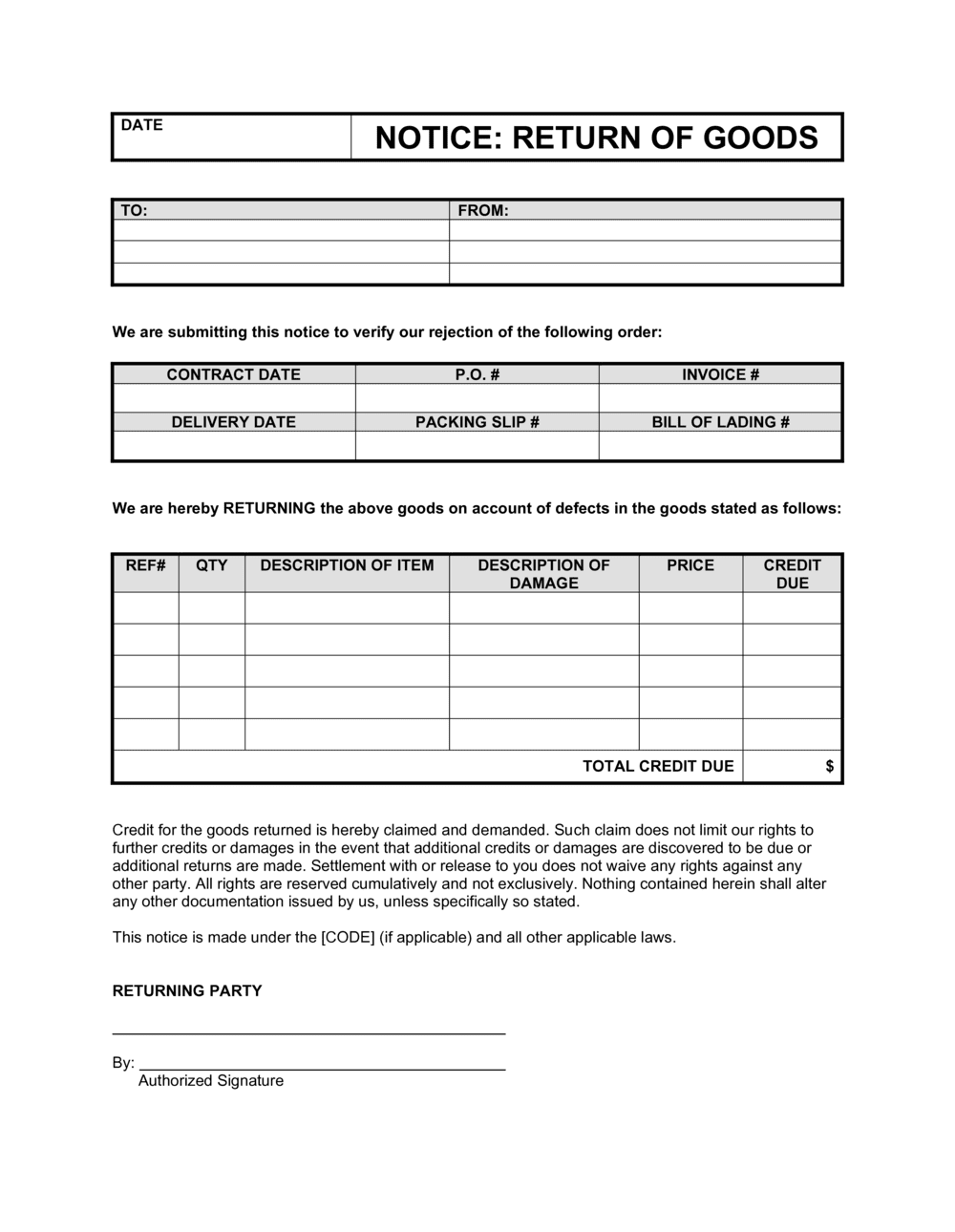
Notice for Return of Goods Template

Free Word download β€’ Edit online β€’ Save & share with Drive β€’ Export to PDF

1 pageβ€’15–25 min to fillβ€’Difficulty: Standard
Learn more ↓
FreeNotice for Return of Goods Template

At a glance

What it is
A Notice for Return of Goods is a formal written communication from a buyer or lessee to a seller or supplier stating the intent to return specific goods, citing the reason β€” defect, non-conformance, end of trial, or lease expiry. This free Word download gives you a ready-to-edit template you can complete in minutes and export as PDF for immediate dispatch.
When you need it
Use it any time you need to formally document a return before shipping goods back β€” whether goods arrived damaged, failed to meet contract specifications, a trial period has ended, or a rental or lease agreement has concluded.
What's inside
Sender and recipient details, reference to the original transaction or agreement, a clear description of the goods being returned, the stated reason for return, proposed return logistics, and a request for confirmation or refund action.

What is a Notice for Return of Goods?

A Notice for Return of Goods is a formal written document sent by a buyer to a supplier declaring the intent to return identified goods, stating the reason β€” defect, non-conformance, end of a trial period, or lease expiry β€” and requesting a defined remedy such as a refund, replacement, or credit note. It references the original transaction by purchase order or invoice number, describes the specific goods being returned, and sets out the proposed return logistics and a deadline for supplier confirmation. Unlike an informal email, a properly drafted return notice creates a documented paper trail that protects your entitlement to a remedy and provides clear evidence if the dispute escalates.

Why You Need This Document

Returning goods without a formal notice leaves you exposed on every front: the supplier can dispute the return basis, delay issuing credit, or claim the goods were returned outside the agreed window. An undocumented return is routinely treated as a courtesy request rather than an enforceable demand, and without proof of notice your accounting team has no basis to withhold payment or raise a chargeback. A clearly worded notice β€” with reference numbers, a specific reason, and a response deadline β€” removes that ambiguity entirely. It puts the supplier on formal notice, starts the clock on their obligation to respond, and gives you the documented evidence you need if the matter moves to a formal dispute or legal proceedings. This template gets you from discovery of the problem to a professional, complete notice in under 15 minutes.

Which variant fits your situation?

If your situation is…Use this template
Returning goods due to visible damage or defect on arrivalNotice for Return of Goods (Defective)
Returning goods that don't match purchase order specificationsNotice for Return of Non-Conforming Goods
Returning leased or rented equipment at end of termEquipment Return Notice
Formally rejecting a delivery and requesting replacementNotice of Rejection of Goods
Disputing an invoice tied to a failed deliveryInvoice Dispute Letter
Requesting a credit note after confirming the returnCredit Note
Escalating an unresolved return to a formal complaintFormal Complaint Letter

Common mistakes to avoid

❌ Sending the notice to the wrong contact

Why it matters: A return notice sent to the sales rep instead of the returns or AP department can sit unread for weeks, causing the return window or warranty period to lapse.

Fix: Confirm the correct recipient β€” by name, title, and email β€” before sending, and copy the general supplier contact email as a backup.

❌ Omitting PO or invoice reference numbers

Why it matters: Suppliers process dozens of returns at a time; a notice without reference numbers cannot be matched to a transaction and will be treated as incomplete.

Fix: Include every available reference β€” PO number, invoice number, and delivery note number β€” in the subject line and body of the notice.

❌ Vague description of the defect or non-conformance

Why it matters: A return notice that says only 'faulty goods' gives the supplier grounds to dispute the return basis and delay issuing credit until an investigation is completed.

Fix: Describe the defect specifically β€” item, symptom, quantity affected, and test or inspection result β€” and attach photographic evidence where possible.

❌ No deadline for supplier confirmation

Why it matters: An open-ended notice is routinely deprioritized; without a response deadline, weeks can pass with no action while you hold unwanted stock.

Fix: State a specific date by which you require written confirmation β€” typically 5–7 business days from the notice date β€” and flag that you will escalate if the deadline is missed.

The 9 key clauses, explained

Header: Sender and recipient details

In plain language: Identifies who is sending the notice and to whom it is addressed, including company names, addresses, and contact information.

Sample language
[SENDER COMPANY NAME] | [ADDRESS] | [CITY, STATE, ZIP] | [DATE] | To: [RECIPIENT NAME], [TITLE] | [SUPPLIER COMPANY NAME] | [SUPPLIER ADDRESS]

Common mistake: Addressing the notice to the sales contact rather than the accounts payable or returns department β€” it then sits unprocessed while your return window closes.

Subject line and reference numbers

In plain language: A concise subject line naming the purpose, plus the original PO number, invoice number, or agreement reference that the return relates to.

Sample language
Subject: Notice of Return of Goods β€” PO No. [PO NUMBER] / Invoice No. [INVOICE NUMBER] dated [DATE]

Common mistake: Omitting the PO or invoice number. Without it, the supplier cannot locate the transaction and the return process stalls immediately.

Opening: Statement of intent to return

In plain language: A clear, direct statement that the buyer intends to return specified goods and the basis on which the return is being made.

Sample language
We write to formally notify you of our intention to return the goods described below, received under the above-referenced Purchase Order, on the grounds of [REASON FOR RETURN].

Common mistake: Writing a vague opening that asks whether return is possible rather than stating intent. A notice should declare intent, not request permission.

Description of goods

In plain language: Identifies the specific goods being returned β€” product name, SKU or model number, quantity, and lot or batch number where applicable.

Sample language
Goods: [PRODUCT NAME / DESCRIPTION] | SKU/Model: [SKU OR MODEL NUMBER] | Quantity: [NUMBER] units | Batch/Lot No.: [LOT NUMBER] (if applicable)

Common mistake: Providing only a generic product name without SKU, quantity, or batch reference. Ambiguous descriptions create disputes about exactly what was returned.

Reason for return

In plain language: States the specific defect, non-conformance, or contractual trigger that justifies the return, with enough detail to match the agreed contract terms.

Sample language
The goods were found to be [defective / non-conforming to specification / beyond the agreed trial period] in the following respects: [SPECIFIC DEFECT OR NON-CONFORMANCE DESCRIPTION].

Common mistake: Stating only 'not as described' without specifics. A documented, itemized reason protects your right to a refund or replacement and prevents the supplier from contesting the return basis.

Reference to the underlying agreement or statutory right

In plain language: Cites the contract clause, purchase order term, warranty provision, or applicable consumer or commercial law that entitles the buyer to return the goods.

Sample language
This return is made pursuant to Clause [X] of our Supply Agreement dated [DATE] / the warranty terms stated in your invoice / [APPLICABLE LAW OR REGULATION].

Common mistake: Including no legal or contractual basis for the return. Without one, the supplier may treat the notice as a courtesy request rather than an enforceable demand.

Return logistics and proposed shipping arrangements

In plain language: Sets out how and when the goods will be returned β€” proposed return date, shipping method, and who bears freight costs.

Sample language
We propose to dispatch the goods by [DATE] via [CARRIER / METHOD]. We request that return freight be borne by [SUPPLIER NAME] / We will arrange return at our cost and deduct from the next invoice.

Common mistake: Leaving logistics open-ended. An unspecified return date gives the supplier grounds to delay issuing a credit or arranging collection indefinitely.

Requested remedy: Refund, replacement, or credit

In plain language: States the specific outcome the buyer expects β€” a full refund, a replacement shipment, or a credit note β€” and sets a reasonable deadline for supplier confirmation.

Sample language
We request [a full refund of [AMOUNT] / replacement of the goods within [X] business days / a credit note for [AMOUNT]] to be confirmed in writing by [DATE].

Common mistake: Requesting a remedy without a deadline. An open-ended request is routinely deprioritized; a specific response-by date creates accountability.

Closing: Contact details and signature block

In plain language: Provides a named contact for the supplier to respond to and closes the letter professionally.

Sample language
Please confirm receipt of this notice and your intended course of action by [DATE]. For any queries, contact [NAME] at [EMAIL] / [PHONE]. Yours faithfully, [AUTHORIZED SIGNATORY NAME], [TITLE], [COMPANY NAME]

Common mistake: Signing with a generic 'The Management' or no name at all. A named signatory makes follow-up traceable and signals that an accountable person is monitoring the return.

How to fill it out

  1. 1

    Enter sender and recipient details

    Add your company name, address, and date at the top, then address the notice to the correct department β€” returns, accounts payable, or the named contract manager β€” at the supplier.

    πŸ’‘ Call the supplier's main line to confirm the correct returns contact before sending. Notices sent to the wrong person frequently disappear.

  2. 2

    Add all reference numbers in the subject line

    Include the original PO number, invoice number, and delivery note number if available. Every reference number you include cuts processing time on the supplier's side.

    πŸ’‘ If you have multiple invoices or deliveries in a single return, list all reference numbers on separate lines rather than combining them in one string.

  3. 3

    State the reason for return with specific detail

    Describe the defect or non-conformance precisely β€” dimensions, color, quantity shortfall, damage location, or failed test result. Vague descriptions invite disputes.

    πŸ’‘ Attach photos or a brief inspection report as supporting evidence. A notice with documented proof is far harder to contest.

  4. 4

    Cite the contractual or statutory entitlement

    Reference the specific clause in your supply agreement, the warranty term printed on the invoice, or the applicable commercial law that entitles you to return the goods.

    πŸ’‘ If you don't have the contract to hand, reference the purchase order terms or the supplier's own returns policy as your basis.

  5. 5

    Specify return logistics and a dispatch date

    Confirm the proposed dispatch date, the carrier or collection method, and who will bear freight costs. Set a date no more than 5–10 business days from the notice date.

    πŸ’‘ Agree the freight-collect arrangement in writing here rather than assuming it β€” misunderstandings over who pays return shipping are one of the most common dispute triggers.

  6. 6

    State the remedy and a response deadline

    Choose one primary remedy β€” refund, replacement, or credit note β€” and set a firm deadline for written confirmation from the supplier, typically 5–7 business days.

    πŸ’‘ Limit the notice to one primary remedy to avoid giving the supplier room to choose the option least favorable to you.

  7. 7

    Sign and dispatch by tracked mail or email with read receipt

    Have an authorized person sign the notice, then send it by a method that generates proof of delivery β€” tracked post, courier, or email with a read receipt.

    πŸ’‘ Retain a copy of the sent notice in your procurement file alongside the original PO and delivery documentation from day one.

Frequently asked questions

What is a notice for return of goods?

A notice for return of goods is a formal written document a buyer sends to a supplier to declare the intent to return specific goods, state the reason, and request a remedy such as a refund, replacement, or credit note. It creates a documented record of the return request and the grounds for it, which is important if a dispute or chargeback escalates later.

When should I send a notice for return of goods?

Send it as soon as you identify the reason for return β€” ideally within the warranty period or the return window stated in your supply agreement. For defective or non-conforming goods, notice should typically be given within a reasonable time after delivery, often defined in the contract as 5–14 business days. Waiting too long can weaken your entitlement to a full remedy.

Does a notice for return of goods need to be signed?

No formal signature is legally required for this type of notice in most jurisdictions, but signing it with a named authorized person's name and title strengthens the document's credibility and makes follow-up traceable. For high-value or disputed returns, a signed notice sent by tracked mail or email with a read receipt provides a clean proof-of-dispatch record.

What is the difference between a notice for return of goods and a rejection of goods?

A rejection of goods is issued before or at the point of delivery, refusing to accept goods into your possession. A notice for return of goods is issued after you have taken delivery and subsequently identified a problem β€” defect, non-conformance, or end of a trial or lease period. Legally, rejection and return can carry different remedies depending on the governing contract and jurisdiction.

Who pays the freight cost for returned goods?

This depends on the reason for return and the terms of your supply agreement. Where the supplier is at fault β€” defective or wrong goods β€” the supplier typically bears return freight costs, either by arranging collection or by accepting a freight-collect shipment. Where the return is a commercial decision, such as end of a trial period, the buyer may bear the cost. Always confirm the arrangement in writing in the notice itself.

Should I attach photos or evidence to the notice?

Yes, wherever possible. Attaching photos of the defect, a copy of the original purchase order, and any inspection or test results significantly strengthens your position and reduces the likelihood of the supplier contesting the return. Evidence attached to the original notice is harder to dispute than documentation produced later in a dispute process.

What remedy should I request in the notice?

Choose the remedy that best fits the situation and state only one primary option. A full refund is appropriate when the goods are unusable and no replacement is needed. A replacement shipment suits situations where you still need the product and the supplier can deliver conforming goods quickly. A credit note works well for ongoing supplier relationships where you will apply the value against a future order.

Can I use this notice for goods returned at the end of a lease or trial?

Yes. The template accommodates returns arising from a commercial trial period, a sale-or-return arrangement, or a lease or rental agreement reaching its end date. In those cases, the reason-for-return clause should reference the contract term that entitles you to return the goods rather than citing a defect.

How this compares to alternatives

vs Notice of rejection of goods

A notice of rejection is issued at or before the point of delivery, refusing to take possession of goods that do not conform. A notice for return of goods is issued after the buyer has already taken delivery and then discovered a problem. Both serve to document the buyer's position, but rejection prevents acceptance while a return notice reverses it.

vs Complaint letter

A complaint letter documents dissatisfaction with a product or service and requests remedial action broadly. A notice for return of goods is narrower and more operational β€” it states a specific intent to return identified goods and sets out the logistics and remedy. For a return, the notice template is more appropriate; use a complaint letter when no physical return is involved.

vs Credit note

A credit note is issued by the seller to reduce the buyer's balance after a return is confirmed. A notice for return of goods is the buyer's document that triggers the credit note process. The notice comes first; the credit note is the supplier's response. Both documents should reference the same PO and invoice numbers.

vs Purchase order

A purchase order is the buyer's authorization to a supplier to deliver goods on agreed terms. A notice for return of goods closes the loop on a failed delivery by formally reversing all or part of that transaction. The original PO number should always be referenced in the return notice to link the two documents in both parties' accounting systems.

Industry-specific considerations

Manufacturing and wholesale

High-volume component and raw material returns require batch and lot number references, inspection certificates, and freight-collect arrangements with the upstream supplier.

Retail and e-commerce

Vendor returns under sale-or-return and consignment agreements require the notice to reference the original consignment note and agreed return window.

Construction and trades

Materials delivered to incorrect specification on live job sites need rapid return notices with photographic evidence to avoid project delays and avoid storage liability.

Professional services and office operations

Returning leased or trial office equipment β€” printers, IT hardware, furniture β€” requires reference to the lease agreement end date and confirmation of collection logistics.

Template vs pro β€” what fits your needs?

PathBest forCostTime
Use the templateBuyers returning defective, non-conforming, or end-of-trial goods to any supplierFree10–15 minutes
Template + professional reviewHigh-value returns where the supplier is likely to contest the basis or the contract terms are complex$100–$300 for a solicitor or commercial advisor review1–2 business days
Custom draftedReturns involving formal legal proceedings, international supply chains, or disputed ownership of goods$500–$1,500+3–7 business days

Glossary

Return Merchandise Authorization (RMA)
A reference number issued by a supplier authorizing the return of specific goods before the buyer ships them back.
Non-Conforming Goods
Goods that fail to meet the description, quality, quantity, or specifications agreed in the purchase order or contract.
Sale or Return
A commercial arrangement where unsold goods can be returned to the supplier at the end of a specified period without penalty.
Rejection of Goods
A buyer's formal refusal to accept delivery of goods that do not conform to the contract β€” distinct from a return made after acceptance.
Credit Note
A document issued by the seller reducing the buyer's outstanding balance, typically issued after a confirmed return of goods.
Consignment
Goods delivered to a buyer for sale on behalf of the supplier, ownership remaining with the supplier until goods are sold.
Proof of Delivery (POD)
A signed document confirming that goods were received at a specified location, used as evidence in return or dispute proceedings.
Purchase Order (PO) Number
A unique reference number assigned by the buyer to a purchasing transaction, used to link invoices, deliveries, and returns.
Warranty Period
The contractual or statutory time frame during which a seller is obligated to repair, replace, or accept return of defective goods.
Freight Collect
A shipping arrangement in which the recipient β€” typically the original seller when goods are being returned β€” pays the freight costs.

Part of your Business Operating System

This document is one of 3,000+ business & legal templates included in Business in a Box.

  • Fill-in-the-blanks β€” ready in minutes
  • 100% customizable Word document
  • Compatible with all office suites
  • Export to PDF and share electronically

Create your document in 3 simple steps.

From template to signed document β€” all inside one Business Operating System.
1
Download or open template

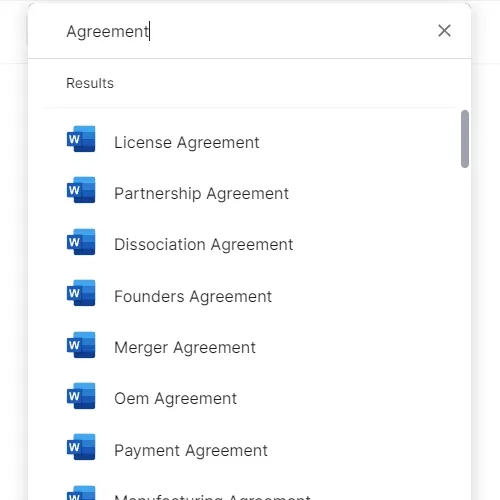
Access over 3,000+ business and legal templates for any business task, project or initiative.

2
Edit and fill in the blanks with AI

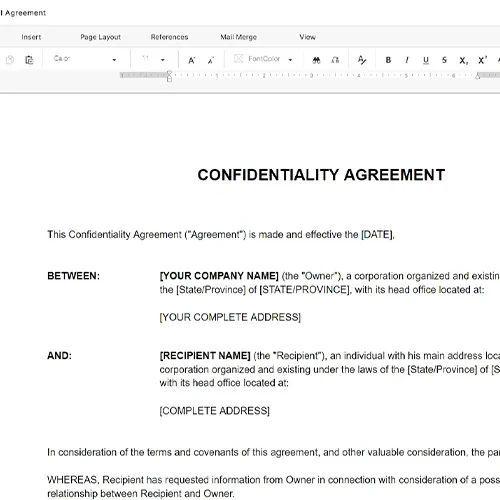
Customize your ready-made business document template and save it in the cloud.

3
Save, Share, Send, Sign

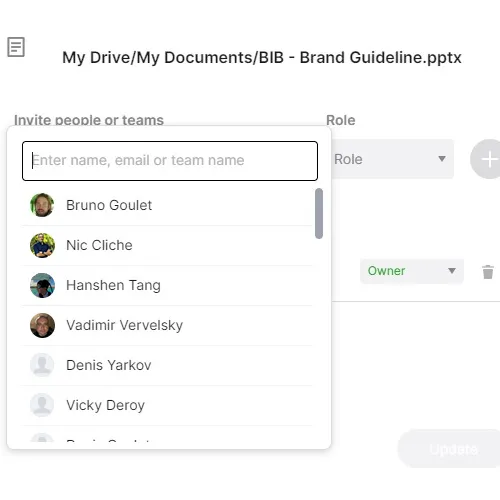
Share your files and folders with your team. Create a space of seamless collaboration.

Save time, save money, and create top-quality documents.

β˜…β˜…β˜…β˜…β˜…

"Fantastic value! I'm not sure how I'd do without it. It's worth its weight in gold and paid back for itself many times."

Managing Director Β· Mall Farm
Robert Whalley
Managing Director, Mall Farm Proprietary Limited
β˜…β˜…β˜…β˜…β˜…

"I have been using Business in a Box for years. It has been the most useful source of templates I have encountered. I recommend it to anyone."

Business Owner Β· 4+ years
Dr Michael John Freestone
Business Owner
β˜…β˜…β˜…β˜…β˜…

"It has been a life saver so many times I have lost count. Business in a Box has saved me so much time and as you know, time is money."

Owner Β· Upstate Web
David G. Moore Jr.
Owner, Upstate Web

Run your business with a system β€” not scattered tools

Stop downloading documents. Start operating with clarity. Business in a Box gives you the Business Operating System used by over 250,000 companies worldwide to structure, run, and grow their business.

Free Forever PlanΒ Β·Β No credit card required