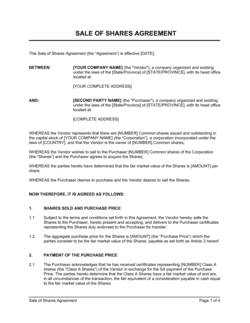
Sale Agreement for International Goods Template

Free Word download • Edit online • Save & share with Drive • Export to PDF

3 pages30–40 min to fillDifficulty: ComplexSignature requiredLegal review recommended
Learn more ↓
FreeSale Agreement for International Goods Template

At a glance

What it is
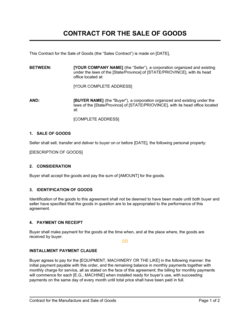
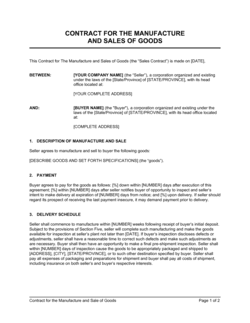
A Sale Agreement for International Goods is a legally binding contract between an exporter and an importer that governs the cross-border sale and delivery of physical products. This free Word download covers Incoterms 2020 delivery terms, price and currency, payment methods (letter of credit, telegraphic transfer, or open account), packaging and inspection obligations, transfer of risk and title, customs and duties responsibility, governing law (including CISG), and dispute resolution — all in a single editable document you can export as PDF and execute with trading partners worldwide.
When you need it
Use it whenever you are exporting or importing goods across national borders and need a written contract that allocates responsibilities, costs, and risks between buyer and seller. It is essential before shipment leaves origin, before a letter of credit is opened, and wherever your standard domestic sales terms do not address customs, Incoterms, or multi-currency payment.
What's inside
Parties and goods description, Incoterms 2020 delivery term and named place, price and currency, payment method and schedule, packaging and labeling requirements, pre-shipment inspection rights, transfer of risk and title, customs and export/import duties allocation, insurance obligations, force majeure, governing law, CISG applicability, and dispute resolution by arbitration or litigation.

What is a Sale Agreement for International Goods?

A Sale Agreement for International Goods is a legally binding contract between an exporter and an importer that governs the cross-border sale, shipment, and delivery of physical products. It goes well beyond a domestic sales contract by addressing the full set of obligations that arise when goods move across national borders: which Incoterms 2020 delivery term applies and at what named location risk transfers, the price expressed in a specified currency, how payment is secured — through a letter of credit, telegraphic transfer, or open account — which party handles customs clearance and pays import duties, who arranges and pays for cargo insurance, and how disputes are resolved when parties are in different legal systems. The agreement also makes a deliberate choice about the UN Convention on Contracts for the International Sale of Goods (CISG), which automatically applies in most cross-border transactions between ratifying countries unless expressly excluded.

Why You Need This Document

Without a written international sale of goods agreement, you have no enforceable allocation of the risks that are unique to cross-border trade: goods damaged in transit with no clear insurance obligation, payment refused on a documentary discrepancy because the LC terms were never aligned with the contract, import duties unexpectedly falling on the wrong party, or a dispute decided by a domestic court whose judgment cannot be enforced in the other party's country. The financial exposure on even a single mid-size shipment — $50,000 to $500,000 or more — dwarfs the cost of a properly drafted contract. This template gives exporters and importers a structured, internationally recognized starting point that reflects current Incoterms 2020 rules and CISG practice, covering every material term before the first carton leaves the warehouse.

Which variant fits your situation?

If your situation is…Use this template
Buyer wants seller to handle freight and insurance to destination portSale Agreement for International Goods (CIF Terms)
Buyer takes risk and arranges freight from seller's named port of loadingSale Agreement for International Goods (FOB Terms)
Seller delivers duty-paid to buyer's named place — fully landedSale Agreement for International Goods (DDP Terms)
Domestic sale with no cross-border componentSales Agreement
Ongoing supply relationship with multiple shipments over timeSupply Agreement
Buyer and seller are establishing a distribution relationshipDistribution Agreement
Goods are being manufactured to order rather than sold off the shelfManufacturing Agreement

Common mistakes to avoid

❌ Incomplete Incoterm — no named place

Why it matters: An Incoterm without a named port or delivery point is legally incomplete. If a dispute arises, a tribunal will determine the delivery point from surrounding evidence — which may not match either party's intent.

Fix: Always follow the Incoterm abbreviation with the full name of the port, terminal, or address. For example: 'FOB Port of Shanghai, China (Incoterms® 2020)' — not just 'FOB Shanghai.'

❌ Assuming CISG does not apply when it is not expressly excluded

Why it matters: The CISG automatically governs contracts between parties in ratifying countries unless explicitly excluded. CISG rules on acceptance, notice of non-conformity, and remedies differ significantly from US UCC and English Sale of Goods Act defaults.

Fix: Make a deliberate decision: include a clause either applying the CISG or expressly excluding it. Either choice is valid, but silence is not a choice — it defaults to CISG application.

❌ Selecting domestic court litigation for dispute resolution

Why it matters: A judgment from a US, Canadian, or UK court has no automatic enforcement mechanism in most of the world. The other party can simply ignore it, forcing expensive re-litigation in their home courts.

Fix: Use binding arbitration under an internationally recognized institution (ICC, LCIA, SIAC, or HKIAC). Arbitral awards are enforceable in 172 countries under the New York Convention.

❌ Mismatching contract documents with the letter of credit

Why it matters: Banks pay under LCs against documents, not goods. If the contract requires a 'full set of 3/3 original bills of lading' and the seller presents 2/3, the bank will refuse payment on a documentary discrepancy — even if the goods arrived perfectly.

Fix: Draft the documentary requirements in the contract and the LC application at the same time, using identical wording. Have your freight forwarder or trade finance bank review both before the LC is opened.

❌ Omitting export control compliance obligations

Why it matters: Exporting controlled goods without the required license can result in criminal penalties, fines, and debarment from future export privileges — regardless of whether the seller knew the goods were controlled.

Fix: Include an express clause requiring both parties to comply with all applicable export control laws, and confirm the HS code and end-use before committing to DDP terms or delivering to a restricted country.

❌ No price adjustment or exchange-rate mechanism for long delivery windows

Why it matters: A fixed-price contract with a 90-day delivery window and no currency adjustment clause can result in significant loss if the transaction currency moves materially against the exporter or importer.

Fix: For contracts with delivery more than 60 days out, include a price-adjustment clause tied to a specified exchange rate index, or require payment in the seller's functional currency.

The 10 key clauses, explained

Parties, goods description, and contract scope

In plain language: Identifies the exporter and importer as legal entities, describes the goods by type, specification, HS code, and quantity, and confirms this agreement governs the specific transaction.

Sample language
This Sale Agreement is entered into on [DATE] between [EXPORTER LEGAL NAME], a company incorporated in [COUNTRY] ('Seller'), and [IMPORTER LEGAL NAME], a company incorporated in [COUNTRY] ('Buyer'). The Seller agrees to sell and the Buyer agrees to purchase [QUANTITY] units of [GOODS DESCRIPTION] (HS Code: [XXXX.XX]) in accordance with the specifications set out in Schedule A.

Common mistake: Using a trade name or brand name instead of the registered legal entity for either party. If the contracting entity does not match the exporter-of-record or the beneficiary named in the letter of credit, shipments can be delayed or payment refused.

Price, currency, and payment method

In plain language: States the agreed unit price and total contract value, the transaction currency, and how and when payment is made — letter of credit, telegraphic transfer, or open account.

Sample language
The contract price is [CURRENCY] [UNIT PRICE] per [UNIT], for a total of [CURRENCY] [TOTAL AMOUNT] ([INCOTERM] [NAMED PLACE]). Payment shall be made by [irrevocable documentary letter of credit / telegraphic transfer / open account] within [X] days of [shipment / delivery / invoice date].

Common mistake: Omitting the currency code and relying on a currency symbol alone. USD and CAD share the '$' symbol; EUR and GBP are frequently confused in multi-currency contracts. Always state the three-letter ISO 4217 currency code.

Incoterms 2020 delivery term and named place

In plain language: Specifies which ICC Incoterm 2020 applies and the precise named location — port, terminal, or address — at which the delivery term is fulfilled and risk transfers.

Sample language
Delivery shall be made on [INCOTERM 2020 TERM] [NAMED PORT / PLACE], in accordance with the International Chamber of Commerce Incoterms® 2020 rules. The named place is [FULL PORT OR ADDRESS].

Common mistake: Stating an Incoterm without a named place — e.g., writing 'FOB' with no port specified. Without the named location, the term is legally incomplete and courts or arbitrators may impose a default that differs from the parties' intent.

Packaging, labeling, and documentation

In plain language: Sets the seller's obligations for export packing standards, labeling (country of origin, hazmat, barcodes), and the set of shipping documents the seller must provide — commercial invoice, packing list, bill of lading, certificate of origin.

Sample language
Goods shall be packed in [EXPORT-GRADE / SEA-WORTHY] packaging suitable for [OCEAN / AIR / ROAD] transport. Each carton shall be labeled with [BUYER'S MARKS], country of origin, and [REGULATORY MARKING]. Seller shall provide: commercial invoice, packing list, [INCOTERM-REQUIRED] bill of lading, certificate of origin, and [ANY OTHER REQUIRED CERTIFICATES] within [X] business days of shipment.

Common mistake: Failing to list every required shipping document in the contract when a letter of credit is the payment method. Any document not specified in both the contract and the LC will be treated as a discrepancy, blocking payment.

Inspection and conformity

In plain language: Allocates the right to inspect goods before shipment and at destination, sets the standard of conformity, and defines the remedy window for non-conforming goods.

Sample language
Buyer reserves the right to arrange pre-shipment inspection by [INSPECTION COMPANY / SGS / BUREAU VERITAS] at Seller's premises. Buyer shall notify Seller in writing of any non-conformity within [X] days of arrival at destination. Seller's liability for non-conforming goods is limited to [replacement / refund / price reduction] at Seller's option.

Common mistake: Setting a non-conformity notification window shorter than the buyer's reasonable ability to inspect — particularly for goods that can only be checked after processing. A 5-day inspection window for bulk agricultural commodities is routinely challenged.

Transfer of risk and title

In plain language: States precisely when the risk of loss or damage to the goods passes from seller to buyer (determined by Incoterm) and when legal title to the goods transfers.

Sample language
Risk of loss or damage to the goods passes to Buyer at the point specified by the agreed Incoterm. Title to the goods passes to Buyer upon [receipt of full payment / delivery at named place / release of bill of lading], whichever is later.

Common mistake: Assuming risk and title transfer at the same point. Under CIF, risk passes at the origin port even though the seller has prepaid freight to the destination — buyers who don't understand this carry uninsured risk for the entire ocean leg.

Customs, export controls, and duties

In plain language: Allocates responsibility for obtaining export licenses, complying with export controls (e.g., EAR, ITAR), paying import duties and taxes, and completing customs clearance at origin and destination.

Sample language
Seller is responsible for obtaining all export licenses and complying with all applicable export control regulations of [EXPORTING COUNTRY], including [EAR / ITAR / EU Dual-Use Regulation] as applicable. Buyer is responsible for all import duties, taxes, and customs clearance costs at the destination unless DDP terms apply.

Common mistake: Using DDP terms for goods subject to US ITAR or EU dual-use export controls without confirming the seller holds the required export license. DDP places customs clearance on the seller — who may legally be prohibited from importing in the destination country.

Insurance

In plain language: States which party is obligated to arrange marine or cargo insurance, the coverage level, and the type of policy required — typically Institute Cargo Clauses (A), (B), or (C).

Sample language
Under CIF/CIP terms, Seller shall procure cargo insurance for at least 110% of the contract value under Institute Cargo Clauses (A) or equivalent, naming Buyer as additional insured. Under all other Incoterms, Buyer is responsible for arranging its own cargo insurance from the point of risk transfer.

Common mistake: Under CIF terms, Seller procuring only minimum 'Clauses C' cover when the goods require 'Clauses A' (all-risk) coverage. Minimum cover excludes theft, contamination, and damage from improper stowage — frequent causes of cargo loss.

Force majeure

In plain language: Excuses delayed or non-performance caused by events beyond a party's reasonable control — including natural disasters, government embargoes, port closures, and pandemics — and sets notice and mitigation obligations.

Sample language
Neither party shall be liable for failure or delay in performance to the extent caused by events beyond its reasonable control, including acts of God, war, government embargo, port closure, or pandemic. The affected party shall notify the other within [X] days and use commercially reasonable efforts to mitigate the impact.

Common mistake: Drafting force majeure to excuse any government action, including predictable regulatory changes or tariff increases. Courts and arbitrators typically require events to be unforeseeable and beyond reasonable control — broad drafting can make the clause unenforceable.

Governing law, CISG, and dispute resolution

In plain language: Specifies which national law governs interpretation, whether the CISG applies or is excluded, and how disputes are resolved — typically ICC or LCIA arbitration for international contracts.

Sample language
This Agreement is governed by the laws of [COUNTRY / STATE], excluding its conflict-of-law rules. The United Nations Convention on Contracts for the International Sale of Goods (CISG) [shall apply / is hereby excluded]. Any dispute shall be finally resolved by binding arbitration under the [ICC / LCIA / SIAC] Rules, seated in [CITY], conducted in [LANGUAGE].

Common mistake: Selecting litigation in a domestic court as the dispute resolution mechanism without considering whether judgments from that court are enforceable in the other party's country. The New York Convention makes arbitral awards enforceable in 172 countries — domestic court judgments have no equivalent multilateral enforcement treaty.

How to fill it out

  1. 1

    Enter the legal entity details for both parties

    Use each party's full registered corporate name, country of incorporation, registered address, and the name and title of the authorized signatory. Confirm these match the entities named in any letter of credit or customs documentation.

    💡 Request a copy of the other party's certificate of incorporation or business registration before execution — entity names in international trade documents must match exactly.

  2. 2

    Describe the goods with HS code and specifications

    Identify the goods by commercial name, HS (Harmonized System) tariff code to at least six digits, technical specifications, and quantity with unit of measure. Attach a detailed product specification sheet as Schedule A.

    💡 The HS code determines duty rates, import licensing requirements, and export control classification — an incorrect code can trigger customs delays or penalties at the destination.

  3. 3

    Select the Incoterm 2020 and specify the named place

    Choose the appropriate Incoterm based on the agreed allocation of freight, insurance, and customs costs. Always append the full name of the port, terminal, or delivery address — never write just the acronym.

    💡 FOB and CIF apply only to sea and inland waterway transport. For containerized ocean freight, FCA (Free Carrier) and CIP (Carriage and Insurance Paid) are the ICC's recommended alternatives.

  4. 4

    Set the price, currency, and payment terms

    Enter the unit price, total contract value, and three-letter ISO currency code. Specify the payment instrument (LC, TT, or open account), the issuing or receiving bank, and the payment trigger — date of bill of lading, date of delivery, or invoice date.

    💡 For letters of credit, confirm the LC terms match the contract before shipment — even minor discrepancies between the contract and the LC presentation documents can block payment.

  5. 5

    Define packaging, labeling, and required documents

    List every export document required: commercial invoice, packing list, bill of lading or airway bill, certificate of origin, inspection certificate, phytosanitary certificate, and any destination-country-specific permits. Specify the number of originals and copies required.

    💡 For LC transactions, list required documents in the contract and in the LC application identically — any divergence between the two creates a documentary discrepancy that delays payment.

  6. 6

    Allocate customs, duties, and export control obligations

    Confirm which party obtains export licenses, which pays import duties and VAT, and which is responsible for customs clearance at each border. Cross-reference your chosen Incoterm — it determines these defaults, but specific goods may require additional obligations.

    💡 Check the US Commerce Department's Export Administration Regulations (EAR) or the EU Dual-Use Regulation before confirming DDP terms — some goods require an export license the seller may not be able to obtain.

  7. 7

    Choose governing law and dispute resolution

    Select a governing law that is neutral and commercially predictable — common choices are English law, New York law, or Singapore law. Decide whether to apply or exclude the CISG. Specify an arbitral institution (ICC, LCIA, SIAC) and seat of arbitration.

    💡 Choose a seat in a country that is a signatory to the 1958 New York Convention so your arbitral award is enforceable in 172 jurisdictions without re-litigating the merits.

  8. 8

    Execute before goods are released or LC is opened

    Both authorized signatories must sign before the seller ships or the buyer opens a letter of credit. For high-value transactions, have each party's legal counsel confirm the execution formalities required in their jurisdiction.

    💡 Some jurisdictions require wet-ink signatures for contracts involving the sale of goods above a threshold value — confirm whether electronic signatures are legally valid in both parties' countries before using eSign.

Frequently asked questions

What is a sale agreement for international goods?

A sale agreement for international goods is a legally binding contract between an exporter and an importer that governs the cross-border sale and delivery of physical products. It covers the description and quantity of goods, Incoterms 2020 delivery terms, price and currency, payment method, packaging and documentation obligations, transfer of risk and title, customs and duties allocation, insurance, force majeure, and the governing law and dispute resolution mechanism. Unlike a domestic sales contract, it must address multi-jurisdiction legal frameworks including the CISG.

What are Incoterms and why do they matter in an international sales contract?

Incoterms 2020 are 11 standardized ICC trade terms that define which party — buyer or seller — is responsible for freight costs, insurance, customs clearance, and the risk of loss at each stage of a shipment. Choosing the wrong Incoterm can leave one party paying costs or bearing risks they did not intend to accept. The most common terms in international trade are FOB (seller loads at origin port, buyer arranges freight), CIF (seller pays freight and insurance to destination port), and DDP (seller delivers fully landed and duty-paid). Every international sales contract should name the Incoterm and the full named place.

Does the CISG automatically apply to my international sales contract?

Yes, in most cases. The United Nations Convention on Contracts for the International Sale of Goods (CISG) automatically governs contracts between parties whose places of business are in different countries that have ratified the convention — which includes the US, Canada, China, Germany, France, and over 90 others. The CISG can be excluded by an express clause. Its rules on contract formation, notice of non-conformity, and remedies differ from the US Uniform Commercial Code and English Sale of Goods Act, so the decision to apply or exclude it should be deliberate.

What payment methods are used in international trade contracts?

The three main payment methods are: a documentary letter of credit (LC), where the buyer's bank guarantees payment against compliant shipping documents — lowest risk for the seller; telegraphic transfer (TT/wire), typically structured as a percentage deposit before shipment and the balance against documents — moderate risk for both; and open account, where goods are delivered before payment is due — highest risk for the seller. The contract should specify the method, the triggering event for payment, and the timeline in days.

Who pays import duties and customs fees in an international sale?

Responsibility for customs duties depends on the agreed Incoterm. Under most terms (FOB, CIF, EXW, CPT, CIP), the buyer is responsible for import clearance and duties at the destination. Under DDP (Delivered Duty Paid), the seller bears all costs including import duties, taxes, and customs clearance at the buyer's named place. The contract should make this allocation explicit even when DDP is not used, because misunderstandings about who pays VAT, GST, or destination-country excise duties are a frequent source of disputes.

What is the difference between transfer of risk and transfer of title?

Risk of loss or damage transfers at the point defined by the agreed Incoterm — for FOB, this is when goods are loaded on board the vessel at the origin port. Title — legal ownership — transfers at the point specified in the contract, which is often different. Many contracts retain title with the seller until full payment is received (a retention-of-title clause), even though risk passed to the buyer weeks earlier. These two concepts must be addressed separately in the contract to avoid disputes over insurance claims and payment obligations after goods are damaged in transit.

Should I use arbitration or litigation to resolve international trade disputes?

Arbitration is strongly preferred for international sale of goods disputes. Arbitral awards are enforceable in 172 countries under the 1958 New York Convention, which means the winning party can enforce the award against the losing party's assets almost anywhere in the world. Domestic court judgments have no equivalent multilateral enforcement mechanism. Common arbitral institutions for international trade include the ICC (Paris), LCIA (London), SIAC (Singapore), and HKIAC (Hong Kong). Choose a seat in a New York Convention signatory country and specify the language of proceedings.

Do I need a lawyer to draft an international sale of goods agreement?

For routine transactions between established trading partners with straightforward goods and standard payment terms, a high-quality template is a sound starting point. Legal review is strongly recommended when the transaction value exceeds $50,000 USD, when the goods are subject to export controls (ITAR, EAR, dual-use), when the buyer is located in a sanctions-listed jurisdiction, when DDP terms are requested, or when a letter of credit with complex documentary requirements is involved. A one-hour review by a trade lawyer typically costs $300–$700 and is inexpensive relative to the exposure on a large shipment.

What documents should accompany an international sale of goods contract?

The standard documentary set for an international shipment includes the commercial invoice, packing list, bill of lading or airway bill, certificate of origin, and — depending on goods and destination — an inspection certificate, phytosanitary or sanitary certificate, dangerous goods declaration, and import license. For LC transactions, the contract and the LC application must list required documents using identical language. Missing or mismatched documents are the single most common cause of payment delays in international trade.

How this compares to alternatives

vs Sales Agreement (domestic)

A domestic sales agreement governs the sale of goods between parties in the same country and operates entirely under local law — no Incoterms, no multi-currency provisions, no customs allocation, and no CISG considerations. An international sale of goods agreement addresses all of these additional layers. Use the domestic template for local transactions and this template whenever goods cross a national border.

vs Supply Agreement

A supply agreement governs an ongoing multi-shipment relationship over time — typically with framework pricing, minimum order quantities, and replenishment mechanics. An international sale of goods agreement is transaction-specific, covering a defined quantity at a fixed price for a single shipment or batch. Use the supply agreement when you have a recurring supplier relationship; use this template for one-off or discrete purchases.

vs Distribution Agreement

A distribution agreement grants a distributor the right to resell the seller's goods in a defined territory over a multi-year term — it governs the commercial relationship, not just one transaction. An international sale of goods agreement covers the mechanics of a specific shipment. In practice, a distribution relationship is supported by both: a distribution agreement for the relationship and individual sale agreements for each order.

vs Purchase Order

A purchase order is a buyer-initiated document authorizing a specific purchase. It is not a full contract — it typically lacks Incoterms definitions, dispute resolution, force majeure, CISG election, and detailed inspection provisions. For international transactions above low dollar thresholds, a signed sale agreement provides significantly stronger protection than a PO alone, even if the PO triggers the order.

Industry-specific considerations

Manufacturing and industrial goods

Machinery and equipment exports typically require certificates of conformity, installation supervision terms, spare-parts clauses, and export control classification under EAR or dual-use regimes.

Agriculture and food products

Phytosanitary and sanitary certificates, shelf-life and cold-chain specifications, pre-shipment inspection by SGS or equivalent, and destination-country import permit conditions are standard inclusions.

Consumer goods and retail

Labeling requirements vary by destination country (CE marking for EU, FCC for US electronics, country-of-origin labeling); packaging compliance and product liability allocation are key negotiating points.

Technology hardware and electronics

Export control classification under EAR ECCN codes, end-user certificates for dual-use technology, and compliance with RoHS and WEEE directives for EU-bound shipments require specific contract language.

Jurisdictional notes

United States

The US has ratified the CISG, which applies automatically to contracts with parties in other ratifying countries unless excluded. US exporters must comply with the Export Administration Regulations (EAR) administered by BIS and, for defense articles, ITAR. State UCC Article 2 governs domestic sales but is displaced by the CISG for international contracts. California, New York, and Texas courts are common choices for governing law, but arbitration is generally preferable for cross-border enforcement.

Canada

Canada has ratified the CISG in all provinces except Quebec as to provincial law matters, though federal implementation covers most international transactions. Canadian exporters must comply with Export and Import Permits Act (EIPA) controls and Export Controls List requirements. Provincial sale-of-goods legislation (based on the UK Sale of Goods Act) applies domestically but is displaced by CISG for international contracts. Quebec contracts may require French-language versions under the Charter of the French Language if dealing with Quebec-based parties.

United Kingdom

The UK ratified the CISG before Brexit and it remains part of UK law post-Brexit. English law is a highly favored choice of governing law for international commercial contracts globally due to its predictability and well-developed commercial case law. UK exporters must comply with UK Strategic Export Controls and obtain export licenses through the Export Control Joint Unit (ECJU) for controlled goods. London arbitration under LCIA rules is a common dispute resolution choice in trade contracts governed by English law.

European Union

All EU member states have ratified the CISG. EU exporters must comply with the EU Dual-Use Regulation (2021/821) for controlled goods and obtain licenses through their national competent authority. The EU's mandatory rules on consumer protection and commercial agency may override contractual choices of law for contracts involving EU parties. Sanctions compliance is governed by EU Council regulations and changes frequently — contracts with parties in or connected to sanctioned jurisdictions require careful screening before execution.

Template vs lawyer — what fits your deal?

PathBest forCostTime
Use the templateEstablished trading partners with straightforward goods, standard Incoterms, and transactions under $50,000 USDFree30–60 minutes
Template + legal reviewTransactions over $50,000 USD, first-time use of LC payment, goods with potential export control implications, or DDP terms requested by the buyer$300–$700 (1-hour trade lawyer review)1–3 days
Custom draftedHigh-value or recurring export programs, dual-use or ITAR-controlled goods, complex multi-leg shipments, or buyers in high-risk jurisdictions$1,500–$5,000+1–3 weeks

Glossary

Incoterms 2020
The International Chamber of Commerce's standard set of 11 trade terms that define which party bears costs, risk, and responsibility at each stage of an international shipment.
FOB (Free on Board)
An Incoterm under which the seller is responsible for delivering goods on board the named vessel at the port of shipment; risk passes to the buyer at that point.
CIF (Cost, Insurance, and Freight)
An Incoterm requiring the seller to pay freight and marine insurance to the destination port, though risk transfers to the buyer once goods are on board the vessel at origin.
DDP (Delivered Duty Paid)
An Incoterm placing maximum obligation on the seller, who delivers goods cleared for import and duty-paid at the buyer's named place — the most seller-friendly to the buyer.
CISG
The United Nations Convention on Contracts for the International Sale of Goods — a treaty ratified by 97 countries that automatically governs cross-border goods contracts unless expressly excluded.
Letter of Credit (LC)
A payment instrument issued by the buyer's bank guaranteeing payment to the seller upon presentation of compliant shipping documents, reducing credit risk for both parties.
Telegraphic Transfer (TT)
A direct wire payment from the buyer's bank to the seller's bank, typically structured as a deposit before shipment and the balance against shipping documents.
Open Account
A payment arrangement where goods are shipped and delivered before payment is due, placing the credit risk entirely on the seller.
Transfer of Risk
The contractual point at which the risk of loss, damage, or destruction of goods shifts from seller to buyer — determined by the agreed Incoterm.
Pre-Shipment Inspection (PSI)
An independent third-party examination of goods before loading to verify quantity, quality, and conformity with the contract — often required by the buyer or the destination country's customs authority.
Force Majeure
A clause excusing a party from performance obligations when an extraordinary event beyond its control — war, natural disaster, government embargo — makes performance impossible or impractical.
Arbitration Clause
A dispute resolution provision requiring parties to submit claims to a private arbitral tribunal rather than national courts — commonly referencing ICC, LCIA, or SIAC rules for international disputes.

Part of your Business Operating System

This document is one of 3,000+ business & legal templates included in Business in a Box.

  • Fill-in-the-blanks — ready in minutes
  • 100% customizable Word document
  • Compatible with all office suites
  • Export to PDF and share electronically

Create your document in 3 simple steps.

From template to signed document — all inside one Business Operating System.
1
Download or open template

Access over 3,000+ business and legal templates for any business task, project or initiative.

2
Edit and fill in the blanks with AI

Customize your ready-made business document template and save it in the cloud.

3
Save, Share, Send, Sign

Share your files and folders with your team. Create a space of seamless collaboration.

Save time, save money, and create top-quality documents.

★★★★★

"Fantastic value! I'm not sure how I'd do without it. It's worth its weight in gold and paid back for itself many times."

Managing Director · Mall Farm
Robert Whalley
Managing Director, Mall Farm Proprietary Limited
★★★★★

"I have been using Business in a Box for years. It has been the most useful source of templates I have encountered. I recommend it to anyone."

Business Owner · 4+ years
Dr Michael John Freestone
Business Owner
★★★★★

"It has been a life saver so many times I have lost count. Business in a Box has saved me so much time and as you know, time is money."

Owner · Upstate Web
David G. Moore Jr.
Owner, Upstate Web

Run your business with a system — not scattered tools

Stop downloading documents. Start operating with clarity. Business in a Box gives you the Business Operating System used by over 250,000 companies worldwide to structure, run, and grow their business.

Start free · No credit card required