Confirmation of Purchase Agreement Template

Free Word download β€’ Edit online β€’ Save & share with Drive β€’ Export to PDF

1 pageβ€’15–25 min to fillβ€’Difficulty: Standard
Learn more ↓
FreeConfirmation of Purchase Agreement Template

At a glance

What it is
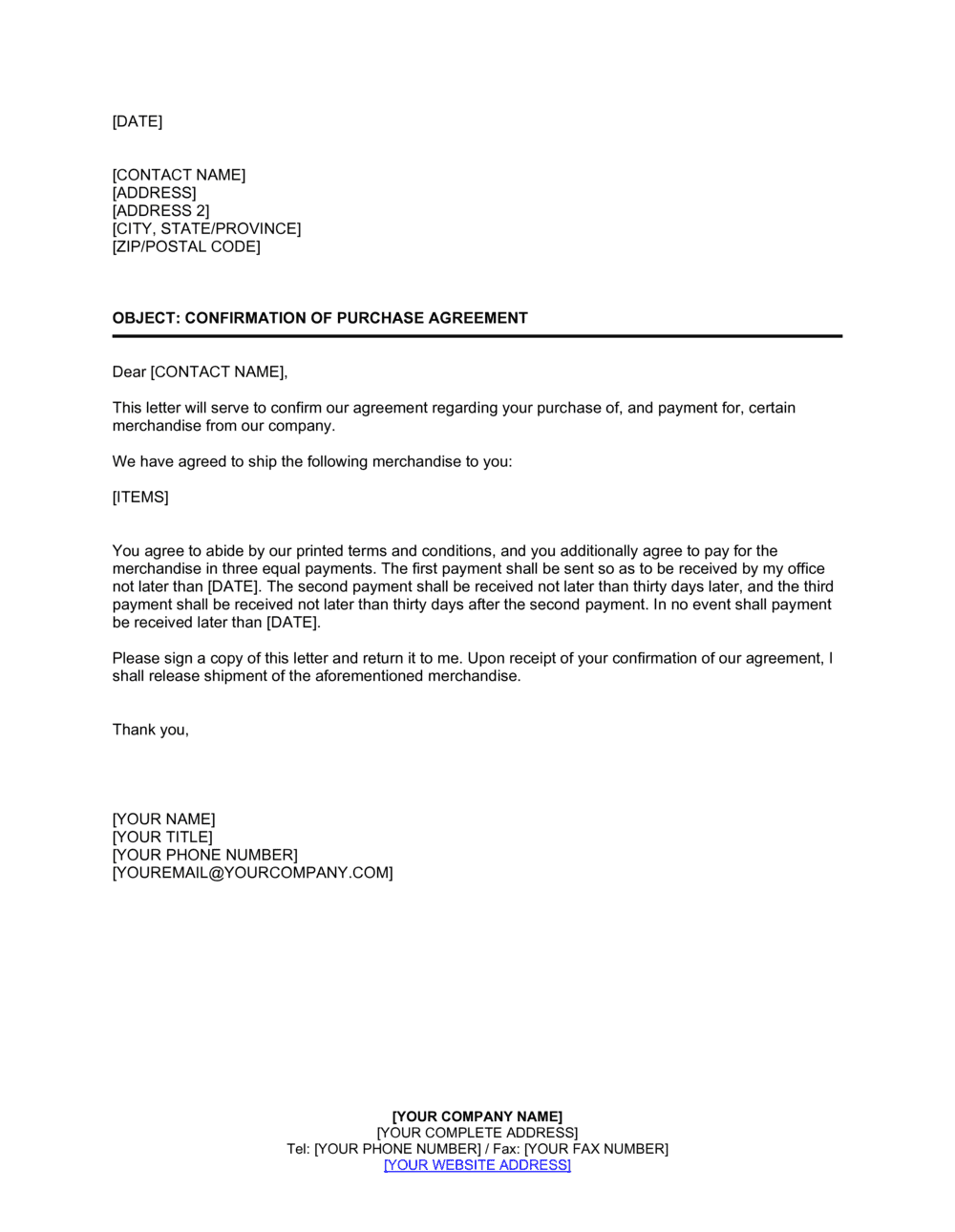
A Confirmation of Purchase Agreement is a formal business letter that puts in writing the key commercial terms both parties agreed to β€” price, quantity, delivery schedule, and payment conditions β€” following a negotiation or purchase order acceptance. This free Word download gives you a ready-to-edit template you can customize and send within minutes, with no formal contract required.
When you need it
Use it immediately after a verbal or email negotiation concludes, when a buyer accepts a seller's quotation, or when a purchase order is received and you need to formally acknowledge the agreed terms before a full contract is drafted.
What's inside
Buyer and seller details, confirmation statement, itemized description of goods or services, agreed price and payment terms, delivery schedule and conditions, and a closing acknowledgment requesting the recipient's countersignature or written acceptance.

What is a Confirmation of Purchase Agreement?

A Confirmation of Purchase Agreement is a formal business letter that puts the key commercial terms of a completed negotiation or accepted purchase order in writing β€” covering the description of goods or services, agreed price, payment terms, and delivery schedule. It functions as a written record between buyer and seller in situations where a full purchase contract has not yet been drafted or is not required. Unlike a purchase order (which the buyer issues to initiate a transaction) or a sales quotation (which the seller issues to propose terms), this letter is issued once both parties have reached agreement, creating a clear and shared reference point before fulfillment begins.

Why You Need This Document

Verbal agreements and email threads are easy to misremember, misinterpret, or lose entirely once a transaction moves into fulfillment. A confirmation of purchase agreement replaces that ambiguity with a single dated document both parties can reference β€” specifying exactly what was ordered, at what price, when it is due, and on what payment terms. Without it, delivery disputes over quantity or specification, payment disagreements over due dates, and freight liability arguments are common outcomes, each of which costs time and money to resolve. For businesses processing recurring supplier orders or onboarding new vendors, this template provides a consistent, professional format that keeps every transaction documented and your accounts-payable and procurement teams aligned from the moment a deal is agreed.

Which variant fits your situation?

If your situation is…Use this template
Confirming a standard product order after PO acceptanceConfirmation of Purchase Agreement
Formalizing a binding contract for high-value or complex goodsPurchase Agreement
Confirming terms for ongoing recurring supplySupply Agreement
Acknowledging receipt of a purchase order before fulfillmentPurchase Order Acknowledgment Letter
Confirming terms for a services engagement rather than goodsService Agreement Confirmation Letter
Providing a preliminary price and delivery confirmation before final orderSales Quotation

Common mistakes to avoid

❌ Vague product descriptions

Why it matters: A description like 'agreed goods' or 'products as discussed' creates disputes at delivery when quantities or specifications are questioned. The letter becomes unusable as an accounts-payable document.

Fix: Copy product names, SKUs, and quantities directly from the PO or quotation. If details are extensive, attach a Schedule A and reference it in the body.

❌ No acceptance deadline

Why it matters: Without a response deadline, the confirmation remains open indefinitely. The seller cannot commit inventory, schedule production, or begin fulfillment with confidence.

Fix: State a specific date β€” typically 3–5 business days from the letter date β€” by which the recipient must confirm or the seller will proceed on the basis of acceptance.

❌ Missing currency on international transactions

Why it matters: An amount stated as '$10,000' is ambiguous when parties are in different countries. Mismatched currency assumptions have resulted in real payment shortfalls of 20–30% on large orders.

Fix: Always include the ISO currency code (USD, CAD, GBP, EUR) immediately after every monetary figure in the letter.

❌ Omitting delivery Incoterms or conditions

Why it matters: Unspecified delivery terms mean both parties assume the other is responsible for freight, insurance, and risk during transit. Damaged goods with no agreed Incoterm become a costly dispute.

Fix: State the applicable Incoterm, the point of transfer, and which party pays freight. Even a simple 'FOB [SELLER WAREHOUSE]' eliminates the most common delivery disputes.

The 9 key clauses, explained

Header and parties

In plain language: Identifies both the sender and recipient by full legal name, company, address, and contact details, and states the date of the letter.

Sample language
[SENDER COMPANY NAME] | [ADDRESS] | [DATE] | To: [RECIPIENT FULL NAME], [TITLE] | [RECIPIENT COMPANY NAME] | [ADDRESS]

Common mistake: Using a trade name instead of the registered legal entity name. If a dispute arises, the confirmation may not be enforceable against the correct legal party.

Subject line and reference

In plain language: States the purpose of the letter and ties it to the originating purchase order or negotiation reference number so both parties can match it to their records.

Sample language
Re: Confirmation of Purchase Agreement β€” PO No. [PO NUMBER] dated [DATE]

Common mistake: Omitting the PO or reference number. Without it, the letter floats disconnected from the buyer's accounting and procurement systems, delaying approval.

Confirmation statement

In plain language: A clear opening paragraph stating that this letter confirms the terms agreed between the two parties as of the referenced date.

Sample language
We are pleased to confirm the terms of the purchase agreement entered into between [BUYER COMPANY NAME] and [SELLER COMPANY NAME] on [DATE], as follows.

Common mistake: Using hedging language like 'this letter is intended to summarize our discussions.' Ambiguous phrasing weakens the letter's value as a written record.

Description of goods or services

In plain language: Itemizes exactly what is being purchased β€” product name, model, SKU, quantity, and unit of measure β€” so there is no ambiguity about what the agreement covers.

Sample language
[QUANTITY] units of [PRODUCT NAME / MODEL NO.] ([SKU / PART NO.]), as described in Attachment A.

Common mistake: Writing a generic description like 'the goods discussed.' Vague descriptions create disputes at delivery and make the letter useless as an accounts-payable reference.

Price and total amount

In plain language: States the agreed unit price, any applicable discounts, applicable taxes, and the total amount payable in the specified currency.

Sample language
Unit price: $[X] [CURRENCY]. Quantity: [N]. Total: $[X] [CURRENCY], exclusive of applicable taxes. Any applicable sales tax will be itemized on the invoice.

Common mistake: Omitting the currency on letters sent to international counterparties. USD and CAD or GBP and EUR are easily confused without an explicit currency code.

Payment terms

In plain language: Specifies when payment is due, the accepted payment methods, and any late-payment consequences.

Sample language
Payment is due [Net 30 / NET 60 / on delivery] from the date of invoice. Accepted methods: [bank transfer / ACH / check]. Late payments accrue interest at [X]% per month after [X] days.

Common mistake: Stating 'payment upon receipt of invoice' without a specific number of days. Recipients interpret this inconsistently, leading to delayed remittance.

Delivery schedule and conditions

In plain language: States the expected delivery date or window, the delivery location, the Incoterm or shipping condition, and who bears freight costs.

Sample language
Goods will be delivered to [DELIVERY ADDRESS] on or before [DATE]. Delivery terms: [FOB / EXW / CIF] [LOCATION]. Freight costs are the responsibility of [BUYER / SELLER].

Common mistake: Leaving delivery terms as 'to be arranged.' Unspecified delivery terms shift the conversation at shipment time and create disputes over damaged or lost goods.

Warranties and disclaimers

In plain language: States any seller warranties on the goods (quality, conformity to specification) and any limitations on liability included in the agreement.

Sample language
Seller warrants that the goods will conform to the specifications in Attachment A and be free from defects for [X] days from delivery. All other warranties, express or implied, are excluded to the extent permitted by applicable law.

Common mistake: Omitting any warranty language entirely. Silence on warranties does not eliminate implied warranties in many jurisdictions β€” stating limitations explicitly is safer.

Acknowledgment and acceptance request

In plain language: Closes the letter by asking the recipient to confirm their acceptance of the stated terms in writing, either by countersignature or a written reply.

Sample language
Please confirm your acceptance of the above terms by signing and returning a copy of this letter to [EMAIL / ADDRESS] by [DATE]. If we do not receive a response by [DATE], we will proceed on the basis that these terms are accepted.

Common mistake: No deadline for acceptance. Without a response deadline, the letter remains open indefinitely and the seller cannot plan fulfillment or commit inventory.

How to fill it out

  1. 1

    Enter both parties' full legal details

    Add the sender's and recipient's registered company names, addresses, and contact names. Use legal entity names, not trading names, and confirm the correct AP or procurement contact.

    πŸ’‘ Ask the buyer for their legal entity name and billing address before drafting β€” mismatches between the letter and PO slow down payment processing.

  2. 2

    Add the PO or reference number in the subject line

    Enter the buyer's purchase order number, or the seller's quotation reference, in the subject line. This links the confirmation to both parties' internal records.

    πŸ’‘ If no PO exists yet, create an internal reference number (e.g., CONF-2026-001) so you can track the document through your own system.

  3. 3

    Describe the goods or services specifically

    List each item with its product name, model or SKU, and quantity. If the description is lengthy, attach a separate Schedule A and reference it in the body.

    πŸ’‘ Copy the product descriptions directly from the accepted quotation or PO to avoid any discrepancy between documents.

  4. 4

    State the price, currency, and tax treatment

    Enter the agreed unit price, quantity, and total. Specify the currency and clarify whether the price is inclusive or exclusive of applicable taxes.

    πŸ’‘ For cross-border transactions, state the FX rate used if price was negotiated in a currency different from the invoicing currency.

  5. 5

    Set specific payment terms with a due date

    Choose Net 30, Net 60, on delivery, or a milestone schedule. Include the accepted payment methods and any late-payment interest rate agreed between the parties.

    πŸ’‘ Net 30 from invoice date β€” not from delivery date β€” gives you more control over the payment clock, especially when fulfillment is staggered.

  6. 6

    Specify delivery date, location, and Incoterm

    Enter the committed delivery date or window, the exact delivery address, and the applicable Incoterm (FOB, EXW, CIF, etc.) that determines who bears risk and freight cost.

    πŸ’‘ If delivery depends on a production lead time, state a range (e.g., 'between [DATE] and [DATE]') rather than a single date you cannot guarantee.

  7. 7

    Set an acceptance deadline and send

    Add a deadline of 3–5 business days for the recipient to countersign or confirm acceptance. Export as PDF and send to the buyer's procurement and AP contacts simultaneously.

    πŸ’‘ Follow up with a short email the day before the acceptance deadline β€” most delays are due to the letter sitting in an inbox, not active disagreement.

Frequently asked questions

What is a confirmation of purchase agreement?

A confirmation of purchase agreement is a formal business letter that restates and acknowledges the key commercial terms both parties agreed to β€” price, quantity, delivery, and payment β€” following a negotiation or purchase order acceptance. It creates a clear written record of the deal before a full contract is drafted or in situations where a formal contract is not used.

Is a confirmation of purchase agreement legally binding?

It can be, depending on the jurisdiction and how it is worded. A confirmation letter that clearly states agreed terms and is countersigned by both parties is generally treated as a binding written record of those terms. However, it typically does not replace a formal purchase contract for high-value or complex transactions β€” consider consulting a lawyer if enforceability is critical to your situation.

When should I send a confirmation of purchase agreement instead of a formal contract?

Use a confirmation letter for routine transactions where both parties have an established relationship, the value is moderate, and speed matters more than extensive legal protection. For high-value, first-time, or cross-border transactions β€” or where IP, warranties, or liability are significant concerns β€” a formal purchase agreement is more appropriate.

What is the difference between a confirmation of purchase agreement and a purchase order?

A purchase order is issued by the buyer to authorize a purchase before the seller has confirmed acceptance. A confirmation of purchase agreement is typically issued by the seller (or jointly) to acknowledge that both parties have agreed to specific terms. The PO initiates the transaction; the confirmation closes the loop and documents the agreed terms.

Does a confirmation of purchase agreement need to be signed?

A signature is not strictly required for the letter to serve as a written record, but requesting a countersignature β€” or a written reply confirming acceptance β€” significantly strengthens its value as evidence of a binding agreement. Including an acceptance deadline in the letter ensures you receive a timely response.

What payment terms should I include in a confirmation of purchase agreement?

State the payment due date in specific terms β€” Net 30 or Net 60 from invoice date is the most common for B2B transactions. Include the accepted payment methods (bank transfer, ACH, check) and any late-payment interest rate. Avoid vague terms like 'due upon receipt,' which different AP departments interpret inconsistently.

Can I use this letter for services as well as goods?

Yes. While confirmation letters are most common for goods transactions, the same format works for services engagements β€” replace the product description and delivery schedule with a scope of work summary and project timeline. For complex services arrangements, a full service agreement is generally more appropriate.

What happens if the other party does not respond to the confirmation letter?

If you include an acceptance deadline and state that silence will be treated as acceptance, the letter is typically treated as accepted in practice β€” though enforceability on this basis varies by jurisdiction. The safer approach is to follow up by phone or email before the deadline and obtain explicit written confirmation.

How this compares to alternatives

vs Purchase Agreement

A purchase agreement is a full legal contract covering title transfer, warranties, indemnification, dispute resolution, and governing law. A confirmation letter is a shorter document used to acknowledge agreed terms quickly β€” it is appropriate for routine transactions but does not provide the same legal depth. Use a purchase agreement when value, risk, or complexity is high.

vs Purchase Order

A purchase order is issued by the buyer to authorize and initiate a purchase. A confirmation of purchase agreement is issued to acknowledge that both parties have accepted the terms. They typically reference each other β€” the PO initiates, the confirmation closes the loop.

vs Sales Quotation

A quotation is a seller's offer stating price and conditions before agreement. A confirmation letter is sent after the buyer accepts β€” it converts the quotation into a documented mutual commitment. The two documents together form a paper trail of the full transaction cycle.

vs Letter of Intent

A letter of intent signals a party's plan to enter an agreement but is typically non-binding and precedes final negotiation. A confirmation of purchase agreement is issued after terms are fully agreed and is intended to be a binding or near-binding record. Use a letter of intent during negotiation; use a confirmation after it concludes.

Industry-specific considerations

Manufacturing and wholesale

Confirms bulk unit pricing, production lead times, FOB terms, and phased delivery schedules tied to inventory planning.

Retail and e-commerce

Documents agreed product quantities, per-unit costs, and shipping windows between buyer and supplier ahead of seasonal stock orders.

Construction and trades

Confirms materials specifications, quantities, and delivery dates tied to project milestones where delays carry direct cost consequences.

Professional services

Confirms scope, fee, and payment schedule for consulting or project-based engagements before a full service agreement is executed.

Template vs pro β€” what fits your needs?

PathBest forCostTime
Use the templateRoutine B2B purchase transactions between established counterparties where speed and simplicity matterFree10–15 minutes per letter
Template + professional reviewFirst-time supplier relationships, international transactions, or orders above $50,000 where terms need a professional check$100–$300 for a legal or commercial advisor review1–2 business days
Custom draftedHigh-value, complex, or multi-jurisdictional purchases requiring a full purchase contract rather than a confirmation letter$500–$2,000+ for a commercial lawyer to draft3–7 business days

Glossary

Purchase Agreement
A binding commercial contract in which a buyer agrees to buy and a seller agrees to sell specific goods or services at defined terms.
Purchase Order (PO)
A buyer-issued document authorizing a specific purchase at an agreed price β€” becomes a binding commitment when the seller accepts it.
Confirmation Letter
A written document that restates and acknowledges terms previously agreed verbally or in preliminary correspondence, creating a clear written record.
Net 30 / Net 60
Payment terms requiring the buyer to remit the full invoice amount within 30 or 60 days of the invoice or delivery date.
Delivery Terms
The conditions governing when, where, and how goods are transferred from seller to buyer, including responsibility for shipping costs and risk of loss.
Incoterms
Standardized international trade terms (e.g., FOB, CIF, EXW) that define which party bears cost and risk at each stage of shipping.
FOB (Free on Board)
A delivery term specifying the point at which the buyer takes ownership and risk of goods β€” typically at the seller's loading dock or the port of origin.
Consideration
Something of value exchanged between parties β€” typically money in exchange for goods or services β€” that makes an agreement legally enforceable.
Counterpart Acceptance
A written response from the recipient confirming they agree to the terms stated in the confirmation letter, often by signing and returning it.
Force Majeure
A clause excusing a party from performance obligations when extraordinary events beyond their control β€” natural disasters, strikes, or government actions β€” prevent fulfillment.

Part of your Business Operating System

This document is one of 3,000+ business & legal templates included in Business in a Box.

  • Fill-in-the-blanks β€” ready in minutes
  • 100% customizable Word document
  • Compatible with all office suites
  • Export to PDF and share electronically

Create your document in 3 simple steps.

From template to signed document β€” all inside one Business Operating System.
1
Download or open template

Access over 3,000+ business and legal templates for any business task, project or initiative.

2
Edit and fill in the blanks with AI

Customize your ready-made business document template and save it in the cloud.

3
Save, Share, Send, Sign

Share your files and folders with your team. Create a space of seamless collaboration.

Save time, save money, and create top-quality documents.

β˜…β˜…β˜…β˜…β˜…

"Fantastic value! I'm not sure how I'd do without it. It's worth its weight in gold and paid back for itself many times."

Managing Director Β· Mall Farm
Robert Whalley
Managing Director, Mall Farm Proprietary Limited
β˜…β˜…β˜…β˜…β˜…

"I have been using Business in a Box for years. It has been the most useful source of templates I have encountered. I recommend it to anyone."

Business Owner Β· 4+ years
Dr Michael John Freestone
Business Owner
β˜…β˜…β˜…β˜…β˜…

"It has been a life saver so many times I have lost count. Business in a Box has saved me so much time and as you know, time is money."

Owner Β· Upstate Web
David G. Moore Jr.
Owner, Upstate Web

Run your business with a system β€” not scattered tools

Stop downloading documents. Start operating with clarity. Business in a Box gives you the Business Operating System used by over 250,000 companies worldwide to structure, run, and grow their business.

Free Forever PlanΒ Β·Β No credit card required