Notice of Rejection of Goods Template

Free Word download β€’ Edit online β€’ Save & share with Drive β€’ Export to PDF

1 pageβ€’15–25 min to fillβ€’Difficulty: Standard
Learn more ↓
FreeNotice of Rejection of Goods Template

At a glance

What it is
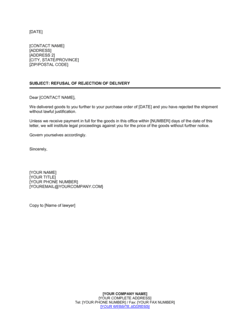
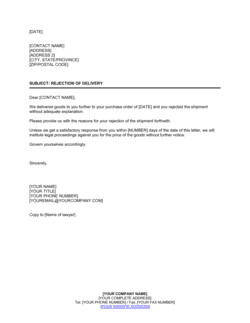
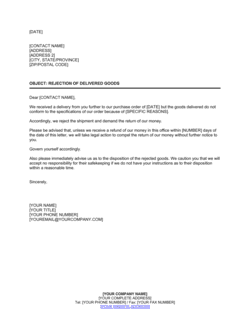
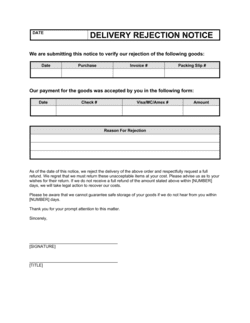
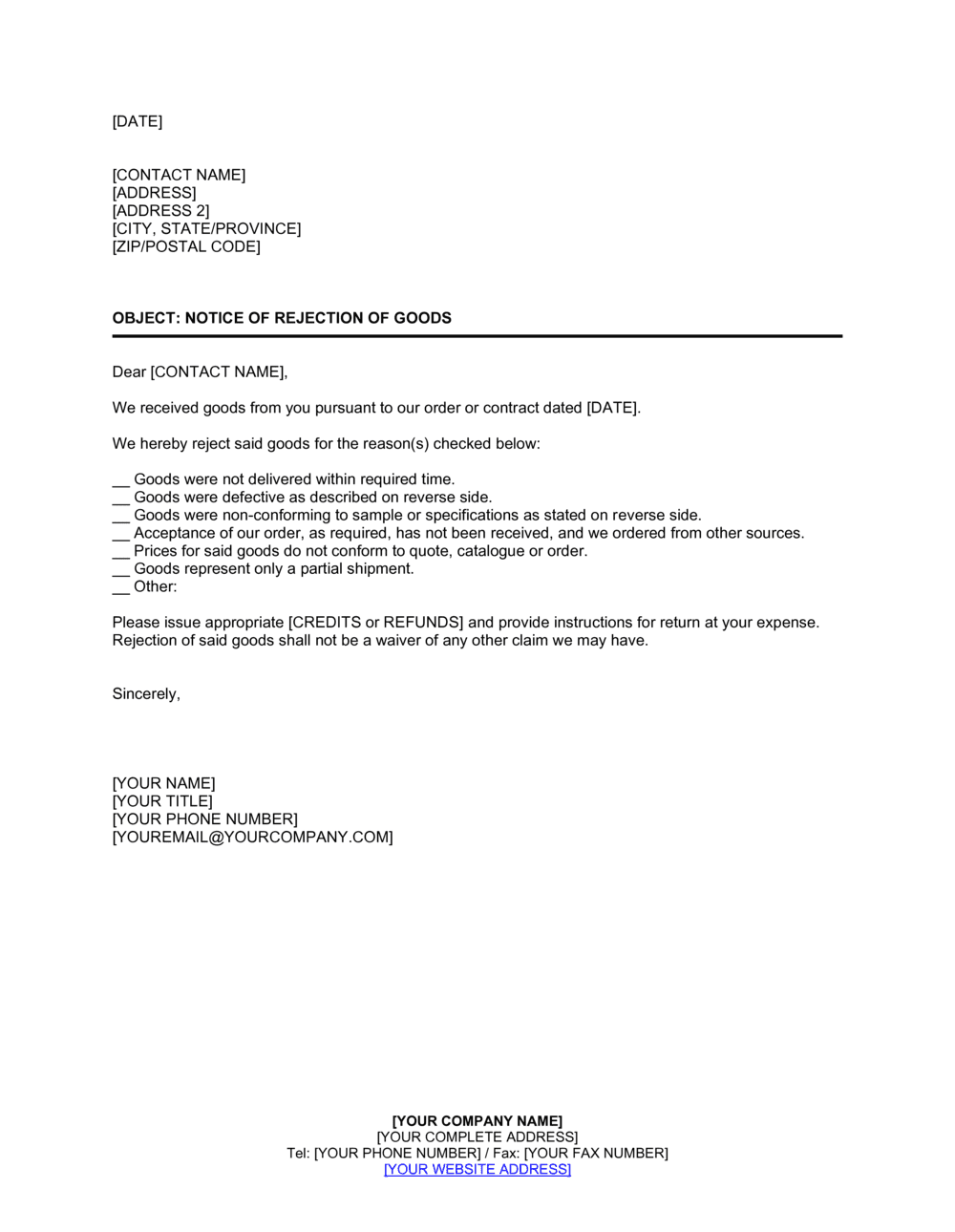
A Notice of Rejection of Goods is a formal written letter a buyer sends to a seller to reject a delivery of goods that are defective, non-conforming to the purchase order or contract, or delivered outside the agreed timeframe. This free Word download gives you a structured, legally grounded template you can complete in minutes and send by email or certified mail to preserve your rights.
When you need it
Use it as soon as your inspection reveals a problem with a delivery β€” defects, wrong quantities, incorrect specifications, damaged packaging, or missed delivery deadlines. Acting within the inspection period defined by your contract or applicable law (typically the UCC or Sale of Goods Act) is critical to keeping your remedies intact.
What's inside
Buyer and seller identification, reference to the original purchase order and delivery, a specific description of the grounds for rejection, a statement preserving the buyer's legal remedies, instructions for goods return or collection, and a demand for replacement, cure, or refund.

What is a Notice of Rejection of Goods?

A Notice of Rejection of Goods is a formal letter a buyer sends to a seller to refuse acceptance of a delivery where the goods are defective, non-conforming to the purchase order or supply contract, delivered in the wrong quantity, or received outside the agreed delivery window. It formally exercises the buyer's right of rejection under the applicable contract and governing law β€” UCC Article 2 in the United States, the Sale of Goods Act in Canada and the United Kingdom, and equivalent legislation in other common-law jurisdictions. Critically, it must be sent promptly after inspection: a buyer who waits too long is deemed to have accepted the goods, surrendering the right to reject and limiting available remedies to damages alone.

Why You Need This Document

Without a formal, written rejection notice, your right to return defective goods and demand a refund or replacement can evaporate silently. Courts apply a strict "reasonable time" standard to rejection β€” informal complaint emails, phone calls, or even a supplier's acknowledgment that the goods were substandard do not substitute for a timely, specific written notice. A properly drafted rejection notice stops the acceptance clock, puts the seller on notice of their cure obligations, and creates a documented paper trail that supports a refund claim, a chargeback, or escalation to arbitration if the seller refuses to cooperate. This template gives you the correct structure β€” parties, reference numbers, specific grounds, reservation of remedies, and a firm deadline β€” so you can act within hours of a failed inspection rather than spending that time drafting from scratch.

Which variant fits your situation?

If your situation is…Use this template
Goods arrive visibly damaged or defective on inspectionNotice of Rejection of Goods
Goods delivered do not match purchase order specificationsNotice of Rejection of Goods (Non-Conformance)
Delivery arrived outside the agreed delivery windowNotice of Rejection of Goods (Late Delivery)
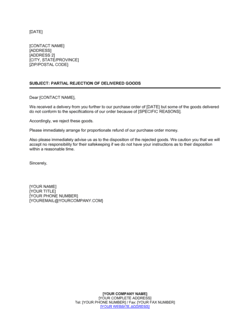
Goods partially conform but a portion of the shipment must be returnedNotice of Partial Rejection of Goods
Buyer has accepted goods but discovered a hidden defect after acceptanceNotice of Revocation of Acceptance
Buyer wants to formally claim compensation for losses caused by defective goodsBreach of Contract Notice Letter
Buyer wants to cancel the purchase order entirely following rejectionPurchase Order Cancellation Letter

Common mistakes to avoid

❌ Waiting past the inspection period before sending the notice

Why it matters: Under the UCC and most Sale of Goods legislation, a buyer who fails to reject within a reasonable time after delivery is deemed to have accepted the goods, forfeiting the right to reject and limiting available remedies.

Fix: Send the rejection notice immediately after inspection confirms the defect β€” the same day if possible, and no later than within two to three business days of delivery.

❌ Using a vague or informal complaint email instead of a formal notice

Why it matters: An email saying 'these aren't right, can you sort it?' does not constitute a formal exercise of the right of rejection and may not stop the acceptance clock from running.

Fix: Use the formal notice template, address it to the correct entity, cite the PO and invoice numbers, and send it on company letterhead by tracked mail or with a delivery receipt.

❌ Failing to specify the grounds for rejection

Why it matters: A rejection notice that only says 'goods are defective' gives the seller grounds to dispute validity and makes it harder to claim damages or enforce a remedy later.

Fix: Describe each defect or non-conformance in specific terms β€” dimensions, quantities, test results, or the specification clause breached β€” so the seller cannot claim uncertainty.

❌ Disposing of or using the rejected goods before the seller collects them

Why it matters: Using or consuming goods that have been formally rejected can be treated as acceptance, voiding the rejection. It also destroys evidence needed for any dispute.

Fix: Hold the rejected goods securely and separately, clearly labeled as 'Rejected β€” Awaiting Collection,' and do not use them in production or resell them pending resolution.

The 9 key clauses, explained

Header and parties

In plain language: Identifies the buyer sending the notice, the seller receiving it, and the date of the letter.

Sample language
[BUYER COMPANY NAME] | [BUYER ADDRESS] | [DATE] | To: [SELLER COMPANY NAME] | Attn: [SELLER CONTACT NAME AND TITLE] | [SELLER ADDRESS]

Common mistake: Addressing the letter to a sales contact rather than the seller's accounts or legal department β€” rejection notices can trigger contractual timelines and need to reach the right person.

Subject line and reference numbers

In plain language: Clearly labels the letter as a formal rejection and cites the purchase order number, invoice number, and delivery date for easy cross-referencing.

Sample language
Re: Notice of Rejection of Goods β€” Purchase Order No. [PO NUMBER] | Invoice No. [INVOICE NUMBER] | Delivery Date: [DATE]

Common mistake: Omitting the purchase order or invoice number. Without a precise reference, the seller may dispute which delivery is being rejected.

Description of delivery received

In plain language: Briefly states what was delivered β€” item description, quantity, and the date and method of delivery β€” to establish the factual record.

Sample language
On [DATE], we received a delivery from your company of [QUANTITY] units of [PRODUCT DESCRIPTION] pursuant to Purchase Order No. [PO NUMBER] dated [PO DATE].

Common mistake: Being too vague about what was received. A brief, specific description prevents the seller from claiming uncertainty about which goods are being rejected.

Grounds for rejection

In plain language: Specifies the precise reason or reasons the goods are rejected β€” defect, non-conformance to specification, incorrect quantity, or late delivery.

Sample language
Upon inspection, we determined that the goods do not conform to the agreed specifications for the following reasons: [SPECIFIC DEFECT OR NON-CONFORMANCE DESCRIPTION, e.g., 'the units exhibit [DEFECT] in breach of the quality standard set out in Section [X] of our Agreement dated [DATE]'].

Common mistake: Citing only a general complaint such as 'quality issues' without specifying the defect. Vague grounds make it easier for the seller to dispute the rejection and harder for the buyer to enforce remedies.

Statement of rejection and legal basis

In plain language: Formally declares the buyer's rejection of the goods and references the contractual or statutory right on which the rejection is based.

Sample language
We hereby formally reject the above-described goods pursuant to [our Agreement dated [DATE] / UCC Β§ 2-601 / the Sale of Goods Act] and notify you that we do not accept the delivery.

Common mistake: Omitting any reference to the legal or contractual basis. Without it, the letter reads as a complaint rather than a formal exercise of a legal right.

Preservation of remedies

In plain language: States that the buyer reserves all rights and remedies arising from the non-conformance, including the right to damages, and that nothing in the letter constitutes a waiver.

Sample language
This notice is without prejudice to any other rights or remedies available to [BUYER COMPANY NAME] under our Agreement, applicable law, or in equity, all of which are expressly reserved.

Common mistake: Omitting this clause entirely. Without a reservation of rights, the seller may later argue that issuing the notice settled the matter.

Instructions for goods disposal or collection

In plain language: Tells the seller what to do with the rejected goods β€” collect them, arrange return shipping, or confirm return instructions within a specified timeframe.

Sample language
The rejected goods remain at your risk and are available for collection at [BUYER'S ADDRESS]. Please arrange collection within [X] business days. If we do not hear from you within this period, we reserve the right to return the goods at your cost.

Common mistake: Failing to state who bears the cost of return. Without this, disputes over return freight charges can delay resolution and add unexpected costs.

Demand for remedy

In plain language: States what the buyer expects the seller to do β€” deliver conforming replacement goods, issue a full refund, or credit the invoice β€” and sets a deadline for response.

Sample language
We require [replacement of the goods with conforming units / full refund of the purchase price of $[AMOUNT] / credit note for the full invoice value] no later than [DATE]. Failure to respond within this period will leave us with no alternative but to pursue available remedies.

Common mistake: Not setting a specific deadline for the seller's response. An open-ended demand creates no urgency and makes it difficult to escalate if the seller stalls.

Closing and signature block

In plain language: Closes the letter professionally, identifies the authorized signatory by name and title, and provides contact details for follow-up.

Sample language
Yours sincerely, | [SIGNATORY FULL NAME] | [TITLE] | [BUYER COMPANY NAME] | [EMAIL] | [PHONE]

Common mistake: Signing the letter without including a direct contact name and phone or email. The seller's team needs a specific person to reach to begin resolution.

How to fill it out

  1. 1

    Gather your reference documents before you start

    Locate the original purchase order, the supply contract or terms and conditions, the delivery note, and the seller's invoice. You will need the PO number, invoice number, and delivery date to complete the header.

    πŸ’‘ Take photographs of the defective or non-conforming goods at inspection β€” attach them to the email alongside the rejection letter as contemporaneous evidence.

  2. 2

    Complete the header with full party details

    Enter your company's full legal name and address, the date, and the seller's full legal name, attention line, and mailing address. Use the seller's accounts payable or legal department address, not just the sales rep.

    πŸ’‘ Send by both email and certified mail or tracked courier. Email creates a time-stamped record; certified mail provides proof of delivery if the matter escalates.

  3. 3

    Enter all reference numbers in the subject line

    Include the purchase order number, invoice number, and delivery date. If the seller uses their own order reference number, add that too β€” it speeds up internal matching.

    πŸ’‘ A clear subject line reduces the chance of the letter being misfiled or ignored as a general complaint.

  4. 4

    Describe the delivery received accurately

    State what was delivered β€” product name or SKU, quantity, and delivery date. Keep this factual and brief; this section is the record of what you received, not yet the complaint.

    πŸ’‘ Match the product description exactly to what appears on the purchase order to prevent any dispute about which goods are being rejected.

  5. 5

    State the grounds for rejection with specifics

    Describe each defect or non-conformance precisely β€” include dimensions, test results, quantities, or specification clauses where relevant. If there are multiple grounds, list them separately.

    πŸ’‘ Reference the specific contract clause or specification schedule that the goods fail to meet. 'Does not meet Section 3.2 of the Technical Specification dated [DATE]' is far stronger than 'wrong quality.'

  6. 6

    Insert your demand and set a firm deadline

    Choose whether you want replacement goods, a full refund, or a credit note, and state a specific calendar date by which the seller must respond or deliver the remedy.

    πŸ’‘ A response deadline of 5–10 business days is standard. Too short may appear unreasonable; too long removes urgency and delays your cash flow or operations.

  7. 7

    Sign and send β€” then follow up in writing

    Have an authorized person at your company sign the letter. Send it via email with a read receipt and by tracked post. Set a calendar reminder to follow up if no response is received by the deadline.

    πŸ’‘ If the seller acknowledges receipt verbally, follow up with a brief email: 'Confirming our phone call today β€” we look forward to your written response by [DATE].'

Frequently asked questions

What is a notice of rejection of goods?

A notice of rejection of goods is a formal letter a buyer sends to a seller to refuse acceptance of a delivery because the goods are defective, do not conform to the purchase order specifications, are the wrong quantity, or arrived outside the agreed delivery window. It formally exercises the buyer's right of rejection under the contract or applicable law β€” such as UCC Article 2 in the US or the Sale of Goods Act in Canada and the UK β€” and preserves the buyer's remedies, including the right to a refund or replacement.

When should I send a notice of rejection of goods?

Send it as soon as inspection reveals a problem β€” ideally on the day of delivery or within two to three business days at most. Under UCC Article 2, rejection must occur within a reasonable time after delivery; what is "reasonable" depends on the nature of the goods and trade custom, but courts interpret this narrowly. Waiting weeks before sending notice is one of the most common ways buyers inadvertently lose their right to reject.

What happens if I use the goods after sending a rejection notice?

Using, consuming, or reselling goods you have formally rejected can be treated as acceptance under the UCC and similar statutes, which would void the rejection. Keep rejected goods segregated and clearly labeled pending collection or return instructions from the seller. If you must use a portion to avoid urgent operational loss, document the circumstances carefully and seek legal advice, as partial use may create complex liability.

Does a notice of rejection of goods need to be signed?

A signature is not a statutory requirement for the notice to be legally effective in most jurisdictions, but it is strongly recommended. A signed letter on company letterhead from an authorized representative is harder to dismiss as informal and creates a cleaner record if the matter escalates to arbitration or litigation.

What is the difference between rejection and revocation of acceptance?

Rejection occurs before acceptance β€” the buyer inspects the goods and refuses them within the inspection period. Revocation of acceptance applies after the buyer has accepted goods, when a substantial non-conformity that was not apparent during inspection is discovered later. Revocation has a higher legal threshold and must occur within a reasonable time of discovering the defect. If you have already accepted goods and found a hidden defect, use a Notice of Revocation of Acceptance rather than this template.

Can I reject only part of a shipment?

Yes. Under the UCC and most Sale of Goods legislation, a buyer can accept conforming units and reject non-conforming ones from the same shipment β€” this is known as partial rejection. You should document clearly which specific units or lots you are accepting and which you are rejecting, referencing serial numbers, batch codes, or quantity counts. A partial rejection notice should be as precise as a full rejection notice.

What remedies can I demand after rejecting goods?

Following a valid rejection, a buyer can typically demand delivery of conforming replacement goods within a reasonable cure period, a full refund of the purchase price, a credit note against future orders, or damages for losses caused by the non-conformance β€” such as production downtime or emergency substitute procurement costs. Which remedy is available and how quickly depends on your contract terms and the applicable statute in your jurisdiction.

Do I need a lawyer to send a notice of rejection of goods?

For most standard commercial rejections β€” defective or non-conforming goods on a routine purchase order β€” a well-completed template is sufficient. Engage a lawyer if the value of the goods is significant, if the seller disputes the rejection or threatens litigation, if the non-conformance caused substantial downstream losses you intend to recover, or if the contract has unusual dispute resolution or notice requirements.

How this compares to alternatives

vs Breach of Contract Notice Letter

A breach of contract notice is a broader document asserting that the other party has violated any term of an agreement and demanding remedy or cure. A notice of rejection of goods is a specific, time-sensitive letter focused on the narrow right to refuse a delivery before acceptance occurs. Use the rejection notice first; escalate to a breach notice if the seller fails to cure.

vs Purchase Order

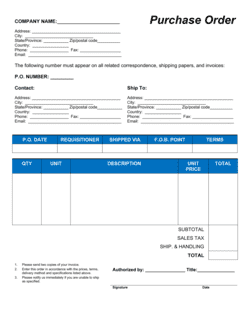
A purchase order initiates the transaction by setting out what the buyer wants, in what quantity, at what price, and by what delivery date. A notice of rejection of goods comes at the end of the transaction when the delivered goods fail to match what the purchase order required. The PO number is a critical reference in every rejection notice.

vs Demand Letter

A demand letter is a general-purpose formal letter requesting payment, performance, or remedy for any type of dispute. A notice of rejection of goods is specifically designed to exercise the statutory right of rejection within the inspection period β€” it cites delivery references, specifies non-conformances, and triggers cure obligations in a way a generic demand letter does not.

vs Credit Note

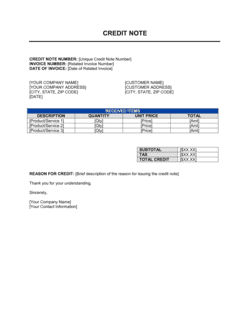
A credit note is issued by the seller to reduce or cancel an invoice after a return or adjustment has been agreed. A notice of rejection of goods is issued by the buyer to initiate that process β€” it is the document that triggers the seller's obligation to issue a credit note or replacement. The rejection notice comes first; the credit note follows.

Industry-specific considerations

Manufacturing

Raw material and component rejections for dimensional non-conformance, material certificate failures, or missed delivery dates that halt production schedules.

Retail and Distribution

Rejection of wholesale deliveries with incorrect SKUs, damaged packaging, short shipments, or goods arriving past the selling-season deadline.

Construction and Trades

Rejection of building materials that fail specification, arrive damaged, or do not meet the grade required by project contracts or building codes.

Food and Beverage

Rejection of perishable goods that arrive outside the required temperature range, past use-by dates, or failing food-safety certification requirements.

Template vs pro β€” what fits your needs?

PathBest forCostTime
Use the templateBuyers rejecting routine commercial deliveries on standard purchase orders where the grounds are clear and the value is modestFree15–30 minutes
Template + professional reviewRejections involving significant contract value, supplier relationship risk, or goods that caused downstream production or financial losses$100–$300 for a brief solicitor or lawyer review1–2 business days
Custom draftedComplex multi-jurisdiction supply disputes, high-value manufacturing contracts, or situations where litigation or arbitration is likely$500–$2,000+3–7 business days

Glossary

Non-Conforming Goods
Goods that fail to match the description, quantity, quality, or specifications set out in the purchase order or supply contract.
Inspection Period
The window of time after delivery during which the buyer is entitled to examine goods and give notice of rejection β€” typically defined by contract or statute.
Right of Rejection
A buyer's entitlement under contract or statute to refuse delivery of goods that do not conform to the agreed terms, before acceptance has occurred.
Acceptance (of Goods)
The point at which a buyer treats delivered goods as conforming β€” either explicitly, by conduct, or by allowing the inspection period to lapse without rejection.
Cure
A seller's right or obligation to remedy a defective or non-conforming delivery within a reasonable time after receiving notice of rejection.
UCC (Uniform Commercial Code)
A body of US commercial law governing the sale of goods; Article 2 sets out the buyer's rights to inspect, reject, and seek remedies for non-conforming deliveries.
Sale of Goods Act
Legislation in Canada, the UK, and other common-law jurisdictions that implies terms about quality, fitness for purpose, and conformity into contracts for the sale of goods.
Revocation of Acceptance
A buyer's right to undo a prior acceptance of goods when a substantial non-conformity that was not discovered during inspection is later revealed.
Perfect Tender Rule
A principle under US UCC Article 2 allowing a buyer to reject an entire shipment if the goods or the tender of delivery fails in any respect to conform to the contract.
Certified Mail
A postal service that provides proof of mailing and delivery β€” the recommended method for sending rejection notices to create a documented, time-stamped record.

Part of your Business Operating System

This document is one of 3,000+ business & legal templates included in Business in a Box.

  • Fill-in-the-blanks β€” ready in minutes
  • 100% customizable Word document
  • Compatible with all office suites
  • Export to PDF and share electronically

Create your document in 3 simple steps.

From template to signed document β€” all inside one Business Operating System.
1
Download or open template

Access over 3,000+ business and legal templates for any business task, project or initiative.

2
Edit and fill in the blanks with AI

Customize your ready-made business document template and save it in the cloud.

3
Save, Share, Send, Sign

Share your files and folders with your team. Create a space of seamless collaboration.

Save time, save money, and create top-quality documents.

β˜…β˜…β˜…β˜…β˜…

"Fantastic value! I'm not sure how I'd do without it. It's worth its weight in gold and paid back for itself many times."

Managing Director Β· Mall Farm
Robert Whalley
Managing Director, Mall Farm Proprietary Limited
β˜…β˜…β˜…β˜…β˜…

"I have been using Business in a Box for years. It has been the most useful source of templates I have encountered. I recommend it to anyone."

Business Owner Β· 4+ years
Dr Michael John Freestone
Business Owner
β˜…β˜…β˜…β˜…β˜…

"It has been a life saver so many times I have lost count. Business in a Box has saved me so much time and as you know, time is money."

Owner Β· Upstate Web
David G. Moore Jr.
Owner, Upstate Web

Run your business with a system β€” not scattered tools

Stop downloading documents. Start operating with clarity. Business in a Box gives you the Business Operating System used by over 250,000 companies worldwide to structure, run, and grow their business.

Free Forever PlanΒ Β·Β No credit card required