Notice of Defective Goods Template

Free Word download β€’ Edit online β€’ Save & share with Drive β€’ Export to PDF

1 pageβ€’15–25 min to fillβ€’Difficulty: Standard
Learn more ↓
FreeNotice of Defective Goods Template

At a glance

What it is
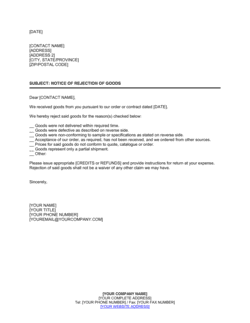
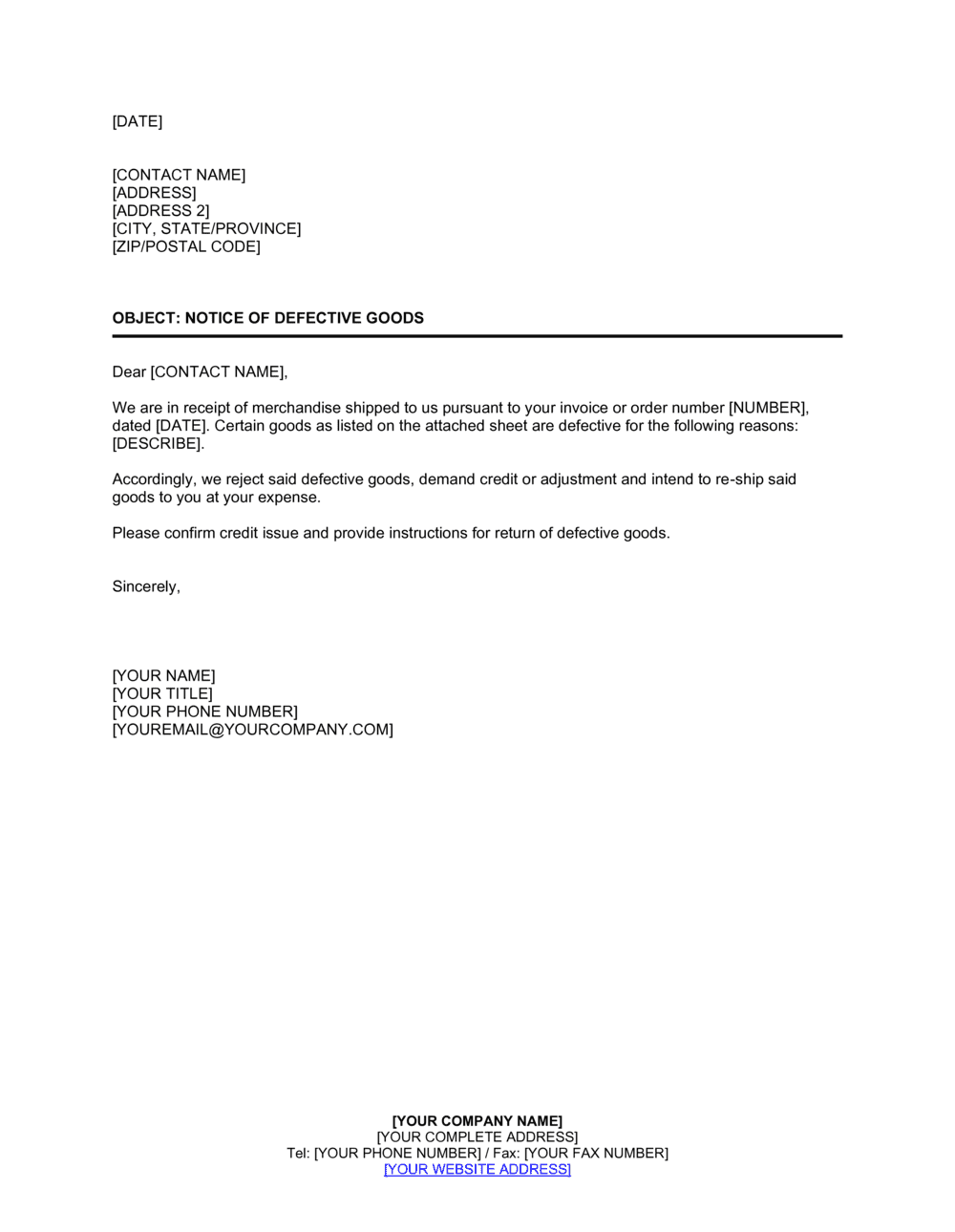
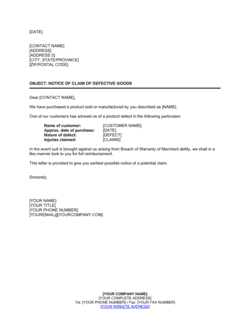
A Notice of Defective Goods is a formal business letter a buyer sends to a supplier or vendor to document that delivered goods fail to meet the agreed specifications, quality standards, or contractual requirements. This free Word download gives you a structured, professional starting point you can edit online in minutes and export as PDF to send by email or post.
When you need it
Use it as soon as you discover that received goods are faulty, damaged, non-conforming, or otherwise unacceptable β€” before returning items, requesting a replacement, or escalating a dispute. Prompt written notice preserves your rights under most purchase agreements and commercial law.
What's inside
Sender and recipient details, a clear description of the defective goods and the nature of the defect, references to the original purchase order and delivery date, the specific remedy requested, a deadline for response, and a professional closing that keeps the door open for resolution.

What is a Notice of Defective Goods?

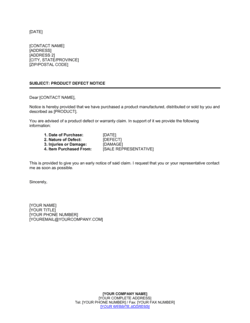
A Notice of Defective Goods is a formal business letter a buyer sends to a supplier or vendor to document in writing that a delivery of goods fails to meet the agreed quality standards, product specifications, or contractual requirements. It identifies the specific items affected, describes the nature of the defect, references the original purchase order, and states the remedy the buyer is requesting β€” replacement, refund, or credit β€” together with a deadline for the supplier to respond. Unlike an informal complaint email, a properly drafted notice creates a timestamped paper trail that preserves the buyer's contractual rights and provides the foundation for any escalation if the supplier fails to act.

Why You Need This Document

Discovering a defective shipment without sending a formal written notice is one of the most common and costly mistakes buyers make. Most supply agreements and commercial law frameworks β€” including the Uniform Commercial Code in the United States and the Sale of Goods Act in the UK β€” require buyers to give timely written notice of defects. Fail to do so, and silence can be treated as acceptance of the goods, extinguishing your right to a refund or replacement regardless of how serious the defect is. A clearly worded notice also protects you when you withhold payment: without it, holding back an invoice can put you in breach of your payment terms even though the goods were faulty. This template gives you a professional, complete notice you can fill in and send within 15 minutes of completing your inspection β€” turning a frustrating supplier problem into a documented, time-stamped claim with a clear path to resolution.

Which variant fits your situation?

If your situation is…Use this template
Goods arrived visibly damaged during transitNotice of Defective Goods (Damaged in Shipping)
Delivered items do not match the agreed specifications or SKUNotice of Defective Goods (Wrong Goods Delivered)
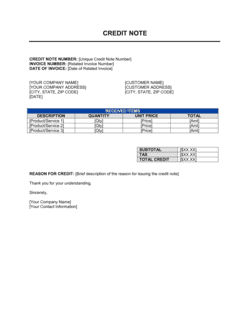
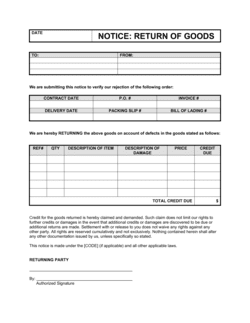
Goods are defective and you want to return the entire shipmentReturn Merchandise Authorization Request
Supplier has repeatedly delivered defective goods and you want to terminate the relationshipSupplier Termination Letter
You need to put payment on hold while the defect is investigatedLetter Disputing an Invoice
Goods caused financial loss and you are seeking compensation beyond replacementDemand Letter

Common mistakes to avoid

❌ Delaying the notice after discovering the defect

Why it matters: Most supply agreements and commercial laws require timely notice of defects. A delay of several weeks can be interpreted as acceptance of the goods, extinguishing your right to a remedy.

Fix: Send the notice within 24–72 hours of completing your goods inspection, even if you are still quantifying the full scope of the problem.
❌ Vague defect description with no measurements or evidence

Why it matters: A description like 'the goods are not right' gives the supplier no actionable information and leaves the dispute open to interpretation at every stage.

Fix: Describe defects with specific, measurable language β€” dimensions, failure test results, batch numbers β€” and attach photographic or written inspection evidence.

❌ No reference to the purchase order or contract

Why it matters: Without a PO or contract reference, the supplier cannot tie your complaint to a specific transaction, slowing resolution and weakening your legal standing.

Fix: Always include the PO number, order date, delivery date, and a reference to the relevant contract clause or quality specification.

❌ Requesting a remedy without setting a response deadline

Why it matters: An open-ended request gives the supplier no urgency to act, and without a documented deadline you cannot formally escalate the matter.

Fix: State a specific deadline β€” '14 calendar days from the date of this notice' β€” and note the action you will take if the deadline is not met.

The 9 key clauses, explained

Header β€” Sender and recipient details

In plain language: Identifies who is sending the notice and who is receiving it, including full business names, addresses, and the date.

Sample language
[SENDER COMPANY NAME] | [ADDRESS] | [CITY, STATE, ZIP] | [DATE] To: [SUPPLIER COMPANY NAME] | Attn: [CONTACT NAME / TITLE] | [ADDRESS]

Common mistake: Addressing the letter to a sales rep rather than the accounts or quality-control department β€” the wrong recipient slows response and can let the cure period run out.

Subject line

In plain language: A one-line summary that references the purchase order number and flags the notice type so the supplier can route it immediately.

Sample language
RE: Notice of Defective Goods β€” Purchase Order #[PO NUMBER], Delivered [DELIVERY DATE]

Common mistake: Using a vague subject like 'Issue with Recent Order.' Without a PO number, the supplier cannot match the letter to the transaction and response is delayed.

Opening β€” Reference to the purchase order and delivery

In plain language: States when the goods were ordered, under which PO, when they were received, and that an inspection has been carried out.

Sample language
We are writing to formally notify you of defective goods received under Purchase Order #[PO NUMBER], dated [ORDER DATE], delivered to our premises on [DELIVERY DATE] and inspected on [INSPECTION DATE].

Common mistake: Omitting the inspection date. Without it, the supplier may argue the defect occurred after delivery and attempt to shift liability.

Description of the defective goods

In plain language: Identifies the specific goods affected β€” product name, SKU, lot or batch number, quantity received, and quantity found defective.

Sample language
The following goods were found to be defective: [PRODUCT NAME], SKU #[SKU], Batch/Lot #[BATCH NUMBER]. Quantity received: [X] units. Quantity found defective: [Y] units.

Common mistake: Describing defects without specifying which units are affected. A vague 'some of the items are faulty' gives the supplier room to dispute the scope of the problem.
Description of the defect

In plain language: Explains the specific nature of the defect β€” what is wrong, how it was discovered, and how the goods fail to meet the agreed standard.

Sample language
The defect observed is as follows: [DESCRIPTION OF DEFECT β€” e.g., 'cracked housing rendering the units inoperable' / 'dimensions 15% outside the tolerance specified in Schedule A of the contract' / 'discoloration inconsistent with the approved sample']. This defect renders the goods [unfit for their intended purpose / not of merchantable quality / non-conforming to the agreed specification].

Common mistake: Using subjective language like 'the goods look poor.' Specific, measurable defect descriptions β€” dimensions, test results, failure modes β€” are far harder to dispute.

Reference to the applicable standard or contract term

In plain language: Ties the defect to the specific contractual obligation or quality standard the goods were supposed to meet.

Sample language
These goods fail to meet the [quality specifications / product description / sample standard] set out in [the Purchase Order / the Supply Agreement dated [DATE] / Schedule [X]].

Common mistake: Sending the notice with no reference to the agreed standard. Without this anchor, the supplier can claim the goods met a 'general' standard and shift the burden of proof to you.

Remedy requested

In plain language: States clearly what the buyer wants β€” replacement, repair, full refund, credit note, or partial price reduction β€” and by when.

Sample language
We hereby request [replacement of all defective units at no additional cost / a full refund of $[AMOUNT] / a credit note in the amount of $[AMOUNT]] within [14 / 30] days of the date of this notice.

Common mistake: Requesting a remedy without a deadline. No deadline means the supplier has no urgency to respond and the dispute can drag on indefinitely.

Notice of intention to withhold payment

In plain language: Informs the supplier that payment for the defective goods will be withheld or disputed until the matter is resolved.

Sample language
Please be advised that we will be withholding payment of $[INVOICE AMOUNT] relating to Invoice #[INVOICE NUMBER] pending satisfactory resolution of this matter.

Common mistake: Withholding payment without stating it in the notice. Doing so without written notice can put you in breach of the payment terms regardless of the defect.

Closing β€” Contact and next steps

In plain language: Provides a contact person for the supplier to reach, states willingness to cooperate in resolution, and sets a professional tone that keeps the business relationship intact.

Sample language
Please contact [NAME] at [EMAIL / PHONE] to arrange collection of the defective goods and confirm your proposed remedy. We remain committed to resolving this matter promptly and continuing our business relationship.

Common mistake: Ending on a threatening or adversarial tone. A professional closing preserves the supplier relationship and makes escalation to formal dispute resolution easier if the matter is not resolved.

How to fill it out

  1. 1

    Enter your company details and the date

    Add your full business name, address, and the date the notice is being sent. This establishes the formal record and starts any applicable cure period.

    πŸ’‘ Send the notice on the same day or the day after you complete your goods inspection β€” delays weaken your position.

  2. 2

    Address the letter to the correct supplier contact

    Direct the letter to the supplier's quality, accounts payable, or customer service department β€” not just the sales rep. Include their full address and an attention line.

    πŸ’‘ Call the supplier's main number to confirm the right AP or quality contact before sending β€” it saves days in the response chain.

  3. 3

    Complete the subject line with the PO number

    Reference the purchase order number, delivery date, and the words 'Notice of Defective Goods' in the subject line so the supplier can locate the transaction instantly.

    πŸ’‘ If your supply agreement assigns a contract reference number, include that too alongside the PO number.

  4. 4

    Describe the defective goods specifically

    List the product name, SKU, batch or lot number, total units received, and total units found defective. Attach photos or inspection reports as supporting evidence.

    πŸ’‘ Photographs with timestamps taken at the time of inspection are the single most effective way to prevent a supplier from disputing the defect.

  5. 5

    Describe the defect with reference to the agreed standard

    State exactly what is wrong and which contractual term, specification, or quality standard the goods fail to meet. Use measurable language where possible.

    πŸ’‘ Quote the exact clause or schedule from your supply agreement β€” it turns a complaint into a contractual notice.

  6. 6

    State your remedy and the deadline

    Choose replacement, refund, or credit note and set a specific response deadline β€” typically 14 to 30 days. Confirm whether you will withhold payment pending resolution.

    πŸ’‘ 14 days is appropriate for urgent operational impact; 30 days is standard for non-urgent defects. Match the deadline to the severity.

  7. 7

    Sign, save, and send by a tracked method

    Have the letter signed by an authorized representative, save a copy for your records, and send by email with read receipt or tracked post.

    πŸ’‘ Email with a read receipt is sufficient for most supplier relationships. For high-value disputes, follow up by registered mail to create an unambiguous delivery record.

Frequently asked questions

What is a notice of defective goods?

A notice of defective goods is a formal written letter a buyer sends to a supplier to document that delivered goods are faulty, damaged, or non-conforming to the agreed specifications. It creates a written record of the defect, references the relevant purchase order, states the specific remedy requested, and sets a deadline for response β€” preserving the buyer's rights under the supply agreement and applicable commercial law.

When should I send a notice of defective goods?

Send it as soon as you have completed an inspection and confirmed a defect β€” typically within 24 to 72 hours of discovery. Most supply agreements require prompt written notice, and many commercial law frameworks treat silence or delay as implied acceptance of the goods. The sooner you send the notice, the stronger your position.

What remedies can I request in a notice of defective goods?

The most common remedies are replacement of the defective units at the supplier's cost, a full or partial refund, or a credit note reducing the invoice balance. You can also request a repair if the goods are repairable, or a price reduction if you choose to keep the goods at a reduced value. State one clear remedy with a specific deadline in the notice.

Can I withhold payment while a defective goods dispute is open?

In most jurisdictions, a buyer can withhold payment for goods that are genuinely defective or non-conforming, provided the notice is sent promptly and the withheld amount corresponds to the disputed goods. Always state the payment hold explicitly in the notice and reference the specific invoice number. Withholding payment without written notice can put you in breach of your payment terms regardless of the defect.

Does a notice of defective goods need to be signed?

No formal signature or notarization is required for a notice of defective goods to be effective. However, it should be signed by an authorized representative of your business to establish accountability and authenticity. Sending by email with a read receipt, or by tracked post, creates the delivery record that matters most.

What supporting evidence should I attach to the notice?

Attach photographs of the defective goods taken at the time of inspection, the original purchase order, the supplier's delivery note, and any inspection or test reports that document the defect. Timestamped photographs are particularly valuable because they establish that the defect existed at the time of delivery rather than arising afterward.

What is the difference between a notice of defective goods and a demand letter?

A notice of defective goods is a formal but cooperative communication that documents the problem and requests a remedy within a reasonable timeframe, typically sent as a first step. A demand letter is a more formal legal document sent when the supplier has failed to respond or resolve the issue, and it signals that legal action or formal dispute resolution is the next step. Most defective-goods situations begin with a notice and escalate to a demand letter only if the notice is ignored.

How long should I give the supplier to respond?

Fourteen days is appropriate when the defect is causing immediate operational disruption or financial loss. Thirty days is the standard cure period for non-urgent defects. Check your supply agreement first β€” it may specify a response timeframe. Whatever period you choose, state the exact calendar date the deadline falls on rather than a number of days to avoid any ambiguity.

How this compares to alternatives

vs Demand Letter

A demand letter is an escalation document sent after a supplier has failed to resolve a defect complaint. A notice of defective goods is the first formal step β€” cooperative in tone, requesting a remedy within a defined period. Use the notice first; send a demand letter only if the supplier ignores or refuses the initial notice.

vs Product Complaint Letter

A product complaint letter is typically used by individual consumers to notify a retailer or manufacturer of a faulty purchase. A notice of defective goods is a B2B document addressed to a commercial supplier, referencing purchase orders, supply agreements, and bulk quantities. The business context makes specific, contractual language essential.

vs Return Merchandise Authorization Request

An RMA request is a form or letter asking the supplier to authorize the physical return of defective goods. A notice of defective goods establishes the formal record of the defect first and may or may not result in a return β€” the remedy could be a refund, replacement, or credit without a return. Send the notice first, then the RMA request once the remedy is agreed.

vs Supplier Termination Letter

A supplier termination letter ends the entire supply relationship, typically citing repeated non-performance or breach. A notice of defective goods addresses a specific delivery and seeks resolution while preserving the relationship. Use the notice for isolated defects; escalate to a termination letter only when a pattern of defective supply makes the relationship untenable.

Industry-specific considerations

Manufacturing

Defective components or raw materials can halt an entire production line, making prompt written notice critical to both supply chain recovery and warranty cost recovery from the upstream supplier.

Retail and wholesale

Damaged or non-conforming inventory cannot be sold, directly impacting revenue β€” formal notice is needed to trigger a replacement shipment or credit before the selling season passes.

Construction and trades

Substandard materials delivered to a job site can compromise structural integrity and trigger project delays, making a documented defect notice essential before installation proceeds.

Food and beverage

Defective or out-of-specification ingredients carry food safety and regulatory implications, requiring immediate written notice to the supplier and documentation for any traceability or recall investigation.

Template vs pro β€” what fits your needs?

PathBest forCostTime
Use the templateAny buyer dealing with a standard defective-goods dispute with a commercial supplierFree10–15 minutes
Template + professional reviewHigh-value shipments, disputes where legal escalation is likely, or complex multi-party supply chains$100–$300 for a solicitor or commercial lawyer review1–2 business days
Custom draftedLarge commercial disputes, regulated industries (food safety, medical devices), or international supply contracts$500–$1,500+3–7 business days

Glossary

Non-Conforming Goods
Goods that fail to meet the specifications, quality standards, or description agreed upon in the purchase order or contract.
Purchase Order (PO)
A buyer-issued document authorizing a supplier to deliver specific goods at an agreed price, quantity, and delivery date.
Remedy
The corrective action requested by the buyer, such as replacement, repair, full refund, or a price reduction.
Rejection of Goods
A buyer's formal refusal to accept delivered goods because they fail to conform to the contract β€” typically triggering a right to a refund or replacement.
Fit for Purpose
A standard requiring that goods are suitable for the specific use the buyer communicated to the seller at the time of purchase.
Merchantable Quality
A baseline standard requiring goods to be of acceptable quality for their ordinary intended use, free from significant defects.
Cure Period
The time a supplier is given to fix, replace, or otherwise remedy a defect before the buyer escalates to a formal dispute or legal claim.
Credit Note
A document issued by the supplier reducing the amount owed by the buyer β€” commonly used to settle defective-goods disputes without a full refund.
RMA (Return Merchandise Authorization)
A supplier-issued approval code or form that authorizes the buyer to return defective goods for exchange or refund.

Part of your Business Operating System

This document is one of 3,000+ business & legal templates included in Business in a Box.

  • Fill-in-the-blanks β€” ready in minutes
  • 100% customizable Word document
  • Compatible with all office suites
  • Export to PDF and share electronically

Create your document in 3 simple steps.

From template to signed document β€” all inside one Business Operating System.
1
Download or open template

Access over 3,000+ business and legal templates for any business task, project or initiative.

2
Edit and fill in the blanks with AI

Customize your ready-made business document template and save it in the cloud.

3
Save, Share, Send, Sign

Share your files and folders with your team. Create a space of seamless collaboration.

Save time, save money, and create top-quality documents.

β˜…β˜…β˜…β˜…β˜…

"Fantastic value! I'm not sure how I'd do without it. It's worth its weight in gold and paid back for itself many times."

Managing Director Β· Mall Farm
Robert Whalley
Managing Director, Mall Farm Proprietary Limited
β˜…β˜…β˜…β˜…β˜…

"I have been using Business in a Box for years. It has been the most useful source of templates I have encountered. I recommend it to anyone."

Business Owner Β· 4+ years
Dr Michael John Freestone
Business Owner
β˜…β˜…β˜…β˜…β˜…

"It has been a life saver so many times I have lost count. Business in a Box has saved me so much time and as you know, time is money."

Owner Β· Upstate Web
David G. Moore Jr.
Owner, Upstate Web

Run your business with a system β€” not scattered tools

Stop downloading documents. Start operating with clarity. Business in a Box gives you the Business Operating System used by over 250,000 companies worldwide to structure, run, and grow their business.

Free Forever PlanΒ Β·Β No credit card required