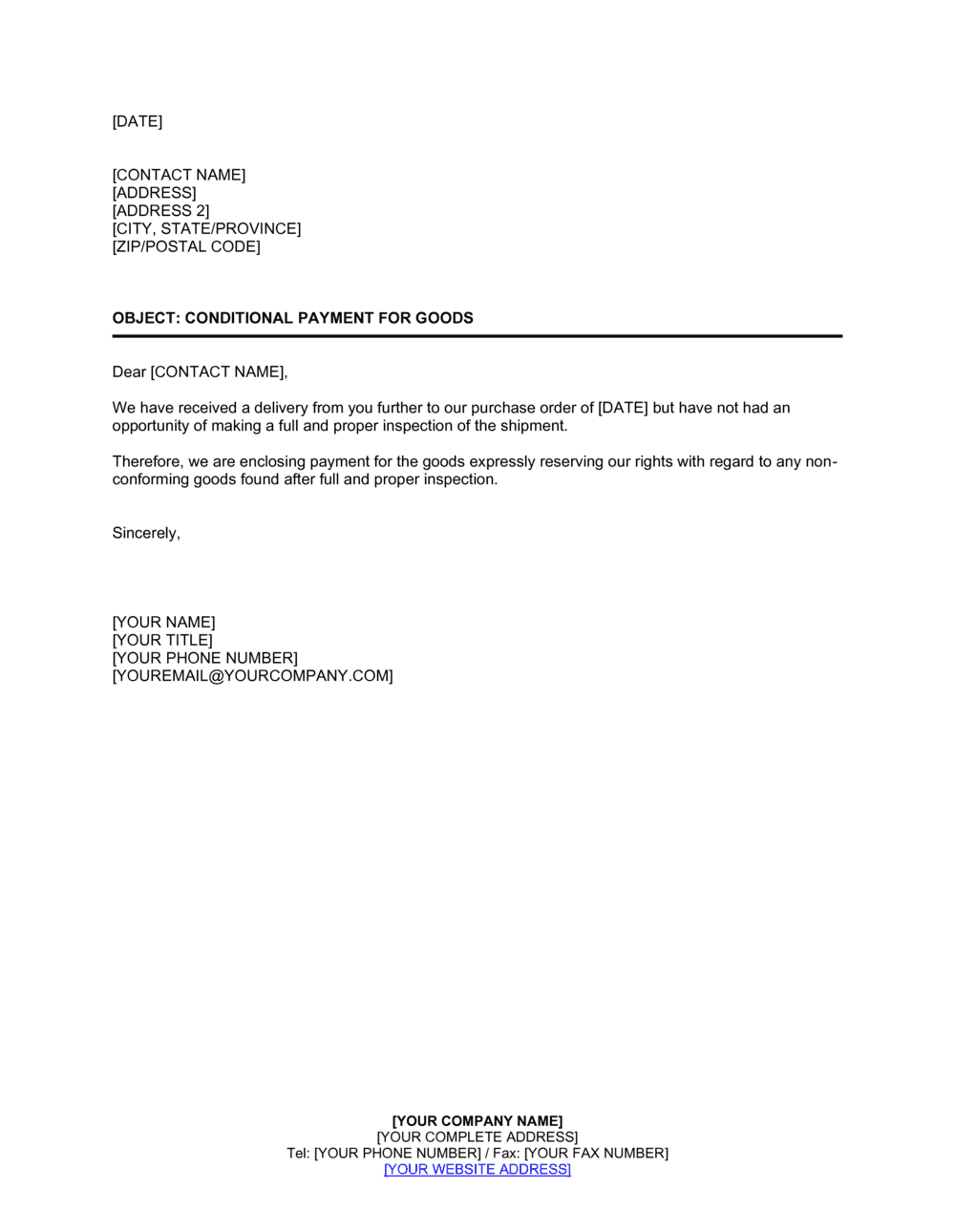
Conditional Payment for Goods Reserving Rights Template

Free Word download • Edit online • Save & share with Drive • Export to PDF

1 page20–30 min to fillDifficulty: StandardSignature requiredLegal review recommended
Learn more ↓
FreeConditional Payment for Goods Reserving Rights Template

At a glance

What it is
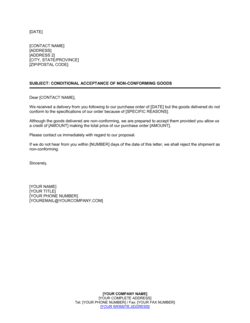
A Conditional Payment for Goods Reserving Rights is a legally binding letter or agreement a buyer or debtor uses when remitting payment for goods while expressly preserving the right to dispute the full amount, quality, or terms of the underlying transaction. This free Word download lets you document the conditional nature of the payment before sending it, protecting you from the legal risk that accepting or issuing the payment constitutes full and final settlement of all claims.
When you need it
Use it when you need to pay an invoice — in whole or in part — but believe the amount is incorrect, the goods were defective, short-shipped, or non-conforming, and you want to avoid the payment being treated as acceptance or accord and satisfaction. It is also used by sellers who accept a partial payment from a buyer but explicitly refuse to release the remainder of their claim.
What's inside
Identification of the parties and the underlying transaction, a clear statement of the amount being paid and the conditions attached to it, an explicit reservation of all legal rights and remedies, a description of the unresolved dispute or outstanding claim, and signature blocks for the paying party with optional acknowledgment by the recipient.

What is a Conditional Payment for Goods Reserving Rights?

A Conditional Payment for Goods Reserving Rights is a formal legal letter a buyer or payer issues when remitting payment for goods — in full or in part — while explicitly preserving every legal claim, defense, and remedy arising from the transaction. It operates as a documented, contemporaneous declaration that the payment is made conditionally and under protest, and that it does not constitute acceptance of the goods as conforming, acknowledgment that the full invoiced amount is correct, or — most critically — accord and satisfaction of any disputed claim. By creating a clear paper trail at the moment of payment, the letter defeats the most common mechanism by which a dispute is inadvertently extinguished: the creditor accepting or depositing a payment and later asserting it closed the matter.

Why You Need This Document

Without a conditional payment letter, remitting payment on a disputed invoice is legally dangerous. In the United States, UCC § 3-311 provides that a creditor who deposits a check tendered as full satisfaction of a disputed claim may be bound by that settlement — even if they crossed out "payment in full" on the memo line or objected verbally afterward. The same risk exists under common-law accord and satisfaction principles in Canada, the UK, and most other common-law jurisdictions. A buyer who pays a defective-goods invoice without a written reservation may find their warranty claim, short-shipment deduction, or damages action extinguished at the moment of payment. A seller who accepts a reduced payment without a written reservation may lose the right to pursue the balance. This template gives both parties the mechanism to meet their immediate payment obligations — avoiding late fees, preserving supplier relationships, and preventing a breach of the underlying contract — while keeping every downstream legal option open. The cost of not using it can be the entire value of the dispute.

Which variant fits your situation?

If your situation is…Use this template
Buyer pays full invoiced amount but disputes defective goodsConditional Payment for Goods Reserving Rights
Buyer pays only the undisputed portion of an invoicePartial Payment Letter Reserving Rights
Seller accepts less than the full amount owed but refuses final settlementConditional Acceptance of Payment Reserving Rights
Payment dispute involves services rather than goodsConditional Payment for Services Reserving Rights
Formal written notice of non-conforming goods before paymentRejection of Goods Letter
Seeking full settlement and release of all claims upon paymentPayment in Full and Final Settlement Agreement
Dispute escalated to formal demand before legal proceedingsDemand Letter for Payment

Common mistakes to avoid

❌ Vague description of the goods dispute

Why it matters: Courts require specific notice of the defect or shortage to give the reservation of rights legal effect. A generic complaint like 'goods were not satisfactory' can be dismissed as insufficient notice of a claim.

Fix: Identify the exact units affected, the specification they failed to meet, the date of delivery, and any inspection or test results — and attach supporting documentation as exhibits to the letter.

❌ Sending the letter after the payment has already been deposited

Why it matters: If the recipient deposits the payment before receiving the reservation of rights letter, they may argue the payment was unconditional at the moment of acceptance, triggering accord and satisfaction in some jurisdictions.

Fix: Send the letter and the payment simultaneously — ideally with the letter attached to or accompanying the payment instrument or referencing the wire transfer confirmation number.

❌ Omitting the accord-and-satisfaction prohibition clause

Why it matters: Under UCC § 1-306 and similar provisions, a creditor who negotiates a payment tendered as full settlement may be bound by that settlement even if they object afterward. Without explicit prohibition language, this risk remains.

Fix: Include a dedicated clause expressly stating that acceptance of this payment does not constitute accord and satisfaction and that the sender reserves all claims for the disputed difference.

❌ Using an unauthorized signatory

Why it matters: A letter signed by someone without authority to bind the company — a junior employee or third party — may be treated as a personal statement rather than a corporate reservation of rights, undermining its legal effect.

Fix: Ensure the letter is signed by an officer, director, or other person whose authority to bind the entity is documented in a corporate resolution, operating agreement, or signing-authority policy.

❌ Choosing a governing law that conflicts with the underlying contract

Why it matters: If the purchase contract specifies Texas law but the reservation letter specifies New York law, courts must resolve the conflict before reaching the merits — often at the expense of the party who introduced the inconsistency.

Fix: Default to the governing law stated in the underlying purchase contract unless there is a specific legal reason to deviate, and note the cross-reference explicitly in the letter.

❌ Failing to send the letter via trackable delivery

Why it matters: If the dispute proceeds to litigation, the recipient may claim they never received the letter, depriving the sender of the reservation's protection at the most critical moment.

Fix: Send via certified mail with return receipt, courier with signature confirmation, or email with a read receipt and a follow-up phone call to confirm receipt — and retain all delivery records in the dispute file.

The 9 key clauses, explained

Identification of Parties and Transaction

In plain language: Names the paying party and the receiving party, and identifies the specific invoice, purchase order, or contract to which the conditional payment relates.

Sample language
This letter is submitted by [BUYER LEGAL NAME] ('Buyer') to [SELLER LEGAL NAME] ('Seller') in connection with Invoice No. [INVOICE NUMBER] dated [DATE], issued under Purchase Order No. [PO NUMBER] for the supply of [GOODS DESCRIPTION] ('Transaction').

Common mistake: Referencing the wrong invoice number or purchase order — a mismatch between the letter and the payment reference allows the recipient to argue the reservation of rights was not properly linked to this payment.

Statement of Payment Amount and Date

In plain language: States the exact dollar amount being remitted, the method of payment, and the date of transmission, creating an unambiguous record of what is being paid.

Sample language
Buyer hereby tenders payment in the amount of $[AMOUNT] by [CHECK / ACH / WIRE TRANSFER] on [DATE]. This amount does not constitute acknowledgment that the full invoiced amount of $[INVOICED AMOUNT] is due and owing.

Common mistake: Omitting the invoiced amount alongside the payment amount. Without the comparison, it is unclear whether a partial or full payment is being made, weakening the reservation of rights.

Description of Dispute or Deficiency

In plain language: Clearly describes the reason the payment is being made conditionally — defective goods, short shipment, pricing error, or breach of warranty — with sufficient specificity to put the recipient on notice.

Sample language
Buyer disputes the full invoiced amount on the following grounds: [DESCRIBE DEFECT / SHORTAGE / PRICING ERROR]. Specifically, [X UNITS / AMOUNT / DESCRIPTION] did not conform to the specifications set out in Purchase Order No. [PO NUMBER] because [SPECIFIC REASON].

Common mistake: Vague descriptions such as 'goods were unsatisfactory.' Courts require specificity to give the reservation of rights effect — an unspecific dispute notice can be disregarded as boilerplate.

Conditional Nature of Payment

In plain language: Expressly states that the payment is being made conditionally and does not constitute acceptance of the goods, satisfaction of the full debt, or waiver of any claims.

Sample language
This payment is made conditionally and under protest. Buyer expressly states that this payment does not constitute: (a) acceptance of the goods as conforming; (b) satisfaction of the full amount claimed by Seller; or (c) a waiver of any rights, claims, or defenses Buyer may have arising from the Transaction.

Common mistake: Burying the conditional language in a footnote or closing paragraph. The conditional nature must be prominent and unambiguous — ideally in the opening paragraph — so no court can find the recipient was unaware of it.

Reservation of All Rights and Remedies

In plain language: A blanket preservation clause stating the paying party retains every legal and equitable right, including the right to seek a refund, damages, replacement goods, or other relief.

Sample language
Buyer expressly reserves all rights and remedies available under the applicable purchase agreement, applicable law (including UCC Article 2 / [APPLICABLE STATUTE]), and in equity, including but not limited to the right to seek a refund of all or part of this payment, damages for breach of warranty, replacement of non-conforming goods, and any other relief to which Buyer may be entitled.

Common mistake: Referencing only statutory rights and omitting contractual or equitable remedies. A seller may argue the reservation was narrowed to statutory claims only, cutting off contract-based remedies.

Prohibition on Treatment as Accord and Satisfaction

In plain language: Explicitly prohibits the recipient from characterizing the acceptance of this payment as accord and satisfaction or full and final settlement of the dispute.

Sample language
Buyer expressly notifies Seller that this payment is not tendered as full satisfaction of the disputed amount and must not be construed as accord and satisfaction. Seller's negotiation or deposit of this payment does not constitute Seller's agreement to release any claims Seller may have, nor does it release Buyer from any claims Buyer has asserted herein.

Common mistake: Omitting this clause entirely and relying only on general reservation language. Courts in several jurisdictions have found that a creditor who deposits a payment marked 'payment in full' triggers accord and satisfaction regardless of intent — this clause directly defeats that argument.

Request for Acknowledgment or Response

In plain language: Invites the recipient to confirm in writing that they have received the payment on the conditional terms stated and to respond to the described dispute within a defined period.

Sample language
Buyer requests that Seller acknowledge receipt of this payment and confirm in writing within [10] business days whether Seller accepts or disputes the conditional terms set out in this letter. Failure to respond shall not be construed as Seller's acceptance of the conditions herein.

Common mistake: Stating that failure to respond constitutes acceptance of the conditional terms. Courts generally will not impose contractual obligations through silence unless expressly permitted by statute or prior agreement.

Governing Law

In plain language: Specifies the jurisdiction whose law governs the interpretation and enforcement of the conditional payment letter.

Sample language
This letter and any disputes arising from the Transaction shall be governed by the laws of [STATE / PROVINCE / COUNTRY], without regard to conflict-of-law principles.

Common mistake: Choosing a governing law that conflicts with the governing law clause in the underlying purchase contract. Inconsistent governing law selections create ambiguity and can void the reservation of rights as applied to the original agreement.

Signature and Authorization

In plain language: Identifies the authorized signatory, their title, and the date of execution, confirming the letter is issued by someone with authority to bind the paying entity.

Sample language
Signed on behalf of [BUYER LEGAL NAME] by: [SIGNATORY NAME], [TITLE], on [DATE]. This individual is duly authorized to execute this letter on behalf of [BUYER LEGAL NAME].

Common mistake: Signing with a personal name without a title or company designation. A letter signed by an individual without identifying their authority to bind the entity may be treated as a personal communication, not a corporate reservation of rights.

How to fill it out

  1. 1

    Identify the parties and the specific transaction

    Enter the full legal names of the paying and receiving parties. Cross-reference the invoice number, purchase order number, and goods description exactly as they appear in the original transaction documents.

    💡 Pull the exact entity names from your signed purchase agreement — trade names and legal entity names must match to avoid a misidentification argument.

  2. 2

    State the payment amount and compare it to the invoiced amount

    Enter both the amount you are remitting and the full amount stated on the invoice. If you are paying in full under protest, state both figures as identical. If paying partially, make the shortfall explicit.

    💡 Send the payment and this letter simultaneously — a gap in timing allows the recipient to argue the payment was unconditional before the letter arrived.

  3. 3

    Describe the dispute or deficiency with specificity

    Detail the exact nature of the problem — defective units, short shipment count, incorrect pricing, failed specification — with dates, quantities, and any reference to the relevant contract term or purchase order specification.

    💡 Attach photographs, inspection reports, or delivery records as exhibits. Documentary exhibits make a vague dispute claim concrete and courts give them significant weight.

  4. 4

    Draft the conditional payment and reservation-of-rights language

    Insert the conditional payment clause and the reservation of all rights paragraph. Ensure both appear prominently — ideally in the first two paragraphs of the letter body rather than in fine print at the end.

    💡 Highlight or bold the phrase 'under protest and without prejudice' in the letter if your jurisdiction permits it — this makes the conditional nature visually unmistakable on deposit.

  5. 5

    Add the accord-and-satisfaction prohibition clause

    Include the explicit clause stating that acceptance or deposit of this payment does not constitute accord and satisfaction. Reference UCC § 1-306 in the US, or the applicable provincial or national statute in other jurisdictions.

    💡 In the US, writing 'full payment' or 'payment in full' on the check without this letter creates an accord and satisfaction risk even when you intend to dispute — never mark checks that way without the accompanying letter.

  6. 6

    Set a response deadline and state the consequences of non-response

    Request acknowledgment within a defined period — 10 business days is standard. State clearly that non-response does not constitute acceptance of your conditional terms.

    💡 Send the letter via certified mail or email with read receipt and retain proof of delivery. Delivery documentation is critical if the dispute proceeds to litigation.

  7. 7

    Have an authorized signatory execute the letter

    The letter must be signed by a person with authority to bind the paying entity — a director, officer, or authorized manager. Include the signatory's title and date of execution.

    💡 If your company requires two signatures for financial commitments above a certain threshold, apply the same authority standard to this letter — it is a legal communication with financial consequences.

  8. 8

    Retain a dated copy and transmit to all required parties

    Save a fully executed copy with proof of transmission to your dispute file. If the purchase agreement requires notices to a specific address or person, send a copy there in addition to the accounts-receivable contact.

    💡 Calendar a follow-up for the response deadline date. If no acknowledgment is received, consider escalating to a formal demand letter or engaging legal counsel.

Frequently asked questions

What is a conditional payment for goods reserving rights?

A conditional payment for goods reserving rights is a formal written notice a buyer or payer sends when remitting payment for goods while explicitly preserving the right to dispute the amount, quality, or terms of the transaction. It prevents the payment from being treated as full and final settlement of all claims — particularly the legal doctrine of accord and satisfaction — by documenting the conditional nature of the payment before or at the time it is made.

When should I use a conditional payment letter instead of simply refusing to pay?

Use a conditional payment letter when refusing to pay entirely would expose you to late-payment penalties, damage a key supplier relationship, or breach your payment obligations under the contract, but you genuinely dispute the amount owed or the quality of the goods delivered. It lets you satisfy your payment obligation and avoid default while keeping your legal claims alive. Outright refusal may be appropriate when the goods are entirely non-conforming and you are formally rejecting them under UCC Article 2 or an equivalent statutory regime.

What is accord and satisfaction, and how does this letter prevent it?

Accord and satisfaction is a legal doctrine that extinguishes a debt when a creditor accepts a lesser sum as full payment of a disputed claim. In the US, if a debtor sends a check marked 'payment in full' for a disputed amount and the creditor deposits it, courts may find the debt fully discharged regardless of the creditor's intent. A conditional payment letter — sent simultaneously with the payment and containing an express prohibition on accord and satisfaction — defeats this argument by putting the recipient on unambiguous notice that the payment is conditional, not a final settlement.

Does the recipient have to sign the letter for it to be effective?

No. A conditional payment letter is effective as a unilateral reservation of rights the moment it is properly transmitted to the recipient alongside or before the payment. The recipient's signature on an acknowledgment block is useful evidence but is not required for the reservation to be valid. What matters is proof that the letter was sent and received — which is why certified mail or tracked email delivery is critical.

Can I use this letter for partial payments as well as full payments?

Yes. The letter works for both situations. When paying the full invoiced amount under protest — for example, to avoid late fees while disputing defective goods — you reserve rights to a refund or damages. When paying only the undisputed portion, you reserve the right to contest liability for the balance. The description of the dispute and the conditional payment clause should clearly specify whether the payment is full or partial and what claims are being preserved in each case.

Is a conditional payment letter enforceable in all jurisdictions?

The concept is recognized in most common-law jurisdictions — the US, Canada, the UK, and Australia — though the statutory framework varies. In the US, UCC § 1-306 governs reservation of rights on payment. In Canada, provincial Sale of Goods Acts and common-law principles apply. The UK and EU rely on contract law and statutory consumer or commercial protections. Because the rules on accord and satisfaction and payment under protest differ by jurisdiction, consider having a local lawyer review the letter before sending in any cross-border transaction.

What should I do if the recipient ignores the conditional payment letter?

If the recipient deposits the payment without responding to your reservation of rights, your legal position is preserved by the letter itself — you do not need their acknowledgment for the reservation to be effective. Follow up in writing restating your dispute within a reasonable time, and retain all correspondence and delivery records. If the dispute is not resolved within the deadline set in your letter, escalate to a formal demand letter or engage legal counsel to pursue your claim for the disputed amount or replacement goods.

Can a seller use this letter as well as a buyer?

Yes. A seller can use a conditional payment letter when accepting a short payment or a payment marked 'payment in full' by the buyer, to make clear that acceptance of the lesser amount does not release the buyer from liability for the balance. The letter structure is the same — identify the transaction, state the amount received, describe the outstanding balance, reserve all rights to collect the remainder, and prohibit interpretation as accord and satisfaction.

What documentation should I attach to the letter?

Attach whatever evidence supports the dispute described in the letter: the original purchase order and invoice, delivery receipts showing quantity shortfalls, inspection reports or photographs documenting defects, written communications with the seller about the problem, and any warranty terms or product specifications from the contract. The stronger the supporting documentation, the more difficult it is for the recipient to claim the dispute is groundless or that the payment was unconditional.

Do I need a lawyer to prepare this letter?

For straightforward domestic disputes involving clearly defective or short-shipped goods, a high-quality template is typically sufficient. Engage a lawyer when the disputed amount is material (generally above $10,000–$25,000), when the transaction is cross-border and governing law is uncertain, when the dispute is likely to proceed to litigation or arbitration, or when the underlying contract contains unusual dispute resolution or notice requirements that must be satisfied for the reservation of rights to be valid.

How this compares to alternatives

vs Accord and Satisfaction Agreement

An accord and satisfaction agreement is the document used when both parties agree to close out a disputed debt for a reduced amount — it is a final settlement and releases all claims. A conditional payment letter is the opposite: it is used when the payer explicitly refuses to treat the payment as final settlement. Use the accord and satisfaction when both parties want to resolve the dispute permanently; use the conditional payment letter when you want to pay now and keep your claims alive.

vs Demand Letter for Payment

A demand letter for payment is sent by a creditor to compel a debtor to pay an overdue amount. A conditional payment letter is sent by the payer to accompany payment while reserving rights. They are used by opposite parties in a dispute — the demand letter precedes or replaces payment; the conditional payment letter accompanies it.

vs Rejection of Goods Letter

A rejection of goods letter formally refuses to accept non-conforming goods under UCC Article 2 or an equivalent statute, typically before payment is made. A conditional payment letter is used when the buyer decides to accept or retain the goods but disputes the price or quality. If the goods are entirely unusable or the buyer has not yet paid, a rejection letter is the appropriate first step.

vs Without Prejudice Settlement Offer

A without-prejudice settlement offer proposes to resolve a dispute for a specific amount, and cannot be used as evidence in court proceedings. A conditional payment letter accompanies actual payment and creates a documented record intended to be part of the legal file. The settlement offer seeks to end the dispute; the conditional payment letter preserves it while meeting a payment obligation.

Industry-specific considerations

Manufacturing and Supply Chain

Short shipments, sub-specification raw materials, and component defects are common triggers — buyers use the letter to pay invoices while preserving warranty and replacement claims.

Retail and Wholesale Distribution

Retailers receiving damaged, mislabeled, or under-quantity stock need to pay suppliers promptly to maintain relationships while formally disputing chargebacks and returns.

Construction and Contracting

Progress payments on contracts involving defective materials or non-conforming deliveries require careful reservation of rights to preserve lien and warranty claims downstream.

Food and Beverage

Perishable goods disputes require rapid payment to avoid supply interruption, making conditional payment letters critical for preserving quality and short-weight claims before the goods are consumed.

Jurisdictional notes

United States

UCC § 1-306 governs reservation of rights on claims after breach or default. UCC § 3-311 addresses accord and satisfaction via negotiable instruments — if a check is tendered as 'full satisfaction' of a disputed claim, the creditor who deposits it may be bound by that settlement. To avoid this, the letter must be sent before or simultaneously with the payment and must use express reservation language. State-level UCC adoptions vary slightly — verify the applicable version in your state.

Canada

Each province has its own Sale of Goods Act setting out buyer and seller remedies for non-conforming goods. The common-law doctrine of accord and satisfaction applies across Canada, and a creditor who accepts a lesser sum as 'full and final payment' can lose the right to pursue the balance. Quebec is governed by the Civil Code of Quebec rather than common law — reservation of rights language must be tailored to civilian legal concepts. French-language versions of the letter are advisable for Quebec transactions.

United Kingdom

The Sale of Goods Act 1979 and the Consumer Rights Act 2015 govern conformity and remedies for non-conforming goods. English contract law recognizes payment under protest as an effective reservation of rights, but the language must be clear and contemporaneous with the payment. The without-prejudice rule applies to settlement communications — if the conditional payment letter includes settlement proposals, mark it 'without prejudice' to protect it from disclosure in litigation.

European Union

EU Directive 2019/771 on the sale of goods harmonizes conformity requirements and buyer remedies across member states for B2C transactions. B2B transactions remain largely governed by national contract law, which varies significantly — German law (BGB), French law (Code Civil), and Dutch law each treat payment under protest and reservation of rights differently. GDPR compliance is relevant if the letter includes personal data about the recipient's employees. For cross-border EU transactions, confirm the applicable national law and consider a local lawyer for disputes above EUR 5,000.

Template vs lawyer — what fits your deal?

PathBest forCostTime
Use the templateBuyers or sellers in straightforward domestic disputes over defective or short-shipped goods where the amount is below $10,000Free30–60 minutes
Template + legal reviewDisputes between $10,000 and $100,000, cross-border transactions, or contracts with specific notice requirements$200–$500 for a one-hour lawyer review1–3 days
Custom draftedMaterial disputes above $100,000, multi-party supply chain claims, regulated industries, or cases where litigation is likely$500–$2,500+3–7 days

Glossary

Reservation of Rights
A formal declaration that a party is not waiving any legal claims, defenses, or remedies by taking a particular action — such as making or accepting a payment.
Accord and Satisfaction
A legal doctrine under which a disputed debt is extinguished when the creditor accepts a lesser amount as full settlement, even if the original amount was higher.
Payment Under Protest
A payment made while the payer explicitly objects to the amount or conditions, preserving the right to seek a refund or pursue claims for the disputed difference.
Non-Conforming Goods
Goods that fail to meet the description, quality, quantity, or specifications agreed in the underlying purchase order or contract.
Without Prejudice
A designation indicating that a communication or action cannot be used as an admission of liability or as evidence in subsequent legal proceedings.
Disputed Amount
The portion of a debt or invoice that one party contests as incorrect, unjustified, or subject to offset due to a defect, shortage, or breach.
Full and Final Settlement
An agreement that a payment resolves all outstanding claims between the parties on a specific transaction, preventing either side from pursuing further recovery.
UCC Article 2
The section of the US Uniform Commercial Code governing the sale of goods, including buyer and seller remedies for non-conforming goods and disputed payments.
Tender of Payment
A formal offer to pay a specific amount, which, if refused by the creditor, can limit the creditor's ability to recover interest or additional costs.
Setoff
A debtor's right to reduce the amount owed to a creditor by applying a counterclaim or amount the creditor owes to the debtor.

Part of your Business Operating System

This document is one of 3,000+ business & legal templates included in Business in a Box.

  • Fill-in-the-blanks — ready in minutes
  • 100% customizable Word document
  • Compatible with all office suites
  • Export to PDF and share electronically

Create your document in 3 simple steps.

From template to signed document — all inside one Business Operating System.
1
Download or open template

Access over 3,000+ business and legal templates for any business task, project or initiative.

2
Edit and fill in the blanks with AI

Customize your ready-made business document template and save it in the cloud.

3
Save, Share, Send, Sign

Share your files and folders with your team. Create a space of seamless collaboration.

Save time, save money, and create top-quality documents.

★★★★★

"Fantastic value! I'm not sure how I'd do without it. It's worth its weight in gold and paid back for itself many times."

Managing Director · Mall Farm
Robert Whalley
Managing Director, Mall Farm Proprietary Limited
★★★★★

"I have been using Business in a Box for years. It has been the most useful source of templates I have encountered. I recommend it to anyone."

Business Owner · 4+ years
Dr Michael John Freestone
Business Owner
★★★★★

"It has been a life saver so many times I have lost count. Business in a Box has saved me so much time and as you know, time is money."

Owner · Upstate Web
David G. Moore Jr.
Owner, Upstate Web

Run your business with a system — not scattered tools

Stop downloading documents. Start operating with clarity. Business in a Box gives you the Business Operating System used by over 250,000 companies worldwide to structure, run, and grow their business.

Start free · No credit card required