Blanket Purchase Agreement Template

Free Word download • Edit online • Save & share with Drive • Export to PDF

3 pages25–30 min to fillDifficulty: StandardSignature requiredLegal review recommended
Learn more ↓
FreeBlanket Purchase Agreement Template

At a glance

What it is
A Blanket Purchase Agreement (BPA) is a legally binding contract between a buyer and a supplier that pre-authorizes recurring purchases of specified goods or services at fixed or formula-based pricing over a defined period — typically 12 months to 3 years. This free Word download lets you define terms once, then release individual orders against the agreement without renegotiating each time.
When you need it
Use it when you purchase the same goods or services from a single supplier repeatedly and want to lock in pricing, streamline ordering, and reduce administrative overhead. It is especially useful when exact quantities are unknown upfront but the category of spend is predictable.
What's inside
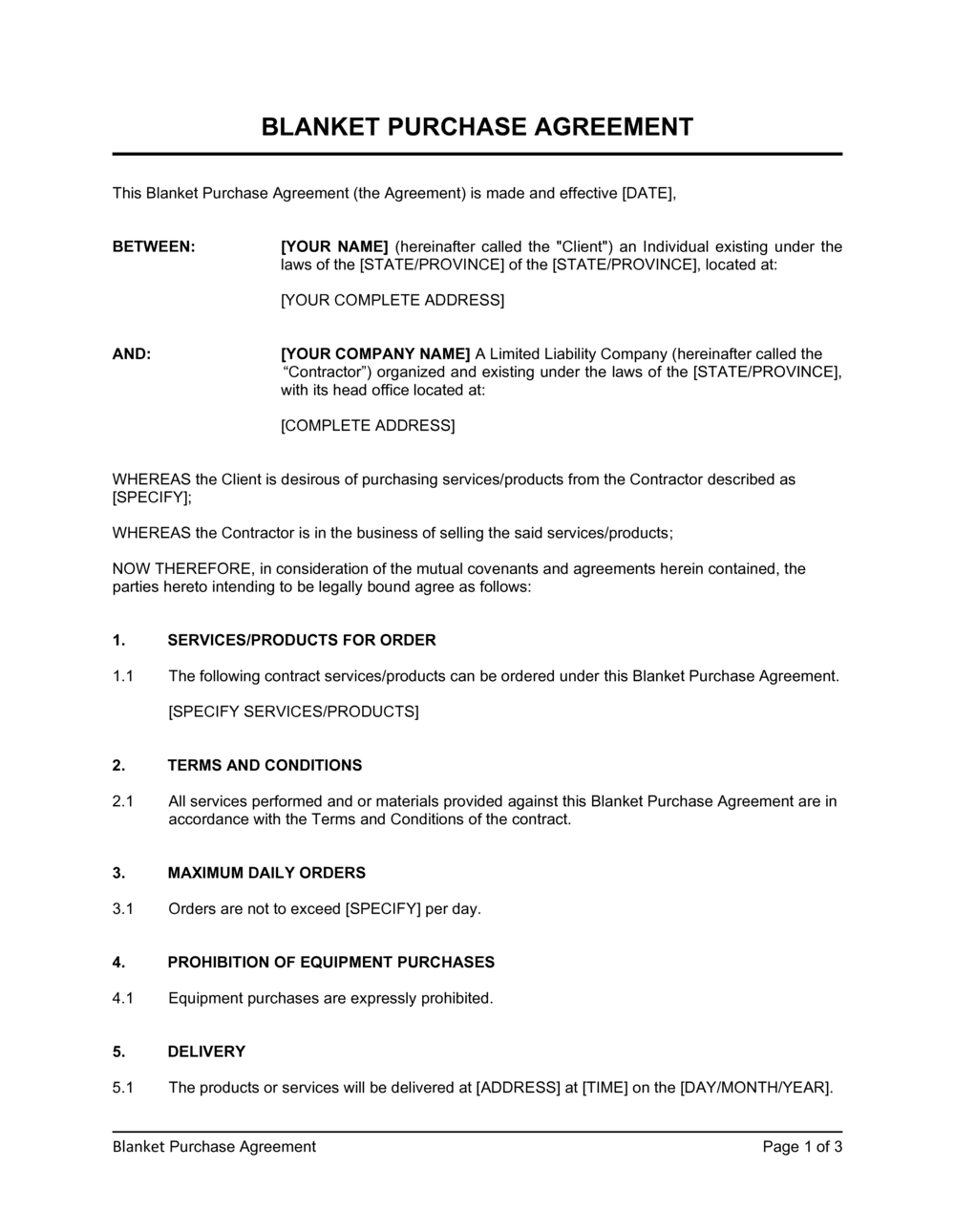
Parties and agreement term, goods or services description, pricing and price adjustment mechanism, minimum and maximum order quantities, delivery and lead-time terms, invoicing and payment conditions, confidentiality, termination rights, and governing law.

What is a Blanket Purchase Agreement?

A Blanket Purchase Agreement (BPA) is a legally binding contract between a buyer and a supplier that pre-authorizes recurring purchases of specified goods or services at fixed or formula-based pricing over a defined period — without requiring a new negotiation or contract for each individual transaction. Instead of issuing a standalone purchase order every time the buyer needs stock replenished or services rendered, the parties agree once on pricing, delivery terms, quality standards, and spending controls, and the buyer then submits simple release orders against those pre-approved terms throughout the agreement's life. BPAs are standard instruments in procurement, supply chain management, and public-sector purchasing — used wherever a buyer purchases from the same supplier repeatedly and wants cost certainty, administrative efficiency, and a clear legal framework governing every transaction.

Why You Need This Document

Operating without a blanket purchase agreement when you buy regularly from the same supplier exposes your business to three compounding risks. First, pricing is unprotected — suppliers can adjust list prices between orders, and without a locked rate, your cost of goods can rise unpredictably mid-budget-cycle. Second, your legal position on each individual purchase rests on the supplier's standard terms, which are written to protect the supplier, not you — covering returns, warranties, liability caps, and dispute resolution in ways that consistently favor the party who drafted them. Third, the absence of a spending cap and documented release process makes budget overruns and unauthorized purchases nearly impossible to catch in real time. A signed BPA eliminates all three exposures: it locks your pricing, replaces the supplier's terms with negotiated ones, and creates an auditable paper trail for every order placed. This template gives you a professionally structured starting point you can tailor and execute in under an hour for straightforward domestic supplier relationships.

Which variant fits your situation?

If your situation is…Use this template
Purchasing identical goods at a fixed price over a set periodBlanket Purchase Agreement (Fixed Price)
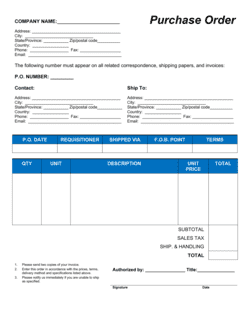
Engaging a supplier for a one-time defined purchasePurchase Order
Establishing broad terms for all future contracts with a supplierMaster Supply Agreement
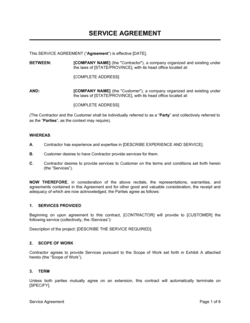
Purchasing services rather than goods on a recurring basisService Agreement
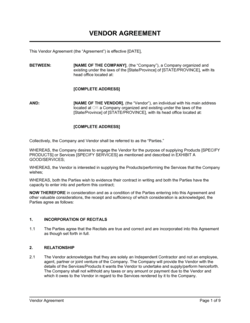
Buying goods from a vendor with custom delivery and consignment termsVendor Agreement
Sourcing goods internationally with customs and Incoterms requirementsInternational Purchase Agreement
Purchasing raw materials from multiple approved suppliers under a single frameworkSupply Chain Framework Agreement

Common mistakes to avoid

❌ No not-to-exceed cap or spending controls

Why it matters: Without a cap, the agreement creates an open-ended financial obligation. Finance teams regularly discover year-end overruns when cumulative release orders exceed the budgeted annual spend by 30–50%.

Fix: Set a specific NTE dollar amount, require the supplier to notify the buyer at 80% consumption, and mandate a written amendment before exceeding the cap.

❌ Agreeing to 'current pricing' instead of a fixed or capped rate

Why it matters: Supplier list prices can change with no notice if the agreement doesn't lock rates, eliminating the cost certainty that is the main reason to use a blanket agreement in the first place.

Fix: Fix unit prices for at least the first 12 months and limit any subsequent adjustment to a published index with a percentage ceiling per contract year.

❌ Leaving the release order process undefined

Why it matters: Informal ordering via email or phone calls with no documented format creates disputed orders, unauthorized purchases, and invoices that AP cannot match — all of which slow payment and damage the supplier relationship.

Fix: Attach a standardized release order form as an exhibit, name authorized signatories, and require the release order number to appear on every invoice.

❌ No cure period before termination for cause

Why it matters: Terminating a supplier immediately on a first breach — rather than giving them time to fix it — frequently triggers breach-of-contract counterclaims and leaves the buyer scrambling for an alternative supplier with no transition period.

Fix: Include a 10–15 business day written cure period for all material breaches except fraud, insolvency, or deliberate misconduct, where immediate termination is justified.

❌ Omitting a data protection addendum for suppliers with system access

Why it matters: If the supplier accesses your ERP, processes customer orders, or handles employee data, you are a data controller under GDPR and most North American privacy laws — and you are liable for the supplier's data handling without a written agreement.

Fix: Attach a data processing addendum (DPA) as an exhibit whenever the supplier will process personal data, specifying the categories of data, permitted purposes, and security standards.

❌ Signing the agreement after placing the first release order

Why it matters: Orders placed before the agreement is executed are governed by the supplier's standard terms — which typically favor the supplier on pricing, returns, and dispute resolution — not by your negotiated terms.

Fix: Execute the signed agreement and all exhibits before submitting any release order. If urgency requires an early order, issue it under a standalone purchase order while the BPA is finalized.

The 10 key clauses, explained

Parties, Recitals, and Agreement Term

In plain language: Identifies the buyer and supplier as legal entities, states the effective date, and sets the duration of the agreement — typically 1 to 3 years with optional renewal.

Sample language
This Blanket Purchase Agreement ('Agreement') is entered into as of [EFFECTIVE DATE] between [BUYER LEGAL NAME], a [STATE/COUNTRY] [ENTITY TYPE] ('Buyer'), and [SUPPLIER LEGAL NAME], a [STATE/COUNTRY] [ENTITY TYPE] ('Supplier'). This Agreement shall remain in effect from [START DATE] through [END DATE], unless terminated earlier in accordance with Section [X].

Common mistake: Using a trade name instead of the registered legal entity. If the supplier entity doesn't match the party named in the agreement, enforcing payment or delivery obligations against the correct contracting party becomes legally complicated.

Description of Goods or Services

In plain language: Defines exactly what the supplier is authorized to provide — product codes, specifications, service descriptions, and any approved substitutions.

Sample language
Supplier shall provide the goods and/or services described in Exhibit A ('Approved Items'), which may be updated by mutual written agreement. No goods or services outside Exhibit A may be supplied or invoiced under this Agreement without prior written authorization from Buyer's designated procurement contact.

Common mistake: Defining goods by brand or marketing description only, without SKUs or technical specifications. When a product line changes or is discontinued, disputes over acceptable substitutes have no reference point to resolve them.

Pricing, Discounts, and Price Adjustment

In plain language: States the agreed unit prices, any volume discount tiers, and the mechanism — if any — by which prices may be adjusted during the term.

Sample language
Unit pricing is as set out in the Price Schedule in Exhibit B. Prices are fixed for the first [12] months. Thereafter, Supplier may request a price adjustment no more than once per contract year, with a maximum increase of [X]% or the change in [CPI / PPI INDEX], whichever is lower. Any adjustment requires [30] days' written notice.

Common mistake: Agreeing to 'supplier's standard pricing at time of order' instead of fixing or capping rates. This eliminates the primary financial benefit of a blanket agreement and exposes the buyer to unbudgeted cost increases.

Order and Release Procedure

In plain language: Establishes how individual release orders are submitted — the format, authorized signatories, minimum order quantities, and any order frequency limits.

Sample language
Buyer shall submit release orders using the form attached as Exhibit C, signed by an authorized Buyer representative. Each release order must specify item codes, quantities, requested delivery date, and delivery location. Releases may be submitted electronically to [SUPPLIER CONTACT / PORTAL]. Minimum order quantity per release: [X UNITS / $X].

Common mistake: Leaving the release process undefined and relying on informal emails or phone calls. Without a documented procedure, disputed orders, unauthorized purchases, and invoicing errors are difficult to resolve because there is no paper trail.

Delivery, Lead Times, and Acceptance

In plain language: Sets the delivery window from order to receipt, specifies who bears shipping risk and cost, and defines the acceptance criteria and inspection period.

Sample language
Supplier shall deliver each release order within [X] business days of receipt. Delivery terms are [FOB DESTINATION / DAP BUYER'S FACILITY]. Buyer shall inspect and accept or reject goods within [5] business days of delivery. Goods failing to meet the specifications in Exhibit A shall be returned at Supplier's expense.

Common mistake: Specifying lead times but not defining what triggers the clock — order submission, order confirmation, or payment receipt. Each starting point can add 1–5 business days of ambiguity that compounds across multiple release orders.

Not-to-Exceed Amount and Spending Controls

In plain language: Caps the total authorized spend under the agreement during its term and specifies what happens if the cap is approached or reached.

Sample language
The total value of all release orders placed under this Agreement shall not exceed [DOLLAR AMOUNT] ('NTE Amount') without prior written amendment signed by both parties. Supplier is not obligated to fulfill release orders that would cause the cumulative value to exceed the NTE Amount.

Common mistake: Omitting an NTE cap entirely, or setting one but not requiring the supplier to notify the buyer when 80–90% of the cap has been reached. Buyers regularly exceed budgeted spend because no one monitored cumulative order value until after the cap was breached.

Invoicing, Payment Terms, and Disputed Invoices

In plain language: States when and how the supplier invoices, the payment period, accepted payment methods, and the process for disputing an incorrect invoice.

Sample language
Supplier shall issue a separate invoice for each release order upon delivery or acceptance, referencing the release order number. Payment is due Net [30] days from invoice date. Invoices disputed in good faith shall be flagged in writing within [10] business days of receipt, and undisputed portions shall remain due on the original due date.

Common mistake: No requirement to reference the release order number on the invoice. Without this link, AP teams cannot match invoices to authorized orders, causing payment delays and creating an opening for duplicate or fraudulent billing.

Confidentiality and Data Protection

In plain language: Prohibits each party from disclosing the other's pricing, specifications, and business information, and addresses any data-handling obligations if the supplier processes personal data.

Sample language
Each party shall hold the other's Confidential Information in strict confidence and shall not disclose it to third parties without prior written consent. 'Confidential Information' includes pricing, technical specifications, forecasts, and customer data. Where Supplier processes personal data on Buyer's behalf, the Data Processing Addendum in Exhibit D applies.

Common mistake: No data protection addendum when the supplier has access to customer lists, employee records, or systems containing personal data. In GDPR-regulated jurisdictions, processing personal data without a compliant addendum exposes the buyer — as data controller — to regulatory fines.

Termination for Convenience and for Cause

In plain language: Gives each party the right to exit the agreement — the buyer for any reason with notice, and either party immediately if the other commits a material breach.

Sample language
Buyer may terminate this Agreement for convenience upon [30] days' written notice to Supplier. Either party may terminate immediately upon written notice if the other party commits a material breach that remains uncured for [15] business days after written notice of the breach. Termination does not affect release orders already accepted prior to the termination date.

Common mistake: No cure period before termination for cause. Terminating immediately on a first claimed breach — without giving the other party a chance to fix it — often escalates minor operational issues into litigation and destroys supplier relationships unnecessarily.

Governing Law, Dispute Resolution, and Entire Agreement

In plain language: Specifies which jurisdiction's law governs the contract, how disputes will be resolved (negotiation, mediation, arbitration, or court), and confirms the written agreement supersedes all prior discussions.

Sample language
This Agreement is governed by the laws of [STATE / PROVINCE / COUNTRY], without regard to conflict-of-law principles. Disputes not resolved by good-faith negotiation within [30] days shall be submitted to binding arbitration under [AAA / JAMS / ICC] rules in [CITY]. This Agreement constitutes the entire agreement between the parties and supersedes all prior representations and understandings.

Common mistake: Choosing a governing law with no connection to where either party operates or where delivery occurs. Courts in some jurisdictions — notably California and Ontario — apply local mandatory law regardless of what the contract specifies, making a foreign choice-of-law clause ineffective against statutory protections.

How to fill it out

  1. 1

    Enter the legal entity names and effective date

    Use each party's full registered corporate name — not a trade name or DBA. Confirm the entity name against the supplier's certificate of incorporation or business registration. Enter the date both parties will sign as the effective date.

    💡 Ask the supplier for their registered entity name and tax ID before drafting — mismatches between the contract name and invoice name cause payment processing problems.

  2. 2

    Define the goods or services in Exhibit A

    List every item or service category the supplier is authorized to provide, using SKUs, part numbers, or detailed service descriptions. Include acceptable substitution rules if product lines may change during the term.

    💡 Attach the supplier's current product catalog or service specification sheet as Exhibit A rather than retyping specifications — this reduces transcription errors and keeps the agreement in sync with what the supplier actually offers.

  3. 3

    Complete the pricing schedule in Exhibit B

    Enter agreed unit prices for each item, any volume discount thresholds, and the price adjustment mechanism — including the index, the frequency, and the maximum percentage change per adjustment.

    💡 Tie price escalation to a published index like the Bureau of Labor Statistics PPI for your product category rather than accepting the supplier's internal cost justification. Published indexes are objective and auditable.

  4. 4

    Set the not-to-exceed amount and term

    Calculate a realistic NTE based on your historical annual spend with this supplier plus a 15–20% buffer for growth. Set the agreement term to match your budget cycle — typically 12 months, renewable annually.

    💡 Include a notification trigger requiring the supplier to alert you in writing when 80% of the NTE has been consumed. This gives you time to amend or plan before hitting the cap.

  5. 5

    Specify the release order procedure

    Attach the release order form as Exhibit C. Identify the authorized buyer representatives who may submit releases and confirm the supplier contact or portal for submission. Set minimum order quantities and any order frequency limits.

    💡 Limit authorized signatories to two or three named individuals and require their signatures on each release. Open-ended authorization creates exposure for unauthorized purchases.

  6. 6

    Define delivery terms, lead times, and acceptance criteria

    Choose an Incoterms rule (e.g., DAP Buyer's Facility) to allocate shipping cost and risk. Enter the lead time in business days from order confirmation — not from order submission. Set the inspection and acceptance window and the return procedure for non-conforming goods.

    💡 Negotiate lead times based on the supplier's actual production or fulfillment cycle, not their aspirational commitment. A lead time the supplier cannot reliably meet creates chronic disputes.

  7. 7

    Review and execute before placing the first order

    Both parties must sign the agreement — and any exhibits — before the first release order is submitted. Post-execution amendments to exhibits require written agreement from both parties.

    💡 Use an e-signature tool with timestamped audit trails. Disputes about when the agreement was signed or which version was executed are common and costly to resolve without a clear record.

Frequently asked questions

What is a blanket purchase agreement?

A blanket purchase agreement (BPA) is a binding contract between a buyer and a supplier that pre-authorizes recurring purchases of specified goods or services at agreed pricing over a defined period — without requiring a new contract for each transaction. The buyer submits individual release orders against the BPA as needs arise, and the supplier fulfills them under the pre-agreed terms. BPAs are commonly used for office supplies, raw materials, maintenance services, and any other category of spend that is predictable in type but variable in volume.

What is the difference between a blanket purchase agreement and a purchase order?

A purchase order is a one-time transaction document authorizing a specific quantity at a specific price for a specific delivery date. A blanket purchase agreement is a standing contract that covers multiple purchase orders over time, setting the pricing, terms, and conditions that apply to each individual release order placed during the agreement's term. The BPA does the heavy legal lifting once; each release order under it is a simple operational document referencing the master terms.

Is a blanket purchase agreement legally binding?

Yes, a properly executed blanket purchase agreement is generally enforceable as a contract when it includes offer, acceptance, consideration, and mutual intent to be bound. The agreement itself binds both parties to the framework terms; each release order creates a separate binding obligation to deliver and pay for the specific goods or services called off. Consider having a lawyer review the agreement for high-value supplier relationships or complex supply chains.

What is a release order under a blanket purchase agreement?

A release order (sometimes called a call-off order) is a document the buyer submits to the supplier to draw down against the blanket agreement — specifying the item codes, quantities, delivery location, and requested delivery date. It operates like a standard purchase order but derives its legal authority from the blanket agreement rather than standing alone. Each release order should reference the BPA number and the authorized buyer signatory.

Do I need a minimum purchase commitment in a blanket purchase agreement?

Not necessarily, but suppliers often require one to justify reserving capacity or offering discounted pricing. A minimum annual spend commitment (e.g., $50,000 per year) or minimum order quantity per release is a common negotiating point. Without any minimum commitment, the agreement may lack the consideration needed to bind the supplier to hold pricing — and the supplier has less incentive to prioritize your orders. If you cannot commit to a minimum, consider a standard purchase order instead.

How long should a blanket purchase agreement last?

Most BPAs run for 12 months, aligned to an annual budget cycle, with an option to renew for one or two additional years. Terms longer than 3 years are generally discouraged unless the buyer is committing to significant volumes, because market pricing and supplier capabilities change faster than long contracts can accommodate. Include a termination- for-convenience clause so either party can exit with 30 to 60 days' notice if the relationship is no longer working.

Can a blanket purchase agreement be used for services as well as goods?

Yes. BPAs are commonly used for recurring services — facilities maintenance, IT support, staffing, and professional services — as well as physical goods. When covering services, the agreement should define the service categories, rate card or hourly rates, response time commitments, and performance standards rather than product specifications and delivery terms. For complex service engagements, a separate service- level agreement or statement of work attached as an exhibit is advisable.

What happens when the not-to-exceed amount is reached?

Once the cumulative value of release orders hits the NTE cap, the supplier is typically not obligated to fulfill additional orders and the buyer has no authority to issue them without a written amendment raising the cap. Best practice is to require the supplier to notify the buyer in writing when 80% of the NTE has been consumed, giving both parties time to assess whether an amendment is needed before operations are disrupted.

Do blanket purchase agreements need to be notarized?

Notarization is not required for a blanket purchase agreement to be legally enforceable in most jurisdictions. Signatures from authorized representatives of each party — evidenced by a corporate signing authority resolution if dealing with large contracts — are sufficient. For high-value agreements or certain public-sector contracts, some organizations require witnessing, but this is a policy requirement, not a legal one in most cases.

How this compares to alternatives

vs Purchase Order

A purchase order is a single-transaction document authorizing one specific delivery at a specific price and date. A blanket purchase agreement governs all purchase orders placed with a supplier over a defined period under pre-agreed terms. Use a standalone PO for one-off or infrequent purchases; use a BPA when you buy from the same supplier repeatedly and want to negotiate terms once.

vs Master Supply Agreement

A master supply agreement sets broad commercial terms for an ongoing supplier relationship but may not specify pricing or quantities for individual product lines. A blanket purchase agreement is more operationally specific — it locks in unit prices, defines the items covered, sets a spending cap, and establishes the release order process. BPAs are typically exhibits or call-off mechanisms under a master supply agreement in large enterprises.

vs Service Agreement

A service agreement governs the ongoing delivery of professional or operational services, focusing on scope, service levels, and deliverables rather than physical goods. A blanket purchase agreement is better suited to recurring purchases of defined goods or commoditized services at a unit price. For complex service engagements requiring statements of work and SLAs, a service agreement or master services agreement is the more appropriate document.

vs Vendor Agreement

A vendor agreement typically governs the resale or distribution relationship between a supplier and a business that sells the supplier's products onward. A blanket purchase agreement is an internal procurement tool used when the buyer is consuming the goods or services directly, not reselling them. If you are buying for internal use or production, use a BPA; if you are buying to resell, a vendor or distributor agreement is more appropriate.

Industry-specific considerations

Manufacturing

Raw material and component sourcing under fixed pricing with volume tiers, just-in-time delivery lead times, and supplier quality conformance standards tied to acceptance criteria.

Healthcare and Life Sciences

Medical supply and consumable procurement under GPO-aligned pricing, lot traceability requirements, and regulatory compliance certifications attached as exhibits.

Government and Public Sector

Pre-approved vendor lists, micropurchase threshold controls, mandatory NTE caps, and audit-ready release order documentation required for compliance with procurement regulations.

Retail and E-commerce

Seasonal inventory replenishment with flexible call-off volumes, FOB pricing to manage import costs, and supplier lead times coordinated with promotional calendar planning.

Jurisdictional notes

United States

BPAs are governed by Article 2 of the Uniform Commercial Code (UCC) for goods and common law for services. Under the UCC, an agreement without a specified quantity may not be enforceable unless it is a requirements or output contract — include either a minimum commitment or an NTE cap to satisfy the quantity requirement. Federal agencies use BPAs specifically as defined instruments under the Federal Acquisition Regulation (FAR), with distinct compliance requirements for government contractors.

Canada

Canadian BPAs are governed by common law in most provinces, with Quebec governed by the Civil Code. Unlike the US UCC, Canada has no single uniform commercial code, so enforceability depends on provincial contract law. In federally regulated industries or public-sector procurement, BPAs may be subject to the Government Contracts Regulations. Quebec contracts should be bilingual, with the French version controlling for provincially regulated entities.

United Kingdom

In the UK, BPAs (often called framework agreements or call-off contracts) are governed by the Sale of Goods Act 1979 for goods and the Supply of Goods and Services Act 1982 for services. Public sector framework agreements must comply with the Procurement Act 2023, which replaced the PCR 2015 for new agreements from February 2025. Post-Brexit, CE marking and product compliance requirements differ from EU standards for goods sourced or delivered across borders.

European Union

EU framework agreements for public procurement are governed by Directive 2014/24/EU, which sets strict rules on duration (maximum 4 years), transparency, and competition between framework parties. For private-sector BPAs, GDPR requires a data processing agreement whenever the supplier processes personal data, regardless of the value of the contract. Cross-border agreements within the EU benefit from relatively harmonized commercial law, but member-state variations — particularly in France, Germany, and the Netherlands — affect enforceability of liquidated damages and penalty clauses.

Template vs lawyer — what fits your deal?

PathBest forCostTime
Use the templateBuyers establishing recurring supplier relationships for standard goods or services under $250,000 annuallyFree30–60 minutes
Template + legal reviewAgreements over $250,000 annually, cross-border suppliers, or supply chains involving regulated goods or personal data$400–$9002–5 days
Custom draftedStrategic sole-source suppliers, high-value manufacturing inputs, or agreements tied to government contract compliance requirements$1,500–$5,000+1–3 weeks

Glossary

Blanket Purchase Agreement (BPA)
A standing contract that pre-authorizes a buyer to place multiple orders with a supplier under pre-agreed terms without renegotiating each transaction.
Release Order
An individual purchase order issued under a blanket agreement that calls off a specific quantity or dollar value against the pre-agreed terms.
Not-to-Exceed (NTE) Amount
A ceiling on the total dollar value of orders that may be placed under the blanket agreement during its term.
Minimum Order Quantity (MOQ)
The smallest quantity of goods or services a buyer must order in a single release to qualify for the blanket agreement pricing.
Price Escalation Clause
A contractual provision allowing the supplier to adjust pricing at defined intervals, typically tied to a published index such as CPI or PPI.
Lead Time
The agreed number of business days between submission of a release order and delivery of the goods or services at the buyer's location.
Incoterms
A set of standardized international trade terms (e.g., FOB, CIF, DAP) published by the ICC that define which party bears shipping costs and risk of loss at each stage of delivery.
Acceptance Criteria
The defined standards or specifications goods or services must meet for the buyer to formally accept delivery and trigger the payment obligation.
Force Majeure
A clause excusing a party from performance when circumstances beyond its reasonable control — such as natural disasters, war, or government action — make delivery impossible.
Indemnification
A contractual obligation by one party to compensate the other for specified losses, damages, or liabilities arising from the agreement or a party's conduct.
Liquidated Damages
A pre-agreed sum payable by a supplier for failing to meet delivery timelines or quality standards, calculated to approximate the buyer's actual loss.

Part of your Business Operating System

This document is one of 3,000+ business & legal templates included in Business in a Box.

  • Fill-in-the-blanks — ready in minutes
  • 100% customizable Word document
  • Compatible with all office suites
  • Export to PDF and share electronically

Create your document in 3 simple steps.

From template to signed document — all inside one Business Operating System.
1
Download or open template

Access over 3,000+ business and legal templates for any business task, project or initiative.

2
Edit and fill in the blanks with AI

Customize your ready-made business document template and save it in the cloud.

3
Save, Share, Send, Sign

Share your files and folders with your team. Create a space of seamless collaboration.

Save time, save money, and create top-quality documents.

★★★★★

"Fantastic value! I'm not sure how I'd do without it. It's worth its weight in gold and paid back for itself many times."

Managing Director · Mall Farm
Robert Whalley
Managing Director, Mall Farm Proprietary Limited
★★★★★

"I have been using Business in a Box for years. It has been the most useful source of templates I have encountered. I recommend it to anyone."

Business Owner · 4+ years
Dr Michael John Freestone
Business Owner
★★★★★

"It has been a life saver so many times I have lost count. Business in a Box has saved me so much time and as you know, time is money."

Owner · Upstate Web
David G. Moore Jr.
Owner, Upstate Web

Run your business with a system — not scattered tools

Stop downloading documents. Start operating with clarity. Business in a Box gives you the Business Operating System used by over 250,000 companies worldwide to structure, run, and grow their business.

Start free · No credit card required