Notice of Buyer's Disposition of Rightfully Rejected Goods Template

Free Word download β€’ Edit online β€’ Save & share with Drive β€’ Export to PDF

1 pageβ€’15–25 min to fillβ€’Difficulty: Standard
Learn more ↓
FreeNotice of Buyer's Disposition of Rightfully Rejected Goods Template

At a glance

What it is
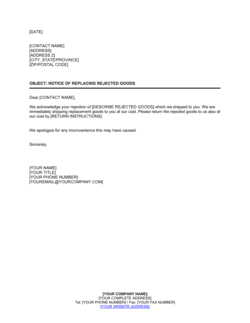
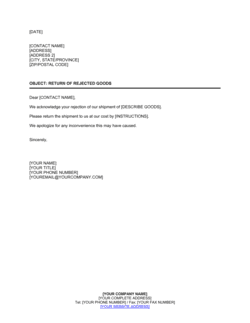
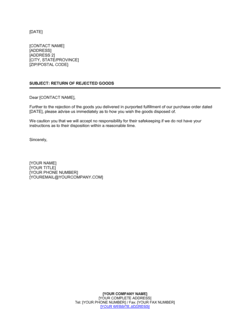
A Notice of Buyer's Disposition of Rightfully Rejected Goods is a formal business letter a buyer sends to a seller after rejecting a non-conforming shipment and deciding how to handle the physical goods β€” returning them, storing them at the seller's expense, or reselling them to recover costs. This free Word download gives you a ready-to-edit letter you can complete and send in under 15 minutes.
When you need it
Use it when you have already issued a rejection notice for goods that fail to conform to the contract and you need to formally notify the seller of what will happen to the goods in your possession. It documents your chosen disposition method and preserves your right to recover associated costs.
What's inside
Buyer and seller identification, reference to the original purchase order and prior rejection notice, the specific grounds for rejection, a clear statement of the disposition method selected, a request for seller instructions or cost reimbursement, and a deadline for seller response.

What is a Notice of Buyer's Disposition of Rightfully Rejected Goods?

A Notice of Buyer's Disposition of Rightfully Rejected Goods is a formal business letter a buyer sends to a seller after rejecting a non-conforming shipment, informing the seller of how the buyer intends to handle the physical goods in their possession. Once a buyer has rightfully rejected goods β€” meaning the goods failed to conform to the contract and the rejection was communicated promptly β€” the buyer cannot simply keep, discard, or ignore the merchandise. Under UCC Article 2, which governs commercial sales of goods in the United States, the buyer has a duty to notify the seller of the disposition and, in the case of merchant buyers, may be required to take reasonable steps to protect the seller's goods pending the seller's instructions. This notice fulfills that duty while simultaneously documenting the buyer's cost recovery claim for inspection, storage, and return expenses.

Why You Need This Document

Without a written disposition notice, a buyer who holds rejected goods risks having their rejection challenged β€” sellers can argue that continued possession without communication implies acceptance. Beyond that legal exposure, undocumented handling of rejected goods leaves the buyer unable to recover storage fees, return freight, or inspection costs, since those claims require a written record of the expenses and the authority under which they were incurred. A properly completed disposition notice also sets a firm deadline for the seller to respond with instructions, which is what gives the buyer the right to proceed β€” return, store, or resell β€” without the seller's active cooperation. For any shipment rejection where the goods have measurable value, this template provides the paper trail that protects your position, supports your cost recovery claim, and keeps the process moving.

Which variant fits your situation?

If your situation is…Use this template
Rejecting goods and returning them to the seller immediatelyNotice of Buyer's Disposition of Rightfully Rejected Goods (Return)
Holding rejected goods in storage at seller's expenseNotice of Buyer's Disposition of Rightfully Rejected Goods (Storage)
Reselling rejected goods to recover costsNotice of Buyer's Disposition of Rightfully Rejected Goods (Resale)
First step β€” formally refusing a non-conforming shipmentNotice of Rejection of Defective Goods
Claiming damages after a seller fails to replace rejected goodsDemand Letter for Breach of Contract
Supplier has repeatedly delivered non-conforming goodsNotice of Contract Termination for Cause
Documenting an agreed return and credit memo with the sellerReturn Merchandise Authorization Agreement

Common mistakes to avoid

❌ Sending this notice without a prior rejection on record

Why it matters: A disposition notice has no legal grounding if the goods were never formally rejected. A seller can argue the goods were accepted, eliminating the buyer's remedy.

Fix: Issue a Notice of Rejection of Goods first. Only send this disposition notice after that rejection is confirmed and on file with a date and reference number.

❌ Vague description of the non-conformity

Why it matters: Describing the defect as 'substandard quality' or 'not what we ordered' gives the seller nothing specific to verify or dispute β€” and weakens the buyer's position if the matter goes to arbitration.

Fix: Cite the specific contract specification, tolerance, quantity, or delivery date that was breached, using the exact language from the purchase order or agreement.

❌ No deadline for seller response

Why it matters: Without a deadline, the seller has no obligation to respond promptly and the buyer cannot proceed with disposing of the goods without risking a claim of improper disposal.

Fix: State a specific calendar date β€” typically 5–10 business days from the notice date β€” after which the buyer will proceed with the stated disposition method.

❌ Omitting the reservation of rights

Why it matters: A notice that resolves the disposition issue without reserving other remedies may be read by a seller as settling all claims arising from the non-conforming delivery.

Fix: Include a standard reservation of rights paragraph stating that the notice does not waive any contractual or legal remedies available to the buyer.

The 9 key clauses, explained

Header and party identification

In plain language: Identifies the buyer and seller by full legal name and address, references the original purchase order number, and states the date of this notice.

Sample language
From: [BUYER COMPANY NAME], [ADDRESS] | To: [SELLER COMPANY NAME], [ADDRESS] | Date: [DATE] | Re: Notice of Disposition of Rightfully Rejected Goods β€” PO No. [PURCHASE ORDER NUMBER]

Common mistake: Using a trade name instead of the seller's registered legal entity name β€” this creates ambiguity about who the notice is addressed to if the matter escalates to a dispute.

Reference to prior rejection notice

In plain language: Cites the earlier rejection notice by date and reference number, confirming that a valid rejection was already communicated to the seller.

Sample language
As set forth in our Notice of Rejection dated [DATE] (Reference No. [REF NUMBER]), Buyer rejected the goods delivered under PO No. [PO NUMBER] on [DELIVERY DATE] on the grounds stated therein.

Common mistake: Omitting the reference to the prior rejection notice, which may imply the goods were accepted β€” undermining the entire basis for the disposition.

Description of rejected goods

In plain language: Identifies the goods by item description, quantity, and lot or batch number so the seller can match the notice to their records.

Sample language
The rejected goods consist of [QUANTITY] units of [ITEM DESCRIPTION], Lot No. [LOT NUMBER], delivered to [DELIVERY LOCATION] on [DATE].

Common mistake: Providing only a general product name without quantity and lot number β€” sellers with multiple open orders cannot identify which shipment the notice applies to.

Grounds for rejection

In plain language: States the specific defect or non-conformity that justified rejection, grounding the disposition decision in the contract breach.

Sample language
The goods were rejected because they [DESCRIPTION OF DEFECT β€” e.g., failed to meet the tensile strength specification of [X] psi set out in Schedule A of the Agreement / arrived [X] days after the contractual delivery date / contained [X] units short of the ordered quantity].

Common mistake: Using vague language like 'did not meet our standards' instead of citing the specific contract specification or delivery term that was breached.

Chosen disposition method

In plain language: States clearly whether the buyer will return the goods, hold them in storage at the seller's expense, or resell them to recover costs β€” and provides the timeline or conditions.

Sample language
Buyer hereby notifies Seller that the rejected goods will be [returned to Seller at Seller's expense / held in storage at [LOCATION] at Seller's expense of $[X] per [day/week] / resold by Buyer on [DATE] if Seller does not provide written instructions by [DEADLINE]].

Common mistake: Stating the disposition method without specifying who bears the cost or the timeline for seller response, leaving both parties uncertain of their obligations.

Cost and expense recovery

In plain language: Puts the seller on notice that the buyer intends to deduct or invoice for all reasonable expenses incurred in inspecting, storing, or returning the rejected goods.

Sample language
Buyer will seek reimbursement for all reasonable costs incurred in connection with the rejected goods, including inspection costs of $[AMOUNT], storage fees of $[AMOUNT], and return shipping of $[AMOUNT], totalling $[TOTAL AMOUNT].

Common mistake: Claiming expenses without listing them individually β€” a lump-sum reimbursement demand is harder to enforce and easier for the seller to dispute.

Request for seller instructions and response deadline

In plain language: Invites the seller to provide written instructions for handling the goods and sets a firm deadline after which the buyer will proceed with the stated disposition.

Sample language
Please provide written instructions for the disposition of the rejected goods no later than [DATE β€” typically 5–10 business days from this notice]. If no instructions are received by that date, Buyer will proceed with [STATED DISPOSITION METHOD] without further notice.

Common mistake: Setting no deadline β€” without one, the seller has no urgency to respond and the buyer cannot proceed without risking a dispute about premature disposal.

Reservation of rights

In plain language: Preserves all of the buyer's legal remedies β€” damages, cover, price reduction β€” so that sending this notice is not interpreted as settling the matter.

Sample language
Nothing in this notice constitutes a waiver of any of Buyer's rights or remedies under the Agreement, applicable law, or otherwise. Buyer expressly reserves all rights, including the right to seek damages for any losses arising from Seller's non-conforming delivery.

Common mistake: Omitting the reservation of rights clause β€” a seller may argue that a notice about disposition implies the buyer accepted the goods or released the claim.

Closing and authorized signature

In plain language: Closes the letter with the name, title, and contact information of the authorized buyer representative sending the notice.

Sample language
Please direct any questions or correspondence to the undersigned. [NAME], [TITLE] | [COMPANY NAME] | [EMAIL] | [PHONE]

Common mistake: Sending the notice from a personal email or without an authorized signatory's title β€” this can raise questions about whether the sender had authority to act on the company's behalf.

How to fill it out

  1. 1

    Confirm the prior rejection was timely and properly documented

    Before completing this notice, verify you sent a rejection notice within a reasonable time after delivery β€” typically within a few business days β€” and that you have that notice on file with its date and reference number.

    πŸ’‘ If you have not yet sent a formal rejection notice, send that document first. This disposition notice has no legal basis without a valid prior rejection.

  2. 2

    Enter buyer and seller details and the PO reference

    Fill in both parties' full legal names, addresses, and the original purchase order number. Include the date of this notice and the date the goods were delivered.

    πŸ’‘ Use the seller's legal entity name exactly as it appears on the original contract or purchase order to avoid misidentification.

  3. 3

    Describe the rejected goods precisely

    Enter the product description, quantity, lot or batch number, and delivery date. Match this information exactly to the packing slip or bill of lading for the rejected shipment.

    πŸ’‘ Attach a copy of the delivery record or inspection report as an exhibit β€” it strengthens the notice and removes any dispute about which goods are affected.

  4. 4

    State the grounds for rejection specifically

    Reference the exact contract clause, specification, or delivery term that the goods failed to meet. Use measurable terms where possible β€” dimensions, tolerances, quantities, or delivery dates.

    πŸ’‘ If you have an inspection report or lab test result, reference it by document number in this clause and attach it to the notice.

  5. 5

    Select and describe the disposition method

    Choose one of three standard options β€” return at seller's expense, storage at seller's expense, or resale β€” and state the specific logistics, location, or timing associated with your choice.

    πŸ’‘ Resale is the most complex option and requires the buyer to act in a commercially reasonable manner. If you choose resale, document the process carefully.

  6. 6

    Itemize your cost recovery claim

    List each expense individually β€” inspection fees, storage charges, return freight β€” with a dollar amount for each. Total them and state the amount you expect the seller to reimburse.

    πŸ’‘ Keep all invoices and receipts for these expenses. If the matter escalates, itemized documentation speeds resolution significantly.

  7. 7

    Set a firm response deadline and send

    Enter a response deadline of 5–10 business days from the date of the notice. Send the notice by a method that creates a delivery record β€” email with read receipt, courier, or certified mail β€” and retain proof.

    πŸ’‘ Email is acceptable for most commercial relationships, but follow up with a physical copy if the contract specifies written notice by mail or if you anticipate a dispute.

Frequently asked questions

What is a notice of buyer's disposition of rightfully rejected goods?

It is a formal letter a buyer sends to a seller after rejecting a non-conforming shipment, informing the seller of how the buyer intends to handle the physical goods β€” returning them, holding them in storage at the seller's expense, or reselling them to offset costs. It creates a written record of the disposition decision, documents the buyer's cost recovery claim, and gives the seller an opportunity to provide alternative instructions before the buyer acts.

When should I send this notice?

Send it promptly after you have already issued a formal rejection notice for the non-conforming goods and have made a decision about what to do with them physically. The timeline matters β€” under UCC Article 2, a buyer who holds rejected goods without notifying the seller of the intended disposition may lose the right to recover storage and handling costs. Five to ten business days after the rejection notice is a common standard.

What are the valid disposition options for rejected goods?

Under UCC Article 2, a buyer in possession of rightfully rejected goods may return them to the seller at the seller's expense, hold them in storage for the seller's account, or resell them in a commercially reasonable manner and apply the proceeds against expenses and any damages owed. The buyer cannot simply discard the goods without notifying the seller and giving them a reasonable opportunity to reclaim or give instructions.

Does this notice constitute acceptance of the goods?

No β€” provided the notice includes a clear reservation of rights clause and references the prior rejection. Handling rejected goods for the seller's account, such as storing or returning them, does not reverse the rejection or imply acceptance under the UCC. The key is to document every action as being taken on the seller's behalf, not as the buyer's own use of the goods.

Can the buyer recover costs for storing or returning rejected goods?

Yes. Under UCC Section 2-603, a merchant buyer has a security interest in rightfully rejected goods for reasonable expenses incurred in their inspection, receipt, transportation, care, and custody. These costs can be deducted from the proceeds of any resale or invoiced to the seller directly. Itemizing each cost in the notice strengthens the recovery claim.

What happens if the seller does not respond by the deadline?

If the seller fails to provide instructions within the stated deadline, the buyer may proceed with the stated disposition method β€” typically return or resale β€” without further notice. The written deadline in this notice is what gives the buyer that right. Keeping proof of delivery of the notice is essential in case the seller later claims they were not notified.

Is this notice legally required or just good practice?

Under UCC Article 2, a merchant buyer who takes steps to protect perishable or rapidly depreciating goods must notify the seller, but the UCC does not mandate a specific form. This notice is best practice β€” it documents your actions, preserves your remedies, gives the seller a fair opportunity to respond, and creates the paper trail you need if costs are disputed or the matter escalates to a formal claim.

Should I attach the original rejection notice to this letter?

Attaching it is strongly recommended. It provides the seller with the full record in one package, removes any argument that they were unaware of the grounds for rejection, and demonstrates that the disposition is the continuation of a properly documented process rather than a unilateral action. Attach the original rejection notice and any inspection reports or test results as exhibits.

How this compares to alternatives

vs Notice of rejection of defective goods

A rejection notice is the first step β€” it formally refuses the non-conforming shipment and puts the seller on notice of the breach. This disposition notice is the follow-up step β€” it tells the seller what the buyer will do with the goods already in their possession. You need both documents: the rejection notice establishes the right; the disposition notice exercises it.

vs Return merchandise authorization (RMA)

An RMA is a bilateral document, typically initiated by the seller, that authorizes a specific return and issues a credit or replacement. This notice is a unilateral buyer document issued when the seller has not yet agreed to a return process. If the seller responds to this notice with an RMA, the RMA then governs the return logistics.

vs Demand letter for breach of contract

A demand letter focuses on claiming monetary damages β€” price refund, cover costs, consequential losses. This disposition notice focuses on the physical handling of the rejected goods and cost recovery for care and custody expenses. The two documents often work together: the disposition notice manages the goods; the demand letter pursues the financial remedy.

vs Notice of contract termination for cause

A termination notice ends the entire supply relationship due to a material or repeated breach. This disposition notice addresses only one rejected shipment within an ongoing or concluded contract. If the rejection is part of a pattern, a termination notice may follow β€” but this notice handles the immediate problem of what to do with the goods on hand.

Industry-specific considerations

Manufacturing

Raw materials and components rejected for failing dimensional tolerances or material certifications require prompt disposal notices to avoid production bottlenecks.

Retail and wholesale distribution

Retailers rejecting short-shipped or mislabeled product runs use this notice to document return logistics and charge-back restocking costs to suppliers.

Food and beverage

Perishable goods rejected for temperature abuse or labeling violations must be disposed of quickly, making a prompt written notice essential for cost recovery before the goods lose all value.

Import and export

Cross-border shipments rejected at customs or on quality inspection require formal written notice to overseas sellers to trigger insurance claims and support freight documentation.

Template vs pro β€” what fits your needs?

PathBest forCostTime
Use the templateBuyers handling routine commercial shipment rejections with a clear prior rejection notice on fileFree10–15 minutes
Template + professional reviewHigh-value shipments, international sellers, or situations where litigation is a realistic possibility$150–$400 for a brief lawyer review1–2 business days
Custom draftedComplex multi-party supply chain disputes, regulated goods, or claims exceeding $50,000$500–$1,5003–5 business days

Glossary

Rightful Rejection
A buyer's lawful refusal to accept goods that fail to conform to the contract in any respect, exercised within a reasonable time after delivery.
Non-Conforming Goods
Goods that fail to match the contract specifications β€” wrong quantity, incorrect description, defective quality, or improper packaging.
Disposition
The buyer's chosen method of handling rejected goods in their possession β€” return, storage, or resale β€” after rejection is communicated to the seller.
UCC Article 2
The Uniform Commercial Code provisions governing sales of goods in the United States, including buyer rejection rights and remedies.
Perfect Tender Rule
The UCC principle that a buyer may reject an entire shipment if the goods or delivery fail to conform to the contract in any way.
Security Interest
A buyer's lien on rightfully rejected goods for expenses reasonably incurred in caring for or reselling them on the seller's behalf.
Cover
A buyer's right to purchase replacement goods from another supplier after rejection and charge the price difference to the breaching seller.
Reasonable Time
The period within which a buyer must act β€” reject goods, notify the seller, or seek a remedy β€” as judged by industry custom and the circumstances of the transaction.
Cure
The seller's right, in certain circumstances, to remedy a non-conforming delivery by sending replacement goods or correcting defects before the contract deadline passes.
Consequential Damages
Losses beyond the purchase price β€” such as lost profits or production downtime β€” that a buyer may recover when a seller's breach was foreseeable at the time of contracting.

Part of your Business Operating System

This document is one of 3,000+ business & legal templates included in Business in a Box.

  • Fill-in-the-blanks β€” ready in minutes
  • 100% customizable Word document
  • Compatible with all office suites
  • Export to PDF and share electronically

Create your document in 3 simple steps.

From template to signed document β€” all inside one Business Operating System.
1
Download or open template

Access over 3,000+ business and legal templates for any business task, project or initiative.

2
Edit and fill in the blanks with AI

Customize your ready-made business document template and save it in the cloud.

3
Save, Share, Send, Sign

Share your files and folders with your team. Create a space of seamless collaboration.

Save time, save money, and create top-quality documents.

β˜…β˜…β˜…β˜…β˜…

"Fantastic value! I'm not sure how I'd do without it. It's worth its weight in gold and paid back for itself many times."

Managing Director Β· Mall Farm
Robert Whalley
Managing Director, Mall Farm Proprietary Limited
β˜…β˜…β˜…β˜…β˜…

"I have been using Business in a Box for years. It has been the most useful source of templates I have encountered. I recommend it to anyone."

Business Owner Β· 4+ years
Dr Michael John Freestone
Business Owner
β˜…β˜…β˜…β˜…β˜…

"It has been a life saver so many times I have lost count. Business in a Box has saved me so much time and as you know, time is money."

Owner Β· Upstate Web
David G. Moore Jr.
Owner, Upstate Web

Run your business with a system β€” not scattered tools

Stop downloading documents. Start operating with clarity. Business in a Box gives you the Business Operating System used by over 250,000 companies worldwide to structure, run, and grow their business.

Free Forever PlanΒ Β·Β No credit card required