Import Export Agreement Template

Free Word download • Edit online • Save & share with Drive • Export to PDF

5 pages25–35 min to fillDifficulty: ComplexSignature requiredLegal review recommended
Learn more ↓
FreeImport Export Agreement Template

At a glance

What it is
An Import-Export Agreement is a legally binding cross-border contract between an exporter and an importer that governs the international sale of goods — specifying the Incoterms rule, customs and duties responsibility, payment method (letter of credit or telegraphic transfer), shipping and insurance obligations, inspection rights, regulatory compliance, and dispute resolution. This free Word download gives you a structured, enforceable starting point you can edit online and export as PDF to share with trading partners in any jurisdiction.
When you need it
Use it whenever you are buying or selling goods across an international border — whether shipping finished products, raw materials, or components — and need a written record of each party's obligations before goods leave the country of origin. It is particularly critical when payment is large, transit is complex, or the parties have not traded together before.
What's inside
Parties and goods description, Incoterms delivery rule, price and currency, payment terms and method (LC or TT), shipping and insurance obligations, customs and duties allocation, inspection and acceptance procedures, regulatory compliance warranties, force majeure, and governing law and arbitration.

What is an Import-Export Agreement?

An Import-Export Agreement is a legally binding cross-border contract between an Exporter (the seller of goods) and an Importer (the buyer) that governs every material dimension of an international sale of goods: the description and specifications of the goods, the agreed price and transaction currency, the applicable Incoterms 2020 rule allocating delivery and risk, the payment method (letter of credit or telegraphic transfer), shipping and insurance obligations, customs clearance and duties responsibility, pre-shipment inspection rights, regulatory and trade sanctions compliance, force majeure, and the governing law and arbitration mechanism for resolving disputes. Unlike a domestic sales contract, an import-export agreement must account for the legal systems and compliance regimes of at least two countries simultaneously, making precise drafting essential to enforceability.

Why You Need This Document

Without a written import-export agreement, the parties are left to argue over who bears the risk when goods are damaged at sea, who pays an unexpected anti-dumping duty at the destination port, and what recourse exists when the importer refuses to pay after delivery. A missing Incoterms clause alone generates disputes that can cost more to resolve than the goods themselves. Open-account payment terms agreed informally without a contract leave exporters with no security against non-payment in a foreign jurisdiction — and cross-border debt recovery is slow, expensive, and uncertain without an arbitration clause backed by the New York Convention. Export control violations and sanctions breaches can result in criminal penalties even when the exporter had no intent to violate the law, making a compliance representation clause non-negotiable. This template gives both parties a clear, enforceable record of agreed terms before goods cross the border, reducing the transaction risk that makes international trade more costly than it needs to be.

Which variant fits your situation?

If your situation is…Use this template
Ongoing supply relationship with a foreign manufacturerInternational Supply Agreement
One-time purchase of goods from an overseas vendorPurchase Order (International)
Appointing a foreign company to distribute your productsInternational Distribution Agreement
Engaging a local agent to sell on your behalf abroadSales Agency Agreement (International)
Licensing technology or IP alongside a cross-border goods saleTechnology Licensing Agreement
Joint venture for manufacturing and export with a foreign partnerJoint Venture Agreement
Short-form confirmation of agreed price and delivery for a known partnerCommercial Invoice

Common mistakes to avoid

❌ No Incoterms rule or a vague one

Why it matters: Without a named Incoterms rule, neither party knows who pays freight, who bears risk of loss during transit, or who clears customs — disputes arise immediately when costs deviate from expectation.

Fix: Always state the full Incoterms 2020 rule and the exact named port or place — e.g., 'CIF Port of Los Angeles (Incoterms 2020)' — in both the delivery clause and the price clause.

❌ Open-account payment on a first cross-border transaction

Why it matters: Extending credit to an unknown foreign buyer without credit insurance means that if the importer defaults, you are pursuing a cross-border debt recovery with no LC or security — typically a 12–24 month process with uncertain outcome.

Fix: Require an irrevocable documentary LC for first-time transactions above a defined threshold, or obtain trade credit insurance before agreeing to open-account or deferred TT terms.

❌ Agreeing to DDP without checking import registration requirements

Why it matters: DDP requires the exporter to clear goods through customs in the destination country, which typically requires VAT/GST registration as an importer of record — a process that can take weeks or be legally unavailable to foreign entities.

Fix: Confirm with a customs broker in the destination country that the exporter can legally act as importer of record before agreeing to DDP; if not, use DAP (Delivered at Place) instead.

❌ Choosing domestic court jurisdiction instead of arbitration

Why it matters: A judgment from a court in the exporter's country is often unenforceable in the importer's country and vice versa — the winning party gets a paper judgment but no real recovery.

Fix: Use institutional arbitration with a neutral seat (ICC, SIAC, or LCIA rules) — awards are enforceable in over 170 countries under the New York Convention, making recovery practical.

❌ No pre-shipment inspection clause on a first order

Why it matters: Defects discovered at the destination port cannot be practically rejected — goods are already in customs, demurrage charges are running, and the exporter has already been paid under an LC.

Fix: Include a right of pre-shipment inspection by an independent body (SGS, Bureau Veritas, or Intertek) as a condition of the LC or a condition of TT payment release.

❌ No sanctions and export control screening clause

Why it matters: Trading with a sanctioned entity or exporting controlled goods without a license exposes the non-screening party to criminal penalties, asset freezes, and license revocations — ignorance is not a recognized defense.

Fix: Add a mutual representation that each party has screened the other against OFAC, EU, UN, and any applicable national sanctions lists before execution, and will re-screen before each shipment.

The 10 key clauses, explained

Parties, goods description, and contract scope

In plain language: Identifies the exporter and importer as legal entities, describes the goods by product name, HS code, and specifications, and confirms the contract covers the transaction described.

Sample language
This Import-Export Agreement is entered into on [DATE] between [EXPORTER LEGAL NAME], a company incorporated in [COUNTRY] ('Exporter'), and [IMPORTER LEGAL NAME], a company incorporated in [COUNTRY] ('Importer'). The Exporter agrees to sell and the Importer agrees to purchase [GOODS DESCRIPTION], HS Code [XXXXXXXXXX], in the quantity and specifications set out in Schedule A.

Common mistake: Using a trade name instead of the registered legal entity name — this creates ambiguity about which entity is liable and can complicate customs declarations, insurance claims, and dispute enforcement.

Price, currency, and quantity

In plain language: States the unit price, total contract value, transaction currency, and agreed quantity or volume — and specifies which Incoterms rule the price is calculated on.

Sample language
The purchase price is [CURRENCY] [UNIT PRICE] per [UNIT] on [INCOTERMS RULE] [NAMED PORT/PLACE] terms, for a total quantity of [QUANTITY] units, amounting to [CURRENCY] [TOTAL CONTRACT VALUE]. All payments shall be made in [CURRENCY].

Common mistake: Omitting the Incoterms rule and named place from the price clause — without this, the parties dispute who bears freight, insurance, and duties when costs deviate from budget.

Payment terms and method

In plain language: Specifies how and when the importer pays — letter of credit (LC), telegraphic transfer (TT), or open account — including the timing, bank details, and documentary conditions that trigger payment.

Sample language
Payment shall be made by [irrevocable documentary letter of credit / telegraphic transfer] in the amount of [CURRENCY] [AMOUNT]. LC shall be opened by [IMPORTER'S BANK] in favour of [EXPORTER] no later than [X] days before the agreed shipment date. Documents required: commercial invoice, bill of lading, packing list, certificate of origin, and inspection certificate.

Common mistake: Allowing open-account payment terms (pay after receipt) on a first-time cross-border transaction without credit insurance — if the importer defaults, recovering payment internationally is slow and expensive.

Delivery, Incoterms, and shipment schedule

In plain language: States the agreed Incoterms rule, the named port or place of delivery, the latest shipment date, the carrier or freight forwarder responsible, and the required shipping documents.

Sample language
Delivery shall be on [FOB / CIF / DDP] [NAMED PORT/PLACE] (Incoterms 2020) terms. The Exporter shall ship the goods no later than [DATE]. The Exporter shall provide the Importer with: (a) bill of lading, (b) commercial invoice, (c) packing list, and (d) certificate of origin within [X] business days of shipment.

Common mistake: Specifying FOB but failing to name the exact port — 'FOB China' is not a valid Incoterms designation and creates a dispute over risk transfer if goods are damaged in transit to the loading port.

Insurance obligations

In plain language: Allocates responsibility for marine cargo insurance between the parties based on the agreed Incoterms rule, and specifies the required coverage level and named insureds.

Sample language
Under [CIF / CIP] terms, the Exporter shall obtain marine cargo insurance on Institute Cargo Clauses (A) terms for a minimum of 110% of the invoice value, naming the Importer as co-insured. Under [FOB / EXW] terms, the Importer is solely responsible for arranging and paying for cargo insurance from the point of risk transfer.

Common mistake: Relying on the carrier's liability for cargo loss under FOB terms without arranging independent marine insurance — carrier liability under the Hague-Visby Rules is typically capped at a low per-package amount far below the goods' value.

Customs, duties, and import compliance

In plain language: Allocates responsibility for export and import customs clearance, applicable duties and taxes, and regulatory compliance — licenses, permits, and product certifications — in each country.

Sample language
The Exporter shall be responsible for export customs clearance and any export duties, taxes, or levies in the country of origin. The Importer shall be responsible for import customs clearance, import duties, VAT, and any applicable anti-dumping or countervailing duties in the country of destination. Each party shall obtain and maintain the regulatory licenses and permits required in its respective jurisdiction.

Common mistake: Using DDP Incoterms without verifying the exporter is registered for VAT/GST in the destination country — unregistered exporters cannot legally act as importer of record in most jurisdictions, making DDP delivery impossible.

Inspection and acceptance

In plain language: Defines when and how the importer may inspect goods, the inspection standards that apply, the process for rejecting non-conforming goods, and the exporter's liability for defects.

Sample language
The Importer shall have the right to inspect the goods at [ORIGIN / DESTINATION PORT / NAMED FACILITY] by an independent inspection company (e.g., SGS or Bureau Veritas) prior to / upon shipment. If goods are found not to conform to the specifications in Schedule A, the Importer shall notify the Exporter in writing within [X] days of [inspection date / arrival date], and the Exporter shall at its option repair, replace, or refund the non-conforming goods.

Common mistake: No pre-shipment inspection clause on a first order from a new supplier — quality defects discovered at the destination port result in goods already in customs with no practical ability to reject them without major cost.

Regulatory compliance and trade sanctions

In plain language: Warrants that the goods comply with all applicable product safety, labeling, and technical standards in the destination country, and confirms neither party is subject to trade sanctions or export controls.

Sample language
Each party warrants that it is not designated on any applicable government sanctions list, including the US OFAC SDN List, EU Consolidated Sanctions List, or UN Security Council Consolidated List. The Exporter warrants that the goods do not require an export control license under [EAR / ITAR / applicable law] or that all required licenses have been obtained. The Importer warrants that the goods comply with applicable product safety and labeling regulations in the country of destination.

Common mistake: No sanctions screening clause — if either party is later found to be on a sanctions list, the non-screened party can face criminal penalties and license revocations regardless of its intent.

Force majeure

In plain language: Excuses a party from performance when an unforeseeable event beyond its control — war, natural disaster, port strikes, pandemic — prevents or delays shipment or payment.

Sample language
Neither party shall be liable for failure or delay in performance caused by Force Majeure Events including, without limitation, acts of God, war, embargo, port closure, pandemic, or government action beyond the affected party's reasonable control. The affected party shall notify the other within [X] days of the event. If Force Majeure continues for more than [60] days, either party may terminate this Agreement by written notice without further liability.

Common mistake: Omitting a termination right after a defined duration — without it, a party can be indefinitely suspended in a Force Majeure state, unable to source from alternatives or claim damages.

Governing law, dispute resolution, and arbitration

In plain language: Specifies the legal system that governs the contract, the language of proceedings, and the arbitration rules and seat for resolving disputes — critical for enforceability in cross-border contexts.

Sample language
This Agreement is governed by the laws of [GOVERNING LAW JURISDICTION], excluding its conflict-of-law rules. Any dispute arising out of or in connection with this Agreement shall be finally resolved by binding arbitration under the [ICC / UNCITRAL / SIAC] Rules, seated in [CITY, COUNTRY], conducted in [LANGUAGE]. The award shall be final and binding and enforceable under the 1958 New York Convention on the Recognition and Enforcement of Foreign Arbitral Awards.

Common mistake: Choosing the courts of one party's home country instead of neutral arbitration — court judgments from one country are rarely enforceable in the counterpart's jurisdiction, making litigation an expensive dead end.

How to fill it out

  1. 1

    Enter the legal entity names, jurisdiction of incorporation, and party roles

    Use the registered legal name of each entity exactly as it appears on corporate filings — not a brand name or trade name. Confirm whether each party is the exporter (seller) or importer (buyer) and document their principal place of business.

    💡 Request a certificate of incorporation or company registry extract from the counterpart before signing — verifying legal existence upfront prevents enforcement problems later.

  2. 2

    Define the goods with the HS code and technical specifications

    Describe the goods by commercial name, HS (Harmonized System) code, and the key technical specifications from Schedule A. The HS code determines applicable duty rates, trade agreement eligibility, and whether an export control license is required.

    💡 If you are unsure of the correct HS code, use the WTO's WTO Tariff Download Facility or your customs broker — misclassification triggers duty underpayment penalties in most jurisdictions.

  3. 3

    Select the correct Incoterms 2020 rule and name the specific place

    Choose the Incoterms rule that matches the agreed commercial arrangement — FOB for seller loading on vessel at origin, CIF for seller arranging freight and insurance to destination, DDP for seller delivering fully cleared. Always name the exact port or place — e.g., 'FOB Port of Shanghai (Incoterms 2020)' — not just the country.

    💡 FOB is the most commonly used rule for ocean freight, but DDP is increasingly preferred by buyers who want to outsource customs complexity — confirm the exporter is legally able to act as importer of record before agreeing to DDP.

  4. 4

    Set the price, currency, and payment method

    State the unit price and total contract value in the agreed transaction currency. Choose the payment method — irrevocable LC, TT in advance, TT against documents, or open account — and document the exact timing and documentary conditions that trigger payment.

    💡 For first-time transactions above $10,000, an irrevocable documentary LC provides the strongest protection for both sides — the exporter is guaranteed payment if documents comply, and the importer is guaranteed documentation before funds are released.

  5. 5

    Specify the shipment schedule and required shipping documents

    Enter the latest shipment date, the port of loading and discharge, the required carrier type, and the full list of shipping documents the exporter must provide (bill of lading, commercial invoice, packing list, certificate of origin, and any inspection certificate).

    💡 Build in a buffer of at least 7–10 business days between the LC opening date and the shipment date — most LC discrepancies result from exporters rushing documents when time is tight.

  6. 6

    Allocate customs, duties, and import compliance obligations

    Confirm which party handles export customs clearance and which handles import customs clearance, duties, and VAT. Ensure any required export licenses, import permits, or product certifications are identified and assigned to the responsible party.

    💡 For restricted goods (dual-use items, food products, medical devices), list the specific licenses and certificates required in Schedule B so neither party can later claim ignorance of a compliance obligation.

  7. 7

    Define the inspection rights and rejection procedure

    Specify whether inspection occurs at origin (pre-shipment), at the destination port, or at the importer's warehouse. Name the acceptable inspection standard (e.g., AQL 2.5, ISO 2859) and the time window within which the importer must give written notice of rejection.

    💡 Pre-shipment inspection is almost always cheaper than destination rejection — a $500–$1,500 inspection fee at origin prevents a $50,000 dispute over rejected goods stuck in customs.

  8. 8

    Select governing law, arbitration rules, and seat of arbitration

    Choose a neutral governing law (Singapore, English, Swiss, or New York law are internationally respected for trade contracts) and a neutral arbitration seat with institutional rules (ICC, SIAC, or LCIA). Confirm the arbitration language matches both parties' working language.

    💡 Singapore and London are the most widely used seats for Asia-Pacific and European trade disputes respectively — both have courts that actively support arbitration and enforce awards efficiently.

Frequently asked questions

What is an import-export agreement?

An import-export agreement is a legally binding contract between an exporter (seller) and an importer (buyer) that governs an international sale of goods. It specifies what goods are being sold, the agreed price and currency, which Incoterms 2020 rule applies, how payment will be made, who arranges shipping and insurance, who handles customs clearance and duties, and how disputes will be resolved. It is the foundational document for any cross-border goods transaction.

What Incoterms should I use in an import-export agreement?

The right Incoterms rule depends on the commercial arrangement and each party's capability. FOB (Free On Board) is the most commonly used rule for ocean freight — the seller loads goods on the vessel and risk transfers to the buyer at that point. CIF (Cost, Insurance, and Freight) is preferred when the seller has better access to competitive freight rates. DDP (Delivered Duty Paid) places maximum obligation on the seller and is increasingly used in e-commerce but requires the seller to be able to clear customs in the destination country. Always specify the exact named port or place alongside the Incoterms rule.

What payment method is safest for international trade contracts?

An irrevocable documentary letter of credit (LC) is generally the safest payment method for new cross-border trading relationships because it protects both parties — the exporter is guaranteed payment if documents comply, and the importer is guaranteed that funds are only released against the required shipping and quality documents. Telegraphic transfer (TT) in advance protects the exporter but not the importer. TT against documents is a middle ground but relies on the importer's bank integrity. Open account is the riskiest for exporters but common between established partners with strong credit relationships.

Who is responsible for customs duties in an import-export agreement?

Responsibility for customs duties is determined by the agreed Incoterms rule and any additional clause in the agreement. Under FOB, CIF, and most rules except DDP, the importer is responsible for import customs clearance and all import duties, VAT, and levies in the destination country. The exporter is responsible for export customs clearance and any export duties in the country of origin. Under DDP, the exporter bears all costs and risks including import duties in the destination country. Always confirm the specific allocation in the customs clause regardless of the Incoterms rule chosen.

Does an import-export agreement need to specify a governing law?

Yes — specifying governing law is essential in cross-border contracts. Without it, courts will apply conflict-of-law rules to determine which country's law governs, and the outcome can be unpredictable. English, New York, Singapore, and Swiss law are commonly chosen for international trade contracts because they are well-developed commercial law systems recognized by courts and arbitral tribunals worldwide. The governing law clause should be paired with an arbitration clause — not a domestic court clause — to ensure any award or judgment is enforceable internationally.

Is the CISG (UN Convention on Contracts for the International Sale of Goods) relevant?

Yes. The CISG automatically applies to contracts for the sale of goods between parties whose places of business are in different countries that have ratified the Convention — currently over 90 countries including the US, most EU members, China, and Canada. The CISG governs formation, obligations, breach, and remedies unless the parties expressly exclude it. Most international trade lawyers recommend explicitly stating whether the CISG applies or is excluded, because its default rules on risk of loss, inspection, and rejection differ from domestic sales law in ways that can surprise non-specialist drafters.

What export controls should I check before signing an import-export agreement?

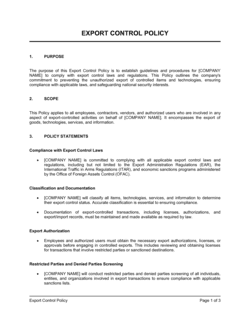
Before executing the agreement, the exporter should confirm whether the goods are subject to export controls under the applicable national regime — the US Export Administration Regulations (EAR), International Traffic in Arms Regulations (ITAR), or EU Dual-Use Regulation, for example. Goods with a nonzero Export Control Classification Number (ECCN) or that are on the US Munitions List may require a license before export to certain destinations or end users. Both parties should also screen each other against OFAC, EU, and UN sanctions lists. Violations carry criminal penalties and can result in permanent denial of export privileges.

Can I use the same import-export agreement for all countries?

A well-drafted template can cover most standard cross-border goods transactions, but country-specific adjustments are often needed. Some jurisdictions require contracts in the local language, impose specific mandatory terms, or restrict certain payment methods. Import licensing requirements, product certification standards (CE mark, FDA registration, CFIA approval), and customs valuation rules vary significantly. For repeat trade with the same country, it is worth having a local trade lawyer review the standard template once to flag any mandatory jurisdiction-specific clauses.

What documents should accompany an import-export agreement?

The core documents that should be referenced in or attached to the agreement are: a Schedule A describing goods specifications and quantity, a Schedule B listing required regulatory licenses and certifications, the pro forma or commercial invoice confirming price and Incoterms, the bill of lading or airway bill, the certificate of origin, the packing list, any inspection certificate, and — where an LC is used — the LC terms. Aligning the document list in the agreement with the LC documentary requirements prevents the most common cause of payment delay: document discrepancies.

How this compares to alternatives

vs Purchase Order

A purchase order is a buyer-issued document confirming a single order's quantity, price, and delivery date — it does not address payment mechanisms like LCs, inspection rights, customs allocation, dispute resolution, or governing law. An import-export agreement covers the full legal framework for the relationship, while a purchase order is a transaction-level instruction that references that framework. For cross-border transactions above a low value threshold, a purchase order alone is insufficient.

vs International Distribution Agreement

A distribution agreement appoints a foreign company as the importer's ongoing authorized reseller in a territory — covering exclusivity, minimum purchase commitments, marketing obligations, and term. An import-export agreement governs a specific sale of goods transaction. Businesses that appoint a distributor typically need both: the distribution agreement sets the relationship, and individual import-export agreements or purchase orders confirm each shipment.

vs Sales Agency Agreement

A sales agency agreement engages a foreign agent to solicit orders on the exporter's behalf for a commission — the agent does not take title to goods and is not the importer. An import-export agreement is a contract of sale between the exporter and the buyer (importer), who does take title. The two documents serve different commercial structures: agency for finding buyers, import-export agreement for closing the sale.

vs Commercial Invoice

A commercial invoice is a transaction document — it records the agreed price, goods description, Incoterms point, and parties for customs purposes. It does not create enforceable obligations around payment mechanics, inspection, dispute resolution, or regulatory compliance. An import-export agreement is the governing contract; the commercial invoice is one of the shipping documents required to perform under it.

Industry-specific considerations

Manufacturing and industrial goods

Component and raw-material sourcing across borders requires precise HS code classification, pre-shipment inspection clauses, and export control screening for dual-use items.

Consumer goods and retail

Product safety certifications (CE, FCC, FDA), labeling requirements in the destination country, and high-volume LC or open-account structures with established suppliers.

Food and agriculture

Phytosanitary and sanitary certificates, CFIA or FDA prior notice, perishables provisions in the force majeure clause, and cold-chain insurance requirements.

Technology hardware and electronics

EAR and ITAR export control screening, FCC and CE certification requirements, encryption classification, and end-user certificate obligations for dual-use components.

Pharmaceutical and medical devices

Regulatory approval conditions precedent (FDA 510(k), CE mark, Health Canada license), GDP-compliant shipping requirements, and batch-level inspection and traceability obligations.

Automotive and aerospace

ITAR licensing for defense components, ISPM 15 wooden packaging compliance, just-in-time delivery schedules tied to production lines, and liability caps calibrated to component value.

Jurisdictional notes

United States

US exporters must comply with the Export Administration Regulations (EAR) and, for defense articles, ITAR — both administered by the Bureau of Industry and Security (BIS) and State Department respectively. OFAC sanctions screening is mandatory before every transaction. The CISG applies automatically to US exporters dealing with buyers in other ratifying states unless expressly excluded. Governing-law clauses selecting New York law are widely enforced internationally.

Canada

Canadian exporters are subject to the Export and Import Permits Act (EIPA) and must screen against Canada's Consolidated Autonomous Sanctions List. The Canada Border Services Agency (CBSA) administers customs valuation under the Customs Act; under-valuation is a common compliance risk. CUSMA/USMCA preferential duty rates apply to qualifying goods traded between Canada, the US, and Mexico. Quebec-based parties may require contracts in French under the Charter of the French Language.

United Kingdom

Post-Brexit, UK exporters and importers must comply with both UK Strategic Export Controls (administered by the Export Control Joint Unit) and separate UK sanctions lists maintained by OFIS (Office of Financial Sanctions Implementation). UK customs declarations now apply to EU trade. English law and London-seated ICC or LCIA arbitration remain the dominant choice for international trade contracts globally and are strongly supported by English courts.

European Union

EU exporters are subject to the EU Dual-Use Regulation (2021/821) for controlled goods and must screen against the EU Consolidated Sanctions List. The CISG applies automatically in most EU member states. Intra-EU trade is governed by different VAT and customs rules than exports outside the EU customs union. GDPR considerations arise if the agreement involves personal data transfers between parties. ICC arbitration seated in Paris, Geneva, or Vienna is commonly used for EU-party trade disputes.

Template vs lawyer — what fits your deal?

PathBest forCostTime
Use the templateStandard goods transactions between established trading partners in common trade corridors with no export controls or complex regulatory requirementsFree30–60 minutes
Template + legal reviewFirst-time cross-border transactions, high-value shipments, restricted goods, or parties in jurisdictions with unfamiliar trade law (e.g., Gulf states, Southeast Asia)$500–$1,5003–7 days
Custom draftedExport-controlled goods (EAR/ITAR), transactions above $500K, complex multi-shipment supply arrangements, or parties in countries with strict foreign trade regulations$2,500–$8,000+2–4 weeks

Glossary

Incoterms
A set of standardized three-letter trade terms published by the ICC that allocate delivery, risk, insurance, and customs obligations between buyer and seller.
FOB (Free On Board)
An Incoterms rule under which the seller delivers goods onto the vessel at the named port of shipment, and risk transfers to the buyer at that point.
CIF (Cost, Insurance, and Freight)
An Incoterms rule under which the seller pays for carriage and insurance to the named destination port, but risk transfers to the buyer once goods are on board the vessel.
DDP (Delivered Duty Paid)
An Incoterms rule placing maximum obligation on the seller, who delivers goods cleared for import to the named destination with all duties and taxes paid.
Letter of Credit (LC)
A bank-issued payment instrument guaranteeing the seller will receive payment once documentary conditions — typically bill of lading, invoice, and inspection certificate — are met.
Telegraphic Transfer (TT)
An electronic funds transfer from the importer's bank to the exporter's bank, typically made in advance or against documents, without the conditional guarantee of a letter of credit.
Bill of Lading (BOL)
A shipping document issued by a carrier that serves as a receipt for goods, a contract of carriage, and a document of title transferable to the importer.
Customs Duty
A tariff or tax imposed by the importing country's government on goods crossing the border, calculated as a percentage of declared customs value.
Certificate of Origin
An official document certifying the country in which goods were manufactured, required by customs authorities to determine applicable duty rates and trade agreement eligibility.
Force Majeure
A clause excusing a party from performance obligations when an extraordinary event beyond its control — war, natural disaster, pandemic — prevents timely delivery or payment.
Arbitration (International)
A private dispute resolution process in which a neutral arbitral tribunal issues a binding award, commonly used in international trade because awards are enforceable in over 170 countries under the New York Convention.
Anti-Dumping Duty
An additional import tariff imposed when a government determines that goods are being sold in its market below fair market value, injuring domestic producers.

Part of your Business Operating System

This document is one of 3,000+ business & legal templates included in Business in a Box.

  • Fill-in-the-blanks — ready in minutes
  • 100% customizable Word document
  • Compatible with all office suites
  • Export to PDF and share electronically

Create your document in 3 simple steps.

From template to signed document — all inside one Business Operating System.
1
Download or open template

Access over 3,000+ business and legal templates for any business task, project or initiative.

2
Edit and fill in the blanks with AI

Customize your ready-made business document template and save it in the cloud.

3
Save, Share, Send, Sign

Share your files and folders with your team. Create a space of seamless collaboration.

Save time, save money, and create top-quality documents.

★★★★★

"Fantastic value! I'm not sure how I'd do without it. It's worth its weight in gold and paid back for itself many times."

Managing Director · Mall Farm
Robert Whalley
Managing Director, Mall Farm Proprietary Limited
★★★★★

"I have been using Business in a Box for years. It has been the most useful source of templates I have encountered. I recommend it to anyone."

Business Owner · 4+ years
Dr Michael John Freestone
Business Owner
★★★★★

"It has been a life saver so many times I have lost count. Business in a Box has saved me so much time and as you know, time is money."

Owner · Upstate Web
David G. Moore Jr.
Owner, Upstate Web

Run your business with a system — not scattered tools

Stop downloading documents. Start operating with clarity. Business in a Box gives you the Business Operating System used by over 250,000 companies worldwide to structure, run, and grow their business.

Start free · No credit card required