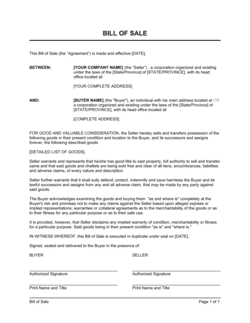
Aircraft Purchase Agreement Template

Free Word download β€’ Edit online β€’ Save & share with Drive β€’ Export to PDF

6 pagesβ€’25–35 min to fillβ€’Difficulty: Complexβ€’Signature requiredβ€’Legal review recommended
Learn more ↓
FreeAircraft Purchase Agreement Template

At a glance

What it is
An Aircraft Purchase Agreement is a legally binding contract between a seller and a buyer that governs the sale and transfer of a civil aircraft, including the agreed purchase price, condition of the aircraft, title transfer mechanics, escrow procedures, and representations about airworthiness and maintenance records. This free Word download gives you a structured, attorney-ready starting point you can edit online and export as PDF to share with counterparties, escrow agents, and aviation lenders.
When you need it
Use it any time a registered aircraft changes ownership β€” whether you are buying or selling a piston single, turboprop, business jet, or helicopter β€” to establish enforceable obligations before any deposit or pre-buy inspection is authorized. It is equally necessary for private-party deals, dealer transactions, and fleet disposals.
What's inside
Identification of the aircraft by make, model, serial number, and registration; purchase price and deposit terms; pre-buy inspection rights; airworthiness and title warranties; escrow and closing mechanics; bill of sale delivery; representations on liens, logs, and maintenance status; and default and dispute resolution provisions.

What is an Aircraft Purchase Agreement?

An Aircraft Purchase Agreement is a legally binding contract between a seller and a buyer that governs every material aspect of a civil aircraft sale β€” from the agreed purchase price and deposit mechanics through pre-buy inspection rights, title and lien warranties, escrow procedures, delivery conditions, and default remedies. Unlike a simple bill of sale, which merely records the transfer of title, a purchase agreement establishes enforceable obligations on both parties before any money changes hands or any inspection is authorized. It identifies the specific aircraft by registration number, serial number, and engine identifiers; allocates risk between signing and closing; and creates a documented record that protects both parties if the transaction breaks down.

Why You Need This Document

Aircraft transactions without a written purchase agreement routinely produce disputes over deposit refundability, undisclosed liens, engine swaps between signing and closing, and unresolved airworthiness directives. The FAA Aircraft Registry does not track contractual obligations β€” it records title only after closing. Without a signed agreement, a buyer who wires a deposit has no enforceable right to a refund if the pre-buy reveals serious problems, and a seller who allows an inspection has no protection if the buyer walks away without cause. A properly drafted aircraft purchase agreement closes these gaps: it makes the deposit terms unambiguous, requires a formal lien search before closing, ties escrow fund release to confirmed FAA filing, and gives both parties defined remedies if the other defaults. For transactions above $50,000 β€” which describes nearly every aircraft sale β€” the cost of skipping a formal agreement is measured in full deposit losses, title disputes, and litigation that can exceed the value of the aircraft itself. This template gives you the structure to avoid all of that.

Which variant fits your situation?

If your situation is…Use this template
Straightforward private-party sale of a piston singleAircraft Purchase Agreement
High-value business jet transaction with financing contingencyAircraft Purchase Agreement (Jet)
Documenting title transfer after the deal closesAircraft Bill of Sale (FAA Form 8050-2)
Temporary use of an aircraft before purchase closesAircraft Lease Agreement
Engaging a broker to find or sell an aircraftAircraft Broker Agreement
Fractional ownership purchase between multiple partiesFractional Aircraft Ownership Agreement
Seller financing where the seller holds a lien on the aircraftAircraft Security Agreement

Common mistakes to avoid

❌ Skipping the formal FAA lien and title search

Why it matters: Aircraft owned by private individuals can carry bank liens, mechanic's liens, or IRS tax liens recorded at the FAA Registry that the seller may not disclose or even know about. A buyer who closes without a clean lien search inherits those encumbrances.

Fix: Require a formal FAA Registry and UCC title search through a qualified aviation title company as a condition precedent to closing β€” this typically costs $150–$300 and takes 24–48 hours.

❌ Releasing escrow funds before FAA filing confirmation

Why it matters: If funds are released before the FAA Bill of Sale and registration application are confirmed as filed, the seller has been paid but the buyer has no documented chain of title β€” a significant problem if the seller later becomes insolvent or disputed.

Fix: Instruct the escrow agent in writing to release funds only upon receipt of a filing confirmation number from the FAA Aircraft Registry, not merely upon dispatch of the documents.

❌ Using a vague or seller-controlled pre-buy inspection process

Why it matters: An inspection conducted by the seller's preferred mechanic or without a written squawk sheet produces findings that are difficult to rely on or enforce in a price renegotiation.

Fix: Specify in the agreement that the buyer selects the inspection facility (subject to mutual agreement) and that the inspector provides a written discrepancy list that becomes an exhibit to the agreement.

❌ No risk-of-loss clause between signing and closing

Why it matters: Aircraft transactions routinely take 30–60 days to close. If the aircraft is damaged in a hangar fire or hailstorm after signing but before closing, the absence of a risk-of-loss clause leaves both parties arguing about who bears the loss.

Fix: Include an explicit risk-of-loss clause stating that risk remains with the seller until closing and that substantial damage or destruction gives the buyer the right to terminate and recover all deposits.

❌ Omitting engine and propeller serial numbers from the aircraft description

Why it matters: Without specific engine serial numbers, a seller could swap a time-expired engine for a freshly overhauled one between signing and closing β€” or the reverse β€” and the buyer has no contractual recourse.

Fix: Record every engine and propeller serial number in the aircraft identification clause and confirm those specific serials are present at the pre-buy inspection and again at closing.

❌ Failing to address existing airworthiness directives and deferred maintenance

Why it matters: An aircraft with open ADs or deferred maintenance items may not be legally airworthy at closing. Buyers who accept the aircraft without resolving these items inherit both the cost and the grounding risk.

Fix: Require the seller to warrant AD compliance as of the closing date, and use the pre-buy inspection squawk sheet to negotiate responsibility for any deferred items before the deposit becomes non-refundable.

The 10 key clauses, explained

Aircraft identification

In plain language: Precisely identifies the specific aircraft being sold by make, model, year of manufacture, FAA registration number, and manufacturer's serial number.

Sample language
The Aircraft is described as follows: Year: [YEAR], Make: [MANUFACTURER], Model: [MODEL], Registration No.: [N-NUMBER], Serial No.: [SERIAL NUMBER], Engine(s): [ENGINE MAKE/MODEL/SERIAL], Propeller(s): [IF APPLICABLE].

Common mistake: Omitting the engine serial number(s). Engine identity matters because engines are often replaced or overhauled separately, and a buyer expecting overhauled engines must have those specific serials documented to avoid disputes at closing.

Purchase price and deposit

In plain language: States the total agreed purchase price, the deposit amount due upon signing, and what happens to the deposit if either party walks away.

Sample language
The total purchase price is [PURCHASE PRICE] USD. Buyer shall deposit [DEPOSIT AMOUNT] USD into escrow within [X] business days of execution. If Buyer terminates for any reason other than a failed pre-buy inspection or title defect, the deposit shall be forfeited to Seller as liquidated damages.

Common mistake: Not specifying whether the deposit is refundable and under what conditions. Ambiguity here is the single largest source of post-deal disputes in aircraft transactions.

Pre-buy inspection rights

In plain language: Grants the buyer the right to conduct an independent pre-purchase inspection within a defined window, identifies who bears the cost, and states the outcome β€” proceed, negotiate, or walk away.

Sample language
Buyer shall have the right to conduct a pre-buy inspection at a facility mutually agreed upon within [X] days of execution. The inspection shall be at Buyer's expense. If the inspection reveals discrepancies exceeding $[THRESHOLD], Buyer may (a) accept the Aircraft as-is, (b) negotiate a price adjustment, or (c) terminate this Agreement and receive a full refund of the deposit.

Common mistake: Leaving the inspection facility selection entirely to the seller. The buyer's inspector should be truly independent β€” using the seller's preferred maintenance shop creates a conflict of interest that can suppress findings.

Seller's representations and warranties

In plain language: The seller's binding promises about the aircraft's title, lien status, airworthiness, logbook completeness, and compliance with applicable airworthiness directives.

Sample language
Seller represents and warrants that: (a) Seller holds good and marketable title to the Aircraft, free and clear of all liens and encumbrances; (b) all Airworthiness Directives applicable to the Aircraft have been complied with as of the date of this Agreement; (c) all logbooks and maintenance records are complete and accurate to the best of Seller's knowledge.

Common mistake: Accepting 'as-is, where-is' language with no representations at all. While common in dealer transactions, a complete absence of title and lien warranties leaves the buyer exposed to discovering an encumbered title after closing.

Title and lien clearance

In plain language: Requires a lien search of the FAA Aircraft Registry and applicable UCC filings before closing, and obligates the seller to clear any liens found.

Sample language
Prior to Closing, Seller shall cause a lien and title search to be conducted through [ESCROW AGENT / TITLE COMPANY]. Any liens, encumbrances, or security interests identified must be satisfied and released by Seller at or before Closing as a condition precedent to Buyer's obligation to close.

Common mistake: Skipping the formal lien search when buying from a private individual who 'knows' the aircraft is unencumbered. Aircraft loans are not always reflected in local UCC filings β€” the FAA Registry search is the authoritative source and must be run.

Condition at closing and delivery

In plain language: Defines the required condition of the aircraft at the time of delivery β€” typically the same condition as the pre-buy inspection minus agreed-upon exceptions β€” and the logistics of physical delivery.

Sample language
At Closing, the Aircraft shall be delivered to Buyer at [DELIVERY LOCATION] in the same condition as existed at the time of the pre-buy inspection, normal use and wear excepted, with all logbooks and maintenance records, current Airworthiness Certificate, and registration documents.

Common mistake: No defined delivery location or an implied obligation that the seller will fly the aircraft to the buyer. If the ferry flight results in damage or an incident, responsibility is ambiguous without explicit delivery and risk-of-loss language.

Escrow and closing mechanics

In plain language: Sets out the escrow agent's role, the sequence of closing actions (fund deposit, document execution, FAA filing, fund release), and the closing deadline.

Sample language
The parties shall utilize [ESCROW COMPANY NAME] as escrow agent. At Closing, Buyer shall wire the balance of the purchase price to escrow. Escrow Agent shall file the FAA Bill of Sale (Form 8050-2) and Aircraft Registration Application (Form 8050-1) with the FAA Registry, and shall release funds to Seller upon confirmation of filing. Closing shall occur no later than [CLOSING DATE].

Common mistake: Releasing funds before the FAA Bill of Sale is filed. The seller receives payment but the FAA Registry still shows the old owner β€” the buyer has no documented title until the filing is confirmed.

Risk of loss

In plain language: States which party bears the risk if the aircraft is damaged, destroyed, or grounded by regulatory action between signing and closing.

Sample language
Risk of loss or damage to the Aircraft shall remain with Seller until Closing. If, prior to Closing, the Aircraft is substantially damaged or destroyed, Buyer may terminate this Agreement and receive a full refund of all deposits. If the Aircraft is grounded by regulatory action prior to Closing, Buyer may elect to terminate or extend the closing deadline by [X] days.

Common mistake: Omitting risk-of-loss language entirely. Without it, courts apply default commercial law rules that vary by jurisdiction and may not match either party's expectations.

Default and termination

In plain language: Defines what constitutes a default by either party, the cure period allowed, and the remedies available β€” forfeiture of deposit, specific performance, or damages.

Sample language
If Seller defaults, Buyer may (a) terminate this Agreement and receive a full refund of all deposits, or (b) seek specific performance. If Buyer defaults (other than a permitted termination), Seller's sole remedy shall be retention of the deposit as liquidated damages, and neither party shall have further obligation to the other.

Common mistake: Drafting seller remedies as unlimited damages rather than capping them at the deposit. Sellers sometimes demand consequential damages for a buyer's breach β€” courts in many jurisdictions accept a liquidated damages clause as a clean and enforceable alternative.

Governing law and dispute resolution

In plain language: Specifies which jurisdiction's law governs the agreement and whether disputes go to arbitration or court, and where.

Sample language
This Agreement shall be governed by and construed in accordance with the laws of the State of [STATE], without regard to its conflict-of-laws principles. Any dispute arising under this Agreement shall be resolved by binding arbitration administered by [AAA / JAMS] in [CITY, STATE], except that either party may seek injunctive relief in any court of competent jurisdiction.

Common mistake: Omitting a governing law clause entirely. Aircraft transactions often involve parties in different states or countries β€” without a choice-of-law provision, courts apply a multi-factor analysis to determine applicable law, creating cost and uncertainty.

How to fill it out

  1. 1

    Identify the aircraft precisely

    Enter the year, make, model, FAA registration number, airframe serial number, engine make(s), model(s), and engine serial number(s) in the identification clause. Include avionics and major equipment if they affect the agreed price.

    πŸ’‘ Pull the serial numbers directly from the aircraft data plate and engine data plates β€” do not rely on the seller's recollection or a listing advertisement.

  2. 2

    Set the purchase price, deposit amount, and deposit terms

    State the total purchase price in US dollars and specify the deposit amount (typically 5–10% of the purchase price), the wire deadline, the escrow agent receiving it, and the exact conditions under which the deposit is refundable.

    πŸ’‘ Define refundable vs. non-refundable scenarios in plain language β€” 'refundable only if pre-buy reveals airworthiness discrepancies exceeding $X' removes ambiguity that causes most aircraft deal disputes.

  3. 3

    Define the pre-buy inspection window and process

    Specify the number of days the buyer has to schedule and complete the inspection, confirm the inspection facility selection process, and set the dollar threshold at which discrepancies trigger renegotiation or termination rights.

    πŸ’‘ Require that the inspection facility be FAA-certificated (or the applicable national authority equivalent) and that the inspector provide a written squawk sheet β€” verbal findings are not enforceable.

  4. 4

    Complete seller representations and warranties

    Have the seller confirm title ownership, absence of liens, AD compliance status, logbook completeness, and any known damage history. Attach any supplemental disclosures as exhibits.

    πŸ’‘ Request the aircraft's full maintenance records and any prior damage history before signing β€” representations are only as good as the seller's knowledge, and a pre-buy inspection catches mechanical issues, not hidden title problems.

  5. 5

    Name the escrow agent and document the closing sequence

    Identify the escrow company by full legal name, specify the sequence of actions (fund deposit, document review, FAA filing, fund release), and set a firm closing deadline with extension provisions.

    πŸ’‘ Use an aviation-specific escrow company familiar with FAA Registry filings β€” general real estate escrow companies frequently miss FAA procedural requirements, delaying registration.

  6. 6

    Address delivery location and risk of loss

    State where physical delivery of the aircraft occurs, which party is responsible for the ferry flight if delivery is not at the seller's base, and the exact moment risk transfers to the buyer.

    πŸ’‘ If the buyer is taking delivery at a location other than the seller's base, specify in writing whether the seller's insurance covers the ferry flight and confirm hull coverage transfers at wheels-down at the delivery airport.

  7. 7

    Set governing law and dispute resolution

    Choose the governing state law β€” typically the seller's state, the buyer's state, or where the aircraft is based β€” and decide between arbitration and litigation for dispute resolution.

    πŸ’‘ Arbitration is generally faster and less expensive for aircraft disputes in the $100K–$2M range; specify AAA or JAMS and include a clause that injunctive relief remains available in court.

  8. 8

    Execute before any deposit is wired

    Both parties β€” and any guarantors β€” must sign the agreement before the buyer wires any deposit to escrow. Retain a fully executed copy with original or verified electronic signatures.

    πŸ’‘ Use a timestamped eSign platform so that execution date and time are permanently recorded β€” in aircraft deals involving title disputes, the sequence of signature and deposit matters legally.

Frequently asked questions

What is an aircraft purchase agreement?

An aircraft purchase agreement is a legally binding contract between a seller and a buyer that documents all material terms of a civil aircraft sale β€” purchase price, deposit, pre-buy inspection rights, title and lien warranties, escrow procedures, delivery conditions, and default remedies. It governs the transaction from the time the parties agree on price through the closing and title transfer at the FAA Registry.

Is a separate bill of sale required in addition to a purchase agreement?

Yes. The aircraft purchase agreement is the governing contract for the transaction; the FAA Bill of Sale (Form 8050-2) is the title transfer document filed with the FAA Aircraft Registry at closing to update the official ownership record. Both documents are required β€” the purchase agreement without the FAA filing leaves the buyer without documented legal title, and the FAA filing without a purchase agreement leaves the parties without enforceable contractual protections.

Do I need a lawyer to use this aircraft purchase agreement template?

For straightforward private-party piston or turboprop transactions, a well-completed template reviewed by an aviation attorney is typically sufficient. For high-value business jet acquisitions (generally above $1M), international purchases, aircraft with financing contingencies, or deals involving complex maintenance histories, engaging an aviation attorney is strongly recommended. Legal review for an aircraft transaction typically costs $500–$2,000 and is a small fraction of transaction risk.

What is the role of an escrow agent in an aircraft transaction?

An escrow agent β€” typically an aviation title company β€” acts as a neutral third party that holds the buyer's funds and closing documents until all conditions of the purchase agreement are met. The escrow agent then simultaneously files the FAA Bill of Sale and releases funds to the seller, ensuring neither party is exposed: the buyer's funds are not released before title is transferred, and the seller's title is not transferred before payment is confirmed.

What should a pre-buy inspection cover?

A pre-buy inspection should include a review of all logbooks and maintenance records, confirmation of AD compliance, a physical inspection of the airframe and interior, engine compression tests and borescope inspections, avionics function checks, and a test flight. The scope should be documented in a written work order before the inspection begins, and all findings should be delivered in a written squawk list that becomes part of the purchase agreement record.

What happens if the pre-buy inspection reveals problems?

The purchase agreement should define three options when material discrepancies are found: accept the aircraft as-is at the agreed price, negotiate a price reduction or seller-paid repairs, or terminate the agreement and receive a full refund of the deposit. The agreement should specify a dollar threshold β€” typically $5,000–$25,000 depending on aircraft value β€” above which discrepancies trigger buyer renegotiation or termination rights.

How do aircraft transactions work across state lines?

The FAA regulates aircraft registration for all US-registered aircraft regardless of which state the transaction occurs in, so the federal registry process is uniform. However, state law governs the contract itself, sales tax obligations, and UCC lien filings β€” and these vary significantly. Sales or use tax can range from zero to over 10% depending on where the buyer takes delivery and registers the aircraft. A governing law clause and pre-closing tax advice are both important for multi-state transactions.

Can an aircraft purchase agreement be used for international transactions?

Yes, but significant modifications are needed. International transactions involve export airworthiness certificates, de-registration from the seller's national registry, and re-registration in the buyer's country β€” each with different timelines and requirements. The purchase agreement should address which party is responsible for each regulatory step, include currency and exchange-rate provisions if payment is not in USD, and specify which country's law governs the agreement. Aviation-specific legal counsel is strongly recommended for cross-border deals.

What taxes apply to an aircraft purchase?

In the US, state sales or use tax is typically the largest tax exposure and varies by state β€” some states exempt aircraft sales entirely, while others charge rates of 6–10%. The tax is generally owed in the state where the aircraft is first based after purchase, not necessarily where it is delivered. Federal excise tax may apply in certain commercial contexts. Buyers should obtain a state-specific tax analysis before closing to avoid unexpected assessments.

How this compares to alternatives

vs Aircraft bill of sale

An aircraft bill of sale (FAA Form 8050-2) is the title transfer document filed with the FAA Registry at closing β€” it records the change of ownership but contains no contractual protections, warranties, or remedies. An aircraft purchase agreement is the governing contract that protects both parties throughout the transaction. You need both: the purchase agreement to govern the deal and the bill of sale to transfer title.

vs Aircraft lease agreement

An aircraft lease agreement transfers the right to use an aircraft for a defined period in exchange for rent payments β€” ownership does not change hands. A purchase agreement transfers full ownership and title at closing. If a transaction starts as a lease with an option to purchase, a separate purchase agreement should be executed when the option is exercised.

vs Letter of intent (LOI)

A letter of intent captures initial agreement on price and major terms before a full purchase agreement is drafted β€” it is typically non-binding except for confidentiality and exclusivity provisions. A purchase agreement is the fully binding transaction document. An LOI is appropriate for complex jet transactions where due diligence may take weeks; for straightforward piston sales, parties often proceed directly to a purchase agreement.

vs Asset purchase agreement

An asset purchase agreement is a broad commercial contract used to acquire business assets including equipment, IP, customer lists, and goodwill. An aircraft purchase agreement is purpose-built for aviation transactions, incorporating FAA-specific title transfer mechanics, airworthiness representations, escrow procedures, and AD compliance warranties that a general asset purchase agreement does not address.

Industry-specific considerations

Corporate aviation

Business jet and turboprop acquisitions involve financing contingencies, pre-buy inspections by independent Part 145 repair stations, and escrow arrangements coordinated with aviation lenders.

Charter and air taxi operations

Charter operators acquiring fleet aircraft must confirm the aircraft's Part 135 eligibility, verify compliance with all applicable operational ADs, and coordinate title transfer with their operations specifications.

Flight training schools

Training fleet purchases focus heavily on engine and propeller time remaining, existing training wear patterns, and Part 141 or Part 61 operational suitability β€” all of which should be addressed in the pre-buy inspection scope.

Agricultural and utility aviation

Ag aircraft purchases require verification of STCs (Supplemental Type Certificates) for spray equipment, confirmation that chemical exposure has been properly documented in the logbooks, and environmental compliance for any contamination history.

Jurisdictional notes

United States

All US-registered civil aircraft title transfers must be filed with the FAA Aircraft Registry in Oklahoma City using Form 8050-2 (Bill of Sale) and Form 8050-1 (Registration Application). The FAA Registry is the authoritative title record β€” UCC filings supplement it for security interests. State sales and use tax varies significantly: some states (e.g., Oregon, Montana) impose no sales tax, while others (e.g., California, Florida) charge 6–10%. Delivery location often determines which state's tax applies.

Canada

Canadian civil aircraft are registered with Transport Canada, and title transfers require a completed Aircraft Registration Transfer Form submitted to the Civil Aviation Registry in Ottawa. Federal GST (5%) applies to most aircraft sales; provincial PST or HST may also apply depending on the province of delivery. Quebec requires French-language contracts for provincially regulated commercial transactions. Import duties may apply when purchasing a US-registered aircraft for Canadian registration.

United Kingdom

Aircraft registered on the UK Civil Aviation Authority (CAA) register require a change of registration filing with the CAA upon ownership transfer, including completion of CAA Form CA1. VAT at 20% may apply to aircraft sales depending on the buyer's VAT registration status and the aircraft's intended use β€” charter operations often benefit from VAT recovery. Post-Brexit, aircraft imported from the EU for UK registration require import VAT and customs clearance. Airworthiness documentation must meet UK CAA (not EASA) requirements for aircraft operating on the UK register.

European Union

Aircraft operating within the EU are primarily regulated by EASA (European Union Aviation Safety Agency), and airworthiness standards are harmonized across member states. Title registration is handled at the national level by each member state's civil aviation authority β€” there is no single EU-wide aircraft registry equivalent to the US FAA Registry. VAT treatment varies by member state, with rates ranging from 19–25%; intra-EU sales between VAT-registered businesses may qualify for zero-rating. Airworthiness Directives issued by EASA are mandatory across all member states.

Template vs lawyer β€” what fits your deal?

PathBest forCostTime
Use the templatePrivate-party piston or turboprop sales below $200K between domestic parties with a straightforward title historyFree30–60 minutes
Template + legal reviewTurboprop or light jet transactions, any aircraft with financing, or deals involving out-of-state parties and sales tax planning$500–$2,000 for aviation attorney review2–5 business days
Custom draftedHigh-value business jets above $1M, international cross-border purchases, fleet acquisitions, or aircraft with complex ownership or title history$3,000–$10,000+1–3 weeks

Glossary

N-Number / Registration Mark
The unique alphanumeric identifier assigned to a civil aircraft by its national aviation authority β€” in the US, this begins with 'N' and is recorded on the FAA Registry.
Aircraft Serial Number
The manufacturer's permanent identifier for a specific airframe, used to track maintenance history, airworthiness directives, and title records.
Pre-Buy Inspection
An independent mechanical and airworthiness evaluation of the aircraft performed by an FAA-certificated (or equivalent) maintenance facility at the buyer's direction before closing.
Airworthiness Certificate
A certificate issued by a national aviation authority confirming that an aircraft conforms to its type certificate and is in a condition for safe operation.
Escrow Agent
A neutral third party β€” typically a title company or aviation-specific escrow service such as AOPA's escrow division β€” that holds purchase funds and closing documents until all conditions are satisfied.
Bill of Sale (FAA Form 8050-2)
The FAA-approved document that legally transfers ownership of a US-registered civil aircraft from seller to buyer and is filed with the FAA Registry to update the title record.
Airworthiness Directive (AD)
A mandatory maintenance or inspection action issued by an aviation authority (e.g., FAA or EASA) that must be complied with by a specific date or interval.
Aircraft Logbooks
Permanent records documenting every inspection, repair, alteration, and maintenance event for the airframe, engine(s), and propeller(s) β€” essential for establishing maintenance history and resale value.
Lien Search
A search of the FAA Aircraft Registry and UCC filing systems to confirm no outstanding loans, judgments, or security interests are recorded against the aircraft.
Closing
The point at which all conditions of the purchase agreement are satisfied, funds are released by the escrow agent, and title documents are filed β€” transferring legal ownership to the buyer.
Type Certificate
The FAA (or equivalent authority) document that establishes the design standards to which a particular make and model of aircraft was built and must be maintained.

Part of your Business Operating System

This document is one of 3,000+ business & legal templates included in Business in a Box.

  • Fill-in-the-blanks β€” ready in minutes
  • 100% customizable Word document
  • Compatible with all office suites
  • Export to PDF and share electronically

Create your document in 3 simple steps.

From template to signed document β€” all inside one Business Operating System.
1
Download or open template

Access over 3,000+ business and legal templates for any business task, project or initiative.

2
Edit and fill in the blanks with AI

Customize your ready-made business document template and save it in the cloud.

3
Save, Share, Send, Sign

Share your files and folders with your team. Create a space of seamless collaboration.

Save time, save money, and create top-quality documents.

β˜…β˜…β˜…β˜…β˜…

"Fantastic value! I'm not sure how I'd do without it. It's worth its weight in gold and paid back for itself many times."

Managing Director Β· Mall Farm
Robert Whalley
Managing Director, Mall Farm Proprietary Limited
β˜…β˜…β˜…β˜…β˜…

"I have been using Business in a Box for years. It has been the most useful source of templates I have encountered. I recommend it to anyone."

Business Owner Β· 4+ years
Dr Michael John Freestone
Business Owner
β˜…β˜…β˜…β˜…β˜…

"It has been a life saver so many times I have lost count. Business in a Box has saved me so much time and as you know, time is money."

Owner Β· Upstate Web
David G. Moore Jr.
Owner, Upstate Web

Run your business with a system β€” not scattered tools

Stop downloading documents. Start operating with clarity. Business in a Box gives you the Business Operating System used by over 250,000 companies worldwide to structure, run, and grow their business.

Start freeΒ Β·Β No credit card required