Business Analysis Templates

4.7from 280+ reviews Trusted by 20M+ businesses

Turn raw data into clear decisions with structured analysis templates for every business situation.

WordEditable onlinePDF34+ business analysis templates

Other Administration categories

250K+Clients
20M+Free users
20+Years
190+Countries
10,000+Law firms
50M+Downloads

Trusted across review platforms

  • Capterra★★★★☆4.649 reviews
  • G2★★★★☆4.713 reviews
  • GetApp★★★★☆4.649 reviews
  • Google Play★★★★☆4.6179 ratings
  • Google Reviews★★★★☆4.567 reviews

Related categories

Frequently asked questions

What is a business analysis template?
A business analysis template is a pre-structured document that guides you through a defined analytical framework — SWOT, market sizing, risk scoring, competitive mapping, or others. It ensures every relevant dimension is covered, makes findings easier to communicate, and produces a consistent format that can be reused and compared over time.
What's the difference between a SWOT and a PESTLE analysis?
A SWOT analysis examines internal factors (strengths, weaknesses) and near-term external factors (opportunities, threats) specific to one company or initiative. A PESTLE analysis examines six macro-environmental forces — Political, Economic, Social, Technological, Legal, Environmental — that affect an entire industry or market. SWOT is often used for specific decisions; PESTLE is used for strategic planning and market entry. Many teams run both together.
When should I use a feasibility study instead of a market analysis?
Use a market analysis when you want to understand demand, customer segments, and competitive dynamics in a target market. Use a feasibility study when you've already identified an opportunity and need to determine whether your business can actually execute it — covering technical, operational, financial, and timeline viability. Market analysis answers "is there an opportunity?"; feasibility study answers "can we capture it?"
How often should business analysis documents be updated?
Competitive analyses and market analyses are typically refreshed annually or whenever a major competitor move or market shift occurs. Risk assessments should be reviewed quarterly for high-risk areas. SWOT and PESTLE analyses are usually refreshed as part of annual strategic planning. Feasibility studies are point-in-time documents and don't require regular updates, though assumptions should be revisited before a final go/no-go decision.
Can I use these templates for a startup or only for established businesses?
All templates in this folder work for startups. In fact, startups benefit most from structured analysis because they have less historical data to rely on — the frameworks force systematic thinking in the absence of operational experience. A startup pitching investors will find the market analysis, competitive landscape, feasibility study, and break-even analysis templates particularly useful for building a credible investment narrative.
What is a business impact analysis and when do I need one?
A business impact analysis (BIA) identifies the critical functions of a business and quantifies the operational and financial consequences of disrupting each one. It is typically required as part of a business continuity or disaster recovery plan. Organizations in regulated industries, businesses with complex supply chains, and any company preparing for ISO 22301 certification typically need one.
Do I need a research agreement before conducting external research?
Yes, any time you engage an external party — a market research firm, a consultant, or an academic institution — to conduct research on your behalf, a written research agreement protects both sides. It defines ownership of findings, confidentiality obligations, deliverables, and payment terms. Without one, ownership of research outputs can be disputed.
What is a stakeholder analysis and why does it matter?
A stakeholder analysis identifies everyone who is affected by or can influence a project or decision, maps their interests and level of influence, and guides how to communicate with and manage each group. It is used in project management, policy development, change management, and M&A. Skipping it is one of the most common reasons major initiatives face unexpected resistance.
How is a competitive analysis different from a competitive landscape analysis?
A competitive analysis examines specific rivals in depth — their products, pricing, positioning, strengths, and weaknesses. A competitive landscape analysis takes a wider view, mapping the entire competitive field including direct competitors, indirect substitutes, emerging entrants, and market share distribution. Use competitive analysis for a head-to-head comparison; use competitive landscape analysis for market-entry or strategic planning.

Business Analysi vs. related documents

Business Analysi vs. Business plan

A business analysis document examines evidence and draws conclusions about a specific question — a market, a risk, a competitor, a process. A business plan synthesizes many analyses into a forward-looking strategy and funding narrative. Analysis feeds the plan; the plan presents the story. Use analysis templates while gathering intelligence, then move to a business plan template when you're ready to commit to a direction.

Business Analysi vs. Report

A report records findings after the fact — what happened, what was observed, what was measured. A business analysis template is designed for active investigation — it structures the questions you ask before and during the process, not just the write-up afterward. Many analysis templates do include a reporting section, but their primary function is to guide the thinking, not just document the outcome.

Business Analysi vs. Audit

An audit is a specific type of business analysis that measures actual performance against a defined standard — financial controls, regulatory requirements, social media metrics, or IT security. General business analysis is broader and exploratory; audits are systematic and comparative. This folder includes both: strategy analysis frameworks and formal audit templates for teams that need both capabilities.

Business Analysi vs. Assessment

An assessment evaluates a current state — the financial risk of a supplier, the skills of a leader, the environmental impact of an operation. An analysis goes a step further to interpret causes, compare options, and recommend action. In practice, assessments are often the first step in a broader analysis, which is why both appear in this folder.

Key clauses every Business Analysi contains

Regardless of the specific framework, every well-built business analysis document contains the same foundational sections.

  • Objective statement. Defines the specific question the analysis is designed to answer, preventing scope creep.
  • Scope and boundaries. Specifies which markets, time periods, business units, or risk categories are included and excluded.
  • Data sources. Lists the primary and secondary sources used so readers can assess reliability and replicate the work.
  • Methodology. Explains the analytical framework applied — SWOT, PESTLE, break-even, matrix scoring, etc.
  • Findings. Presents the evidence in a structured format matched to the methodology chosen.
  • Key risks and assumptions. Flags conditions that must hold for the conclusions to remain valid.
  • Recommendations. Translates findings into specific, prioritized actions the business can take.
  • Owner and review date. Records who produced the analysis and when it should be revisited as conditions change.

How to write a business analysis

A strong business analysis follows a disciplined sequence — define the question first, then gather data, then interpret, then recommend.

  1. 1

    Define the decision you need to make

    Write one sentence stating the business question the analysis must answer — vague objectives produce vague conclusions.

  2. 2

    Choose the right framework

    Match the framework to the question: SWOT for strategic position, PESTLE for macro environment, break-even for pricing, risk matrix for risk prioritization.

  3. 3

    Set the scope and time horizon

    Specify which markets, business units, products, or time periods are in scope before collecting any data.

  4. 4

    Gather data from credible sources

    Use industry reports, internal records, customer surveys, competitor filings, and government statistics — and document each source.

  5. 5

    Populate the template

    Fill in each section in order; resist the urge to skip sections even when data is thin — gaps are themselves findings.

  6. 6

    Identify patterns and contradictions

    Look for where multiple data points converge on the same conclusion and where they conflict — conflicts deserve extra investigation.

  7. 7

    Write specific, prioritized recommendations

    Each recommendation should name a clear action, an owner, and a timeline — not just a direction.

  8. 8

    Set a review date

    Business conditions change; record when the analysis should be updated so it doesn't become dangerously stale.

At a glance

What it is
A business analysis template is a structured document that guides a team through collecting, organizing, and interpreting information about a company, market, competitor, or risk. It replaces blank-page paralysis with a repeatable framework that produces consistent, actionable output every time.
When you need one
Any time a decision requires evidence — launching a product, entering a market, assessing a risk, or auditing an operation — a business analysis template ensures nothing important is missed.

Which Business Analysi do I need?

The right template depends on what question you're trying to answer. Match your situation to the correct framework below.

Your situation
Recommended template

Evaluating a company's internal strengths and external threats

Maps strengths, weaknesses, opportunities, and threats in one structured view.

Sizing a market and understanding demand before launch

Structures market size, growth trends, customer segments, and key drivers.

Deciding whether a new project or venture is worth pursuing

Evaluates technical, financial, and operational viability before committing resources.

Mapping the competitive landscape and rival positioning

Identifies key competitors, their positioning, and market share gaps.

Quantifying and prioritizing operational or strategic risks

Scores risks by likelihood and impact to set mitigation priorities.

Analysing the political, economic, and environmental forces affecting the business

Covers six macro-environmental dimensions that affect strategy.

Calculating the revenue needed to cover all costs

Calculates the exact unit or revenue volume at which the business stops losing money.

Reviewing internal controls, processes, or compliance

Provides a structured checklist so auditors miss no control area.

Glossary

SWOT analysis
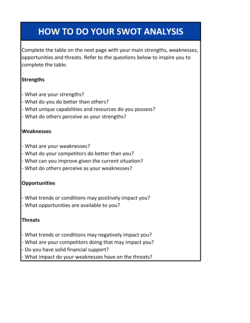
A structured framework that evaluates a company's Strengths, Weaknesses, Opportunities, and Threats.
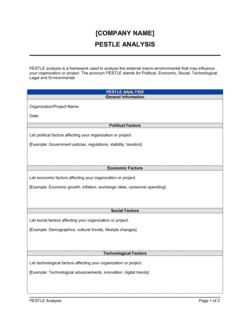
PESTLE analysis
A macro-environmental scan covering Political, Economic, Social, Technological, Legal, and Environmental factors.
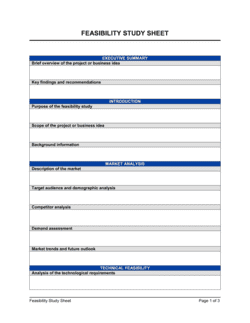
Feasibility study
A document that evaluates whether a proposed project or venture is technically, operationally, and financially viable.
Break-even analysis
A calculation that identifies the sales volume or revenue level at which total costs equal total revenue — yielding zero profit or loss.
Risk assessment matrix
A grid that scores identified risks by their likelihood and potential impact to prioritize mitigation efforts.
Business impact analysis (BIA)
A process that identifies critical business functions and quantifies the consequences of disrupting them.
Competitive landscape
The full set of competitors, substitutes, and market forces a business faces in a given market.
Internal audit
A systematic review of a company's own processes, controls, or compliance against defined standards.
Stakeholder analysis
An exercise that maps all parties affected by a decision, their interests, and their relative influence.
Market analysis
A structured assessment of market size, growth rate, customer segments, and competitive dynamics in a target market.
Demographic analysis
The study of a target population's characteristics — age, income, location, occupation — to inform product or marketing decisions.
Research agreement
A contract that defines ownership, confidentiality, deliverables, and payment terms when a third party conducts research on behalf of a company.

What is a business analysis?

A business analysis is a structured process of gathering and interpreting information to support a specific business decision — whether that's entering a new market, pricing a product, assessing a risk, or auditing an operation. Business analysis templates formalize this process by providing a defined framework, a consistent set of sections, and built-in prompts that ensure every relevant factor is considered before a conclusion is reached.

Business analysis covers a wide range of disciplines. Strategic analysis tools like SWOT and PESTLE examine position and macro-environment. Market and competitive analysis tools size opportunities and map rivals. Risk and impact assessment tools quantify uncertainty and operational vulnerability. Audit tools measure actual practice against defined standards. What unites all of these is the same underlying logic: define the question, gather evidence, structure the findings, and produce a clear recommendation.

When you need a business analysis

Any time a significant decision depends on understanding something you don't yet fully know — a market, a competitor, a risk, a process — you need a structured business analysis. The larger the decision and the higher the cost of being wrong, the more important it is to use a formal template rather than informal judgment.

Common triggers:

  • A company is considering launching a new product or entering a new market
  • An executive team is preparing the annual strategic plan and needs a current SWOT or PESTLE
  • A finance team needs to calculate break-even before approving a capital investment
  • An operations team needs to identify and score risks before a major process change
  • A procurement team is assessing the risk profile of a new vendor or supplier
  • A project team needs to identify stakeholder interests before a change initiative
  • An IT or compliance team is preparing for a security or operational audit
  • A business development team is mapping competitors ahead of a pricing or positioning review

Skipping structured analysis doesn't eliminate uncertainty — it just means decisions get made on assumption rather than evidence. The templates in this folder give every team, from a solo founder to a corporate strategy department, the frameworks they need to work from facts.

Award-winning platform

  • Great Place to Work 2025
  • BIG Award — Product of the Year 2025
  • Smartest Companies 2025
  • Global 100 Excellence 2026
  • Best of the Best 2025

Create your document in 3 simple steps.

From template to signed document — all inside one Business Operating System.
1
Download or open template

Access over 3,000+ business and legal templates for any business task, project or initiative.

2
Edit and fill in the blanks with AI

Customize your ready-made business document template and save it in the cloud.

3
Save, Share, Send, Sign

Share your files and folders with your team. Create a space of seamless collaboration.

Save time, save money, and create top-quality documents.

★★★★★

"Fantastic value! I'm not sure how I'd do without it. It's worth its weight in gold and paid back for itself many times."

Managing Director · Mall Farm
Robert Whalley
Managing Director, Mall Farm Proprietary Limited
★★★★★

"I have been using Business in a Box for years. It has been the most useful source of templates I have encountered. I recommend it to anyone."

Business Owner · 4+ years
Dr Michael John Freestone
Business Owner
★★★★★

"It has been a life saver so many times I have lost count. Business in a Box has saved me so much time and as you know, time is money."

Owner · Upstate Web
David G. Moore Jr.
Owner, Upstate Web

Run your business with a system — not scattered tools

Stop downloading documents. Start operating with clarity. Business in a Box gives you the Business Operating System used by over 250,000 companies worldwide to structure, run, and grow their business.

Free Forever Plan · No credit card required