Checklist Industry Analysis

Free download β€’ Use as a template β€’ Print or share

1 pageβ€’20–25 min to useβ€’Difficulty: Standard
Learn more ↓
FreeChecklist Industry Analysis Template

At a glance

What it is
A Checklist Industry Analysis is a structured operational template that guides analysts, founders, and strategists through every critical dimension of evaluating an industry β€” market size, growth trajectory, competitive forces, buyer and supplier dynamics, regulatory environment, and key success factors. This free Word download gives you a reusable, section-by-section framework you can edit online and export as PDF for internal decisions, investor presentations, or strategic planning sessions.
When you need it
Use it before entering a new market, evaluating an acquisition target, building a business plan, or briefing a leadership team on the competitive landscape of an existing industry. It is also useful when a new regulatory change or technology shift requires a fresh assessment of an industry you already operate in.
What's inside
Industry definition and scope, market size and growth metrics, competitive landscape assessment, Porter's Five Forces analysis, customer and buyer profile, supplier and distribution dynamics, regulatory and compliance environment, technology and innovation trends, key success factors, and a summary risk-and-opportunity matrix.

What is a Checklist Industry Analysis?

A Checklist Industry Analysis is a structured operational template that guides analysts, founders, and strategists through a systematic evaluation of an industry's attractiveness, competitive dynamics, and structural risk factors. It organizes the analysis into defined sections β€” market size, competitive forces, buyer and supplier dynamics, regulatory environment, technology trends, and key success factors β€” ensuring every critical variable is examined rather than left to informal judgment. By combining a Porter's Five Forces assessment with quantitative market metrics and a risk-opportunity matrix, the checklist produces a repeatable, defensible brief that can support market-entry decisions, investor presentations, or annual strategic planning reviews.

Why You Need This Document

Entering a market, allocating capital, or refreshing your strategy without a structured industry analysis means making high-stakes decisions based on incomplete information. Overlooking a dominant regulatory requirement can stall a product launch for 12 to 18 months. Misjudging supplier concentration can expose your cost structure to disruption the moment a single vendor raises prices. Failing to identify the two or three actual key success factors in a sector means building capabilities that don't move the competitive needle. A structured checklist prevents these gaps by forcing every dimension of the analysis to be addressed before a decision is made β€” and this template gives you a ready-to-use framework that cuts the setup time in half and produces a document credible enough to share with investors, boards, and executive teams.

Which variant fits your situation?

If your situation is…Use this template
Conducting a full strategic plan requiring internal and external analysisStrategic Planning Template
Analyzing your company's specific competitive position within the industryCompetitive Analysis Template
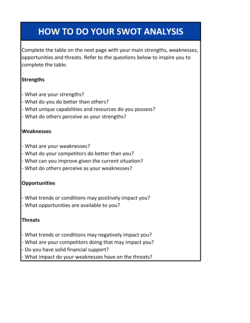
Identifying internal strengths and external threats alongside industry forcesSWOT Analysis Template
Evaluating a specific market opportunity for a new product or serviceMarket Analysis Template
Assessing a target company before acquisition or investmentDue Diligence Checklist
Building a full investor-ready plan around the industry findingsBusiness Plan Template
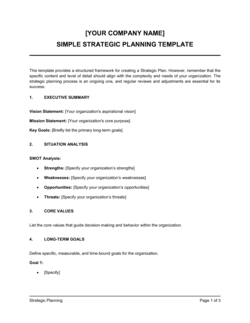
Summarizing industry findings in a one-page strategic overviewOne-Page Business Plan

Common mistakes to avoid

❌ Defining the industry scope too broadly

Why it matters: Analyzing 'healthcare' instead of 'cloud-based EHR software for independent physician practices' produces market-size figures and competitive conclusions that are useless for operational decisions.

Fix: Narrow the scope to the specific segment, geography, and customer type before gathering any data. Restate the scope at the top of each major section to keep the analysis anchored.

❌ Relying on a single market research report for size and growth figures

Why it matters: Single-source market data goes unchallenged until it is presented to an investor or executive who cites a conflicting figure β€” undermining the credibility of the entire document.

Fix: Cross-reference at least two independent sources and reconcile any differences explicitly. A bottom-up estimate built from customer count and average spend is a reliable internal check.

❌ Rating all five Porter's forces as medium

Why it matters: Uniform medium ratings signal the analyst assigned scores without examining evidence, making the framework exercise a box-ticking exercise rather than a useful diagnostic.

Fix: Force at least one high and one low rating across the five forces. If every force genuinely appears medium, document the specific evidence for each β€” the discipline of writing it down usually surfaces differentiation.

❌ Omitting technology trend time horizons

Why it matters: Listing AI, blockchain, and automation as trends without staging their maturity leads decision-makers to treat speculative possibilities as near-term threats, misallocating investment and planning effort.

Fix: Assign each technology trend an adoption stage (experimentation, early adoption, or mainstream deployment) and estimate the time horizon to material commercial impact β€” one to two years, three to five years, or beyond five years.

❌ Completing the risk matrix before finishing the body sections

Why it matters: A risk matrix built before the competitive, regulatory, and technology sections are complete will miss the risks those sections surface, resulting in an incomplete and misleading summary.

Fix: Always populate the risk and opportunity matrix last, pulling forward the highest-impact findings from each completed section.

❌ Listing generic key success factors

Why it matters: Factors like 'strong leadership' or 'customer focus' appear in every industry analysis and provide no actionable differentiation β€” they obscure the specific capabilities that actually explain competitive outcomes in this industry.

Fix: Test each KSF against this question: 'Does this explain why the current top-three players win?' If the answer is no, replace it with one that does.

The 10 key sections, explained

Industry definition and scope

Market size and growth metrics

Competitive landscape

Porter's Five Forces assessment

Customer and buyer profile

Supplier and distribution dynamics

Regulatory and compliance environment

Technology and innovation trends

Key success factors

Risk and opportunity summary matrix

How to fill it out

  1. 1

    Define the industry scope precisely

    Write a one-paragraph scoping statement that identifies the specific industry segment, geography, and time horizon being analyzed. Assign the relevant NAICS or SIC code.

    πŸ’‘ If two colleagues read your scope statement and name different industries, it is too vague β€” tighten it before proceeding.

  2. 2

    Gather market size data from at least two independent sources

    Pull current market size and CAGR from two distinct sources β€” a commercial research report and a trade association or government publication. Note both figures and reconcile any discrepancy.

    πŸ’‘ If the two sources diverge by more than 25%, flag the gap explicitly rather than averaging. The disagreement itself is strategically informative.

  3. 3

    Map the competitive landscape with share and positioning data

    List the top four to six players by estimated market share, their pricing model, and their primary point of differentiation. Note any recent M&A activity from the past 24 months.

    πŸ’‘ Annual reports, 10-K filings, and earnings call transcripts are the most reliable free sources for competitor revenue and strategic positioning.

  4. 4

    Rate each Porter's Five Forces with supporting evidence

    Assign a low, medium, or high rating to each force and write one to two sentences of supporting evidence for each rating. Do not skip any force β€” a missing force is a visible gap to any strategic reviewer.

    πŸ’‘ Start with the force you know least β€” supplier power or substitute threat β€” to avoid anchoring on the dynamics most familiar to you.

  5. 5

    Profile the customer buying process

    Describe who the primary buyer is, what their top purchase criteria are, how long the sales cycle typically runs, and what the switching costs are. Use customer interview data or industry reports if available.

    πŸ’‘ If you do not have primary research, a minimum of three customer interviews will surface patterns that no secondary source captures.

  6. 6

    Document regulatory requirements and pending changes

    List the primary laws and licensing requirements affecting the industry. Then identify any proposed regulations or enforcement trends that could materially change the competitive landscape within 24 months.

    πŸ’‘ Set a Google Alert for the industry name plus 'regulation' or 'compliance' β€” this surfaces pending changes faster than periodic research sweeps.

  7. 7

    Identify two to four technology trends with adoption stage ratings

    For each technology trend, note whether it is in early experimentation, early adoption, or widespread deployment across the industry. Rate the disruptive impact on the existing value chain as low, medium, or high.

    πŸ’‘ Check Gartner Hype Cycle reports for your sector to anchor technology maturity ratings against a widely recognized framework.

  8. 8

    Populate the risk and opportunity matrix last

    After completing all other sections, extract the top three to five risks and top three to five opportunities. Rate each on probability and impact, then write a single strategic implication sentence for each entry.

    πŸ’‘ The matrix should drive decisions β€” if you cannot write an implication sentence, the risk or opportunity is too abstract to be actionable.

Frequently asked questions

What is an industry analysis checklist?

An industry analysis checklist is a structured template that guides analysts and strategists through the key dimensions of evaluating an industry β€” market size, competitive forces, buyer and supplier dynamics, regulatory environment, technology trends, and key success factors. It ensures every critical variable is examined systematically rather than relying on informal judgment or incomplete research. The checklist format makes the process repeatable across different industries and team members.

When should you conduct an industry analysis?

Conduct an industry analysis before entering a new market, evaluating an acquisition or investment target, building a business plan, or when a major external shift β€” new regulation, technology disruption, or macroeconomic change β€” requires a reassessment of your competitive environment. For businesses already operating in a sector, an annual refresh aligned to the strategic planning cycle is standard practice.

What is Porter's Five Forces and why does it belong in an industry analysis?

Porter's Five Forces is a framework developed by Harvard Business School professor Michael Porter that evaluates industry attractiveness by examining five structural forces: competitive rivalry, threat of new entrants, threat of substitutes, buyer bargaining power, and supplier bargaining power. It belongs in an industry analysis because it moves beyond market size to explain why some industries are structurally more profitable than others and where strategic pressure points lie. A high-rivalry, high-substitution industry with powerful buyers is inherently less attractive than one with low rivalry and high switching costs, regardless of market size.

What data sources should I use for market size figures?

Reliable sources include commercial market research reports (IBISWorld, Statista, Grand View Research), government statistical agencies (U.S. Census Bureau, Statistics Canada, Eurostat), industry trade associations, and publicly filed annual reports and 10-K filings. Always cross-reference at least two independent sources and build a bottom-up estimate β€” customer count multiplied by average spend β€” as an internal validity check. A discrepancy of more than 25% between sources warrants explicit documentation and investigation rather than simple averaging.

How is an industry analysis different from a competitive analysis?

An industry analysis examines the structural forces and dynamics that shape all competitors in a sector β€” market size, entry barriers, regulatory environment, technology trends, and buyer/supplier power. A competitive analysis focuses on the specific companies competing for the same customers, comparing their strategies, capabilities, pricing, and positioning. The industry analysis sets the playing field; the competitive analysis maps who is on it and how they play. A complete strategic assessment typically requires both.

How long should an industry analysis take to complete?

A standard industry analysis using a structured checklist template takes roughly 8 to 20 hours for a single analyst, depending on data availability and the complexity of the industry. The market sizing and competitive landscape sections typically consume the most time. A consultant conducting a client-facing brief may spend 20 to 40 hours including primary research and verification. The checklist format reduces time by 30 to 50% compared to building the structure from scratch.

Do I need primary research or is secondary research sufficient?

Secondary research β€” published reports, filings, and trade publications β€” is sufficient for the structural sections of an industry analysis (market size, regulatory environment, competitive landscape). Primary research adds critical value in two sections: the customer and buyer profile, where three to five interviews surface purchasing behaviors no report captures, and the key success factors section, where practitioner conversations reveal the real drivers of competitive advantage. For high-stakes decisions such as market entry or acquisition, primary research is strongly recommended for at least these two sections.

How often should an industry analysis be updated?

For businesses actively competing in an industry, an annual full refresh aligned to the strategic planning cycle is standard. A targeted update is warranted any time a major structural shift occurs β€” a significant regulatory change, a high-profile new entrant, a disruptive technology reaching mainstream adoption, or a large M&A transaction reshaping market concentration. Market size figures older than 18 months are typically considered stale for investor or board presentations.

Can a small business use this template, or is it only for large companies?

A checklist industry analysis is equally useful for small businesses β€” particularly when evaluating whether to expand into a new product category, geography, or customer segment. The scale of research required adjusts to the decision at stake: a small business considering a local market entry needs a lighter-touch analysis than a corporation evaluating a $50M acquisition. The template's checklist format scales down gracefully by allowing you to mark certain sections as not applicable or complete them at a summary level rather than with full quantitative depth.

How this compares to alternatives

vs SWOT Analysis

A SWOT analysis evaluates a specific company's internal strengths and weaknesses alongside external opportunities and threats. An industry analysis examines the structural dynamics of the entire sector, independent of any single player. SWOT is company-centric and fast to complete; an industry analysis is broader, evidence-heavy, and more useful for market-entry or investment decisions. Most strategic plans require both.

vs Competitive Analysis

A competitive analysis profiles specific competitor companies β€” their strategies, pricing, strengths, and market share. An industry analysis examines the structural forces shaping all competitors simultaneously. The industry analysis answers whether the playing field is attractive; the competitive analysis answers who is winning on it and why. Conduct the industry analysis first to provide the context in which competitor profiles are interpreted.

vs Market Analysis Template

A market analysis focuses on customer demand β€” segment sizing, buyer behavior, and the specific opportunity for a product or service. An industry analysis is broader, covering supply-side dynamics, regulatory environment, competitive forces, and structural profitability drivers. A market analysis answers whether customers exist and will pay; an industry analysis answers whether the sector is structurally attractive to operate in.

vs Due Diligence Checklist

A due diligence checklist evaluates a specific company being considered for acquisition or investment β€” financials, legal liabilities, contracts, and operational risks. An industry analysis evaluates the sector the target company operates in. Both are typically completed together in M&A processes: the industry analysis establishes the strategic rationale; due diligence validates the specific target.

Industry-specific considerations

Technology / SaaS

Platform dependency risks, network effects as an entry barrier, cloud infrastructure cost benchmarks, and API ecosystem dynamics all require dedicated checklist items beyond standard Five Forces.

Healthcare / MedTech

FDA clearance pathways, reimbursement code coverage, and HIPAA compliance requirements are structural forces that shape competitive dynamics as significantly as buyer or supplier power.

Retail / E-commerce

Last-mile fulfillment cost structures, platform fee exposure (Amazon, Shopify), seasonal demand concentration, and private-label competitive threat from major retailers are sector-specific checklist items.

Financial Services

Regulatory licensing requirements (banking charters, broker-dealer registration), capital adequacy standards, and the competitive impact of open-banking mandates require a dedicated regulatory section beyond standard compliance notes.

Manufacturing

Raw material supply concentration, tariff and trade policy exposure, capacity utilization benchmarks, and union labor agreements are structural forces that often outweigh technology trends in near-term competitive impact.

Professional Services

Talent acquisition as a primary barrier to entry, billing rate benchmarks by service line, client concentration risk, and the threat from technology-enabled self-service platforms are the most strategically significant checklist dimensions.

Template vs pro β€” what fits your needs?

PathBest forCostTime
Use the templateFounders, small business owners, and analysts conducting internal market-entry or strategic planning researchFree8–20 hours
Template + professional reviewStrategy teams preparing board presentations, investor decks, or acquisition screening reports$500–$2,000 for a strategy consultant or market research analyst review1–2 weeks
Custom draftedInvestment banks, PE firms, or corporations commissioning a full sector report for a material capital allocation decision$5,000–$30,000+ for a custom research engagement3–8 weeks

Glossary

TAM (Total Addressable Market)
The total annual revenue opportunity available if a product or service achieved 100% market share β€” used as an upper-bound market size estimate.
Porter's Five Forces
A framework that evaluates industry attractiveness by analyzing competitive rivalry, threat of new entrants, threat of substitutes, buyer bargaining power, and supplier bargaining power.
Market Concentration
The degree to which a small number of firms control the majority of market share in an industry, typically measured using the Herfindahl-Hirschman Index or CR4 ratio.
Barriers to Entry
Structural factors β€” capital requirements, regulatory licenses, proprietary technology, network effects, or economies of scale β€” that make it difficult for new competitors to enter an industry.
CAGR (Compound Annual Growth Rate)
The annualized rate at which a market has grown or is projected to grow over a specified period, smoothing out year-to-year volatility.
Value Chain
The sequence of activities from raw input to end-customer delivery through which an industry creates and transfers value, identifying where margin is captured at each stage.
Key Success Factors (KSFs)
The specific capabilities, assets, or activities a company must have or perform well to compete effectively in a given industry.
Regulatory Environment
The body of laws, licensing requirements, standards, and government oversight that govern how companies in an industry must operate.
Substitutes
Products or services from outside the industry that satisfy the same customer need and could draw demand away if price or quality conditions shift.
Industry Life Cycle
The stage of development an industry is in β€” introduction, growth, maturity, or decline β€” which affects growth rates, competitive intensity, and profitability norms.

Part of your Business Operating System

This document is one of 3,000+ business & legal templates included in Business in a Box.

  • Fill-in-the-blanks β€” ready in minutes
  • 100% customizable Word document
  • Compatible with all office suites
  • Export to PDF and share electronically

Create your document in 3 simple steps.

From template to signed document β€” all inside one Business Operating System.
1
Download or open template

Access over 3,000+ business and legal templates for any business task, project or initiative.

2
Edit and fill in the blanks with AI

Customize your ready-made business document template and save it in the cloud.

3
Save, Share, Send, Sign

Share your files and folders with your team. Create a space of seamless collaboration.

Save time, save money, and create top-quality documents.

β˜…β˜…β˜…β˜…β˜…

"Fantastic value! I'm not sure how I'd do without it. It's worth its weight in gold and paid back for itself many times."

Managing Director Β· Mall Farm
Robert Whalley
Managing Director, Mall Farm Proprietary Limited
β˜…β˜…β˜…β˜…β˜…

"I have been using Business in a Box for years. It has been the most useful source of templates I have encountered. I recommend it to anyone."

Business Owner Β· 4+ years
Dr Michael John Freestone
Business Owner
β˜…β˜…β˜…β˜…β˜…

"It has been a life saver so many times I have lost count. Business in a Box has saved me so much time and as you know, time is money."

Owner Β· Upstate Web
David G. Moore Jr.
Owner, Upstate Web

Run your business with a system β€” not scattered tools

Stop downloading documents. Start operating with clarity. Business in a Box gives you the Business Operating System used by over 250,000 companies worldwide to structure, run, and grow their business.

Free Forever PlanΒ Β·Β No credit card required