Strategic Considerations For Selecting An Ideal Business Partner Template

Free download β€’ Use as a template β€’ Print or share

3 pagesβ€’20–25 min to useβ€’Difficulty: Standard
Learn more ↓
FreeStrategic Considerations For Selecting An Ideal Business Partner Template

At a glance

What it is
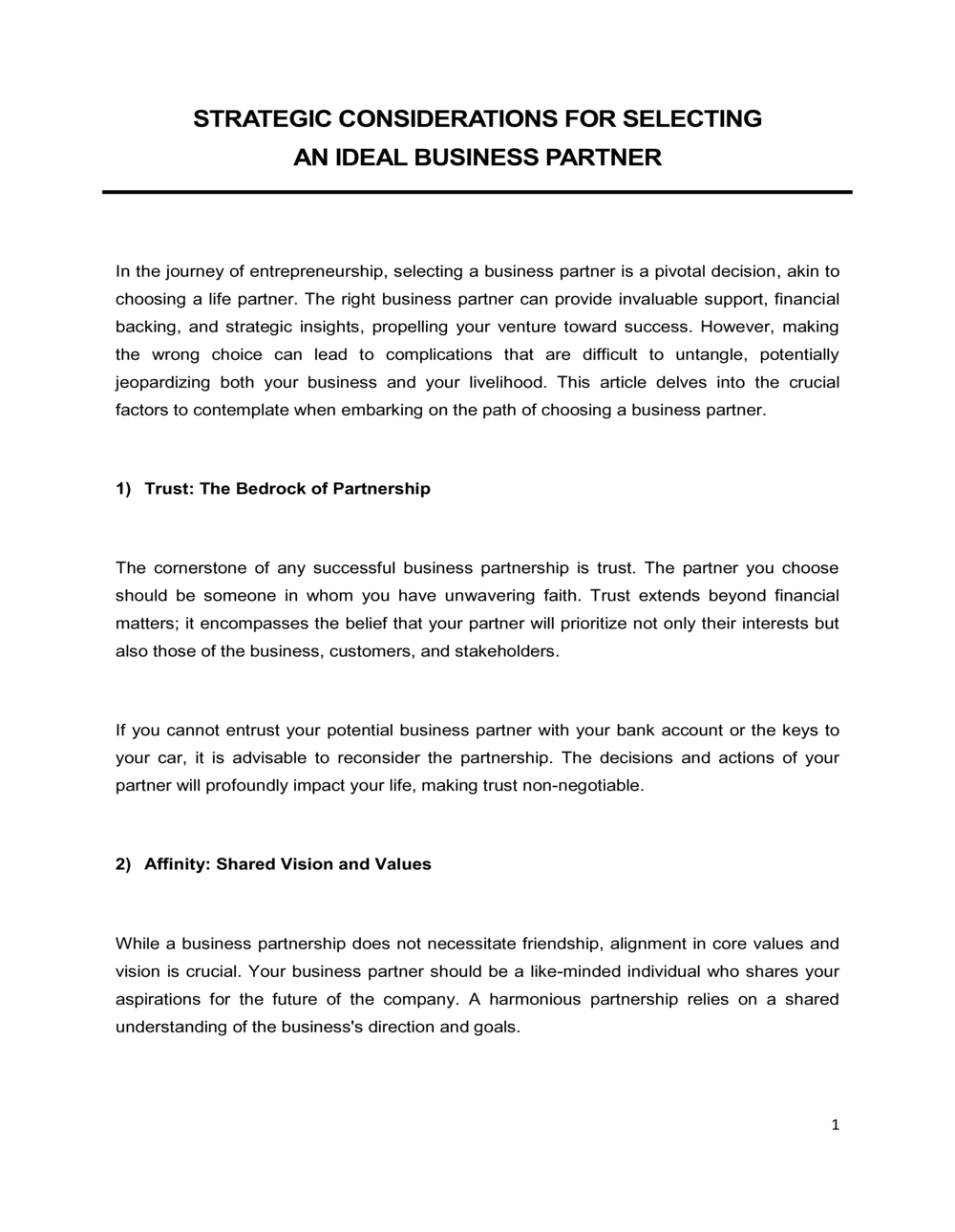
The Strategic Considerations for Selecting an Ideal Business Partner template is a structured evaluation document that guides founders, executives, and business owners through the key factors to assess before committing to a partnership. This free Word download organizes the decision into scored criteria sections β€” from strategic alignment and financial capacity to risk tolerance and exit provisions β€” so you can compare candidates objectively and document your rationale.
When you need it
Use it before entering any formal partnership negotiation: co-founding a new venture, bringing on an equity partner to an existing business, forming a joint venture, or structuring a strategic alliance with another company. The earlier in the process you apply this framework, the more costly misalignments you will surface before they become binding obligations.
What's inside
The template covers strategic fit analysis, values and culture alignment, financial capacity assessment, operational role definition, risk and liability evaluation, conflict-resolution mechanisms, and exit planning considerations β€” structured as a repeatable scoring framework you can apply to multiple candidates side by side.

What is a Strategic Considerations for Selecting an Ideal Business Partner document?

A Strategic Considerations for Selecting an Ideal Business Partner document is a structured evaluation framework that guides business owners, founders, and executives through the critical factors to assess before committing to a business partnership. It organizes the selection decision into scored sections β€” covering strategic rationale, candidate fit, values alignment, financial capacity, operational roles, due diligence, and exit provisions β€” so that candidates can be evaluated consistently and the final decision can be documented with a clear rationale. This free Word download gives you a repeatable process you can apply to multiple candidates and export as PDF for your records or advisor review.

Why You Need This Document

Choosing the wrong business partner is one of the most expensive operational mistakes a business can make β€” partnership dissolutions routinely result in litigation, forced buyouts at unfavorable valuations, operational disruption, and customer attrition. Most of these failures were predictable: unverified financial commitments, undefined decision authority, or values misalignment that was visible during selection but ignored. Without a structured evaluation on file, you also have no documentation of the process if a rejected candidate or departing partner later challenges the fairness of the decision. This template gives you a disciplined framework that surfaces deal-breaking incompatibilities before they become binding legal obligations β€” and creates a documented record that protects the business at every stage from selection through exit.

Which variant fits your situation?

If your situation is…Use this template
Evaluating a potential equity co-founder for a new startupStrategic Considerations for Selecting an Ideal Business Partner
Formalizing the agreed terms after partner selection is completePartnership Agreement
Structuring a project-specific collaboration between two companiesJoint Venture Agreement
Documenting a non-equity strategic alliance between businessesStrategic Alliance Agreement
Protecting sensitive business information shared during partner due diligenceNon-Disclosure Agreement
Defining roles and profit sharing once a partner is selectedBusiness Partnership Agreement
Planning ownership succession when a partner eventually exitsBuy-Sell Agreement

Common mistakes to avoid

❌ Evaluating the person before defining the need

Why it matters: When a specific candidate is in mind before the evaluation begins, every section of the framework gets shaped to justify the predetermined choice rather than stress-test it.

Fix: Complete the Partnership Objectives and Minimum Criteria sections before identifying or speaking with any candidate. Treat the criteria as locked before the evaluation starts.

❌ Skipping the values alignment assessment because it feels unstructured

Why it matters: The majority of partnership dissolutions β€” across legal, consulting, and entrepreneurial contexts β€” trace back to values and decision-style misalignment, not financial underperformance.

Fix: Use scenario-based questions that force the candidate to describe actual past behavior. Document responses verbatim so they can be compared objectively across candidates.

❌ Accepting unverified financial commitments

Why it matters: A partner who commits capital they do not actually have will either fail to contribute, take on harmful personal debt to do so, or exit early β€” all of which damage the business.

Fix: Require documented financial verification β€” bank statements, a CPA letter, or audited financials β€” before any candidate advances past the first evaluation round.

❌ Deferring role and authority definition to the partnership agreement

Why it matters: If two partners cannot agree on who owns which decisions during the evaluation stage, they will not agree after the partnership is signed β€” and disputes without pre-agreed authority lines escalate quickly.

Fix: Complete the Operational Roles section in full during the selection process, and treat significant disagreements on role boundaries as a disqualifying signal.

❌ Avoiding exit and deadlock discussions to keep the conversation positive

Why it matters: Partners who have never discussed exit terms before signing are consistently the ones who end up in expensive litigation or court-ordered buyouts when the relationship sours.

Fix: Treat exit provisions as a standard due-diligence item β€” frame the conversation as mutual protection for both parties, not as a sign of distrust.

❌ Using a single reference from the candidate's own network

Why it matters: A reference chosen by the candidate will almost never surface concerns about conduct, reliability, or how they behave in a dispute β€” the information you most need.

Fix: Ask the candidate for their reference list, then independently identify and contact at least one former business partner or employer not on that list.

The 9 key sections, explained

Partnership Objectives and Strategic Rationale

Candidate Profile and Minimum Criteria

Strategic and Market Fit Assessment

Values, Work Style, and Culture Alignment

Financial Capacity and Contribution Analysis

Operational Roles and Decision Authority

Risk, Liability, and Reputation Due Diligence

Conflict Resolution and Decision Deadlock Provisions

Exit Planning and Continuity Provisions

How to fill it out

  1. 1

    Define your partnership objectives before evaluating any candidate

    Complete the Partnership Objectives section first. Write down the specific problem, gap, or opportunity the partnership is meant to address β€” in one paragraph with a measurable outcome.

    πŸ’‘ If you cannot articulate the objective in a single paragraph, the business is not ready to bring on a partner yet.

  2. 2

    Set non-negotiable minimum criteria

    List three to five hard requirements a candidate must meet regardless of other strengths. These are gates, not preferences β€” failing one disqualifies the candidate from further evaluation.

    πŸ’‘ Keep minimum criteria to genuinely non-negotiable items; a list of ten criteria that are all flexible provides no filtering value.

  3. 3

    Score each candidate against strategic and market fit

    For each candidate, map their existing business against your market position. Identify complementary capabilities, potential conflicts of interest, and channel overlaps. Use a 1–5 scale for consistency across candidates.

    πŸ’‘ Run this section before meeting candidates in person β€” first-impression bias significantly skews strategic fit scores when completed afterward.

  4. 4

    Conduct structured values and work-style conversations

    Ask each candidate the same set of scenario-based questions covering risk tolerance, decision speed, conflict response, and long-term vision. Document responses in the template before comparing candidates.

    πŸ’‘ Scenario questions β€” 'What would you do if the business ran out of cash in 90 days?' β€” reveal real decision-making style far better than direct questions about values.

  5. 5

    Verify financial capacity through documentation

    Request and review bank statements, tax returns, or an accountant's letter confirming the candidate's ability to fulfill their capital commitment. Record the verification method and date in the Financial Capacity section.

    πŸ’‘ Establish mutual financial disclosure β€” share your own financials at the same time to set a tone of transparency that carries into the partnership.

  6. 6

    Complete due diligence on risk and reputation

    Run a background check, search court records, and conduct at least two reference calls with former partners or employers. Record findings in the Risk and Due Diligence section, including any identified issues and your mitigation assessment.

    πŸ’‘ Former business partners are the highest-value references β€” ask specifically about how the candidate handled disagreements and financial stress.

  7. 7

    Draft and discuss the conflict resolution and exit provisions

    Present your proposed conflict escalation tiers and exit valuation method to the candidate before finalizing the evaluation. Their response is itself an evaluation input.

    πŸ’‘ A candidate who negotiates the deadlock and exit provisions thoughtfully is demonstrating partnership maturity β€” that response belongs in your evaluation notes.

  8. 8

    Score, compare, and document your final decision rationale

    Aggregate scores across all sections for each candidate. Write a one-paragraph rationale for the selected partner β€” and for any candidate who was seriously considered but not chosen. Both documents belong in your records.

    πŸ’‘ Documenting rejection rationale protects you if a rejected candidate later claims the process was arbitrary or discriminatory.

Frequently asked questions

What are the most important factors when selecting a business partner?

The most important factors are strategic fit, values alignment, complementary skills, financial capacity, and pre-agreed conflict resolution. Most failed partnerships break down on values and decision-making style rather than technical or financial factors. A structured evaluation framework forces you to assess each dimension systematically rather than relying on personal rapport alone.

How is this template different from a partnership agreement?

This template is a pre-agreement evaluation and decision tool β€” it helps you determine whether a specific candidate is the right partner before any legal document is drafted. A partnership agreement is the binding legal contract that governs the relationship once the selection decision has been made. The evaluation should be completed and documented before negotiating the partnership agreement.

How many candidates should I evaluate before selecting a business partner?

Evaluating at least two or three candidates before making a final decision significantly improves outcomes. Selecting the first available candidate β€” even a strong one β€” removes the comparative context that reveals relative strengths and weaknesses. In practice, most business owners evaluate two to four serious candidates using a structured framework.

Should I share this evaluation document with the candidates?

The scoring criteria and minimum requirements can be shared transparently β€” doing so signals professionalism and sets clear expectations. The individual scores and comparative notes should remain internal. Before sharing any proprietary business information during the evaluation, have each candidate sign a non-disclosure agreement.

What financial information should I request from a potential business partner?

At minimum, request documentation of the capital they propose to contribute β€” a recent bank statement, CPA-prepared financial summary, or audited accounts. For significant equity partnerships, a full personal financial statement and a review of outstanding personal liabilities and guarantees is appropriate. Reciprocal disclosure is standard practice and sets the right tone.

Can this template be used to evaluate a corporate partner rather than an individual?

Yes. The sections on strategic fit, financial capacity, due diligence, and conflict resolution apply directly to corporate joint-venture or strategic alliance candidates. For corporate candidates, replace personal financial verification with a review of audited company financials, and add a section on the counterparty's decision-making authority β€” confirming that the individual you are negotiating with can bind their organization.

What is the most common reason business partnerships fail?

Research on partnership dissolution consistently identifies unresolved values misalignment and undefined decision authority as the leading causes β€” not financial underperformance. Partners who agree on strategy but disagree on how decisions get made, how conflict is handled, or how profits are reinvested create an unworkable dynamic that financial success does not fix. Structured pre-selection evaluation reduces this risk significantly.

When should I involve a lawyer in the partner selection process?

Legal counsel is not required for the evaluation and selection phase itself, but should be engaged before drafting or signing any partnership agreement, equity split document, or buy-sell provision. If the candidate evaluation surfaces undisclosed litigation, regulatory issues, or complex ownership structures, consult a lawyer before advancing the conversation further.

How long should the business partner evaluation process take?

A thorough evaluation of a single candidate typically takes two to four weeks β€” covering initial criteria screening, structured conversations, financial verification, reference checks, and documentation of findings. Rushing the process to close quickly is one of the most reliable predictors of a partnership that requires an expensive exit within three years.

How this compares to alternatives

vs Partnership Agreement

A partnership agreement is the legally binding governance document drafted after a partner has been selected. This evaluation template is the pre-decision framework used to identify and vet candidates before any agreement is negotiated. Use this template first; engage the partnership agreement once the selection decision is documented and both parties are ready to formalize terms.

vs Joint Venture Agreement

A joint venture agreement structures a specific project-based collaboration between two existing companies β€” each retaining its own legal identity. This evaluation template applies when selecting an equity partner who will co-own and operate the business itself, not a project-specific arrangement. For a defined-scope JV, pair this evaluation with the joint venture agreement template.

vs Strategic Alliance Agreement

A strategic alliance is a non-equity cooperation agreement β€” referral arrangements, co-marketing, or shared distribution β€” where neither party acquires ownership in the other. This evaluation template is designed for equity partnerships where shared ownership, governance, and liability are at stake. Strategic alliances require a different, lighter-weight vetting process.

vs Co-Founder Agreement

A co-founder agreement documents the equity split, vesting schedule, roles, and IP assignment between startup founders. This evaluation template is the upstream step β€” the structured assessment you complete before deciding who to co-found with and on what terms. The output of this template informs the terms you negotiate in the co-founder agreement.

Industry-specific considerations

Professional Services

Law, accounting, and consulting firms use structured partner evaluation to assess client-base complementarity, billing philosophy, and equity buy-in capacity before admitting a new equity partner.

Technology / SaaS

Technical co-founder selection is particularly high-stakes; the evaluation places extra weight on IP ownership history, prior equity disputes, and the candidate's ability to commit full-time rather than advising part-time.

Real Estate and Construction

Project partnership evaluation focuses on licensing, bonding capacity, lender relationships, and track record completing projects on budget β€” all documented in the financial capacity and due diligence sections.

Retail and Franchise

Multi-location operators evaluating a franchise partner or operating co-owner prioritize brand alignment, local market knowledge, and the candidate's ability to manage site-level operations without daily oversight.

Template vs pro β€” what fits your needs?

PathBest forCostTime
Use the templateFounders, small business owners, and operators conducting an initial partner evaluation without a dedicated corporate development teamFree2–4 weeks across candidate conversations, verification, and documentation
Template + professional reviewBusinesses evaluating a partner who will hold significant equity or contribute substantial capital, where an advisor's validation of the scoring and due diligence adds confidence$500–$2,000 for a business advisor or accountant review3–5 weeks
Custom draftedComplex multi-party partnerships, cross-border joint ventures, or high-value equity arrangements where a lawyer or M&A advisor should structure and oversee the evaluation process$2,000–$8,000+4–8 weeks

Glossary

Strategic Fit
The degree to which a potential partner's goals, capabilities, and market position complement and reinforce your own business direction.
Values Alignment
Agreement between partners on the core principles that guide decision-making β€” including risk appetite, ethics, employee treatment, and long-term vision.
Due Diligence
The structured investigation of a potential partner's financial health, legal history, reputation, and operational track record before formalizing an agreement.
Complementary Skills
Capabilities a partner brings that fill genuine gaps in the existing team rather than duplicating strengths already present.
Equity Split
The agreed percentage of business ownership allocated to each partner, which determines voting rights, profit distribution, and exit proceeds.
Vesting Schedule
A timeline over which each partner earns their full equity stake, typically 4 years with a 1-year cliff, designed to protect the business if a partner leaves early.
Conflict-Resolution Mechanism
A pre-agreed process β€” such as mediation, a casting vote, or a deadlock buyout trigger β€” for resolving partner disputes without litigation.
Buy-Sell Provision
A contractual clause defining how one partner can buy out the other's interest in defined circumstances, including disagreement, death, disability, or voluntary exit.
Fiduciary Duty
The legal obligation of each partner to act in the best interests of the partnership rather than their own personal interests.
Sweat Equity
Ownership stake granted in exchange for labor, expertise, or time contributed to the business rather than cash investment.

Part of your Business Operating System

This document is one of 3,000+ business & legal templates included in Business in a Box.

  • Fill-in-the-blanks β€” ready in minutes
  • 100% customizable Word document
  • Compatible with all office suites
  • Export to PDF and share electronically

Create your document in 3 simple steps.

From template to signed document β€” all inside one Business Operating System.
1
Download or open template

Access over 3,000+ business and legal templates for any business task, project or initiative.

2
Edit and fill in the blanks with AI

Customize your ready-made business document template and save it in the cloud.

3
Save, Share, Send, Sign

Share your files and folders with your team. Create a space of seamless collaboration.

Save time, save money, and create top-quality documents.

β˜…β˜…β˜…β˜…β˜…

"Fantastic value! I'm not sure how I'd do without it. It's worth its weight in gold and paid back for itself many times."

Managing Director Β· Mall Farm
Robert Whalley
Managing Director, Mall Farm Proprietary Limited
β˜…β˜…β˜…β˜…β˜…

"I have been using Business in a Box for years. It has been the most useful source of templates I have encountered. I recommend it to anyone."

Business Owner Β· 4+ years
Dr Michael John Freestone
Business Owner
β˜…β˜…β˜…β˜…β˜…

"It has been a life saver so many times I have lost count. Business in a Box has saved me so much time and as you know, time is money."

Owner Β· Upstate Web
David G. Moore Jr.
Owner, Upstate Web

Run your business with a system β€” not scattered tools

Stop downloading documents. Start operating with clarity. Business in a Box gives you the Business Operating System used by over 250,000 companies worldwide to structure, run, and grow their business.

Free Forever PlanΒ Β·Β No credit card required