- Value Chain
- A sequential set of activities a firm performs to deliver a product or service, classified by Michael Porter into primary activities and support activities.
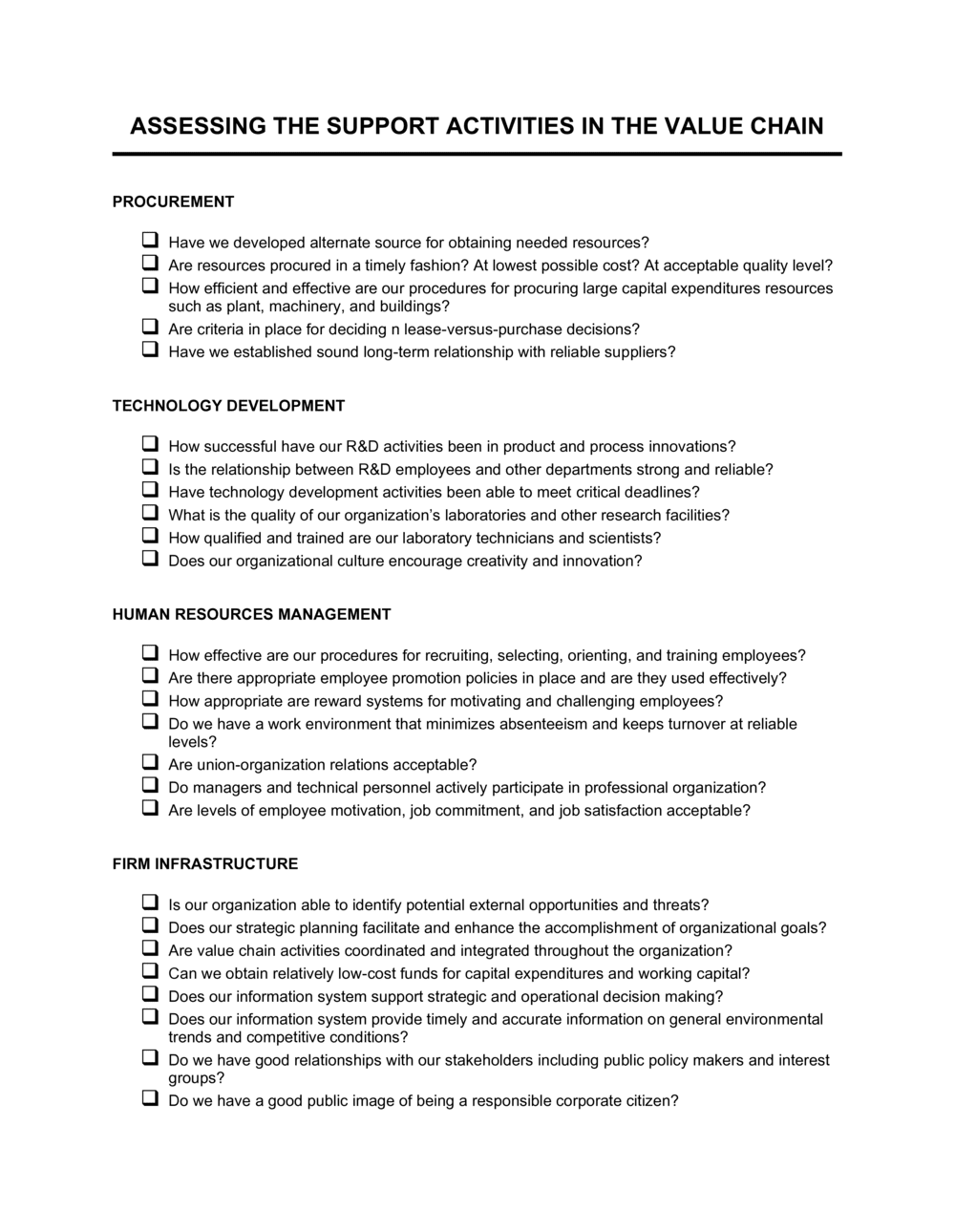
- Support Activities
- The four firm-wide functions in Porter's Value Chain — firm infrastructure, human resource management, technology development, and procurement — that enable and enhance primary activities.
- Firm Infrastructure
- The organizational systems, governance structures, finance, legal, and planning functions that underpin all other activities in the value chain.
- Human Resource Management
- All activities related to recruiting, hiring, training, developing, compensating, and retaining employees across the organization.
- Technology Development
- The processes, systems, and know-how involved in product development, process improvement, automation, and intellectual property creation.
- Procurement
- The processes a firm uses to acquire inputs — raw materials, equipment, services, and supplies — used across all primary and support activities.
- Competitive Advantage
- A position of sustained superiority over rivals achieved by performing value chain activities more efficiently or distinctively than competitors.
- Value Chain Analysis
- A systematic examination of each activity in the value chain to identify where value is added and where cost or differentiation advantages can be built or improved.
- Capability Gap
- The measurable difference between the current performance level of a support activity and the level required to achieve a stated strategic objective.
- Due Diligence
- A formal investigation and assessment of a business's operations, financials, and capabilities, typically conducted in anticipation of a transaction or investment.
- Porter's Framework
- Michael Porter's analytical model, introduced in Competitive Advantage (1985), that decomposes a firm's activities into a value chain to identify sources of competitive advantage.