Cost Benefit Analysis Template

Free download β€’ Use as a template β€’ Print or share

10 pagesβ€’25–30 min to useβ€’Difficulty: Complex
Learn more ↓
FreeCost Benefit Analysis Template

At a glance

What it is
A Cost Benefit Analysis (CBA) is a structured operational document that quantifies all expected costs and benefits of a proposed project, investment, or decision so decision-makers can determine whether the initiative is financially justified. This free Word download gives you a ready-to-edit framework you can complete in hours and export as PDF for stakeholder review.
When you need it
Use it before committing budget to a new project, technology purchase, process change, or expansion initiative β€” any decision where you need to justify spend with evidence rather than intuition.
What's inside
Executive summary, project description, assumptions, a full cost inventory (one-time and recurring), a benefit inventory (tangible and intangible), NPV and ROI calculations, a risk-adjusted sensitivity analysis, and a recommendation with a clear go/no-go conclusion.

What is a Cost Benefit Analysis?

A Cost Benefit Analysis (CBA) is a structured operational document that systematically identifies, quantifies, and compares all expected costs and benefits of a proposed project, investment, or policy decision. It converts both financial and non-financial outcomes into comparable monetary values, then applies standard financial metrics β€” net present value, return on investment, and payback period β€” to produce a clear, evidence-based answer to the question: does this initiative create more value than it consumes? A well-constructed CBA documents its assumptions transparently so that decision-makers can test the analysis rather than simply accept its conclusion.

Why You Need This Document

Organizations that commit budget without a formal cost benefit analysis routinely discover β€” months into execution β€” that costs were underestimated, benefits were overstated, or the wrong option was selected from a set of alternatives that were never properly compared. The consequences are concrete: projects run over budget, deliver less than promised, and consume resources that could have been deployed more effectively elsewhere. A CBA forces every assumption into the open before money is spent, giving stakeholders a structured basis to challenge the numbers, negotiate scope, or redirect investment to a higher-return alternative. For any initiative requiring board, CFO, or external funder approval, the absence of a CBA is often sufficient grounds to defer the decision entirely. This template gives you a complete, audit-ready framework that covers every component a rigorous cost benefit analysis requires β€” from the cost inventory and benefit quantification through to the sensitivity analysis and final recommendation.

Which variant fits your situation?

If your situation is…Use this template
Evaluating a single capital expenditure or equipment purchaseCost Benefit Analysis (CapEx)
Comparing two or more competing project options side by sideComparative Cost Benefit Analysis
Building a full business justification with strategic contextBusiness Case Template
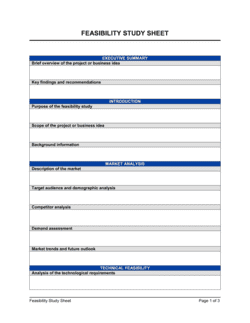
Assessing feasibility before detailed planning beginsFeasibility Study
Tracking realized versus projected benefits after project completionPost-Implementation Review
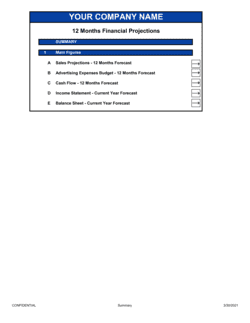
Forecasting revenue and expenses for a new venture or productFinancial Projections Template
Presenting a concise investment summary to executives or a boardExecutive Summary Template

Common mistakes to avoid

❌ Omitting recurring costs from the cost inventory

Why it matters: Listing only upfront implementation costs and ignoring annual licensing, maintenance, and support fees makes the project look cheaper than it is. The error typically surfaces during Year 2 budget cycles when the real cost structure becomes visible.

Fix: Create separate line items for one-time and annual recurring costs. Sum the full 3-year or 5-year cost of ownership before calculating ROI.

❌ Excluding intangible benefits entirely

Why it matters: Risk reduction, compliance assurance, and employee retention improvements are real and financially material. Leaving them out systematically understates the case for initiatives where the primary value is non-financial.

Fix: Assign a conservative dollar range to each intangible benefit with a documented basis β€” even a wide range is better than zero, and it prevents the analysis from rejecting high-value initiatives on a technicality.

❌ Using a discount rate of zero for multi-year analyses

Why it matters: Treating a dollar of benefit received in Year 5 as equal in value to a dollar received today overstates NPV and distorts the payback period calculation for long-horizon projects.

Fix: Apply your organization's cost of capital or a standard hurdle rate β€” typically 8–12% for corporate investments β€” to all multi-year cash flows before summing them.

❌ Presenting data without a stated recommendation

Why it matters: An analysis that lays out costs and benefits but leaves the conclusion unstated forces every reader to form their own interpretation, often leading to inconsistent decisions across the organization.

Fix: Close every cost benefit analysis with an explicit go/no-go recommendation, the two or three assumptions it depends on, and the immediate next steps if approved.

The 9 key sections, explained

Executive summary

Project description and objectives

Assumptions and constraints

Cost inventory

Benefit inventory

NPV, ROI, and payback period

Sensitivity analysis

Risk assessment

Recommendation and next steps

How to fill it out

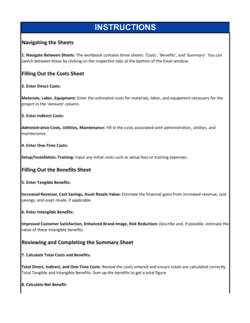
  1. 1

    Define the project scope and objectives

    Write a clear one-paragraph description of what the initiative involves, what problem it solves, and what measurable outcomes you expect. Set explicit scope boundaries so reviewers know what is and is not included.

    πŸ’‘ Frame objectives as outcomes, not activities β€” 'reduce invoice processing time by 40%' is stronger than 'implement new accounting software.'

  2. 2

    Document all assumptions upfront

    List the discount rate, benefit horizon (typically 3–5 years), FTE cost rates, inflation assumptions, and any constraints before building the cost or benefit tables. Every number in the analysis should trace back to a named assumption.

    πŸ’‘ A discount rate of 8–12% is a common baseline for corporate projects; check your organization's cost of capital or hurdle rate if one exists.

  3. 3

    Build a complete cost inventory

    Separate one-time costs (implementation, setup, training) from recurring costs (licensing, maintenance, support, additional headcount). Include indirect costs such as employee time spent on transition.

    πŸ’‘ Add a 10–15% contingency buffer to your total cost estimate β€” projects rarely come in under budget, and a buffer prevents the analysis from being invalidated by minor overruns.

  4. 4

    Quantify all benefits with supporting logic

    For each benefit, write out the calculation: hours saved Γ— FTE rate, or revenue uplift Γ— conversion rate. For intangible benefits, assign a conservative dollar range and note the basis for the estimate.

    πŸ’‘ Use conservative benefit estimates in your base case. An analysis that under-promises and over-delivers builds more credibility than one that inflates projections.

  5. 5

    Calculate NPV, ROI, and payback period

    Apply the discount rate to each year's net benefit to compute NPV. Divide total net benefit by total cost for ROI. Count the months from project launch until cumulative benefits exceed cumulative costs for the payback period.

    πŸ’‘ If the payback period exceeds the benefit horizon you selected, the project does not break even within the analysis window β€” flag this clearly rather than extending the horizon to make the numbers work.

  6. 6

    Run a three-scenario sensitivity analysis

    Create a base case, an optimistic case (benefits +30%, costs -10%), and a pessimistic case (benefits -30%, costs +20%). Show the NPV and ROI for each scenario in a summary table.

    πŸ’‘ If the pessimistic case still yields a positive NPV, the recommendation is straightforward. If the pessimistic NPV is negative, explain the risk mitigation strategy that closes the gap.

  7. 7

    State a clear recommendation with conditions

    Write a direct go/no-go recommendation supported by the headline metrics. If the recommendation is conditional β€” 'proceed only if vendor pricing can be reduced by 15%' β€” state the condition explicitly.

    πŸ’‘ Decision-makers who disagree with the recommendation need to challenge the assumptions, not the conclusion β€” make it easy for them by listing the top three assumptions the recommendation depends on.

  8. 8

    Write the executive summary last

    Pull the project description, total cost, total benefit, NPV, ROI, payback period, and recommendation into a single summary page. This should be self-contained enough that a busy executive can form a view without reading the body.

    πŸ’‘ Keep the executive summary to one page. If it runs longer, the supporting detail has leaked into the summary β€” move it back to the relevant section.
Frequently asked questions

What is a cost benefit analysis?

A cost benefit analysis is a structured framework that lists and quantifies all expected costs and benefits of a proposed project or decision, then calculates whether the benefits outweigh the costs over a defined time horizon. It typically produces three headline metrics: NPV, ROI, and payback period. Decision-makers use it to compare options, justify budget requests, and document the rationale for major investments.

When should you use a cost benefit analysis?

Use a cost benefit analysis before committing significant budget to any project, technology purchase, process change, staffing decision, or market expansion. It is particularly important when multiple options are competing for the same budget, when the initiative is irreversible, or when you need to document the financial basis for a decision to a board, CFO, or external funder. For minor operational decisions under a defined threshold β€” typically under $10,000 β€” a simplified one-page version is usually sufficient.

What is the difference between a cost benefit analysis and a business case?

A cost benefit analysis is a financial evaluation tool β€” its primary output is quantified metrics (NPV, ROI, payback) that answer whether an initiative is financially justified. A business case is a broader strategic document that includes the CBA financials but also covers strategic alignment, stakeholder analysis, implementation approach, and risk management. The CBA is often one section inside a full business case.

What costs should be included in a cost benefit analysis?

Include all one-time costs (implementation, setup, training, migration), all annual recurring costs (licensing, maintenance, support, additional headcount), indirect costs (employee time spent on transition, productivity dip during rollout), and a contingency buffer of 10–15%. Sunk costs β€” money already spent that cannot be recovered β€” should be excluded because they do not affect the forward-looking decision.

How do you calculate ROI in a cost benefit analysis?

ROI is calculated as total net benefit divided by total cost, expressed as a percentage. Total net benefit equals total benefits minus total costs. For example, if a project costs $200,000 and delivers $320,000 in benefits over three years, the net benefit is $120,000 and the ROI is 60%. For multi-year analyses, use discounted cash flows (NPV) rather than simple ROI to account for the time value of money.

What is a sensitivity analysis and why does it matter?

A sensitivity analysis tests how much the NPV and ROI change when key assumptions β€” cost estimates, benefit projections, or the discount rate β€” are varied from the base case. It typically produces a best case, base case, and worst case. It matters because no forecast is precise; a sensitivity analysis shows decision-makers the range of outcomes and identifies which assumptions the conclusion is most dependent on.

How far into the future should a cost benefit analysis project benefits?

Three to five years is the standard benefit horizon for most operational and technology investments. A 3-year horizon is appropriate for fast-moving markets or technology with a short useful life. A 5-year horizon suits capital-intensive projects such as equipment purchases or facility upgrades. Extending beyond 5 years increases forecast uncertainty enough that the additional precision is usually not worth the complexity.

Do intangible benefits belong in a cost benefit analysis?

Yes β€” omitting intangible benefits systematically understates the value of initiatives where the primary returns are risk reduction, compliance, employee satisfaction, or brand equity. Assign a conservative dollar range to each intangible benefit with a documented basis for the estimate. Presenting a range (e.g., $30,000–$80,000 per year in reduced turnover costs) is more credible than either inflating the number or excluding it entirely.

Who should prepare a cost benefit analysis?

The project sponsor or project manager typically prepares the first draft, working with finance to validate cost estimates and the business unit to quantify benefit assumptions. A finance manager or CFO reviews the financial calculations. For large or complex investments, an independent reviewer should stress-test the assumptions before the analysis goes to the decision authority. A structured template significantly reduces preparation time and ensures no standard component is omitted.

How this compares to alternatives

vs Business Case

A business case is a broader document that incorporates a CBA but also covers strategic rationale, stakeholder analysis, implementation options, and risk management. A cost benefit analysis is narrower β€” it answers only whether the financials justify the investment. Use the CBA when a financial evaluation is all that is needed; use the full business case when you need to persuade stakeholders on strategy as well as economics.

vs Feasibility Study

A feasibility study evaluates whether a project is technically, operationally, and financially possible before detailed planning begins. A cost benefit analysis assumes feasibility is already established and focuses purely on whether the financial return justifies proceeding. The feasibility study comes first; the CBA follows once the viable options are identified.

vs Financial Projections

Financial projections model future revenue, expenses, and cash flow for an ongoing business or product line over a 12-month or multi-year period. A cost benefit analysis is a decision-specific document that compares incremental costs against incremental benefits for a defined initiative. Use projections for ongoing business planning; use a CBA for evaluating a specific investment or change.

vs ROI Calculator / Spreadsheet

An ROI calculator or spreadsheet produces a single financial metric quickly but lacks the structured narrative, assumption documentation, sensitivity analysis, and recommendation that a full CBA provides. A calculator is useful for a quick screening check; a cost benefit analysis is the document you present to a CFO, board, or external funder to support a funding decision.

Industry-specific considerations

Technology / SaaS

Software licensing costs, integration and migration effort, productivity gains from automation, and reduction in manual support tickets are the primary cost and benefit line items.

Healthcare

Regulatory compliance savings, patient outcome improvements, and liability risk reduction are significant intangible benefits that must be quantified with documented clinical or actuarial data.

Manufacturing

Equipment downtime reduction, scrap rate improvement, energy savings, and throughput increases lend themselves to precise per-unit calculations that make CBAs particularly straightforward.

Government and Public Sector

Funders and oversight bodies typically require a formal CBA for any capital project above a defined threshold, often including social cost and benefit metrics alongside financial ones.

Template vs pro β€” what fits your needs?

PathBest forCostTime
Use the templateProject managers, operations leads, and small business owners evaluating standard investment decisions up to $500KFree4–8 hours
Template + professional reviewFinance managers or CFOs stress-testing assumptions for board-level or investor presentations$300–$1,000 for a financial analyst or advisor review1–3 days
Custom draftedGovernment or infrastructure projects requiring social cost-benefit methodology, or complex multi-option capital allocations above $5M$3,000–$15,000 for a specialist consultant2–6 weeks

Glossary

Net Present Value (NPV)
The sum of all future cash flows discounted back to today's dollars, minus the initial investment β€” a positive NPV means the initiative creates value.
Discount Rate
The percentage used to convert future dollars into today's equivalent value, reflecting the cost of capital or the minimum acceptable return.
Return on Investment (ROI)
Net benefit divided by total cost, expressed as a percentage β€” the simplest measure of whether a project generates more than it costs.
Payback Period
The length of time required for cumulative benefits to equal or exceed the total costs of an investment.
Tangible Benefit
A benefit that can be directly measured in dollars β€” such as revenue increase, cost reduction, or headcount savings.
Intangible Benefit
A benefit that is real but difficult to quantify precisely β€” such as improved employee morale, brand reputation, or customer satisfaction.
Opportunity Cost
The value of the next-best alternative foregone when a decision is made β€” relevant when comparing mutually exclusive options.
Sensitivity Analysis
A test that shows how the analysis conclusion changes if key assumptions β€” such as cost estimates or benefit projections β€” are higher or lower than expected.
Sunk Cost
Money already spent that cannot be recovered β€” sunk costs should be excluded from a forward-looking cost benefit analysis.
Break-Even Point
The point in time at which cumulative benefits exactly equal cumulative costs, after which the initiative generates net positive value.

Part of your Business Operating System

This document is one of 3,000+ business & legal templates included in Business in a Box.

  • Fill-in-the-blanks β€” ready in minutes
  • 100% customizable Word document
  • Compatible with all office suites
  • Export to PDF and share electronically

Create your document in 3 simple steps.

From template to signed document β€” all inside one Business Operating System.
1
Download or open template

Access over 3,000+ business and legal templates for any business task, project or initiative.

2
Edit and fill in the blanks with AI

Customize your ready-made business document template and save it in the cloud.

3
Save, Share, Send, Sign

Share your files and folders with your team. Create a space of seamless collaboration.

Save time, save money, and create top-quality documents.

β˜…β˜…β˜…β˜…β˜…

"Fantastic value! I'm not sure how I'd do without it. It's worth its weight in gold and paid back for itself many times."

Managing Director Β· Mall Farm
Robert Whalley
Managing Director, Mall Farm Proprietary Limited
β˜…β˜…β˜…β˜…β˜…

"I have been using Business in a Box for years. It has been the most useful source of templates I have encountered. I recommend it to anyone."

Business Owner Β· 4+ years
Dr Michael John Freestone
Business Owner
β˜…β˜…β˜…β˜…β˜…

"It has been a life saver so many times I have lost count. Business in a Box has saved me so much time and as you know, time is money."

Owner Β· Upstate Web
David G. Moore Jr.
Owner, Upstate Web

Run your business with a system β€” not scattered tools

Stop downloading documents. Start operating with clarity. Business in a Box gives you the Business Operating System used by over 250,000 companies worldwide to structure, run, and grow their business.

Free Forever PlanΒ Β·Β No credit card required