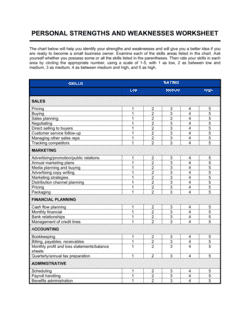
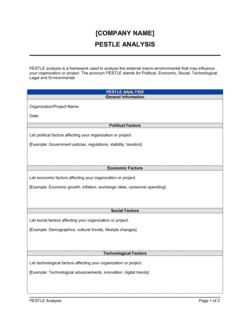
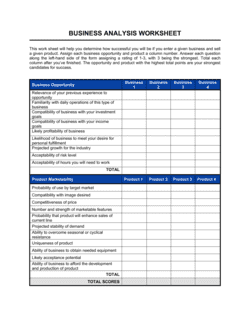
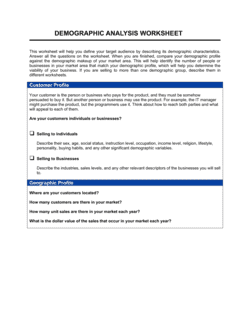
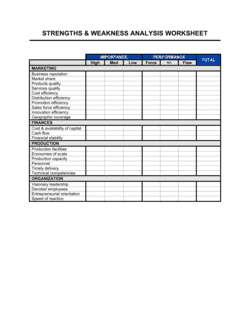
Worksheet — Strengths & Weaknesses Analysis

Editable template•1 page•20–25 min to use•Difficulty: Standard
Learn more ↓

The full editable document opens in Business in a Box.

At a glance

What it is
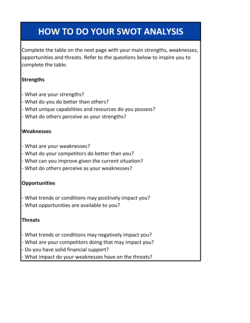
A Strengths and Weaknesses Analysis Worksheet is a structured operational document that guides teams or individuals through a systematic assessment of internal capabilities and gaps. This Word template gives you a ready-to-complete framework you can edit online and export as PDF for strategic planning sessions, performance reviews, or project kick-offs.
When you need it
Use it before a strategic planning cycle, ahead of a major business decision, or during a performance review when you need a clear, evidence-based picture of what your organization — or a specific person, product, or project — does well and where it falls short.
What's inside
A purpose statement block, instructions for identifying and rating strengths, a parallel section for cataloguing weaknesses with root-cause notes, a scoring or priority matrix, and an action-planning section that converts findings into concrete next steps.

Which variant fits your situation?

If your situation is…Use this template
Analyzing the full internal and external environment for strategic planningSWOT Analysis
Comparing your business against direct competitors on specific dimensionsCompetitive Analysis Template
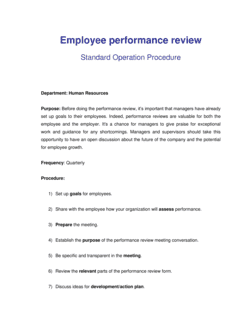
Reviewing an individual employee's performance and development areasEmployee Performance Review
Evaluating strengths and weaknesses of a specific project before launchProject Assessment Report
Running a full strategic planning cycle for the coming yearStrategic Planning Template
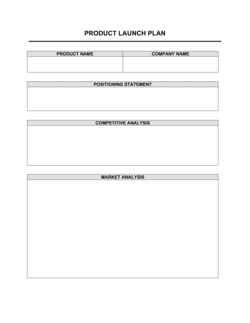
Identifying product-level capability gaps ahead of a roadmap reviewProduct Launch Plan
Assessing team capabilities for a new business unit or departmentOrganizational Chart with Role Descriptions

What is a Strengths and Weaknesses Analysis Worksheet?

A Strengths and Weaknesses Analysis Worksheet is a structured operational document that guides a business, team, or individual through a systematic, evidence-based assessment of internal capabilities and gaps. It provides a repeatable framework for inventorying what an organization does well — and where it falls short — then converting those findings into prioritized action plans. Unlike a general brainstorm or a verbal discussion, the worksheet enforces consistency through defined rating scales, root-cause prompts, and an owner-and-deadline structure that keeps findings from stalling at the observation stage.

Why You Need This Document

Strategic decisions made without a clear internal assessment routinely misallocate resources — investing in capabilities that were already sufficient while leaving genuine gaps unaddressed. Without a completed worksheet, planning sessions default to the loudest voices in the room rather than the most important evidence. Teams spend time debating whether something is a strength when the answer is available in the data, or they agree on weaknesses they never actually assign to anyone to fix. A structured worksheet eliminates that drift by forcing every finding to meet an evidence standard, every weakness to trace to a root cause, and every priority action to have a named owner before the session closes. This template gives you a proven, immediately usable format so your next planning cycle produces decisions you can execute — not just a list you revisit once a year.

Common mistakes to avoid

❌ Listing opinions instead of evidence-backed findings

Why it matters: Subjective strengths like 'innovative culture' or 'great team' cannot be acted on, measured, or compared across planning cycles. They produce false confidence.

Fix: Require each strength and weakness entry to cite at least one specific data point — a metric, customer quote, or benchmark comparison — before it is accepted into the worksheet.

❌ Analyzing too broad a scope in a single session

Why it matters: A worksheet that tries to cover the whole organization at once produces vague findings that no single team can act on, leading to the document being filed and forgotten.

Fix: Scope each worksheet to one unit, product, function, or individual. Run separate sessions for different areas and synthesize findings at the leadership level.

❌ Confusing weaknesses with threats

Why it matters: A threat is an external market condition — a new competitor, a regulation change. A weakness is an internal gap you control. Mixing the two creates a remediation plan aimed at the wrong target.

Fix: Before finalizing the weaknesses list, apply a simple test: 'Is this something we could fix with internal resources and decisions?' If no, it belongs in a SWOT analysis under threats, not here.

❌ Completing the analysis without assigning owners to action items

Why it matters: Findings with no named owner and no deadline have a near-zero completion rate. The worksheet becomes a historical document rather than a management tool.

Fix: Before the session ends, assign a named individual — not a team or department — to every top-priority action item, with a specific target date and the resources required.

❌ Never revisiting the worksheet after it is completed

Why it matters: A strengths and weaknesses analysis that is not reviewed in the next planning cycle provides no feedback loop — the organization repeats the same gaps year after year.

Fix: Schedule the next review date in the sign-off block before distributing the completed worksheet. At the next session, start by scoring progress on the previous cycle's action items.

❌ Using the worksheet as a top-down exercise completed by one person

Why it matters: A single author's perspective systematically misses blind spots — the weaknesses most damaging to a business are often the ones leadership is least aware of.

Fix: Gather input from at least three levels of the organization — leadership, middle management, and individual contributors — and reconcile differences explicitly rather than averaging them away.

The 9 key sections, explained

Purpose and scope statement

Analysis context and instructions

Strengths inventory

Weaknesses inventory

Priority and impact matrix

Strength leverage opportunities

Weakness remediation plan

Summary scorecard

Review and sign-off block

How to fill it out

  1. 1

    Define the scope and purpose before distributing

    Write a one-sentence scope statement identifying what entity is being assessed, the time horizon, and how findings will be used. Share this with all participants before the session begins.

    💡 A tightly scoped worksheet — one business unit, one product, one team — produces more actionable findings than an organization-wide sweep.

  2. 2

    Calibrate the rating scale with the group

    Spend five minutes aligning all participants on what a 1, 3, and 5 means for your specific context before anyone fills in a score. Use one shared example to anchor the scale.

    💡 Anchoring on a known benchmark — 'a 5 means we outperform the industry average by more than 20%' — produces far more consistent scoring than leaving participants to self-interpret.

  3. 3

    Populate the strengths inventory with evidence

    For each strength, require at least one supporting data point — customer NPS, win rate, cost per unit, or employee tenure — not an adjective. Rate each and note the strategic goal it supports.

    💡 Limit the initial list to ten strengths maximum. Forced ranking prevents every capability from being labeled a strength.

  4. 4

    Document weaknesses with root causes, not symptoms

    For each weakness, ask 'why does this exist?' at least twice before writing the root cause. Rate severity based on the business impact if the weakness remains unaddressed for 12 months.

    💡 The '5 Whys' technique — asking 'why' five times in succession — is the fastest way to move from symptom to root cause in a workshop setting.

  5. 5

    Plot findings on the priority matrix

    Place each strength and weakness on the impact-versus-effort grid. Focus the remediation plan on the high-impact, low-effort quadrant first.

    💡 If more than four items land in the high-impact, low-effort quadrant, re-examine your effort estimates — underestimating effort is the most common calibration error.

  6. 6

    Assign owners and deadlines to every action item

    Every weakness in the top-priority quadrant needs a named owner (not a department), a specific action, and a due date. Every high-rated strength needs a leverage opportunity mapped to a current initiative.

    💡 If an action item has no obvious owner, that absence is itself a finding — it signals an accountability gap in the organizational structure.

  7. 7

    Complete the summary scorecard and schedule the next review

    Distill findings to the top three to five per category, complete the sign-off block, and book the next review before the current session ends.

    💡 Quarterly reviews are standard for fast-moving businesses; annual is the minimum. Set the calendar invite before the worksheet leaves the room.

Frequently asked questions

What is a strengths and weaknesses analysis worksheet?

A strengths and weaknesses analysis worksheet is a structured document that guides an organization, team, or individual through a systematic assessment of internal capabilities (strengths) and gaps (weaknesses). It provides a reusable framework for collecting evidence, rating each factor, prioritizing findings, and converting them into action plans. Unlike a full SWOT analysis, it focuses exclusively on internal factors within the organization's control.

What is the difference between a strengths and weaknesses analysis and a SWOT analysis?

A SWOT analysis covers four quadrants — Strengths, Weaknesses, Opportunities, and Threats — where opportunities and threats are external market factors. A strengths and weaknesses worksheet focuses only on the two internal quadrants. It is the right tool when you need a deep, evidence-based internal audit rather than a full environmental scan. Many organizations complete the strengths and weaknesses worksheet first, then layer in the external analysis to build a complete SWOT.

When should I use a strengths and weaknesses analysis?

Use it before a strategic planning cycle, ahead of a major investment or expansion decision, at the start of a business improvement initiative, or during employee performance reviews. It is also valuable at the beginning of a consulting engagement when a clear picture of internal capabilities is needed before any external analysis begins. The worksheet is most useful when scoped to a specific entity rather than applied to the entire organization at once.

How many strengths and weaknesses should I identify?

Eight to twelve entries per category is a practical working range for most organizational assessments. Start with a longer brainstorm list — fifteen to twenty items per category — then apply the priority matrix to cut to the most strategically significant. More than twelve per category in the final worksheet typically signals an insufficiently scoped analysis or an inability to distinguish significant factors from minor ones.

Who should participate in completing a strengths and weaknesses analysis?

For the most accurate results, involve representatives from at least three organizational levels — leadership, middle management, and individual contributors — as well as any relevant functional specialists. Customer-facing staff often surface weaknesses that leadership is unaware of. For a product or project analysis, include both internal team members and, if possible, a sample of customers or end users.

How is a strengths and weaknesses analysis different from a performance review?

A performance review assesses an individual employee against their role expectations, goals, and behavioral competencies over a defined review period. A strengths and weaknesses worksheet can be applied at the individual level, but it is broader in scope — it can analyze a team, a product, a business unit, or an entire organization. The worksheet focuses on strategic capability rather than performance against targets.

How often should a strengths and weaknesses analysis be updated?

For most organizations, an annual update aligned to the strategic planning cycle is the minimum. Fast-growing companies or those going through significant change — a merger, a new market entry, or a leadership transition — typically benefit from a quarterly review. The most important discipline is checking progress on the previous cycle's action items before adding new findings.

Can this worksheet be used for individual career development?

Yes. The same framework applies directly to individual professional development when scoped to a specific role or career goal. The strengths inventory maps to skills and experiences that differentiate the individual; the weaknesses inventory maps to capability gaps relative to the next career milestone. The action plan then becomes a personal development plan with specific learning activities and target dates.

What should I do with the findings after completing the worksheet?

Prioritize the top three to five findings per category using the priority matrix, assign a named owner and deadline to every top-priority weakness action, map each high-rated strength to a specific initiative it can accelerate, and include the summary scorecard in the next strategic planning or board deck. Schedule the follow-up review session before distributing the completed worksheet so findings are not filed and forgotten.

How this compares to alternatives

vs SWOT Analysis

A SWOT analysis adds two external quadrants — Opportunities and Threats — to the internal strengths and weaknesses assessment. Use this worksheet when you need a focused internal audit with detailed root-cause analysis and action planning. Use a full SWOT when the strategic question requires mapping internal capabilities against external market conditions.

vs Strategic Planning Template

A strategic planning template is a broader document covering mission, vision, multi-year goals, initiatives, KPIs, and resource allocation. A strengths and weaknesses worksheet is one input to that larger process — typically completed in the diagnostic phase before goals and initiatives are set. The two documents are complementary, not interchangeable.

vs Employee Performance Review

A performance review evaluates an individual against role expectations and prior-period goals, typically for compensation and promotion decisions. A strengths and weaknesses worksheet applied at the individual level focuses on strategic capability development rather than performance scoring. Use the review for backward-looking evaluation; use this worksheet for forward-looking development planning.

vs Competitive Analysis Template

A competitive analysis maps your organization against external competitors on specific dimensions — pricing, features, market share, and distribution. A strengths and weaknesses worksheet is an internal-only document; competitor data may inform it but is not its primary subject. Complete the internal worksheet first, then use the competitive analysis to test whether your identified strengths actually differentiate you in the market.

Industry-specific considerations

Professional Services

Used to assess billable skill coverage against client demand, identify training needs, and benchmark utilization rates before a practice expansion.

SaaS / Technology

Applied at the product level to map feature capabilities against competitor offerings and identify engineering or UX gaps ahead of a roadmap planning cycle.

Retail / E-commerce

Evaluates supply chain resilience, customer experience touchpoints, and pricing capability gaps relative to direct competitors before a seasonal peak.

Manufacturing

Focuses on production capacity, quality control processes, supplier concentration risks, and workforce skill coverage against planned output targets.

Healthcare

Assesses clinical workflow efficiency, technology adoption gaps, staffing ratios, and compliance capability before a regulatory review or accreditation cycle.

Education

Used by department heads to evaluate curriculum coverage, faculty expertise gaps, and student outcome metrics against accreditation benchmarks or peer institutions.

Template vs pro — what fits your needs?

PathBest forCostTime
Use the templateSmall business owners, team leads, and HR managers running internal planning sessions or development reviewsIncluded with Business in a Box2–4 hours for a focused team session
Template + professional reviewOrganizations preparing findings for a board presentation, investor update, or external consultant engagement$300–$1,500 for a strategy advisor or facilitator review1–2 days including facilitation and synthesis
Custom draftedLarge organizations running enterprise-wide capability assessments or pre-merger due diligence requiring custom scoring rubrics$3,000–$15,000 for a management consulting engagement2–6 weeks

Glossary

Internal Analysis
An evaluation of factors within an organization's direct control — resources, processes, skills, and culture — as opposed to external market forces.
Core Competency
A specific capability or combination of skills that gives an organization a meaningful, hard-to-replicate advantage over competitors.
Capability Gap
The measurable difference between a current skill or resource level and the level required to achieve a stated goal or standard.
SWOT Analysis
A four-quadrant framework covering Strengths, Weaknesses, Opportunities, and Threats — this worksheet focuses on the first two (internal) quadrants only.
Root Cause
The underlying reason a weakness exists, as distinct from its visible symptoms — identifying root causes prevents treating symptoms while the real problem persists.
Priority Matrix
A 2×2 grid that ranks identified items by two dimensions — typically impact and effort or impact and urgency — to determine which to address first.
Benchmarking
Comparing your organization's performance or capabilities against a defined standard — an industry average, a competitor, or a best-practice reference point.
Development Action
A specific, time-bound task assigned to address a documented weakness or close a capability gap, with an owner and a due date.
Leverage
In strategic analysis, using an identified strength to capture an opportunity or neutralize a threat — the direct application of a capability gap finding.
Weighting Score
A numerical value assigned to each strength or weakness to reflect its relative importance to the organization's goals, allowing ranked prioritization.

Part of your Business Operating System

This document is one of 3,000+ business & legal templates included in Business in a Box.

  • Fill-in-the-blanks — ready in minutes
  • 100% customizable Word document
  • Compatible with all office suites
  • Export to PDF and share electronically

Browse related collections

Create your document in 3 simple steps.

From template to signed document — all inside one Business Operating System.

1
Download or open template

Access over 3,000+ business and legal templates for any business task, project or initiative.

2
Edit and fill in the blanks with AI

Customize your ready-made business document template and save it in the cloud.

3
Share with your team

Share your files and folders with your team. Create a space of seamless collaboration.

Save time, save money, and create top-quality documents.

★★★★★

"Fantastic value! I'm not sure how I'd do without it. It's worth its weight in gold and paid back for itself many times."

Managing Director · Mall Farm
Robert Whalley
Managing Director, Mall Farm Proprietary Limited
★★★★★

"I have been using Business in a Box for years. It has been the most useful source of templates I have encountered. I recommend it to anyone."

Business Owner · 4+ years
Dr Michael John Freestone
Business Owner
★★★★★

"It has been a life saver so many times I have lost count. Business in a Box has saved me so much time and as you know, time is money."

Owner · Upstate Web
David G. Moore Jr.
Owner, Upstate Web

Run your business with a system — not scattered tools

Stop downloading documents. Start operating with clarity. Business in a Box gives you the Business Operating System used by over 250,000 companies worldwide to structure, run, and grow their business.

Start free · No credit card required