1
Define the scope and strategic question
Begin by completing the Scope and Purpose Statement. Name the exact business unit, team, or individual being analyzed and state the specific strategic decision the analysis will inform. A scoped worksheet produces actionable findings; an unscoped one produces noise.
💡 Write the strategic question in one sentence before your session begins — for example, 'What internal factors will determine our success in entering the [MARKET] by [DATE]?'
2
Assemble the right participants
Invite 3–8 people who have direct, first-hand knowledge of the unit being analyzed. Include at least one person from outside the immediate team to challenge assumptions and surface blind spots.
💡 Pre-send a brief questionnaire asking participants to list their top three strengths and top three weaknesses before the session — this prevents groupthink and surfaces disagreements worth exploring.
3
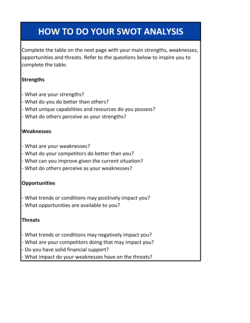
Complete the Strengths Identification section
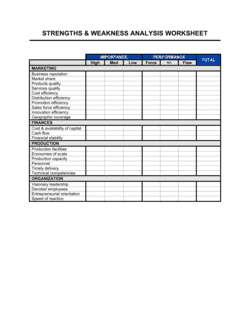
List each strength with a specific description and at least one supporting data point — a metric, customer quote, market share figure, or recent win. Assign a competitive relevance rating (High, Medium, or Low) to each.
💡 Challenge every strength claim with the question: 'Can we prove this with data?' If the answer is no, downgrade it to an assumption until evidence is available.
4
Complete the Weaknesses Identification section
List each weakness with a description of how it is currently affecting performance or limiting strategic potential. Assign a severity rating of 1–5 for each. Be specific — 'limited marketing budget of $[X]/quarter' is actionable; 'weak marketing' is not.
💡 Encourage candor by framing the session as a planning tool, not a performance review. Teams that feel safe being honest produce more accurate and useful analyses.
5
Prioritize and rank all items
Work through the Prioritization and Ranking section with the group. Assign each strength and weakness to a priority tier (1, 2, or 3) based on its strategic impact and the urgency of action. Resolve disagreements by tying the ranking to the stated strategic question.
💡 If more than 30% of items land in Tier 1, repeat the ranking exercise with a forced ranking: each participant assigns ranks independently, then the group reconciles.
6
Document root causes for high-severity weaknesses
For every weakness rated Severity 3 or above, complete the Root Cause Documentation section. Ask 'why?' at least three times to move from symptom to cause. Document the finding in one specific sentence.
💡 Use the '5 Whys' technique for any weakness rated Severity 4 or 5 — surface-level root causes lead to surface-level fixes.
7
Assign owners and deadlines to every action item
Complete the Strengths Leverage Strategy and Weakness Remediation Action Plan sections. Every item must have a named owner, a target date, and a measurable success metric. Unowned actions are not plans — they are wishes.
💡 Assign action items to individuals, not teams. 'Marketing team' owns nothing; '[NAME], Head of Marketing' owns something.
8
Obtain sign-off and schedule a review date
Have the accountable executive complete the Review and Sign-Off section before the worksheet is used in any strategic decision-making process. Set a calendar date — typically 90 days out — to review progress against each action item.
💡 Store the signed worksheet in a shared location accessible to all action-item owners, and calendar a mid-cycle check-in at the 45-day mark.