Pestle Analysis Template

Free download β€’ Use as a template β€’ Print or share

2 pagesβ€’20–25 min to useβ€’Difficulty: Standard
Learn more ↓
FreePestle Analysis Template

At a glance

What it is
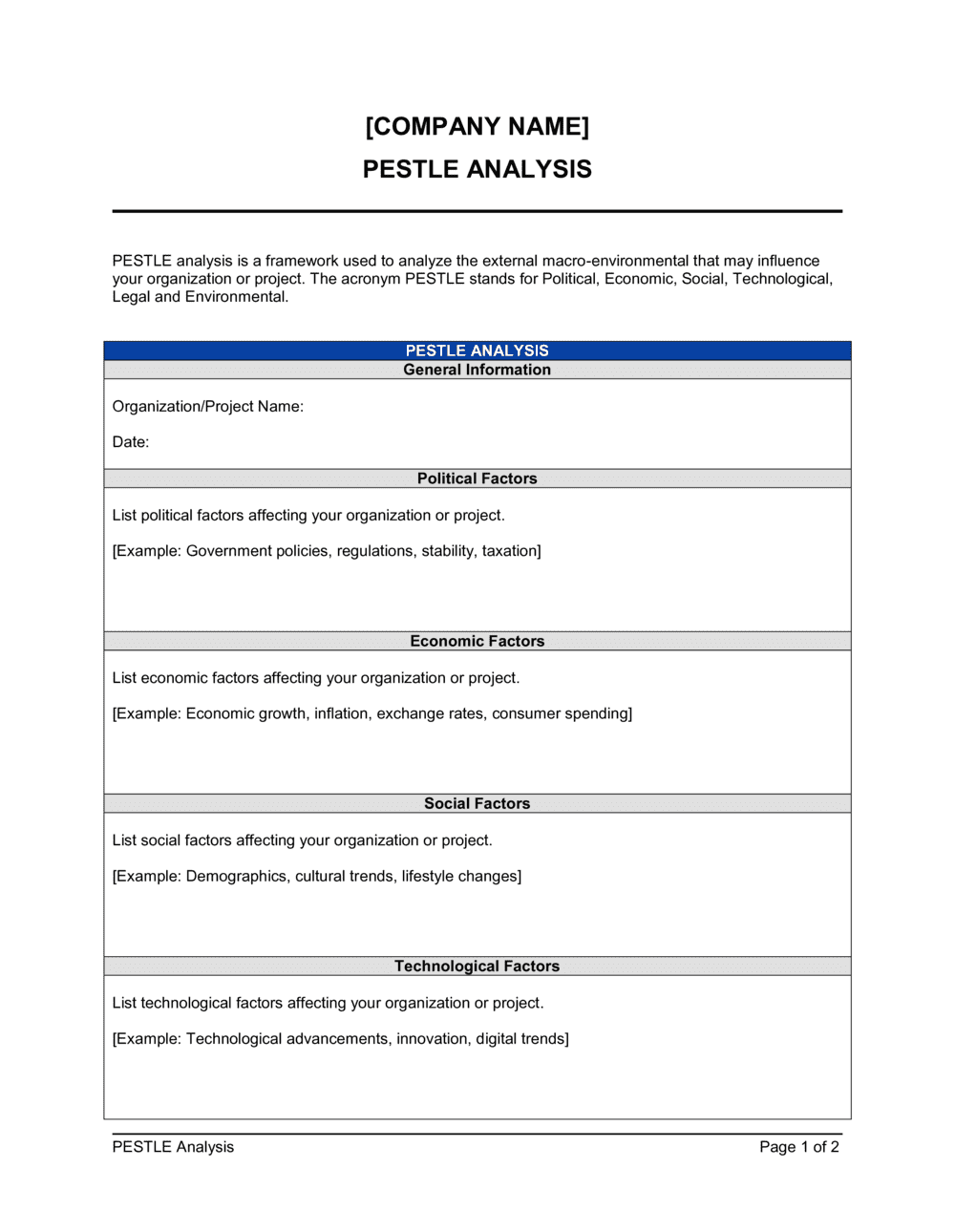
A PESTLE Analysis is a structured strategic planning document that maps the external macro-environmental forces β€” Political, Economic, Social, Technological, Legal, and Environmental β€” that affect an organization's ability to operate and grow. This free Word download gives you a ready-made framework you can edit online and export as PDF to support strategic plans, board presentations, or investment proposals.
When you need it
Use it when entering a new market, launching a product, completing a strategic planning cycle, or preparing a business case that requires a documented view of external risks and opportunities.
What's inside
Six labeled analysis sections covering each PESTLE factor, a summary findings block, and an implications and action priorities section β€” giving decision-makers a clear picture of the external landscape and what to do about it.

What is a PESTLE Analysis?

A PESTLE Analysis is a structured strategic planning document that systematically evaluates the six categories of macro-environmental forces β€” Political, Economic, Social, Technological, Legal, and Environmental β€” that shape the conditions in which an organization competes. Unlike internal assessments, a PESTLE focuses entirely on factors outside the organization's direct control, giving strategy teams a disciplined way to surface external risks and opportunities before committing to a plan. The framework originated in academic business strategy and is now a standard deliverable in corporate planning cycles, market entry assessments, and investor-facing business plans.

Why You Need This Document

Organizations that skip a formal external environment scan routinely build strategies on outdated assumptions β€” underestimating regulatory costs, missing demographic demand shifts, or entering markets just as a policy change erodes the economics. A completed PESTLE analysis forces every material external factor onto the table before decisions are made, not after. It gives leadership teams a common factual base for strategic discussions, reduces the risk of blind-spot surprises, and provides the documented market context that investors and lenders expect to see supporting financial projections. This template structures the analysis so findings translate directly into prioritized actions, turning a scan of the external environment into a concrete input to your strategic plan.

Which variant fits your situation?

If your situation is…Use this template
Quick scan focusing only on macro-economic and political factorsPEST Analysis
Internal and external factor analysis for strategic planningSWOT Analysis
Competitive landscape assessment alongside macro factorsCompetitive Analysis
Full strategic plan incorporating PESTLE findingsStrategic Plan
Market entry feasibility incorporating PESTLE and financialsBusiness Plan
Risk register derived from PESTLE findingsRisk Assessment
Industry-specific environment scan for a new product launchProduct Launch Plan

Common mistakes to avoid

❌ Scoping the analysis too broadly

Why it matters: A PESTLE that covers 'all markets globally' produces generic observations that no team can act on. Decision-makers need specific findings tied to a defined geography or product line.

Fix: Define the unit of analysis in the document header before filling in any section. One market, one business unit, or one product line per analysis.

❌ Using outdated data without source dates

Why it matters: Economic indicators, regulatory requirements, and political conditions change rapidly. A PESTLE built on 18-month-old figures can point the strategy team in the wrong direction.

Fix: Require a source and date for every data point. Flag any factor where the most recent data available is older than 12 months and note it as requiring verification.

❌ Treating all factors as equally urgent

Why it matters: A list of 30 equally weighted factors gives decision-makers no signal about where to focus. Without prioritization, the analysis creates work rather than reducing it.

Fix: Use a simple impact-versus-likelihood matrix in the summary section to separate immediate action items from watch-list items.

❌ Writing implications without assigning owners or deadlines

Why it matters: An implication that says 'the company should consider adapting its supply chain' has never once resulted in a supply chain being adapted. Accountability requires a name and a date.

Fix: Format every implication as: action β€” owner β€” deadline β€” success metric. If you cannot fill all four fields, the implication is not ready to include.

The 9 key sections, explained

Document header and scope

Political factors

Economic factors

Social factors

Technological factors

Legal factors

Environmental factors

Summary of key findings

Strategic implications and action priorities

How to fill it out

  1. 1

    Define the scope and unit of analysis

    Specify the exact market, geography, business unit, or product line the PESTLE covers. A scoped analysis produces focused, actionable findings; an unscoped one produces a list of global news headlines.

    πŸ’‘ If you are analyzing multiple markets, run a separate PESTLE for each β€” factors that are low-risk in one geography can be existential in another.

  2. 2

    Gather data for each factor category

    Research each of the six PESTLE categories using government publications, industry reports, trade association data, and central bank statistics. Record the source and date for every data point.

    πŸ’‘ Set a maximum data age of 12 months for economic and legal factors β€” anything older should be verified before inclusion.

  3. 3

    Complete the political factors section

    Document relevant government policies, trade agreements, tariffs, and political stability indicators. Note the direction of each factor β€” improving, stable, or deteriorating β€” not just its current state.

    πŸ’‘ Use a simple three-point trend indicator (arrow up, flat, arrow down) next to each factor so readers can scan direction at a glance.

  4. 4

    Complete the economic, social, and technological sections

    Fill each section with quantified factors where possible β€” GDP growth rate, consumer confidence index, demographic percentages, technology adoption rates. Narrative without numbers is opinion, not analysis.

    πŸ’‘ Link each economic factor directly to a cost or revenue line in your financial model. If you cannot draw that line, the factor may not be material enough to include.

  5. 5

    Complete the legal and environmental sections

    List specific, enforceable regulations and their compliance deadlines for the legal section. For environmental, include quantified cost estimates for carbon pricing, energy costs, or disclosure requirements where applicable.

    πŸ’‘ For the legal section, distinguish between regulations already in force and pending legislation β€” the strategic response differs significantly.

  6. 6

    Prioritize findings in the summary section

    Score each factor on a 2Γ—2 grid of impact (high/low) and likelihood or certainty (high/low). Surface the top three to five factors that require an immediate strategic response.

    πŸ’‘ A factor that is high-impact but low-probability still warrants a contingency plan β€” include it in a 'watch list' rather than the action priorities.

  7. 7

    Write the strategic implications with owners and deadlines

    For every high-priority finding, write one specific recommended action, assign an owner by role, and set a target completion date. Avoid vague language like 'continue to monitor.'

    πŸ’‘ Pair each implication with a measurable KPI so you can assess whether the action resolved the risk or captured the opportunity at the next review cycle.

  8. 8

    Set a review cadence and distribute to stakeholders

    Record the date of the analysis and the next scheduled review β€” quarterly for volatile markets, annually for stable ones. Distribute to strategy, finance, and operations leads so findings inform decisions across functions.

    πŸ’‘ Feed the PESTLE findings directly into the Opportunities and Threats quadrants of a SWOT analysis to complete your strategic planning cycle.

Frequently asked questions

What is a PESTLE analysis?

A PESTLE analysis is a strategic planning framework that systematically evaluates six categories of external macro-environmental factors β€” Political, Economic, Social, Technological, Legal, and Environmental β€” that affect an organization's ability to operate and compete. It is used to identify risks and opportunities in the external environment before making significant strategic, investment, or market-entry decisions.

What does PESTLE stand for?

PESTLE stands for Political, Economic, Social, Technological, Legal, and Environmental. Some versions of the framework use the acronym PEST (dropping the Legal and Environmental categories) or STEEPLE (adding Ethical factors). The six-factor PESTLE version is the most widely used in corporate strategy and business school curricula.

What is the difference between a PESTLE analysis and a SWOT analysis?

A PESTLE analysis focuses exclusively on the external macro-environment β€” factors outside the organization's control. A SWOT analysis maps both internal factors (Strengths and Weaknesses) and external factors (Opportunities and Threats). In practice, PESTLE findings feed directly into the Opportunities and Threats quadrants of a SWOT, making the two frameworks complementary rather than interchangeable.

When should I use a PESTLE analysis?

Use a PESTLE analysis when entering a new market or geography, launching a new product, completing an annual strategic planning cycle, preparing a board presentation on external risk, or building the market context section of a business plan or investor deck. It is most valuable when the external environment is changing rapidly and decision-makers need a structured way to separate signal from noise.

How often should a PESTLE analysis be updated?

For stable, mature markets, an annual review aligned to the strategic planning cycle is standard. For volatile markets β€” new geographies, regulated industries, or sectors affected by rapid technology change β€” a quarterly refresh is more appropriate. The key is to record the date of the analysis and set a firm review date, not to update it ad hoc when something major happens.

What is the difference between PESTLE and PEST?

PEST is an earlier, shorter version of the framework covering only Political, Economic, Social, and Technological factors. PESTLE adds Legal and Environmental categories, which became increasingly material as regulatory complexity and climate-related risks grew. For most modern businesses, the full six-factor PESTLE provides more complete coverage and is the preferred format.

Can a PESTLE analysis be used for internal strategic planning as well as investor presentations?

Yes. Internally, a PESTLE analysis informs resource allocation, risk management, and operational planning by surfacing external forces the leadership team needs to account for. Externally, it supports the market context and competitive environment sections of a business plan, investor deck, or board report. The same underlying analysis can serve both audiences with minor formatting adjustments.

How detailed should each PESTLE factor section be?

Each factor section should include three to six specific, quantified factors with a stated trend direction and data source. Aim for depth over breadth β€” three well-evidenced factors with clear strategic implications are more useful than ten vague observations. The goal is to surface factors that require a decision, not to document everything that is happening in the world.

How this compares to alternatives

vs SWOT Analysis

A SWOT analysis covers both internal factors (Strengths, Weaknesses) and external factors (Opportunities, Threats). A PESTLE analysis focuses exclusively on the external macro-environment across six structured categories. The two are complementary β€” run the PESTLE first, then use its findings to populate the external half of your SWOT.

vs Competitive Analysis

A competitive analysis examines specific competitors β€” their positioning, pricing, strengths, and weaknesses. A PESTLE analysis examines the broader macro-environment that affects all competitors equally. Use both: the PESTLE identifies industry-wide headwinds and tailwinds; the competitive analysis shows how you stack up against the field within that environment.

vs Strategic Plan

A strategic plan is the action document β€” goals, initiatives, KPIs, and resource allocation for the next 1–3 years. A PESTLE analysis is the environmental scan that informs the strategic plan's assumptions and risk section. The PESTLE should be completed before the strategic plan is drafted, not after.

vs Risk Assessment

A risk assessment catalogs specific operational, financial, and compliance risks with likelihood and impact scores. A PESTLE analysis identifies the macro-environmental sources from which those risks emerge. PESTLE findings are a primary input to the risk assessment β€” particularly for regulatory, economic, and environmental risk categories.

Industry-specific considerations

Retail / E-commerce

Trade tariff changes, consumer confidence cycles, social media-driven demand shifts, and last-mile delivery regulation make all six PESTLE factors material to retail strategy.

Healthcare / MedTech

Regulatory approval pathways, reimbursement policy changes, aging demographics, and ESG reporting requirements for medical waste all require dedicated PESTLE tracking.

Manufacturing

Raw material tariffs, energy price volatility, carbon pricing, and automation-driven workforce transformation make PESTLE analysis central to capacity and sourcing decisions.

SaaS / Technology

Data privacy regulation (GDPR, CCPA), AI governance policy, talent market competition, and infrastructure investment cycles dominate the PESTLE landscape for technology companies.

Template vs pro β€” what fits your needs?

PathBest forCostTime
Use the templateStrategy teams, founders, and analysts completing internal planning, market entry scoping, or business plan market context sectionsFreeHalf a day to 1 full day of research and writing
Template + professional reviewBoard presentations, investor decks, or strategic plans where external environment assumptions will be challenged by sophisticated stakeholders$500–$2,000 for a strategy consultant or market research review2–5 business days
Custom draftedMajor market-entry decisions, M&A due diligence, or regulated industry expansions requiring primary research and specialist regulatory input$3,000–$15,000 for a consulting firm engagement2–6 weeks

Glossary

PESTLE
An acronym for Political, Economic, Social, Technological, Legal, and Environmental β€” the six macro-environmental categories used to audit external forces affecting a business.
Macro-environment
The broad external conditions β€” government policy, economic cycles, demographic trends, and so on β€” that affect an entire industry rather than a single firm.
Political factor
Government stability, trade policy, tax regimes, tariffs, and regulatory frameworks that create or remove constraints on business operations.
Economic factor
GDP growth, inflation, interest rates, unemployment, exchange rates, and consumer spending patterns that affect demand and operating costs.
Social factor
Demographic shifts, cultural attitudes, lifestyle changes, education levels, and consumer behavior trends that shape market demand.
Technological factor
Innovation cycles, automation, digital infrastructure, R&D activity, and technology adoption rates that create competitive disruption or opportunity.
Legal factor
Employment law, data protection regulations, health and safety requirements, intellectual property rules, and consumer protection statutes that impose compliance obligations.
Environmental factor
Climate change, carbon regulations, resource scarcity, sustainability expectations, and natural disaster risk that affect operations and reputation.
Strategic implication
A specific action, investment, or risk mitigation step that follows logically from a PESTLE finding β€” turning analysis into a decision.
SWOT Analysis
A complementary framework that maps internal Strengths and Weaknesses against external Opportunities and Threats β€” PESTLE findings typically feed the Opportunities and Threats quadrants.

Part of your Business Operating System

This document is one of 3,000+ business & legal templates included in Business in a Box.

  • Fill-in-the-blanks β€” ready in minutes
  • 100% customizable Word document
  • Compatible with all office suites
  • Export to PDF and share electronically

Create your document in 3 simple steps.

From template to signed document β€” all inside one Business Operating System.
1
Download or open template

Access over 3,000+ business and legal templates for any business task, project or initiative.

2
Edit and fill in the blanks with AI

Customize your ready-made business document template and save it in the cloud.

3
Save, Share, Send, Sign

Share your files and folders with your team. Create a space of seamless collaboration.

Save time, save money, and create top-quality documents.

β˜…β˜…β˜…β˜…β˜…

"Fantastic value! I'm not sure how I'd do without it. It's worth its weight in gold and paid back for itself many times."

Managing Director Β· Mall Farm
Robert Whalley
Managing Director, Mall Farm Proprietary Limited
β˜…β˜…β˜…β˜…β˜…

"I have been using Business in a Box for years. It has been the most useful source of templates I have encountered. I recommend it to anyone."

Business Owner Β· 4+ years
Dr Michael John Freestone
Business Owner
β˜…β˜…β˜…β˜…β˜…

"It has been a life saver so many times I have lost count. Business in a Box has saved me so much time and as you know, time is money."

Owner Β· Upstate Web
David G. Moore Jr.
Owner, Upstate Web

Run your business with a system β€” not scattered tools

Stop downloading documents. Start operating with clarity. Business in a Box gives you the Business Operating System used by over 250,000 companies worldwide to structure, run, and grow their business.

Start freeΒ Β·Β No credit card required