Decision Matrix Template

Free download β€’ Use as a template β€’ Print or share

1 pageβ€’20–30 min to useβ€’Difficulty: Standardβ€’Signature requiredβ€’Legal review recommended
Learn more ↓
FreeDecision Matrix Template

At a glance

What it is
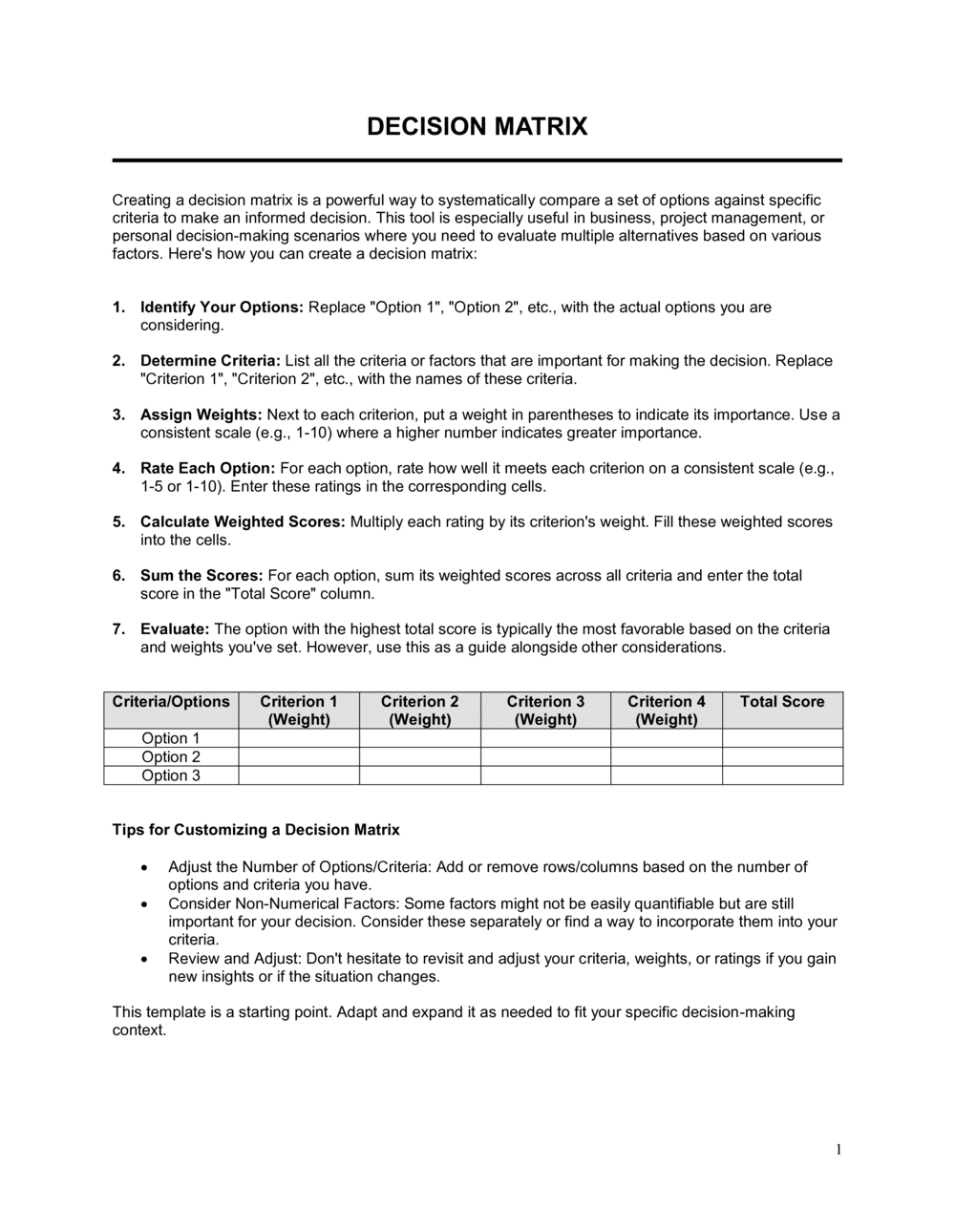
A Decision Matrix is a structured analytical document used to evaluate and compare multiple options against a defined set of weighted criteria, producing a scored ranking that supports defensible business decisions. This free Word download provides a ready-to-use framework you can edit online and export as PDF for procurement approvals, vendor selection, strategic planning, and any high-stakes choice that requires documented rationale.
When you need it
Use it when you must choose between two or more options with competing trade-offs β€” vendor selection, technology procurement, site selection, hiring decisions, or strategic direction β€” and when the decision requires an auditable record for stakeholders, boards, or regulatory bodies.
What's inside
A decision matrix includes the objective statement and scope, a list of candidate options, evaluation criteria with assigned weights, individual scores per option per criterion, a weighted total calculation, a recommendation narrative, and sign-off fields for the approving parties.

What is a Decision Matrix?

A Decision Matrix is a structured analytical document that evaluates multiple competing options against a defined set of weighted criteria, producing a scored and ranked result that forms the documented basis for a formal business decision. Each option is rated against every criterion on a consistent numeric scale; those raw scores are multiplied by pre-assigned criterion weights; and the weighted totals are summed to reveal which option best satisfies the organisation's priorities. When signed by evaluators and approving authorities, a completed decision matrix creates an auditable record of how the decision was made, who made it, and what information they relied on.

Unlike informal judgment calls or consensus-based meetings, a decision matrix forces stakeholders to agree on what matters β€” and how much β€” before scores are assigned, separating the definition of success from the evaluation of candidates. The signed sign-off and conflict-of-interest declarations give the document legal and procedural weight in procurement, HR, and regulatory contexts where the rationale for a choice may later be examined or challenged.

Why You Need This Document

Without a documented decision matrix, high-stakes choices leave your organisation exposed on multiple fronts. In procurement, selecting a vendor without a scored record means an unsuccessful bidder can challenge the award on process grounds β€” and you have no documented defence. In HR, a hiring decision made without scored criteria is significantly harder to defend against a discrimination claim under Title VII, the Equality Act, or applicable provincial human rights codes. For regulated industries β€” healthcare, financial services, government contracting β€” auditors specifically look for evidence that evaluation criteria were defined before scoring and that weights were not adjusted after results were known.

A completed, signed decision matrix resolves all of these risks in a single document. It creates a process record that satisfies procurement compliance requirements, supports conflict-of-interest accountability, and provides the rationale narrative that transforms a numerical output into a defensible business decision. This template gives you the structure to run a consistent, credible evaluation process for any significant choice β€” and the documented result to stand behind it.

Which variant fits your situation?

If your situation is…Use this template
Comparing vendors for a procurement contractVendor Evaluation Matrix
Scoring job candidates after interviewsCandidate Evaluation Form
Selecting a technology platform or software toolSoftware Evaluation Scorecard
Choosing between strategic initiatives for annual planningStrategic Priority Matrix
Evaluating risk across multiple project optionsRisk Assessment Matrix
Ranking features for a product roadmapProduct Prioritization Matrix
Assessing potential acquisition or partnership targetsDue Diligence Checklist

Common mistakes to avoid

❌ Assigning weights after seeing the raw scores

Why it matters: Post-hoc weighting converts an objective evaluation tool into a mechanism for reverse-engineering a predetermined outcome. In procurement contexts, it can constitute a process violation and void the selection.

Fix: Record and obtain stakeholder sign-off on all criteria weights before any scoring session begins. Date-stamp the weights document separately from the scores.

❌ Using undefined scoring anchors

Why it matters: When two evaluators assign a score of 4 to the same criterion using different mental benchmarks, the aggregated score is meaningless. The matrix produces a false sense of precision.

Fix: Define what each score level means for every criterion β€” for a cost criterion, '5' might mean 'at least 20% below budget' and '1' might mean 'exceeds budget by more than 15%'.

❌ Skipping the conflict-of-interest declaration

Why it matters: An undisclosed evaluator relationship with a winning vendor is the primary trigger for procurement audits, legal challenges, and regulatory sanctions. The absence of a declaration makes the relationship harder to detect and easier to exploit.

Fix: Require every evaluator to sign a dated conflict declaration before their scores are included in the matrix. Disclose known relationships to a neutral authority before the evaluation begins.

❌ Omitting the rationale narrative when the top scorer is not selected

Why it matters: Choosing a lower-scoring option without a written explanation creates an immediate inference of impropriety. In regulated industries and government procurement, it can trigger a formal challenge from competing vendors.

Fix: Write a specific, factual rationale citing the objective business reason β€” regulatory timing, reference-check findings, or a disqualifying compliance gap β€” and have the approving authority countersign it.

❌ Adding or removing options mid-process

Why it matters: Changing the option list after scoring has begun requires rescoring all criteria from scratch. Partial rescores produce incomparable data and signal manipulation to any reviewer examining the document.

Fix: Finalise and document the complete option list before the first score is assigned. If a new option must be added, restart the entire scoring process and record the reason for the restart.

❌ Obtaining approver signatures before the matrix is complete

Why it matters: A signature on an incomplete document does not constitute informed approval. If the decision is challenged, incomplete approvals are routinely treated as procedurally invalid.

Fix: Circulate the matrix for signature only after the objective statement, all scores, weighted totals, rationale narrative, and conflict declarations are finalised and populated.

The 10 key clauses, explained

Objective statement and scope

In plain language: Defines the specific decision being made, the time frame it covers, and what is explicitly outside the scope of this evaluation.

Sample language
This Decision Matrix documents the evaluation of [NUMBER] candidate [OPTIONS / VENDORS / APPROACHES] for [SPECIFIC PURPOSE] as of [DATE]. This evaluation covers [SCOPE DESCRIPTION] and does not address [EXCLUDED MATTERS].

Common mistake: Leaving the objective vague β€” writing 'select the best vendor' instead of 'select a cloud storage vendor for the finance department supporting up to 50 users at a budget not exceeding $[X]/year.' Vague objectives allow evaluators to shift criteria after scores are revealed, undermining the integrity of the result.

Candidate options

In plain language: Lists each option being evaluated with a brief description sufficient to distinguish it from the others.

Sample language
Option A: [VENDOR / SOLUTION NAME] β€” [BRIEF DESCRIPTION]. Option B: [VENDOR / SOLUTION NAME] β€” [BRIEF DESCRIPTION]. Option C: [VENDOR / SOLUTION NAME] β€” [BRIEF DESCRIPTION].

Common mistake: Adding or removing options after scoring has begun. Mid-process changes to the option list invalidate earlier scores and create a conflict-of-interest exposure in procurement contexts.

Evaluation criteria

In plain language: Lists every criterion against which options will be scored, with a plain-language description of what each criterion measures.

Sample language
Criterion 1 β€” Cost: Total 3-year cost of ownership including implementation, licensing, and support. Criterion 2 β€” Compliance: Adherence to [REGULATION / STANDARD]. Criterion 3 β€” [CRITERION NAME]: [DESCRIPTION].

Common mistake: Defining criteria so broadly that two evaluators interpret the same criterion differently β€” e.g., 'quality' with no agreed measurement. Each criterion should have a one-sentence definition agreed upon before any scoring begins.

Criteria weights

In plain language: Assigns a numerical weight to each criterion reflecting its relative importance; all weights must sum to 100%.

Sample language
Cost: [X]%. Compliance: [X]%. Technical Capability: [X]%. Delivery Timeline: [X]%. Support and SLA: [X]%. Total: 100%.

Common mistake: Assigning weights after reviewing the raw scores. Retroactive weighting is the single most common way a decision matrix is manipulated β€” it converts an objective tool into a post-hoc justification for a preferred outcome.

Scoring scale and instructions

In plain language: Defines the scoring range, what each score level means, and the procedure evaluators must follow to assign scores consistently.

Sample language
All options shall be scored on a scale of 1–5 for each criterion, where 1 = [DEFINITION], 3 = [DEFINITION], and 5 = [DEFINITION]. Each evaluator shall score independently before group reconciliation. Scores shall not be revised after the reconciliation session closes.

Common mistake: Using an undefined scale where 'good' and 'excellent' mean different things to different evaluators. A scoring guide with concrete anchors for each level eliminates inter-rater variability.

Weighted score calculations

In plain language: Records the raw score and weighted score for each option on each criterion, and the cumulative weighted total for each option.

Sample language
Option A β€” Cost: Raw Score [X] Γ— Weight [X]% = [WEIGHTED SCORE]. Technical Capability: Raw Score [X] Γ— Weight [X]% = [WEIGHTED SCORE]. Total Weighted Score: [TOTAL].

Common mistake: Performing calculations outside the matrix in a separate spreadsheet and pasting only the totals. The individual weighted scores must be visible in the document so any reviewer can independently verify the arithmetic.

Decision recommendation and rationale

In plain language: States which option the matrix recommends based on the weighted totals and provides a narrative explaining qualitative factors, risks, or trade-offs the scores alone do not capture.

Sample language
Based on the weighted evaluation, [OPTION NAME] is the recommended selection with a total weighted score of [X] out of [MAXIMUM SCORE]. Key differentiators include [FACTOR 1] and [FACTOR 2]. Residual risks: [RISK DESCRIPTION]. These risks are accepted by [APPROVER NAME / TITLE] as documented below.

Common mistake: Omitting a rationale narrative and relying solely on the numerical ranking. When the second-highest scorer is chosen for qualitative reasons, the absence of a written rationale exposes the decision to conflict-of-interest challenges.

Tie-breaker protocol

In plain language: Specifies in advance how a tied result will be resolved β€” through a secondary criterion, escalation to a named authority, or a defined re-scoring procedure.

Sample language
In the event that two or more options achieve identical total weighted scores, the tie shall be resolved by applying the secondary criterion of [CRITERION NAME]. If a tie persists, the decision shall be escalated to [TITLE / COMMITTEE] for final determination within [X] business days.

Common mistake: Having no tie-breaker clause and improvising a resolution method after a tie occurs. An ad hoc tie-breaker applied after scores are revealed is difficult to defend in a procurement dispute or regulatory review.

Conflicts of interest and evaluator declarations

In plain language: Requires each evaluator to declare any personal, financial, or professional relationship with the options being evaluated and to confirm their scores are unbiased.

Sample language
Each evaluator signing below confirms that they have no undisclosed financial, personal, or professional interest in any option evaluated herein, or that any such interest has been disclosed to [TITLE] prior to scoring as documented in Exhibit [X].

Common mistake: Skipping the conflict-of-interest declaration for internal evaluations. Procurement audits and legal challenges regularly focus on undisclosed evaluator relationships β€” a signed declaration creates a meaningful deterrent and a paper trail.

Sign-off and approval

In plain language: Records the name, title, and signature of each approving authority, confirming the decision is final and authorised for implementation.

Sample language
Approved by: [NAME], [TITLE], [DATE]. Co-approver (if required): [NAME], [TITLE], [DATE]. This approval authorises [DEPARTMENT / TEAM] to proceed with [SPECIFIC NEXT STEP] effective [DATE].

Common mistake: Obtaining approval signatures before the rationale narrative and conflict declarations are completed. A signature on an incomplete matrix does not constitute informed approval and can be challenged if the decision is later contested.

How to fill it out

  1. 1

    Write the objective statement before anything else

    State the specific decision to be made, the scope boundary, and the date by which the decision must be finalised. Confirm the objective with all stakeholders before proceeding.

    πŸ’‘ A one-sentence objective that includes budget, user count, or time horizon eliminates the most common source of post-decision disputes.

  2. 2

    List all candidate options

    Enter every option under consideration with a short, neutral description. Confirm the list is final before assigning criteria β€” adding options after scoring begins invalidates the process.

    πŸ’‘ Include at least one status-quo or do-nothing option where applicable; it forces evaluators to justify change on its merits.

  3. 3

    Define and lock evaluation criteria

    List each criterion with a one-sentence definition. Share the criteria with all evaluators and confirm that each person interprets each criterion the same way before scores are assigned.

    πŸ’‘ Five to eight criteria is the practical ceiling β€” more than eight dilutes the weight of each factor to the point where differences in scoring become statistically insignificant.

  4. 4

    Assign weights before reviewing raw scores

    Have stakeholders agree on the weight for each criterion as a percentage summing to 100%, before any scoring data is visible. Record the agreed weights in the document and consider having each stakeholder sign the weights section.

    πŸ’‘ If stakeholders cannot agree on weights, that disagreement itself is a valuable signal β€” it often reveals a strategic misalignment that the decision-making process should surface explicitly.

  5. 5

    Collect scores independently per evaluator

    Each evaluator scores every option against every criterion using the defined scale. Collect scores independently, without evaluators seeing each other's responses, then convene a reconciliation session to discuss and resolve material differences.

    πŸ’‘ Differences of two or more points on a 5-point scale warrant a discussion β€” they usually signal that evaluators are using different real-world information, not just different opinions.

  6. 6

    Calculate weighted totals and populate the matrix

    Multiply each raw score by its criterion weight to produce the weighted score, then sum across all criteria to produce the option total. Show all intermediate calculations in the document β€” do not paste totals only.

    πŸ’‘ Have a second person verify the arithmetic before circulating the completed matrix. A calculation error discovered after approval is embarrassing; one discovered in a procurement challenge is costly.

  7. 7

    Write the recommendation and rationale narrative

    State the recommended option, its total score, and a paragraph explaining any qualitative factors, risks, or trade-offs the numerical scores do not capture. If the top-scoring option is not chosen, document the specific reason in full.

    πŸ’‘ If you are not choosing the top scorer, be explicit and specific β€” 'Option A's implementation timeline conflicts with the Q3 regulatory deadline' is defensible; 'Option A was not the best cultural fit' is not.

  8. 8

    Obtain conflict declarations and approver signatures

    Have each evaluator sign the conflict-of-interest declaration, then route the completed matrix to all required approvers for sign-off. Signatures must follow, not precede, the completed rationale and declarations.

    πŸ’‘ Store the fully executed matrix alongside the contract or purchase order it authorised β€” auditors expect the two documents to be retrievable together.

Frequently asked questions

What is a decision matrix?

A decision matrix is a structured evaluation tool that compares multiple options against a set of weighted criteria to produce a scored ranking. Each option receives a raw score per criterion; that score is multiplied by the criterion's pre-assigned weight to produce a weighted score; and the weighted scores are summed to generate a comparable total for each option. The result is a transparent, auditable record of how a decision was made and why.

When should I use a decision matrix instead of making an informal judgment call?

Use a decision matrix when the decision involves more than two options, when the criteria for a good outcome are disputed among stakeholders, when the decision carries procurement, regulatory, or legal accountability requirements, or when the chosen option will need to be defended to a board, auditor, or regulator. For low-stakes decisions with an obvious answer, a matrix adds overhead without value.

How many criteria should a decision matrix include?

Between four and eight criteria is the practical range for most business decisions. Fewer than four typically means important trade-offs are not being captured. More than eight dilutes each criterion's influence to the point where differences in scoring produce negligible differences in totals, and evaluator attention degrades. If you find yourself with more than eight criteria, group related factors and evaluate the group as a single criterion.

What scoring scale works best for a decision matrix?

A 1–5 scale works well for most decisions because it is intuitive and produces meaningful differentiation without demanding false precision. A 1–10 scale is appropriate when fine-grained distinctions matter and evaluators have detailed data to support them. Whichever scale you choose, define what each numeric level means for each criterion before scoring begins β€” an undefined scale produces inconsistent results.

Can a decision matrix be used for hiring decisions?

Yes, and many organisations use a scored evaluation matrix as a documented part of their hiring process to demonstrate that candidate selection was based on job-relevant criteria rather than protected characteristics. In jurisdictions with anti-discrimination employment law β€” including the US, UK, Canada, and EU member states β€” a documented scoring process is a meaningful procedural defence in the event of a discrimination claim. The criteria must be role-relevant and defined before the interview process begins.

Is a decision matrix a legally binding document?

A decision matrix is not itself a contract, but it can have significant legal implications. In procurement contexts, the matrix may be incorporated by reference into a contract or tender award letter, making its contents enforceable. Signed conflict-of-interest declarations create legal obligations for evaluators. In regulated industries, a decision matrix may be required documentation for compliance. Consider having a lawyer review the matrix and any associated documents when the decision involves material contracts or regulatory approval.

Who should sign a decision matrix?

At minimum, every evaluator who contributed scores should sign the conflict-of-interest declaration, and the designated approving authority should sign the final recommendation. For procurement decisions, the budget holder and a compliance or legal representative should also sign. For board-level strategic decisions, the CEO or a delegated officer typically provides sign-off. Always confirm signing requirements against your organisation's delegation-of-authority policy.

How do I handle a tie in a decision matrix?

The best approach is to define the tie-breaker protocol before the scoring session begins and document it in the matrix itself. Common tie-breakers include applying a secondary criterion not used in the main evaluation, escalating to a senior authority, or giving additional weight to the single highest-weighted criterion. An ad hoc tie-breaker applied after scores are revealed is difficult to defend if the decision is challenged, particularly in procurement or regulated contexts.

How long should a completed decision matrix be retained?

Retention depends on the type of decision. Procurement decision matrices supporting contracts should be retained for at least as long as the contract itself plus any applicable statute of limitations for disputes β€” typically 6–10 years in most jurisdictions. HR selection matrices should be retained in line with your jurisdiction's employment records requirements. For regulated industries (healthcare, financial services, government contracting), check sector-specific record-retention rules, which commonly require 7–10 years.

How this compares to alternatives

vs Risk Assessment Matrix

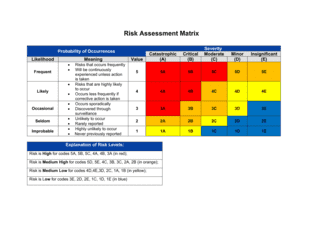
A risk assessment matrix maps the likelihood and impact of potential threats, not the relative merit of competing options. Use a risk assessment matrix to identify and prioritise risks within a project or operation; use a decision matrix to choose between options before committing. The two documents are often used in sequence β€” a decision matrix selects the approach, then a risk assessment evaluates its execution risks.

vs SWOT Analysis

A SWOT analysis identifies strengths, weaknesses, opportunities, and threats for a single option or organisation. It does not score or compare multiple options against each other. A decision matrix is the appropriate tool when you need to rank and select among alternatives; a SWOT analysis is more useful for understanding a single strategic position in depth.

vs Due Diligence Checklist

A due diligence checklist documents whether specific facts, conditions, or disclosures exist β€” it produces a pass/fail or yes/no result per item. A decision matrix scores trade-offs across criteria to produce a relative ranking. In practice, due diligence results often feed directly into decision matrix scores as the evidence base for a criterion's rating.

vs Strategic Planning Template

A strategic plan defines long-term goals, initiatives, and resource allocation for an organisation. A decision matrix resolves a specific bounded choice in support of a strategic plan. Strategic planning is continuous and high-level; a decision matrix is a point-in-time evaluation tool applied to a specific decision within the broader planning context.

Industry-specific considerations

Procurement and Supply Chain

Vendor selection matrices are required documentation for procurement compliance in most regulated organisations, and the signed matrix is typically attached to the purchase order or contract award.

Technology / SaaS

Software and platform evaluation matrices weigh total cost of ownership, integration complexity, security certifications, and vendor viability β€” all factors with direct contractual and compliance implications.

Healthcare

Equipment procurement, supplier qualification, and clinical protocol selection require documented decision rationale for FDA, Joint Commission, and HIPAA audit purposes.

Financial Services

Vendor and technology decisions at regulated financial institutions require a documented evaluation process to satisfy OCC, FCA, and OSFI third-party risk management requirements.

Government and Public Sector

Public procurement law in the US, UK, Canada, and EU requires documented evaluation criteria and scores to be retained and disclosed to unsuccessful bidders on request.

Professional Services

Partnership selection, technology adoption, and client engagement model decisions benefit from a signed matrix that protects the firm against later partner or client disputes about how a choice was made.

Jurisdictional notes

United States

Federal and state procurement regulations β€” including the Federal Acquisition Regulation (FAR) for government contractors β€” typically require documented evaluation criteria and scores to be retained and available for protest review. In employment contexts, a scored decision matrix is a documented procedural defence against Title VII and ADA discrimination claims. State contract law governs the enforceability of any representations made in the matrix.

Canada

Public sector procurement in Canada is governed by the Financial Administration Act and provincial equivalents, which require documented and auditable vendor selection processes. The Canadian Human Rights Act and provincial human rights codes make scored hiring matrices valuable compliance documentation. In Quebec, any matrix used in a provincially regulated procurement context should be prepared in French or bilingual format.

United Kingdom

The Procurement Act 2023 (effective February 2025) requires public sector contracting authorities to document and publish award criteria and weightings before evaluating bids. Unsuccessful bidders have a statutory right to a debrief including their scores. For private sector use, the Equality Act 2010 supports documented scoring processes in hiring as evidence of fair and non-discriminatory selection.

European Union

EU public procurement Directives (2014/24/EU and 2014/25/EU) mandate that contracting authorities define award criteria and their weightings in the contract notice before evaluating tenders. These requirements apply in all member states and are strictly enforced. GDPR applies when personal data about individual evaluators or candidates is recorded in the matrix β€” retain only the minimum necessary personal data and comply with applicable data subject rights.

Template vs lawyer β€” what fits your deal?

PathBest forCostTime
Use the templateInternal operational decisions, vendor selection under $50K, and technology evaluations without regulatory filing requirementsFree1–3 hours to complete
Template + legal reviewProcurement decisions that will be attached to contracts, HR selection matrices, or decisions in regulated industries$200–$500 for a legal or compliance review1–2 days
Custom draftedGovernment procurement, high-value vendor contracts over $500K, or decisions subject to formal tender or bidding law$1,000–$5,000+ depending on regulatory complexity1–3 weeks

Glossary

Weighted Criteria
Evaluation factors assigned a numerical weight (typically percentages summing to 100%) to reflect their relative importance to the decision.
Scoring Scale
A defined range β€” commonly 1–5 or 1–10 β€” used to rate each option against each criterion consistently across all evaluators.
Weighted Score
The product of an option's raw score for a criterion multiplied by that criterion's weight, used to calculate a comparable total across options.
Option
Each candidate solution, vendor, approach, or choice being evaluated and compared within the matrix.
Criterion
A specific measurable factor β€” such as cost, delivery time, or compliance β€” against which all options are independently scored.
Consensus Scoring
A process in which multiple evaluators independently score options and then reconcile differences before finalising the matrix results.
Decision Rationale
A written narrative explaining why the highest-scoring option was selected, including any qualitative factors not captured in the scores.
Tie-Breaker Protocol
A pre-defined rule specifying how to resolve a situation where two options produce identical weighted totals β€” typically a secondary criterion or escalation to a named authority.
Scope of Decision
A statement defining the boundaries of the decision being made β€” what is included, what is excluded, and the time horizon it covers.
Sign-Off Authority
The individual or body with the formal authority to approve and execute the decision documented in the matrix.
Audit Trail
The documented record of how scores were assigned, by whom, and when β€” essential for procurement compliance and post-decision review.

Part of your Business Operating System

This document is one of 3,000+ business & legal templates included in Business in a Box.

  • Fill-in-the-blanks β€” ready in minutes
  • 100% customizable Word document
  • Compatible with all office suites
  • Export to PDF and share electronically

Create your document in 3 simple steps.

From template to signed document β€” all inside one Business Operating System.
1
Download or open template

Access over 3,000+ business and legal templates for any business task, project or initiative.

2
Edit and fill in the blanks with AI

Customize your ready-made business document template and save it in the cloud.

3
Save, Share, Send, Sign

Share your files and folders with your team. Create a space of seamless collaboration.

Save time, save money, and create top-quality documents.

β˜…β˜…β˜…β˜…β˜…

"Fantastic value! I'm not sure how I'd do without it. It's worth its weight in gold and paid back for itself many times."

Managing Director Β· Mall Farm
Robert Whalley
Managing Director, Mall Farm Proprietary Limited
β˜…β˜…β˜…β˜…β˜…

"I have been using Business in a Box for years. It has been the most useful source of templates I have encountered. I recommend it to anyone."

Business Owner Β· 4+ years
Dr Michael John Freestone
Business Owner
β˜…β˜…β˜…β˜…β˜…

"It has been a life saver so many times I have lost count. Business in a Box has saved me so much time and as you know, time is money."

Owner Β· Upstate Web
David G. Moore Jr.
Owner, Upstate Web

Run your business with a system β€” not scattered tools

Stop downloading documents. Start operating with clarity. Business in a Box gives you the Business Operating System used by over 250,000 companies worldwide to structure, run, and grow their business.

Start freeΒ Β·Β No credit card required