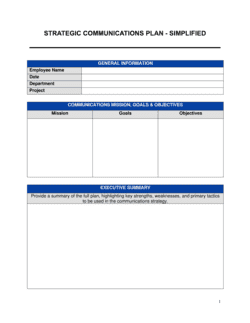
Marketing Plans and Campaigns Templates

4.7from 280+ reviews Trusted by 20M+ businesses

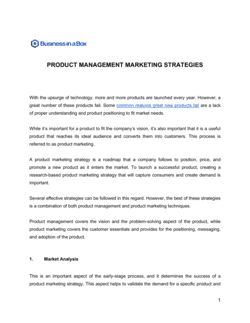
Plan, launch, and measure every marketing initiative with templates built for real business use.

WordEditable onlinePDF39+ marketing plan and campaign templates

Other Sales & Marketing categories

250K+Clients
20M+Free users
20+Years
190+Countries
10,000+Law firms
50M+Downloads

Trusted across review platforms

  • Capterra★★★★☆4.649 reviews
  • G2★★★★☆4.713 reviews
  • GetApp★★★★☆4.649 reviews
  • Google Play★★★★☆4.6179 ratings
  • Google Reviews★★★★☆4.567 reviews

Related categories

Frequently asked questions

What should a marketing plan include?
A marketing plan should include a situation analysis, a defined target audience, measurable goals with KPIs, a channel and tactic mix, a budget breakdown, a timeline, and a measurement framework. Most plans also include a brief competitive overview and a messaging or positioning statement. The length varies — a small business plan may be 5 pages; an enterprise plan may run 30 — but the core sections remain the same.
How is a marketing plan different from a marketing campaign?
A marketing plan covers the full scope of marketing activity over a period — usually a quarter or a year — across all channels and audiences. A campaign is a focused, time-bound initiative with a single objective. Campaigns are components of the plan; the plan is the container that holds all of them.
How long should a marketing plan be?
There's no required length. A startup or small business can produce a functional plan in 5–10 pages. A mid-size company typically produces 15–25 pages. Enterprise plans can run longer, though adding pages does not improve execution. Focus on substance over length — every section should answer a question a stakeholder or team member will actually ask.
What is a marketing brief and when do I need one?
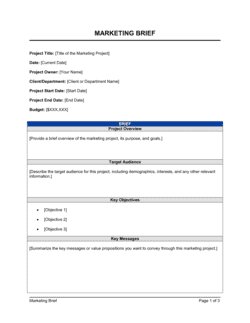
A marketing brief is a short document — typically 1–4 pages — that aligns a team or external partner on the objectives, audience, key messages, and deliverables for a project or campaign. You need one any time you're briefing an agency, a freelancer, or a cross-functional team on a new initiative. Without a brief, projects frequently drift from the original goal.
How do I set a marketing budget?
Start with your revenue goal and work backward: what does a lead cost, what is your close rate, and how many leads do you need? Alternatively, benchmark against industry norms — B2B companies typically spend 5–12% of revenue on marketing; B2C companies often spend 8–20%. Break the total by channel, assign owners, and reserve 10–15% as a contingency for tests or unexpected opportunities.
What marketing metrics should I track?
The most important metrics depend on your stage and goals, but broadly: cost per lead, cost per acquisition, conversion rate by channel, return on ad spend (ROAS), email open and click rates, organic search traffic, and marketing-sourced revenue. Avoid tracking vanity metrics — impressions and follower counts — unless they directly tie to a business outcome you care about.
Do I need a separate plan for digital marketing?
It depends on how large your digital investment is. If digital channels represent a significant share of your budget and require coordination across SEO, paid media, email, and social, a standalone digital marketing plan keeps those efforts aligned without overloading the master plan. Smaller businesses can include digital channels as sections within a single plan.
How do I measure whether a marketing campaign was successful?
Compare actual results against the goals and KPIs you defined before the campaign launched. A post-campaign evaluation should cover reach, engagement, leads generated, cost per outcome, and contribution to revenue. If you didn't set numeric targets before launch, you can still document what happened — but you won't be able to call it a success or failure objectively.
When should I use a marketing agreement template?
Use a marketing agreement any time you're engaging an external party to perform marketing services — an agency, a consultant, an influencer, or an affiliate. The agreement should define scope, deliverables, fees, payment terms, IP ownership, and confidentiality before work begins. Working without one creates disputes over who owns the creative output and what was actually agreed to.

Marketing Plans and Campaign vs. related documents

Marketing plan vs. marketing strategy

A marketing strategy defines the long-term positioning of your brand — who you're targeting, what makes you different, and why customers should choose you. A marketing plan translates that strategy into specific actions, channels, timelines, and budgets for a defined period. You need the strategy first; the plan is how you execute it. Most businesses document both in a single annual planning cycle.

Marketing plan vs. marketing campaign

A marketing plan is a broad, multi-channel document covering an entire business or product line over months or a year. A marketing campaign is a focused, time-bound initiative with a single objective — launching a product, generating leads for a specific segment, or driving traffic to a seasonal promotion. Campaigns live inside the plan; a plan may contain several campaigns running concurrently.

Marketing brief vs. marketing campaign brief

A marketing brief describes an ongoing or project-level engagement — often used to onboard an agency or align a team at the start of a relationship. A campaign brief is scoped to a single initiative with defined start and end dates, specific deliverables, and measurable success criteria. Use the campaign brief whenever execution has a clear finish line.

Marketing plan vs. business plan

A business plan covers every functional area of the company — operations, finance, HR, and go-to-market. The marketing section of a business plan is typically a summary. A standalone marketing plan goes much deeper: channel mix, messaging frameworks, audience segmentation, and campaign-level tactics. Use the business plan for investors and lenders; use the marketing plan to run the team day to day.

Key clauses every Marketing Plans and Campaign contains

Whether you're writing an annual plan, a campaign brief, or a channel-specific strategy, every effective marketing document shares the same structural elements.

  • Situation analysis. A snapshot of where the business stands today — market size, competitive landscape, and internal strengths and weaknesses.
  • Target audience definition. Specific description of the customer segment(s) the plan addresses, including demographics, behavior, and pain points.
  • Goals and KPIs. Measurable objectives — reach, leads, conversions, revenue — with numeric targets and a timeframe.
  • Channel and tactic mix. Which channels will be used (email, paid search, social, events) and what specific actions will run in each.
  • Budget allocation. How spend is distributed across channels and initiatives, and who has authority to approve changes.
  • Timeline and milestones. Key dates for creative delivery, campaign launch, mid-point review, and end-of-period evaluation.
  • Messaging and positioning. The core value proposition and key messages that will be consistent across all campaign touchpoints.
  • Measurement and reporting. How results will be tracked, which tools will be used, and the cadence for reporting back to stakeholders.

How to write a marketing plan

A strong marketing plan follows a repeatable structure regardless of company size or budget — here's how to build one from scratch.

  1. 1

    Conduct a situation analysis

    Assess your current market position using a SWOT analysis, competitive review, and summary of past campaign performance.

  2. 2

    Define your target audience

    Document the specific customer segments you're addressing, including their demographics, purchase triggers, and where they spend attention.

  3. 3

    Set measurable goals

    Assign numeric targets to each objective — number of leads, cost per acquisition, revenue contribution — with a clear timeframe.

  4. 4

    Choose your channel mix

    Select channels based on where your audience is and what your budget can sustain; prioritize channels with proven ROI before experimenting.

  5. 5

    Build a budget

    Break spend by channel and tactic, assign owners, and flag which line items are fixed versus discretionary.

  6. 6

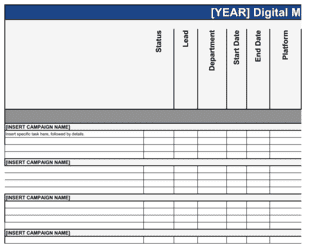
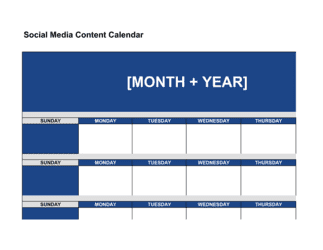
    Create a campaign and content calendar

    Map every initiative to a date, owner, and deliverable so execution stays coordinated across teams.

  7. 7

    Define your measurement framework

    Decide upfront which metrics matter, which tools will track them, and how often results will be reviewed and reported.

  8. 8

    Review and iterate

    Schedule a mid-period review to compare results to targets and reallocate budget or effort where needed.

At a glance

What it is
A marketing plan is a structured document that outlines your target audience, goals, channels, budget, and tactics for a defined period. A marketing campaign plan focuses on a single initiative — a product launch, a promotion, or a seasonal push — with specific timelines and measurable outcomes.
When you need one
Any time you're allocating budget, coordinating a team, or pitching a marketing initiative to stakeholders, a written plan keeps execution aligned and results measurable.

Which Marketing Plans and Campaign do I need?

The right template depends on whether you're building an annual strategy, planning a specific campaign, managing a channel, or formalizing a marketing relationship. Match your situation below.

Your situation
Recommended template

Setting the overall marketing direction for the next 12 months

Covers goals, audience, channels, tactics, and budget in a single document.

Planning paid search, SEO, and social across digital channels

Structured specifically for online channels with KPIs and channel allocation.

Briefing an agency or internal team on a specific campaign

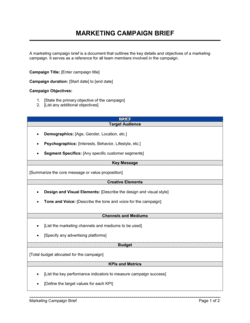
Captures objectives, audience, key messages, deliverables, and deadlines.

Allocating and tracking the annual or quarterly marketing spend

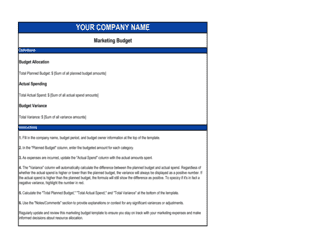
Breaks spend by channel and initiative so nothing is over- or under-funded.

Building a 30–60–90-day content publishing schedule

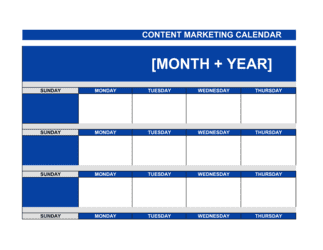
Organizes topics, formats, channels, owners, and publish dates in one view.

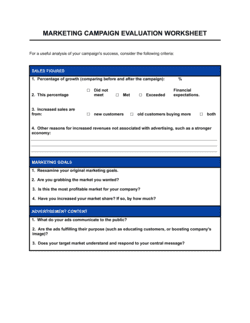
Measuring whether a campaign hit its goals after it ran

Structures post-campaign analysis against original objectives and spend.

Drafting a plan focused on accelerating revenue growth

Ties marketing activity directly to growth levers like acquisition and retention.

Engaging an external marketing consultant or agency

Sets scope, deliverables, fees, and IP ownership before work begins.

Glossary

Marketing plan
A document that outlines a company's marketing goals, target audiences, channels, tactics, and budget for a defined time period.
Marketing campaign
A coordinated set of marketing activities focused on a single objective, with a defined start and end date.
Marketing brief
A short alignment document that defines the objectives, audience, key messages, and deliverables for a project or campaign.
KPI (Key Performance Indicator)
A measurable value that shows whether a marketing activity is meeting its defined objective.
Channel mix
The combination of marketing channels — email, paid search, social, events, content — used to reach a target audience.
Cost per acquisition (CPA)
The total marketing spend divided by the number of customers or conversions generated in the same period.
Return on ad spend (ROAS)
Revenue generated divided by the amount spent on advertising, expressed as a ratio or percentage.
Marketing funnel
The stages a prospect moves through — awareness, consideration, decision — from first contact to becoming a customer.
Content calendar
A schedule that maps content topics, formats, channels, owners, and publish dates across a planning period.
Marketing automation
Software that executes marketing tasks — email sequences, lead scoring, social posting — based on triggers and rules without manual action.
Conversion rate
The percentage of people who take a desired action — clicking, signing up, purchasing — out of the total who were exposed to the opportunity.
Situation analysis
An assessment of internal strengths and weaknesses alongside external market conditions and competitive dynamics, typically using a SWOT framework.

What is a marketing plan?

A marketing plan is a written document that outlines how a business will reach its target customers, what it will spend, which channels it will use, and how it will measure results over a defined period — typically a quarter or a year. It functions as both an operating guide for the marketing team and a communication tool for leadership, investors, and external partners.
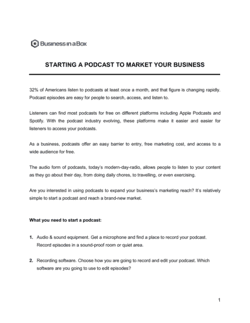
Marketing plans range from a single focused document covering one product or segment to multi-part enterprise plans covering dozens of channels and initiatives. A marketing campaign plan is a narrower variant: a document focused on a single initiative — a product launch, a seasonal promotion, a lead-generation push — with specific timelines, a defined budget, and measurable success criteria. Both types of plans share the same underlying structure; the campaign plan is just scoped to a shorter window and a single objective.

Beyond planning documents, this category also includes the agreements, guides, and evaluation tools that surround a marketing program — briefing templates, budget trackers, channel-specific playbooks, and post-campaign evaluation frameworks.

When you need a marketing plan

If you're spending money on marketing without a written plan, you're making resource allocation decisions reactively rather than strategically. A plan is necessary any time you need to align a team, justify a budget, or make it possible to measure whether what you did actually worked.

Common triggers:

  • Starting a new fiscal year and allocating the annual marketing budget across channels
  • Launching a new product, service, or market and coordinating the go-to-market effort
  • Briefing an agency or freelancer on a new campaign or ongoing engagement
  • Presenting a marketing strategy to founders, board members, or investors
  • Scaling a digital channel — email, paid search, social — and needing a documented framework
  • Running a seasonal or time-limited campaign with specific revenue targets
  • Evaluating past campaign performance to inform next-period planning decisions

Without a written plan, teams spend time on tactics that don't connect to goals, budgets get exhausted before the highest-priority activities run, and post-campaign reviews have nothing to compare results against. A documented plan — even a short one — closes all three gaps.

Award-winning platform

  • Great Place to Work 2025
  • BIG Award — Product of the Year 2025
  • Smartest Companies 2025
  • Global 100 Excellence 2026
  • Best of the Best 2025

Create your document in 3 simple steps.

From template to signed document — all inside one Business Operating System.
1
Download or open template

Access over 3,000+ business and legal templates for any business task, project or initiative.

2
Edit and fill in the blanks with AI

Customize your ready-made business document template and save it in the cloud.

3
Save, Share, Send, Sign

Share your files and folders with your team. Create a space of seamless collaboration.

Save time, save money, and create top-quality documents.

★★★★★

"Fantastic value! I'm not sure how I'd do without it. It's worth its weight in gold and paid back for itself many times."

Managing Director · Mall Farm
Robert Whalley
Managing Director, Mall Farm Proprietary Limited
★★★★★

"I have been using Business in a Box for years. It has been the most useful source of templates I have encountered. I recommend it to anyone."

Business Owner · 4+ years
Dr Michael John Freestone
Business Owner
★★★★★

"It has been a life saver so many times I have lost count. Business in a Box has saved me so much time and as you know, time is money."

Owner · Upstate Web
David G. Moore Jr.
Owner, Upstate Web

Run your business with a system — not scattered tools

Stop downloading documents. Start operating with clarity. Business in a Box gives you the Business Operating System used by over 250,000 companies worldwide to structure, run, and grow their business.

Free Forever Plan · No credit card required