Marketing Campaign Evaluation Template

Free Word download β€’ Edit online β€’ Save & share with Drive β€’ Export to PDF

2 pagesβ€’20–30 min to fillβ€’Difficulty: Standardβ€’Signature requiredβ€’Legal review recommended
Learn more ↓
FreeMarketing Campaign Evaluation Template

At a glance

What it is
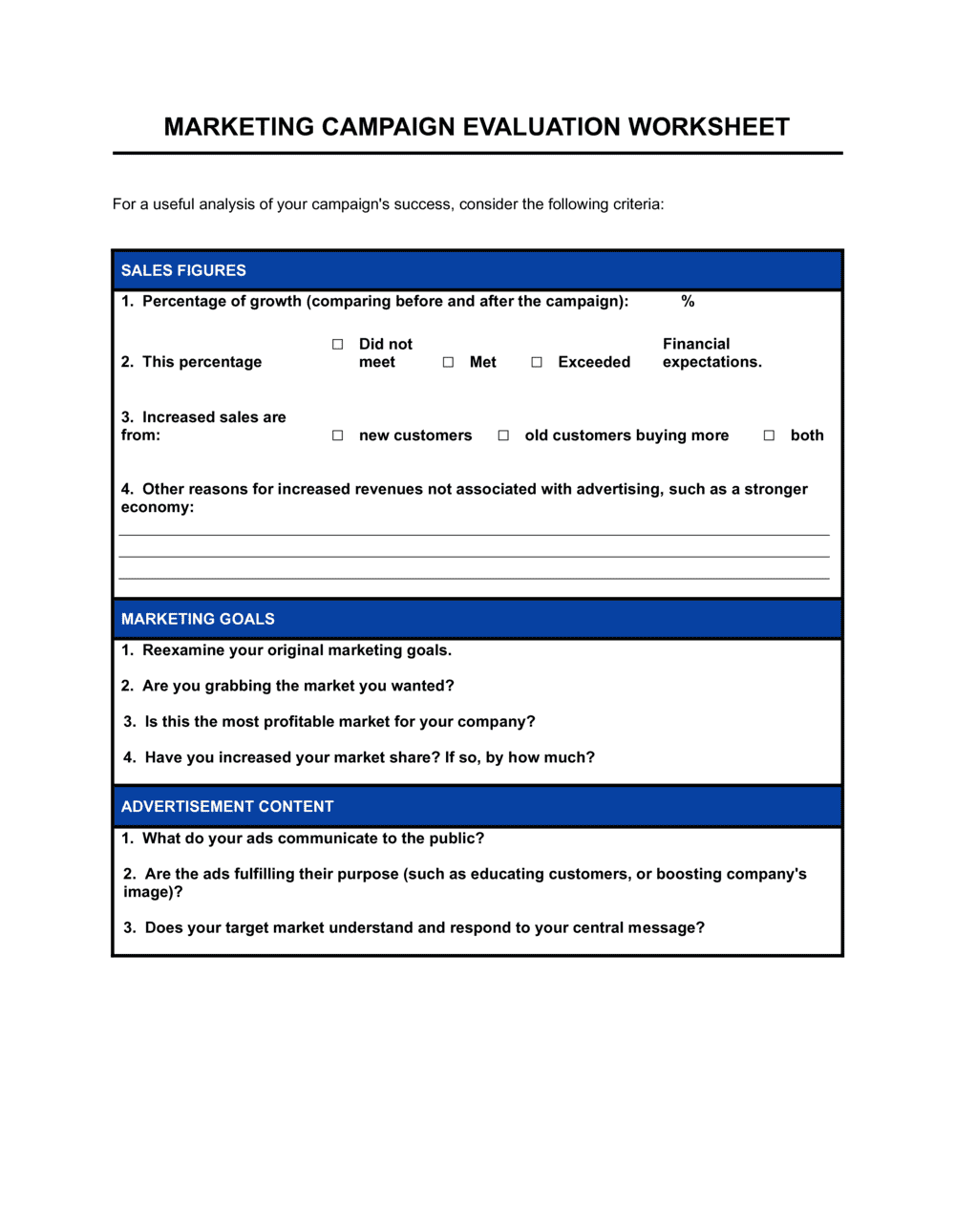
A Marketing Campaign Evaluation is a formal document that measures and records the performance of a marketing campaign against its original objectives, KPIs, budget, and expected outcomes. This free Word download gives you a structured, binding framework to document campaign results, assign accountability, and fulfill reporting obligations to internal stakeholders or external clients β€” exportable as PDF in minutes.
When you need it
Use it at the conclusion of any paid, earned, or owned media campaign where performance must be reported to a client, executive team, or board. It is also triggered when a marketing agency or vendor is contractually required to demonstrate ROI against an agreed service agreement.
What's inside
Campaign objectives and scope, KPI definitions and benchmarks, channel performance data, budget versus actual spend, ROI and attribution analysis, audience and engagement metrics, lessons learned, and recommended next steps β€” structured as a signed formal deliverable between the evaluating party and the sponsoring stakeholder.

What is a Marketing Campaign Evaluation?

A Marketing Campaign Evaluation is a formal document that measures and records the performance of a completed marketing campaign against its pre-agreed objectives, KPIs, budget, and expected outcomes. It covers every material dimension of campaign performance β€” channel metrics, ROI calculations, audience analysis, budget variance, lessons learned, and recommendations β€” and, when co-signed by the evaluating party and the campaign sponsor, functions as binding evidence that contractual performance-reporting obligations have been fulfilled. Unlike an informal post-mortem or dashboard export, a properly structured evaluation creates an accountable, auditable record that both parties have acknowledged as an accurate reflection of campaign results.

Why You Need This Document

Without a formal, signed campaign evaluation, marketing agencies and in-house teams face four concrete risks. First, there is no documented baseline connecting actual results to the KPIs agreed before the campaign launched β€” making it impossible to objectively demonstrate performance or contest a client's claim of underdelivery. Second, unsigned reports have no standing as deliverables under a marketing services agreement, meaning invoices tied to performance milestones can be disputed without recourse. Third, attribution and data discrepancies across platforms go undisclosed, exposing the evaluating party to challenges over inflated or inconsistent metrics. Fourth, lessons learned and recommendations without a disclaimer become implied performance guarantees for the next campaign. A completed, co-signed marketing campaign evaluation closes all four gaps β€” transforming a routine report into an enforceable performance record that protects both parties and drives smarter campaign investment decisions going forward.

Which variant fits your situation?

If your situation is…Use this template
Evaluating a paid digital advertising campaign across Google and MetaDigital Marketing Campaign Evaluation
Reporting results of an email marketing or drip campaignEmail Marketing Campaign Report
Assessing performance of a product launch across multiple channelsProduct Launch Campaign Evaluation
Delivering a formal post-campaign report to an external clientMarketing Campaign Evaluation
Evaluating a nonprofit or charitable fundraising campaignNonprofit Campaign Performance Report
Reviewing an influencer marketing or social media activationSocial Media Campaign Evaluation
Conducting a quarterly marketing performance review across all campaignsMarketing Plan

Common mistakes to avoid

❌ Revising KPIs after the campaign to match actual results

Why it matters: Post-hoc KPI changes make underperformance invisible and destroy the evaluation's credibility as a performance accountability document. Clients or auditors who compare the evaluation to the original brief will identify the discrepancy immediately.

Fix: Reproduce original KPIs verbatim from the approved brief and attach it as a schedule. Report actual results against the original targets regardless of outcome.

❌ Reporting metrics without an attribution methodology disclosure

Why it matters: Different attribution models β€” last-click, first-click, linear, data-driven β€” can produce ROI figures that differ by 40–80% on the same campaign. Without disclosure, the sponsor cannot validate the numbers or compare them across evaluations.

Fix: Name the attribution model, define its logic in one paragraph, and confirm it was agreed upon before the campaign launched or explain why it was selected post-campaign.

❌ Leaving the evaluation unsigned

Why it matters: An unsigned evaluation is an informal report, not a deliverable. It cannot be used to evidence fulfillment of performance-reporting obligations under a marketing services agreement and has no standing in a dispute over service delivery.

Fix: Route the evaluation for co-signature by the sponsor before distribution. Include a defined signature deadline in your delivery email.

❌ Omitting the advisory disclaimer on recommendations

Why it matters: Without a disclaimer, recommendations can be interpreted as contractual commitments or performance guarantees for future campaigns β€” creating liability if the next campaign underperforms despite following the advice.

Fix: Add a one-sentence disclaimer in the recommendations section: 'These recommendations are advisory and do not create additional service obligations under any existing agreement.'

❌ Using only vanity metrics as evidence of campaign success

Why it matters: Reporting impressions, reach, and follower growth without connecting them to conversions, revenue, or qualified pipeline hides the true business impact of the campaign and erodes stakeholder trust in marketing reporting.

Fix: Anchor every metric section to at least one business-outcome metric β€” CPA, revenue attributed, pipeline generated, or cost per qualified lead.

❌ Presenting data from multiple platforms without noting discrepancy windows

Why it matters: Google Ads, Meta, and LinkedIn each use different conversion attribution windows β€” combining them without a disclaimer can overcount total conversions by 20–50%, misleading stakeholders on actual campaign efficiency.

Fix: Add a data limitations section that names each platform, its default attribution window, and the date on which data was pulled. Note any known double-counting risk.

The 10 key clauses, explained

Parties, campaign identification, and effective date

In plain language: Identifies the evaluating party (agency or marketing team) and the sponsoring party (client or executive stakeholder), names the campaign, and records the evaluation date.

Sample language
This Marketing Campaign Evaluation is prepared by [AGENCY / TEAM NAME] ('Evaluator') for [CLIENT / COMPANY NAME] ('Sponsor') and covers the [CAMPAIGN NAME] campaign executed from [START DATE] to [END DATE]. Evaluation date: [DATE].

Common mistake: Omitting the campaign date range or referencing only the evaluation date β€” leaving the scope of the performance period legally ambiguous in any disputes over deliverable completion.

Campaign objectives and agreed KPIs

In plain language: Restates the specific, measurable objectives and KPIs that were agreed upon before the campaign launched, creating the baseline against which results are measured.

Sample language
The campaign objectives were: (1) generate [X] qualified leads at a CPA of no more than $[X]; (2) achieve a click-through rate of at least [X]% on paid placements; (3) grow [PLATFORM] following by [X]% within the campaign window.

Common mistake: Restating objectives vaguely after the fact to match actual results. If the original objectives were documented in a brief or contract, reproduce them verbatim β€” post-hoc rewrites undermine the integrity of the evaluation.

Budget summary and variance analysis

In plain language: Records the approved campaign budget, actual spend by channel and category, and explains any variance above a defined materiality threshold.

Sample language
Approved budget: $[X]. Actual spend: $[X]. Variance: $[X] ([X]%). Variances exceeding 10% of approved budget by line item are detailed in Schedule A and approved in writing by [NAME / TITLE].

Common mistake: Reporting only total budget versus total spend without breaking down variance by channel. A $0 net variance can mask significant overspend on one channel offset by underspend on another, distorting performance analysis.

Channel performance metrics

In plain language: Documents the performance data for each channel used in the campaign β€” paid search, social, email, display, events, or others β€” against the KPI benchmarks set at the outset.

Sample language
Paid Search: Impressions [X], Clicks [X], CTR [X]%, CPC $[X], Conversions [X], CPA $[X]. Email: Sent [X], Open Rate [X]%, CTR [X]%, Unsubscribes [X]. Results by channel are detailed in Schedule B.

Common mistake: Reporting vanity metrics β€” impressions and follower counts β€” without tying them to conversion or revenue outcomes. Stakeholders who funded the campaign care about business results, not reach alone.

ROI and attribution statement

In plain language: Calculates the overall return on campaign investment and documents the attribution methodology used to assign revenue or value to the campaign.

Sample language
Total attributable revenue: $[X]. Total campaign spend: $[X]. ROI: [X]%. Attribution model used: [LAST-CLICK / LINEAR / DATA-DRIVEN]. Attribution methodology and assumptions are described in Schedule C.

Common mistake: Stating ROI without disclosing the attribution model. Last-click and data-driven models can produce ROI figures that differ by 40–80% on the same campaign β€” the methodology must be stated and agreed upon in advance.

Audience and engagement analysis

In plain language: Summarizes who the campaign reached, how they engaged, and whether the audience composition matched the intended target profile.

Sample language
Target audience: [DESCRIPTION]. Actual audience reached: [X] unique individuals. Demographic match to target: [X]%. Engagement actions (clicks, shares, comments, downloads): [X]. Audience insights are detailed in Schedule D.

Common mistake: Skipping audience analysis entirely when reach targets were met. Reaching a large but off-profile audience wastes spend and inflates metrics without generating qualified demand.

Lessons learned and root cause findings

In plain language: Documents what worked, what underperformed, and the root cause of any material variance β€” creating a formal record for future campaign planning.

Sample language
Performing elements: [DESCRIPTION] exceeded benchmark by [X]%. Underperforming elements: [DESCRIPTION] delivered [X]% below target. Root cause: [EXPLANATION]. These findings are acknowledged by both parties as the basis for future planning recommendations.

Common mistake: Writing lessons learned as generic observations like 'creative could be stronger.' Lessons must be specific enough to inform a budget or channel decision β€” for example, 'video ads on Instagram generated 3Γ— the CPA of static image ads and should be excluded in future buys.'

Recommendations and next steps

In plain language: States the evaluator's formal recommendations for the next campaign cycle, including channel reallocation, creative direction, audience refinement, and budget adjustments.

Sample language
Based on campaign results, the Evaluator recommends: (1) reallocate [X]% of [CHANNEL] budget to [CHANNEL]; (2) retire [CREATIVE ELEMENT] and test [NEW APPROACH]; (3) narrow target audience to [SEGMENT] to improve CPA by an estimated [X]%. These recommendations are advisory and do not create additional service obligations.

Common mistake: Omitting a disclaimer that recommendations are advisory. Without it, the client may treat recommendations as binding deliverables, creating scope creep or liability if subsequent campaigns underperform.

Data sources, limitations, and disclaimers

In plain language: Identifies the data sources used in the evaluation, any known data gaps or platform discrepancies, and disclaims liability for metrics outside the evaluator's control.

Sample language
Data sourced from: [PLATFORM / TOOL LIST] as of [DATA PULL DATE]. Known limitations: [PLATFORM] reporting delays of up to [X] days; cross-device attribution is estimated. The Evaluator disclaims responsibility for inaccuracies in third-party platform data.

Common mistake: Presenting platform-reported metrics without a data disclaimer. Different ad platforms count conversions using different attribution windows β€” presenting Google Ads and Meta data side-by-side without noting the discrepancy can overcount total conversions by 20–50%.

Acknowledgment, signatures, and governing terms

In plain language: Records the formal acknowledgment by both parties that the evaluation reflects an accurate account of campaign performance and specifies the governing agreement under which it was prepared.

Sample language
The parties acknowledge that this evaluation accurately reflects the campaign results to the best of the Evaluator's knowledge based on available data. This evaluation is prepared pursuant to the Marketing Services Agreement dated [DATE] between the parties. Signed: [EVALUATOR NAME / TITLE], [DATE] | [SPONSOR NAME / TITLE], [DATE].

Common mistake: Leaving the evaluation unsigned as an informal report. An unsigned evaluation has no standing as a deliverable under a services agreement and cannot be used to evidence fulfillment of contractual performance-reporting obligations.

How to fill it out

  1. 1

    Identify the parties and the campaign scope

    Enter the full legal names of the evaluating party and the sponsoring party, the official campaign name, and the exact execution date range. Confirm the scope matches what was documented in the original campaign brief or services agreement.

    πŸ’‘ If the campaign ran in phases, list each phase date range separately β€” this prevents scope disputes when evaluating a multi-phase program.

  2. 2

    Reproduce the original objectives and KPIs verbatim

    Copy the campaign objectives and KPI targets exactly as they appeared in the approved brief, proposal, or contract. Do not revise them to align with actual results.

    πŸ’‘ Attach the original brief as Schedule A so both parties can verify the baseline without dispute.

  3. 3

    Complete the budget variance table

    Enter approved and actual spend by channel and category. Calculate percentage variance for each line and flag any category with more than 10% variance for written explanation.

    πŸ’‘ Use the same budget categories as the original approved plan β€” reclassifying spend after the fact inflates some channels and deflates others artificially.

  4. 4

    Pull and enter channel metrics against benchmarks

    Download performance data from each platform on the same date so reporting windows are consistent. Enter actual results next to the agreed benchmarks for each KPI and calculate percentage achievement.

    πŸ’‘ Pull all platform data on the same day to avoid discrepancies caused by different attribution window lengths across platforms.

  5. 5

    Calculate and disclose ROI with the attribution model

    Enter total attributable revenue or value, total campaign spend, and the resulting ROI percentage. Name the attribution model used and describe its logic in one or two sentences in Schedule C.

    πŸ’‘ If the attribution model was not agreed upon in the original brief, align on it with the sponsor before publishing the evaluation β€” a model change after the fact looks self-serving.

  6. 6

    Write specific lessons learned tied to data

    For each underperforming element, state the shortfall in percentage terms and identify the most likely root cause. For each overperforming element, describe what drove the result and whether it is repeatable.

    πŸ’‘ Limit lessons learned to four to six findings β€” a list of 15 observations dilutes the most actionable insights and signals a lack of analytical prioritization.

  7. 7

    State recommendations with an advisory disclaimer

    List recommended changes for the next campaign with a brief rationale tied to the data. Add a sentence confirming these are advisory and do not constitute additional contracted deliverables.

    πŸ’‘ Frame recommendations as hypotheses to test rather than guarantees of improvement β€” this sets the right expectation and protects you from performance liability on the next campaign.

  8. 8

    Obtain signatures before the report is distributed

    Route the completed evaluation to the sponsor for review and co-signature before distributing to any broader audience. File the fully executed copy in your project records alongside the original services agreement.

    πŸ’‘ Set a signature deadline of five business days from delivery β€” open-ended signature requests often go unsigned indefinitely, leaving the deliverable in limbo.

Frequently asked questions

What is a marketing campaign evaluation?

A marketing campaign evaluation is a formal document that measures the results of a completed marketing campaign against its pre-agreed objectives, KPIs, budget, and expected outcomes. It records channel performance data, ROI calculations, audience metrics, lessons learned, and recommendations for future campaigns. When signed by both the evaluating party and the sponsor, it also serves as evidence that contractual performance-reporting obligations under a marketing services agreement have been fulfilled.

Why does a marketing campaign evaluation need to be signed?

A signature transforms the evaluation from an informal report into a formal deliverable that can evidence fulfillment of contractual obligations. If a client disputes whether campaign targets were met, or if a services agreement requires periodic performance reporting, a co-signed evaluation is the document that resolves the dispute. Unsigned reports have no standing under most marketing services agreements and cannot be used in arbitration or litigation.

What KPIs should a marketing campaign evaluation include?

The KPIs included should be exactly those agreed upon in the original campaign brief or services contract β€” not selected after the fact. Typical KPIs include cost per acquisition, click-through rate, conversion rate, return on ad spend, reach and impressions, email open and click rates, and revenue or pipeline attributed to the campaign. Every KPI should be reported as both an absolute number and a percentage of the agreed benchmark.

What attribution model should I use in the evaluation?

The attribution model should be agreed upon before the campaign launches and documented in the campaign brief. Last-click attribution is the default in most platforms but understates the contribution of upper-funnel channels. Data-driven attribution is more accurate but requires sufficient conversion volume. Whichever model you use, disclose it explicitly in the evaluation β€” different models on the same campaign can produce ROI figures that differ by 40–80%, making disclosure essential for credibility.

How is a marketing campaign evaluation different from a marketing plan?

A marketing plan is a forward-looking document that defines campaign strategy, channels, budget, and objectives before execution begins. A marketing campaign evaluation is a backward-looking document that measures actual results against those pre-stated objectives after the campaign ends. The plan sets the baseline; the evaluation scores performance against it. Both documents are typically required under a full marketing services agreement.

Can a marketing campaign evaluation be used in a client dispute?

Yes β€” a co-signed marketing campaign evaluation that accurately reproduces the original KPI targets and reports actual results against them is typically admissible as evidence in contract disputes over service delivery. In most jurisdictions, a signed document that both parties acknowledged at the time of completion carries significant weight. Evaluations that retroactively revised KPIs or omitted material underperformance, however, can be challenged as unreliable.

How often should marketing campaigns be evaluated?

Every discrete campaign should receive a formal post-campaign evaluation within 30 days of the campaign end date, while platform data is still fresh and complete. For ongoing always-on programs, a monthly or quarterly evaluation cadence is standard. Annual program evaluations should roll up all campaign-level evaluations into a summary scorecard for executive or board reporting.

Do I need a lawyer to prepare a marketing campaign evaluation?

For standard internal evaluations or routine agency-to-client reports, a well-structured template is typically sufficient. Legal review is recommended when the evaluation will be used as evidence of contractual performance delivery, when there is an active dispute with the client over campaign results, or when the evaluation includes liability disclaimers that could affect the enforceability of the underlying services agreement.

What should the recommendations section of a marketing evaluation include?

The recommendations section should include specific, data-backed changes for the next campaign β€” channel budget reallocations with supporting CPA data, creative directions based on performance differentials, audience refinements tied to engagement or conversion patterns, and timing or sequencing adjustments. Each recommendation should reference the specific finding that supports it. The section must also include a disclaimer that recommendations are advisory and do not constitute guaranteed outcomes or additional contracted deliverables.

How this compares to alternatives

vs Marketing Plan

A marketing plan is a forward-looking strategy document that defines campaign objectives, channels, audience, and budget before execution. A marketing campaign evaluation is a backward-looking performance document that measures actual results against those objectives after the campaign ends. The plan creates the accountability baseline; the evaluation scores performance against it. Both are typically required under a full marketing services engagement.

vs Marketing Campaign Proposal

A campaign proposal is issued before work begins to outline the campaign strategy, deliverables, timeline, and estimated budget for client or executive approval. A campaign evaluation is issued after the campaign ends to report actual performance against the approved proposal. The proposal is the commitment; the evaluation is the audit of whether that commitment was met.

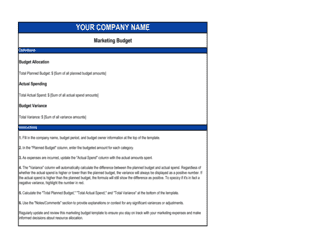
vs Marketing Budget

A marketing budget documents planned spend allocations by channel and category for a period or campaign. A campaign evaluation incorporates budget versus actual spend as one section within a broader performance assessment. The budget is an input to the evaluation β€” not a substitute for it.

vs Marketing Report

A marketing report is typically a recurring operational document β€” monthly or quarterly β€” summarizing metrics across all marketing activity. A campaign evaluation is a discrete, campaign-specific document with formal acknowledgment and signature blocks, making it suitable as a contractual deliverable. Use a report for ongoing program monitoring and an evaluation as the formal close-out of a specific campaign.

Industry-specific considerations

Marketing and Advertising Agencies

Agencies use signed evaluations as proof of deliverable completion under retainer and project contracts, directly affecting invoice approval and client renewals.

Retail and E-commerce

Retail marketers evaluate campaigns by ROAS, revenue per channel, and cart conversion rate β€” with budget variance analysis feeding directly into seasonal spend planning.

SaaS and Technology

SaaS marketing evaluations center on MQL-to-SQL conversion, pipeline generated per dollar spent, and CAC payback period across demand-generation channels.

Nonprofit and Public Sector

Grant funders and boards often require a formal signed evaluation as a condition of fund release or program renewal, making the signature block and data sourcing sections particularly critical.

Jurisdictional notes

United States

In the US, a signed marketing campaign evaluation can serve as evidence of contractual deliverable completion in disputes under a marketing services agreement. State contract law governs enforceability β€” California and New York courts look for the evaluation to match the scope and KPIs defined in the underlying services contract. Liability disclaimers in the data and recommendations sections are generally enforceable if they are clear and conspicuous.

Canada

Canadian contract law requires that performance evaluations accurately reflect the agreed deliverables to be enforceable as evidence of completion. Quebec's civil law system may require specific language to be valid in French for provincially regulated entities. PIPEDA and provincial privacy laws apply when the evaluation includes audience data containing personal information β€” data sourcing disclosures must be compliant with applicable privacy obligations.

United Kingdom

UK marketing services agreements under the Contracts (Rights of Third Parties) Act 1999 may give third-party beneficiaries standing to rely on a campaign evaluation. ICO guidance requires that any personal data processed in campaign analytics is handled lawfully β€” the data sources and limitations section should confirm GDPR-compliant processing. Unfair contract terms rules under the Consumer Rights Act 2015 can limit the effect of broad liability disclaimers.

European Union

GDPR applies directly to audience data included in campaign evaluations β€” personal data must be anonymized or pseudonymized before inclusion in a report shared with third parties. The EU Unfair Commercial Practices Directive may apply if evaluations are used in client-facing marketing materials. Member state contract law governs enforceability of the signature block and liability disclaimers, with significant variation between France, Germany, and the Netherlands.

Template vs lawyer β€” what fits your deal?

PathBest forCostTime
Use the templateAgencies and in-house teams delivering routine post-campaign reports to clients or internal stakeholdersFree2–4 hours to complete per campaign
Template + legal reviewEvaluations tied to large retainer contracts, performance-based fee arrangements, or any situation involving disputed results$300–$800 for a contract lawyer review of the liability and disclaimer language1–3 business days
Custom draftedEnterprise agency agreements where the evaluation triggers milestone payments, performance bonuses, or contract renewal decisions$1,500–$4,000 for a custom commercial lawyer-drafted evaluation framework1–2 weeks

Glossary

KPI (Key Performance Indicator)
A measurable value agreed upon before a campaign launches that determines whether the campaign has achieved its objective β€” for example, cost per lead or click-through rate.
ROI (Return on Investment)
Campaign revenue or value generated minus total campaign spend, divided by total spend β€” expressed as a percentage.
Attribution
The process of assigning credit for a conversion or sale to a specific marketing channel, touchpoint, or campaign element.
Conversion Rate
The percentage of people who completed a desired action β€” purchase, sign-up, or download β€” out of the total who were exposed to the campaign.
Cost Per Acquisition (CPA)
Total campaign spend divided by the number of customers or conversions generated during the campaign period.
Impressions
The total number of times a campaign asset β€” ad, post, or email β€” was displayed to an audience, regardless of whether it was clicked.
Reach
The number of unique individuals who were exposed to the campaign at least once during the measurement period.
Benchmark
A pre-established performance standard β€” drawn from prior campaigns, industry averages, or contractual commitments β€” against which actual results are compared.
Campaign Scope
The defined boundaries of a campaign including channels, audience, geography, duration, and budget that both parties agreed to before execution.
Variance Analysis
A comparison of planned versus actual results for budget, KPIs, and timelines, with documented explanations for any material differences.
Earned Media
Organic coverage β€” press mentions, shares, and word-of-mouth β€” generated by the campaign without direct paid placement.

Part of your Business Operating System

This document is one of 3,000+ business & legal templates included in Business in a Box.

  • Fill-in-the-blanks β€” ready in minutes
  • 100% customizable Word document
  • Compatible with all office suites
  • Export to PDF and share electronically

Create your document in 3 simple steps.

From template to signed document β€” all inside one Business Operating System.
1
Download or open template

Access over 3,000+ business and legal templates for any business task, project or initiative.

2
Edit and fill in the blanks with AI

Customize your ready-made business document template and save it in the cloud.

3
Save, Share, Send, Sign

Share your files and folders with your team. Create a space of seamless collaboration.

Save time, save money, and create top-quality documents.

β˜…β˜…β˜…β˜…β˜…

"Fantastic value! I'm not sure how I'd do without it. It's worth its weight in gold and paid back for itself many times."

Managing Director Β· Mall Farm
Robert Whalley
Managing Director, Mall Farm Proprietary Limited
β˜…β˜…β˜…β˜…β˜…

"I have been using Business in a Box for years. It has been the most useful source of templates I have encountered. I recommend it to anyone."

Business Owner Β· 4+ years
Dr Michael John Freestone
Business Owner
β˜…β˜…β˜…β˜…β˜…

"It has been a life saver so many times I have lost count. Business in a Box has saved me so much time and as you know, time is money."

Owner Β· Upstate Web
David G. Moore Jr.
Owner, Upstate Web

Run your business with a system β€” not scattered tools

Stop downloading documents. Start operating with clarity. Business in a Box gives you the Business Operating System used by over 250,000 companies worldwide to structure, run, and grow their business.

Start freeΒ Β·Β No credit card required